
Verwandte Artikel zu The Idiot (Modern Library Classics)
Inhaltsangabe
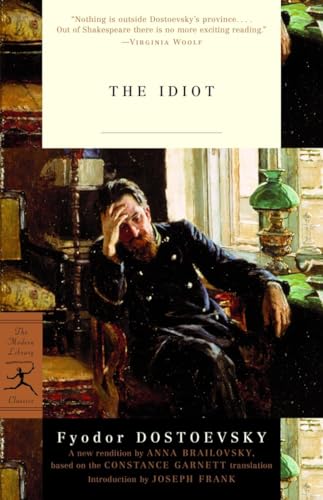
Returning to Russia from a sanitarium in Switzerland, the Christ-like epileptic Prince Myshkin finds himself enmeshed in a tangle of love, torn between two women—the notorious kept woman Nastasya and the pure Aglaia—both involved, in turn, with the corrupt, money-hungry Ganya. In the end, Myshkin’s honesty, goodness, and integrity are shown to be unequal to the moral emptiness of those around him. In her revision of the Garnett translation, Anna Brailovsky has corrected inaccuracies wrought by Garnett’s drastic anglicization of the novel, restoring as much as possible the syntactical structure of the original.
Die Inhaltsangabe kann sich auf eine andere Ausgabe dieses Titels beziehen.
Über die Autorin bzw. den Autor
About the Translators:
Richard Pevear has published translations of Alain, Yves Bonnefoy, Alberto Savinio, Pavel Florensky, and Henri Volohonsky, as well as two books of poetry. He has received fellowships or grants for translation from the National Endowment for the Arts, the Ingram Merrill Foundation, the Guggenheim Foundation, the National Endowment for the Humanities, and the French Ministry of Culture.
Larissa Volokhonsky was born in Leningrad. She has translated works by the prominent Orthodox theologians Alexander Schmemann and John Meyendorff into Russian. Together, Pevear and Volokhonsky have translated Dead Souls and The Collected Tales by Nikolai Gogol, and The Brothers Karamazov, Crime and Punishment, Notes from Underground, Demons, and The Idiot by Fyodor Dostoevsky. They were awarded the PEN Book-of-the-Month Club Translation Prize for their version of The Brothers Karamazov, and more recently Demons was one of three nominees for the same prize. They are married and live in France.
Von der hinteren Coverseite
Returning to Russia from a sanitarium in Switzerland, the Christ-like epileptic Prince Myshkin finds himself enmeshed in a tangle of love, torn between two women--the notorious kept woman Nastasya and the pure Aglaia--both involved, in turn, with the corrupt, money-hungry Ganya. In the end, Myshkin's honesty, goodness, and integrity are shown to be unequal to the moral emptiness of those around him. In her revision of the Garnett translation, Anna Brailovsky has corrected inaccuracies wrought by Garnett's drastic anglicization of the novel, restoring as much as possible the syntactical structure of the original.
Aus dem Klappentext
Russia from a sanitarium in Switzerland, the Christ-like epileptic Prince Myshkin finds himself enmeshed in a tangle of love, torn between two womenthe notorious kept woman Nastasya and the pure Aglaiaboth involved, in turn, with the corrupt, money-hungry Ganya. In the end, Myshkins honesty, goodness, and integrity are shown to be unequal to the moral emptiness of those around him. In her revision of the Garnett translation, Anna Brailovsky has corrected inaccuracies wrought by Garnetts drastic anglicization of the novel, restoring as much as possible the syntactical structure of the original.
Auszug. © Genehmigter Nachdruck. Alle Rechte vorbehalten.
I
In late November, during a thaw, around nine in the morning, a train on the Petersburg–Warsaw railway line was approaching Petersburg at full blast. It was so damp and foggy that it had just barely grown light; within ten paces to the right and left of the rails, it was difficult to make out anything at all from the carriage windows. Among the passengers were some returning from abroad; but the third-class compartments were more crowded, mainly with common folk on business, from not too far away. As usual, everyone was tired, everyone’s eyes had grown heavy in the night, everyone was chilled, all the faces were pale and yellow, matching the color of the fog.
In one of the third-class carriages, right by the window, two passengers had, from early dawn, been sitting facing one another—both were young people, both traveled light, both were unfashionably dressed, both had rather remarkable faces, and both expressed, at last, a desire to start a conversation. If they had both known, one about the other, in what way they were especially remarkable in that moment, they would naturally have wondered that chance had so strangely placed them face to face in a third-class carriage of the Warsaw–Petersburg train. One of them was a short man about twenty-seven, with almost black curly hair and small but fiery gray eyes. His nose was broad and flat, his cheekbones high; his thin lips continually curved into a sort of insolent, mocking and even malicious smile; but the high and well-shaped forehead redeemed the ignoble lines of the lower part of the face. What was particularly striking about the young man’s face was its deathly pallor, which lent him an exhausted look in spite of his fairly sturdy build, and at the same time something passionate to the point of suffering, which did not harmonize with his insolent and coarse smile and his sharp and self-satisfied gaze. He was warmly dressed in a full, black, sheepskin-lined overcoat, and had not felt the cold at night, while his neighbor had been forced to endure all the pleasures of a damp Russian November night, for which he was evidently unprepared. He had a fairly thick and wide cloak with no sleeves and a huge hood, just like those frequently used by travelers in winter somewhere far abroad, in Switzerland or, for instance, Northern Italy, who do not reckon, of course, on such distances along the journey as from Eydtkuhnen1 to Petersburg. But what was entirely suitable and satisfactory in Italy turned out to be not quite fitting for Russia. The owner of the hooded cloak was a young man, also twenty-six or twenty-seven years old, somewhat above the average in height, with very fair thick hair, with sunken cheeks and a thin, pointed, almost white beard. His eyes were large, blue and intent; there was something calm, though somber, in their expression, something full of that strange look by which some can surmise epilepsy in a person at first glance. The young man’s face was otherwise pleasing, delicate and lean, though colorless, and at this moment even blue with cold. From his hands dangled a meager bundle tied up in an old, faded raw-silk kerchief, which, it seemed, contained the entirety of his traveling effects. He wore thick-soled boots and spats—it was all very un-Russian. His dark-haired neighbor in the sheepskin observed all this, partly from having nothing to do, and at last, with that indelicate smile in which satisfaction at the misfortunes of others is sometimes so unceremoniously and casually expressed, he asked:
“Chilly?”
And he shuddered.
“Very,” answered his neighbor, with extraordinary readiness, “and just think, it’s thawing, too. What if there were a frost? I didn’t even think it would be so cold at home. I’ve become unused to it.”
“From abroad, eh?”
“Yes, from Switzerland.”
“Phew! You don’t say!” The dark-haired man whistled and burst into laughter.
They struck up a conversation. The readiness of the fair young man in the Swiss cloak to answer all his swarthy companion’s inquiries was astonishing and without the merest suspicion of the absolute thoughtlessness, inappropriateness and idleness of some of the questions. In answering, he declared by the by that he had indeed not been in Russia for a long time, a little over four years, that he had been sent abroad on account of an illness, some kind of strange nervous illness, like epilepsy or St. Vitus’s dance, resulting in trembling fits and convulsions. The swarthy man chuckled several times as he listened; and he laughed particularly when, in answer to his inquiry, “Well, have they cured you?” the fair one answered, “No, they haven’t.”
“Ha! You must have wasted a lot of money over it, and we believe in them over here,” the swarthy man observed sarcastically.
“That’s the honest truth!” interposed a badly dressed gentleman sitting beside them, a petty official type, set in his crusty scrivener’s ways, about forty, powerfully built, with a red nose and pimpled face—“That’s the honest truth, sir, they only absorb all the resources of Russia for nothing!”
“Oh, you are quite mistaken in my case!” the patient from Switzerland chimed in with a gentle and conciliatory voice. “Of course, I can’t argue with you because I don’t know all about it, but my doctor even shared his last penny with me for the journey here; and there, he supported me at his expense for nearly two years.”
“Why, had you no one to pay for you?” asked the swarthy man.
“No; Mr. Pavlishchev, who used to pay for me there, died two years ago. I’ve since written to Generaless Epanchin, a distant relation of mine, but I’ve had no answer. So I’ve come . . .”
“Where are you going then?”
“You mean, where am I going to stay? . . . I don’t rightly know yet . . . Somewhere . . .”
“You’ve not made up your mind yet?” And both his listeners burst out laughing again.
“And no doubt that bundle is all you’ve got in the world?” asked the swarthy man.
“I’m willing to bet on it,” chimed in the red-nosed official with an exceptionally gleeful air, “and that he’s got nothing else in the luggage van, though poverty is no vice, which, again, one mustn’t neglect to note.”
It turned out that this was the case, too; the fair-haired young man acknowledged it at once with extraordinary readiness.
“Your bundle has some value, anyway,” the petty official went on, when they had laughed to their heart’s content (remarkably, the owner of the bundle finally began to laugh himself, looking at them, which increased their mirth), “and though you could stake your head that it contains no golden rolls of foreign coin with Napoleons or Friedrichs, to say nothing of Dutch Arapchicks, which may already be concluded merely from the spats covering those foreign boots of yours, yet . . . when we add to your bundle such a purported relation as, for ex- ample, Generaless Epanchin, then even the bundle takes on a certain different significance, needless to say, but only in the case that Generaless Epanchin is really your relation and you are not mistaken, out of absentmindedness . . . which a person is very, very wont to do, if only . . . from an excess of imagination.”
“Ah, you’ve guessed right again,” the fair young man chimed in. “It really is almost a mistake, that’s to say, she is almost no relation; so much so that I really was not at all surprised back then, when I got no answer...
„Über diesen Titel“ kann sich auf eine andere Ausgabe dieses Titels beziehen.
Suchergebnisse für The Idiot (Modern Library Classics)

Beispielbild für diese ISBN
The Idiot (Modern Library Classics)
Verlag:
Modern Library (edition New edition), 2003
ISBN 10: 0679642420
ISBN 13: 9780679642428
Gebraucht
Paperback
Anbieter: BooksRun, Philadelphia, PA, USA
Verkäuferbewertung 5 von 5 Sternen

Paperback. Zustand: Very Good. New edition. It's a well-cared-for item that has seen limited use. The item may show minor signs of wear. All the text is legible, with all pages included. It may have slight markings and/or highlighting. Bestandsnummer des Verkäufers 0679642420-11-1
Gebraucht kaufen
EUR 11,20
Versand gratis
Versand innerhalb von USA
Versand innerhalb von USA
Anzahl: 1 verfügbar
Beispielbild für diese ISBN
The Idiot (Modern Library Classics)
Anbieter: Lakeside Books, Benton Harbor, MI, USA
Verkäuferbewertung 5 von 5 Sternen
Zustand: New. Brand New! Not Overstocks or Low Quality Book Club Editions! Direct From the Publisher! We're not a giant, faceless warehouse organization! We're a small town bookstore that loves books and loves it's customers! Buy from Lakeside Books! Bestandsnummer des Verkäufers OTF-S-9780679642428
Neu kaufen
EUR 11,05
EUR 3,43 Versand
Versand innerhalb von USA
Versand innerhalb von USA
Anzahl: 2 verfügbar
Foto des Verkäufers
Idiot
Anbieter: GreatBookPrices, Columbia, MD, USA
Verkäuferbewertung 5 von 5 Sternen
Zustand: New. Bestandsnummer des Verkäufers 735071-n
Neu kaufen
EUR 12,24
EUR 2,27 Versand
Versand innerhalb von USA
Versand innerhalb von USA
Anzahl: 7 verfügbar
Beispielbild für diese ISBN
Idiot
Anbieter: GreatBookPrices, Columbia, MD, USA
Verkäuferbewertung 5 von 5 Sternen
Zustand: As New. Unread book in perfect condition. Bestandsnummer des Verkäufers 735071
Gebraucht kaufen
EUR 13,26
EUR 2,27 Versand
Versand innerhalb von USA
Versand innerhalb von USA
Anzahl: 7 verfügbar
Beispielbild für diese ISBN
The Idiot Format: Paperback
Anbieter: INDOO, Avenel, NJ, USA
Verkäuferbewertung 5 von 5 Sternen
Zustand: As New. Unread copy in mint condition. Bestandsnummer des Verkäufers RH9780679642428
Gebraucht kaufen
EUR 15,61
Versand gratis
Versand innerhalb von USA
Versand innerhalb von USA
Anzahl: Mehr als 20 verfügbar
Beispielbild für diese ISBN
The Idiot Format: Paperback
Anbieter: INDOO, Avenel, NJ, USA
Verkäuferbewertung 5 von 5 Sternen
Zustand: New. Brand New. Bestandsnummer des Verkäufers 9780679642428
Neu kaufen
EUR 15,69
Versand gratis
Versand innerhalb von USA
Versand innerhalb von USA
Anzahl: Mehr als 20 verfügbar
Foto des Verkäufers
The Idiot (Paperback)
Verlag:
Random House USA Inc, New York, 2003
ISBN 10: 0679642420
ISBN 13: 9780679642428
Neu
Paperback
Anbieter: Grand Eagle Retail, Bensenville, IL, USA
Verkäuferbewertung 5 von 5 Sternen
Paperback. Zustand: new. Paperback. Returning to Russia from a sanitarium in Switzerland, the Christ-like epileptic Prince Myshkin finds himself enmeshed in a tangle of love, torn between two women-the notorious kept woman Nastasya and the pure Aglaia-both involved, in turn, with the corrupt, money-hungry Ganya. In the end, Myshkin's honesty, goodness, and integrity are shown to be unequal to the moral emptiness of those around him. In her revision of the Garnett translation, Anna Brailovsky has corrected inaccuracies wrought by Garnett's drastic anglicization of the novel, restoring as much as possible the syntactical structure of the original. Contains an introduction by Joseph Frank. This book also includes a reading group guide. Shipping may be from multiple locations in the US or from the UK, depending on stock availability. Bestandsnummer des Verkäufers 9780679642428
Foto des Verkäufers
The Idiot
Anbieter: Rarewaves USA, HEBRON, KY, USA
Verkäuferbewertung 5 von 5 Sternen
Paperback. Zustand: New. Bestandsnummer des Verkäufers LU-9780679642428
Neu kaufen
EUR 16,63
Versand gratis
Versand innerhalb von USA
Versand innerhalb von USA
Anzahl: Mehr als 20 verfügbar
Beispielbild für diese ISBN
The Idiot (Modern Library Classics)
Anbieter: California Books, Miami, FL, USA
Verkäuferbewertung 4 von 5 Sternen

Zustand: New. Bestandsnummer des Verkäufers I-9780679642428
Beispielbild für diese ISBN
The Idiot
Anbieter: Massive Bookshop, Erving, MA, USA
Verkäuferbewertung 4 von 5 Sternen
Paperback. Zustand: New. Bestandsnummer des Verkäufers 9780679642428
Neu kaufen
EUR 15,94
EUR 4,08 Versand
Versand innerhalb von USA
Versand innerhalb von USA
Anzahl: 10 verfügbar