
Verwandte Artikel zu The Murders in the Rue Morgue: The Dupin Tales (Modern...
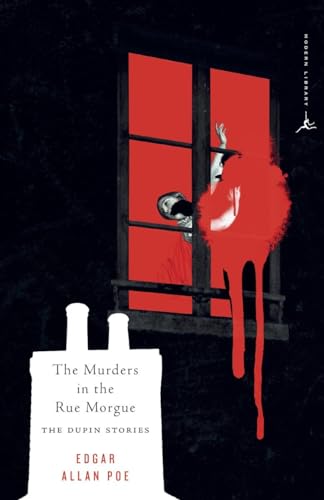
Inhaltsangabe
Edited and with an Introduction by Matthew Pearl
Includes “The Murders in the Rue Morgue,” “The Mystery of Marie Rogêt,” and “The Purloined Letter”
Between 1841 and 1844, Edgar Allan Poe invented the genre of detective fiction with three mesmerizing stories of a young French eccentric named C. Auguste Dupin. Introducing to literature the concept of applying reason to solving crime, these tales brought Poe fame and fortune. Years later, Dorothy Sayers would describe “The Murders in the Rue Morgue” as “almost a complete manual of detective theory and practice.” Indeed, Poe’s short mysteries inspired the creation of countless literary sleuths, among them Sherlock Holmes. Today, the unique Dupin stories still stand out as utterly engrossing page-turners.
Includes a Modern Library Reading Group Guide
Die Inhaltsangabe kann sich auf eine andere Ausgabe dieses Titels beziehen.
Über die Autorin bzw. den Autor
Matthew Pearl is the New York Times bestselling author of The Dante Club, The Poe Shadow, The Last Dickens, The Technologists, The Last Bookaneer, and The Dante Chamber, and the editor of the Modern Library editions of Dante’s Inferno (translated by Henry Wadsworth Longfellow) and Edgar Allan Poe’s The Murders in the Rue Morgue: The Dupin Tales. His books have been translated into more than thirty languages, and his nonfiction writing has appeared in The New York Times, The Wall Street Journal, The Boston Globe, and Slate.
Auszug. © Genehmigter Nachdruck. Alle Rechte vorbehalten.
The Murders in the Rue Morgue
What song the Syrens sang, or what name Achilles assumed when he hid himself among women, although puzzling questions, are not beyond all conjecture.
Sir Thomas Browne The mental features discoursed of as the analytical, are, in themselves, but little susceptible of analysis. We appreciate them only in their effects. We know of them, among other things, that they are always to their possessor, when inordinately possessed, a source of the liveliest enjoyment. As the strong man exults in his physical ability, delighting in such exercises as call his muscles into action, so glories the analyst in that moral activity which disentangles. He derives pleasure from even the most trivial occupations bringing his talent into play. He is fond of enigmas, of conundrums, of hieroglyphics; exhibiting in his solutions of each a degree of acumen which appears to the ordinary apprehension præternatural. His results, brought about by the very soul and essence of method, have, in truth, the whole air of intuition.
The faculty of re-solution is possibly much invigorated by mathematical study, and especially by that highest branch of it which, unjustly, and merely on account of its retrograde operations, has been called, as if par excellence, analysis. Yet to calculate is not in itself to analyse. A chess-player, for example, does the one without effort at the other. It follows that the game of chess, in its effects upon mental character, is greatly misunderstood. I am not now writing a treatise, but simply prefacing a somewhat peculiar narrative by observations very much at random; I will, therefore, take occasion to assert that the higher powers of the reflective intellect are more decidedly and more usefully tasked by the unostentatious game of draughts than by all the elaborate frivolity of chess. In this latter, where the pieces have different and bizarre motions, with various and variable values, what is only complex is mistaken (a not unusual error) for what is profound. The attention is here called powerfully into play. If it flag for an instant, an oversight is committed, resulting in injury or defeat. The possible moves being not only manifold but involute, the chances of such oversights are multiplied; and in nine cases out of ten it is the more concentrative rather than the more acute player who conquers. In draughts, on the contrary, where the moves are unique and have but little variation, the probabilities of inadvertence are diminished, and the mere attention being left comparatively unemployed, what advantages are obtained by either party are obtained by superior acumen. To be less abstract—Let us suppose a game of draughts where the pieces are reduced to four kings, and where, of course, no oversight is to be expected. It is obvious that here the victory can be decided (the players being at all equal) only by some recherché movement, the result of some strong exertion of the intellect. Deprived of ordinary resources, the analyst throws himself into the spirit of his opponent, identifies himself therewith, and not unfrequently sees thus, at a glance, the sole methods (sometimes indeed absurdly simple ones) by which he may seduce into error or hurry into miscalculation.
Whist has long been noted for its influence upon what is termed the calculating power; and men of the highest order of intellect have been known to take an apparently unaccountable delight in it, while eschewing chess as frivolous. Beyond doubt there is nothing of a similar nature so greatly tasking the faculty of analysis. The best chess-player in Christendom may be little more than the best player of chess; but proficiency in whist implies capacity for success in all those more important undertakings where mind struggles with mind. When I say proficiency, I mean that perfection in the game which includes a comprehension of all the sources whence legitimate advantage may be derived. These are not only manifold but multiform, and lie frequently among recesses of thought altogether inaccessible to the ordinary understanding. To observe attentively is to remember distinctly; and, so far, the concentrative chess-player will do very well at whist; while the rules of Hoyle (themselves based upon the mere mechanism of the game) are sufficiently and generally comprehensible. Thus to have a retentive memory, and to proceed by “the book,” are points commonly regarded as the sum total of good playing. But it is in matters beyond the limits of mere rule that the skill of the analyst is evinced. He makes, in silence, a host of observations and inferences. So, perhaps, do his companions; and the difference in the extent of the information obtained, lies not so much in the validity of the inference as in the quality of the observation. The necessary knowledge is that of what to observe. Our player confines himself not at all; nor, because the game is the object, does he reject deductions from things external to the game. He examines the countenance of his partner, comparing it carefully with that of each of his opponents. He considers the mode of assorting the cards in each hand; often counting trump by trump, and honor by honor, through the glances bestowed by their holders upon each. He notes every variation of face as the play progresses, gathering a fund of thought from the differences in the expression of certainty, of surprise, of triumph, or of chagrin. From the manner of gathering up a trick he judges whether the person taking it can make another in the suit. He recognises what is played through feint, by the air with which it is thrown upon the table. A casual or inadvertent word; the accidental dropping or turning of a card, with the accompanying anxiety or carelessness in regard to its concealment; the counting of the tricks, with the order of their arrangement; embarrassment, hesitation, eagerness or trepidation—all afford, to his apparently intuitive perception, indications of the true state of affairs. The first two or three rounds having been played, he is in full possession of the contents of each hand, and thenceforward puts down his cards with as absolute a precision of purpose as if the rest of the party had turned outward the faces of their own.
The analytical power should not be confounded with simple ingenuity; for while the analyst is necessarily ingenious, the ingenious man is often remarkably incapable of analysis. The constructive or combining power, by which ingenuity is usually manifested, and to which the phrenologists (I believe erroneously) have assigned a separate organ, supposing it a primitive faculty, has been so frequently seen in those whose intellect bordered otherwise upon idiocy, as to have attracted general observation among writers on morals. Between ingenuity and the analytic ability there exists a difference far greater, indeed, than that between the fancy and the imagination, but of a character very strictly analogous. It will be found, in fact, that the ingenious are always fanciful, and the truly imaginative never otherwise than analytic.
The narrative which follows will appear to the reader somewhat in the light of a commentary upon the propositions just advanced.
Residing in Paris during the spring and part of the summer of 18—, I there became acquainted with a Monsieur C. Auguste Dupin. This young gentleman was of an excellent—indeed of an illustrious family, but, by a variety of untoward events, had been reduced to such poverty that the energy of his character succumbed beneath it, and he ceased to bestir himself in the world, or to care for the retrieval of his fortunes. By courtesy of his creditors, there still remained in his possession a small remnant of his patrimony; and, upon the...
„Über diesen Titel“ kann sich auf eine andere Ausgabe dieses Titels beziehen.
Suchergebnisse für The Murders in the Rue Morgue: The Dupin Tales (Modern...

Foto des Verkäufers
The Murders in the Rue Morgue (Modern Library Classics)
Anbieter: Dream Books Co., Denver, CO, USA
Verkäuferbewertung 5 von 5 Sternen

Zustand: acceptable. This copy has clearly been enjoyedâ"expect noticeable shelf wear and some minor creases to the cover. Binding is strong, and all pages are legible. May contain previous library markings or stamps. Bestandsnummer des Verkäufers DBV.0679643427.A
Gebraucht kaufen
EUR 4,52
Versand gratis
Versand innerhalb von USA
Versand innerhalb von USA
Anzahl: 2 verfügbar
Beispielbild für diese ISBN
The Murders in the Rue Morgue (Modern Library Classics)
Anbieter: New Legacy Books, Annandale, NJ, USA
Verkäuferbewertung 5 von 5 Sternen
paperback. Zustand: Good. Fast shipping and order satisfaction guaranteed. A portion of your purchase benefits Non-Profit Organizations, First Aid and Fire Stations! Bestandsnummer des Verkäufers mon0000179317
Gebraucht kaufen
EUR 2,84
EUR 2,22 Versand
Versand innerhalb von USA
Versand innerhalb von USA
Anzahl: 1 verfügbar
Foto des Verkäufers
The Murders in the Rue Morgue (Modern Library Classics)
Anbieter: Greenworld Books, Arlington, TX, USA
Verkäuferbewertung 5 von 5 Sternen
Zustand: very_good. Fast Free Shipping â" Very Good condition book with a firm cover and clean pages. Shows normal use and some light wear or limited notes markings. A solid, nice copy to enjoy. Bestandsnummer des Verkäufers GWV.0679643427.VG
Gebraucht kaufen
EUR 6,04
Versand gratis
Versand innerhalb von USA
Versand innerhalb von USA
Anzahl: 1 verfügbar
Beispielbild für diese ISBN
The Murders in the Rue Morgue
Anbieter: World of Books Inc, Montgomery, IL, USA
Verkäuferbewertung 4 von 5 Sternen

Paperback. Zustand: Very Good. The Murders in the Rue Morgue is a short story by Edgar Allan Poe published in Graham's Magazine in 1841. It has been recognized as the first modern detective story; Poe referred to it as one of his tales of ratiocination. The story opens with a lengthy explanation of ratiocination. Dupin demonstrates his prowess by deducing his companion's thoughts as if through apparent supernatural power. The story then turns to the baffling double murder of Madame L'Espanaye and her daughter at their home in the Rue Morgue, a fictional street in Paris. According to newspaper accounts, the mother was found in a yard behind the house, with multiple broken bones and her throat so deeply cut that her head fell off when the body was moved. The daughter was found strangled to death and stuffed upside down into a chimney. The murders occurred in a fourth-floor room that was locked from the inside; on the floor were found a bloody straight razor, several bloody tufts of gray hair, and two bags of gold coins. Several witnesses reported hearing two voices at the time of the murder, one male and French, but disagreed on the language spoken by the other. The speech was unclear, and every witness admits that he does not know the language he claims to have heard. Paris natives Dupin and his friend, the unnamed narrator of the story, read these newspaper accounts with interest. The two live in seclusion and allow no visitors. They have cut off contact with former associates and venture outside only at night. We existed within ourselves alone, the narrator explains. When a bank clerk named Adolphe Le Bon is arrested even though no evidence exists pointing to his guilt (other than his delivering the gold coins to the two ladies the day before), Dupin becomes intrigued and remembers a service that Le Bon once performed for him. He decides to offer his assistance to G-, the prefect of police. Because none of the witnesses can agree on the language the murderer spoke, Dupin concludes they were not hearing a human voice at all. He and the narrator examine the house thoroughly; the following day, Dupin dismisses the idea of both Le Bon's guilt and a robbery motive, citing the fact that the gold was not taken from the room. He also points out that the murderer would have had to have superhuman strength to force the daughter's body up the chimney. He formulates a method by which the murderer could have entered the room and killed both women, involving an agile climb up a lightning rod and a leap to a set of open window shutters. Poe biographer Jeffrey Meyers sums up the significance of The Murders in the Rue Morgue it] changed the history of world literature. Often cited as the first detective fiction story, the character of Dupin became the prototype for many future fictional detectives, including Arthur Conan Doyle's Sherlock Holmes and Agatha Christie's Hercule Poirot. The genre is distinctive from a general mystery story in that the focus is on analysis. Poe's role in the creation of the detective story is reflected in the Edgar Awards, given annually by the Mystery Writers of America. The Murders in the Rue Morgue also established many tropes that would become common elements in mystery fiction: the eccentric but brilliant detective, the bumbling constabulary, the first-person narration by a close personal friend. Poe also portrays the police in an unsympathetic manner as a sort of foil to the detective. Poe also initiates the storytelling device where the detective announces his solution and then explains the reasoning leading up to it. It is also the first locked room mystery in detective fiction. Bestandsnummer des Verkäufers CIN0679643427VG
Gebraucht kaufen
EUR 6,41
Versand gratis
Versand innerhalb von USA
Versand innerhalb von USA
Anzahl: 1 verfügbar
Beispielbild für diese ISBN
The Murders in the Rue Morgue
Anbieter: ThriftBooks-Reno, Reno, NV, USA
Verkäuferbewertung 5 von 5 Sternen
Paperback. Zustand: Fair. No Jacket. Readable copy. Pages may have considerable notes/highlighting. ~ ThriftBooks: Read More, Spend Less. Bestandsnummer des Verkäufers G0679643427I5N00
Gebraucht kaufen
EUR 6,50
Versand gratis
Versand innerhalb von USA
Versand innerhalb von USA
Anzahl: 1 verfügbar
Beispielbild für diese ISBN
The Murders in the Rue Morgue
Anbieter: ThriftBooks-Atlanta, AUSTELL, GA, USA
Verkäuferbewertung 5 von 5 Sternen
Paperback. Zustand: Fair. No Jacket. Readable copy. Pages may have considerable notes/highlighting. ~ ThriftBooks: Read More, Spend Less. Bestandsnummer des Verkäufers G0679643427I5N00
Gebraucht kaufen
EUR 6,53
Versand gratis
Versand innerhalb von USA
Versand innerhalb von USA
Anzahl: 1 verfügbar
Beispielbild für diese ISBN
The Murders in the Rue Morgue
Anbieter: ThriftBooks-Atlanta, AUSTELL, GA, USA
Verkäuferbewertung 5 von 5 Sternen
Paperback. Zustand: Very Good. No Jacket. May have limited writing in cover pages. Pages are unmarked. ~ ThriftBooks: Read More, Spend Less. Bestandsnummer des Verkäufers G0679643427I4N00
Gebraucht kaufen
EUR 6,53
Versand gratis
Versand innerhalb von USA
Versand innerhalb von USA
Anzahl: 1 verfügbar
Beispielbild für diese ISBN
The Murders in the Rue Morgue
Anbieter: ThriftBooks-Dallas, Dallas, TX, USA
Verkäuferbewertung 5 von 5 Sternen
Paperback. Zustand: Good. No Jacket. Pages can have notes/highlighting. Spine may show signs of wear. ~ ThriftBooks: Read More, Spend Less. Bestandsnummer des Verkäufers G0679643427I3N00
Gebraucht kaufen
EUR 6,53
Versand gratis
Versand innerhalb von USA
Versand innerhalb von USA
Anzahl: 1 verfügbar
Beispielbild für diese ISBN
The Murders in the Rue Morgue
Anbieter: ThriftBooks-Dallas, Dallas, TX, USA
Verkäuferbewertung 5 von 5 Sternen
Paperback. Zustand: Fair. No Jacket. Readable copy. Pages may have considerable notes/highlighting. ~ ThriftBooks: Read More, Spend Less. Bestandsnummer des Verkäufers G0679643427I5N00
Gebraucht kaufen
EUR 6,53
Versand gratis
Versand innerhalb von USA
Versand innerhalb von USA
Anzahl: 1 verfügbar
Beispielbild für diese ISBN
The Murders in the Rue Morgue
Anbieter: ThriftBooks-Atlanta, AUSTELL, GA, USA
Verkäuferbewertung 5 von 5 Sternen
Paperback. Zustand: Fair. No Jacket. Former library book; Readable copy. Pages may have considerable notes/highlighting. ~ ThriftBooks: Read More, Spend Less. Bestandsnummer des Verkäufers G0679643427I5N10
Gebraucht kaufen
EUR 6,53
Versand gratis
Versand innerhalb von USA
Versand innerhalb von USA
Anzahl: 1 verfügbar