
Verwandte Artikel zu A Woman's Education: The Road from Coorain Leads...
Inhaltsangabe
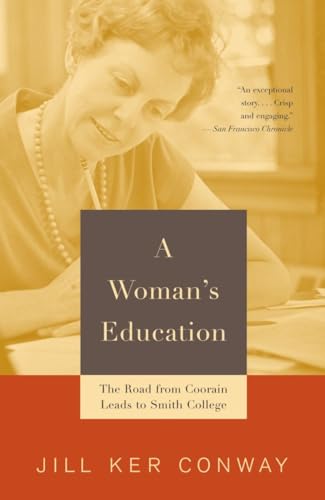
The beloved bestselling author of The Road from Coorain and True North continues her remarkable autobiography with an account of her decade as the first woman president of Smith College–a time when she was faced with the challenge of reinventing women’s education and with the demands of her own life.
Conway took on the helm at Smith at the height of exploding culture wars and the rising popularity of coeducation. With the college’s future at stake, she battled conservative faculty, ossified traditions, and doubtful funders to turn Smith into a place committed to preparing young women for the new realities of the future. Through it all, Conway served as an inspiration to thousands of students, while balancing the demands of her public role against the private pressures of coping with her husband’s bipolar disorder. A moving tribute to the value of single-sex education and to one woman’s achievements, A Woman’s Education is sure to become a classic.
Die Inhaltsangabe kann sich auf eine andere Ausgabe dieses Titels beziehen.
Über die Autorin bzw. den Autor
Jill Ker Conway was born in Hillston, New South Wales, Australia, graduated from the University of Sydney in 1958, and received her Ph.D. from Harvard University in 1969. In 1962 she married John Conway and moved with him to his native Canada. From 1964 to 1975 she taught at the University of Toronto, where she was also Vice President, before going to Smith College. Since 1985 she has been a visiting scholar and professor in MIT’s Program in Science, Technology, and Society. She serves on the boards of Nike, Merrill Lynch, and Colgate-Palmolive, and as Chairman of Lend Lease Corporation. She lives in Boston.
Von der hinteren Coverseite
The beloved bestselling author of "The Road from Coorain and "True North continues her remarkable autobiography with an account of her decade as the first woman president of Smith College-a time when she was faced with the challenge of reinventing women's education and with the demands of her own life.
Conway took on the helm at Smith at the height of exploding culture wars and the rising popularity of coeducation. With the college's future at stake, she battled conservative faculty, ossified traditions, and doubtful funders to turn Smith into a place committed to preparing young women for the new realities of the future. Through it all, Conway served as an inspiration to thousands of students, while balancing the demands of her public role against the private pressures of coping with her husband's bipolar disorder. A moving tribute to the value of single-sex education and to one woman's achievements, A Woman's Education" is sure to become a classic.
Auszug. © Genehmigter Nachdruck. Alle Rechte vorbehalten.
1
CHOICE
On a stormy day in November 1973, I walked back across the campus to Simcoe Hall, the University of Toronto's administration building, which nestled behind the dome of Convocation Hall, looking out across a spacious circle of green, toward the amazing Victorian excess of University College, the gentler lines of Hart House, the men's union, and the nondescript international style of the overcrowded humanities library. The tout ensemble symbolized all the contradictory things I loved about the University. The scale and classical façade of Convocation Hall spoke about the national aspirations of Canada's oldest university. The aggressively Victorian mien of University College announced the weight the founders gave to its secular leanings, which opposed the church-affiliated colleges that made up the rest of the University. Every outrageous gargoyle and buttress proclaimed Darwin and Spencer. Hart House's graceful arches showed the Oxbridge loyalties that had shaped the university's intellectual aspirations, and the overcrowded and nondescript library announced the wave of expansion that had swept over the university in the baby boom years. I never looked at them all without an affectionate pleasure for the three-dimensional representation they provided of the frustrations and challenges of running part of this large and untidy institution.
But this afternoon my usual pleasure was replaced by exasperation at the day's interviews. I'd been reviewing the budgets of University services all day, telling everyone the unwelcome news that there would have to be severe budget cuts and personnel layoffs in the next fiscal year. Everyone knew the reductions were caused by declining Ontario government support for the University, but nonetheless the bearer of bad tidings always has to hear out the complaints of the victims, complaints I sympathized with even though I had to be firm about the cuts. It had been painful to tell my old physician friend that in his last years as head of the health service, he must scale back its quality. And the offbeat countercultural types who ran the best counseling service for youthful drug users around had looked at me knowingly as though they'd always expected that it was inevitable that I'd let them down someday.
So I didn't climb the stairs to my second-floor office at my usual pace. Still deep in thought about finance and politics, I came in the door to find my secretary poised by my desk. Petite and dark, with eyes that flashed, she was, to me, a kind of muse, her arms forever laden with mail and folders, her dazzling smile always urging me on. Though easily fifteen years my junior, she treated me with affectionate firmness, as if she were my mother.
As I signed the mail, she began rattling off details of my flight to Ottawa, who was to meet me, where the evening's dinner meeting was, all the while stuffing things into my briefcase. As she rammed the last folder in, she gave me a brilliant smile. "There's another letter from a search committee in there," she said, gesturing toward the bulging briefcase. "It's an American one. I hope you don't do it."
I was heading out the door, laden with luggage, when I stopped to ask the usual question. "Any news?" She broke into peals of laughter. "He's still there," she said, "and no one's got cholera yet." She was giving me the
daily bulletin on the determined emeritus professor who had barricaded himself in his office in the University library, refusing to move to the new space allocated to emeriti. He'd survived in his old office for six weeks, apparently without benefit of plumbing, using most of his time to bombard my office with wonderfully crotchety memoranda, which we all loved to read.
I was, as usual, late at the airport, necessitating a sprint through the elongated terminal for the Ottawa gate. So by the time I collapsed, puffing and sweating, into my seat, I'd forgotten the conversation. Then, as we waited for the obligatory deicing required by the early storm, I came across the letter from the Smith College Presidential Search Committee. Something of an anticlimax after being inspected so transparently almost six months ago. It contained an invitation to meet with them as soon as possible, signed by Robert Morgenthau, who I knew to be the much-respected Manhattan District Attorney. I glanced down the list of committee members, spotting the noted art historian we'd met in May at the MacLeishes', and a Harvard professor of Tudor history, who was an old graduate school friend of my husband's.
Once the plane took off, there was no more time to think about it, because I had to read the papers for my late-afternoon meeting and collect my thoughts for the dinner speech I was to make. Later, when I called John in Toronto to say good night and mentioned the belated appearance of the letter, he was instantly alert and said I must definitely meet with the Search Committee. I didn't want to change my life or the job I loved, but to please him, I answered the invitation affirmatively and set my disapproving secretary to work making arrangements, her cheeks pink with indignation, and the straightness of her back a powerful reproach.
The night before meeting the Search Committee at the Century Association in New York, I dined there with John's and my old friend and confidant, Stephen Graubard. Steve was a friend of John's from graduate school days, a historian of modern Europe, someone who'd known me since my teaching fellow days in his and John's course at Harvard. He was an enthusiastic advocate of thinking seriously about going to Smith, or some institution like it.
"Look," he said over the Century's bad dinner and excellent wine, "you've begun working in academic administration. I doubt that you'll settle for just a history department again. You should come back to the United States. There's more to be achieved here in the private system, much more than you'll be able to do in Canada."
Steve's advice and concern with my career, and John's and my happiness, recalled our years together in Cambridge, Massachusetts, years among the happiest of my life. After dinner, we slipped easily into talk about our circle of mutual friends. His affection and friendship made it seem easier to move again.
The next day, back in one of the private dining rooms at the Century, I enjoyed the initial interview. It was a welcome change from my role as budget cutter for all the parts of the University of Toronto that reported
to me. The group was pretty much what I'd meet on a Canadian governing board, but their mood was different. Faculty, the student member, and trustees alike wanted to talk about achieving greatness. How did I think
Smith's pioneering history and mission could be restated, redefined, enlarged to make it the outstanding leader in women's education for the next quarter century? I was talking to a group of energetic and affirmative people about building academic excellence and serving the cause of women, the things closest to my heart. They seemed to take it for granted that resources could be raised for any program of excellence.
It was seductive to talk with people for whom education was the highest priority, rather than one in a competing set of interests politicians traded off. I began to sense the contemporary energy and drive of an institution I knew mostly from its history. The interview hummed with vitality. They were easy to talk to about my historical work, and startled by my outsider's perception that it didn't matter in the least that all the Ivies were going coeducational. I knew there were enough bright women needing an education to go around. Besides, I thought that a women's college that drew from the best high schools around the country might be a more interesting place to attend than one...
„Über diesen Titel“ kann sich auf eine andere Ausgabe dieses Titels beziehen.
Weitere beliebte Ausgaben desselben Titels

Suchergebnisse für A Woman's Education: The Road from Coorain Leads...

Beispielbild für diese ISBN
A Woman's Education: The Road from Coorain Leads to Smith College
Anbieter: BRT Resales, DeLand, FL, USA
Verkäuferbewertung 5 von 5 Sternen

Soft cover. Zustand: Good. Name written on first page, otherwise very Good Paperback 9780679744627. Bestandsnummer des Verkäufers Am8
Gebraucht kaufen
EUR 3,46
Versand gratis
Versand innerhalb von USA
Versand innerhalb von USA
Anzahl: 1 verfügbar
Beispielbild für diese ISBN
A Woman's Education: The Road from Coorain Leads to Smith College
Anbieter: World of Books (was SecondSale), Montgomery, IL, USA
Verkäuferbewertung 5 von 5 Sternen
Zustand: Very Good. Item in very good condition! Textbooks may not include supplemental items i.e. CDs, access codes etc. Bestandsnummer des Verkäufers 00105605148
Gebraucht kaufen
EUR 3,85
Versand gratis
Versand innerhalb von USA
Versand innerhalb von USA
Anzahl: 1 verfügbar
Beispielbild für diese ISBN
A Woman's Education: The Road from Coorain Leads to Smith College
Anbieter: World of Books (was SecondSale), Montgomery, IL, USA
Verkäuferbewertung 5 von 5 Sternen
Zustand: Good. Item in good condition. Textbooks may not include supplemental items i.e. CDs, access codes etc. Bestandsnummer des Verkäufers 00096482743
Gebraucht kaufen
EUR 3,85
Versand gratis
Versand innerhalb von USA
Versand innerhalb von USA
Anzahl: 4 verfügbar
Beispielbild für diese ISBN
A Woman's Education: The Road from Coorain Leads to Smith College
Anbieter: World of Books (was SecondSale), Montgomery, IL, USA
Verkäuferbewertung 5 von 5 Sternen
Zustand: Acceptable. Item in acceptable condition! Textbooks may not include supplemental items i.e. CDs, access codes etc. Bestandsnummer des Verkäufers 00100089497
Gebraucht kaufen
EUR 3,85
Versand gratis
Versand innerhalb von USA
Versand innerhalb von USA
Anzahl: 1 verfügbar
Foto des Verkäufers
A Woman's Education: The Road from Coorain Leads to Smith College
Anbieter: Greenworld Books, Arlington, TX, USA
Verkäuferbewertung 5 von 5 Sternen
Zustand: very_good. Fast Free Shipping â" Very Good condition book with a firm cover and clean pages. Shows normal use and some light wear or limited notes markings. A solid, nice copy to enjoy. Bestandsnummer des Verkäufers GWV.0679744622.VG
Gebraucht kaufen
EUR 5,26
Versand gratis
Versand innerhalb von USA
Versand innerhalb von USA
Anzahl: 1 verfügbar
Foto des Verkäufers
A Woman's Education: The Road from Coorain Leads to Smith College
Anbieter: Greenworld Books, Arlington, TX, USA
Verkäuferbewertung 5 von 5 Sternen
Zustand: good. Fast Free Shipping â" Good condition. It may show normal signs of use, such as light writing, highlighting, or library markings, but all pages are intact and the book is fully readable. A solid, complete copy that's ready to enjoy. Bestandsnummer des Verkäufers GWV.0679744622.G
Gebraucht kaufen
EUR 5,37
Versand gratis
Versand innerhalb von USA
Versand innerhalb von USA
Anzahl: 1 verfügbar
Beispielbild für diese ISBN
A Woman's Education: The Road from Coorain Leads to Smith College
Verlag:
Knopf Doubleday Publishing Group, 2002
ISBN 10: 0679744622
ISBN 13: 9780679744627
Gebraucht
Paperback
Anbieter: ThriftBooks-Phoenix, Phoenix, AZ, USA
Verkäuferbewertung 5 von 5 Sternen
Paperback. Zustand: Very Good. No Jacket. May have limited writing in cover pages. Pages are unmarked. ~ ThriftBooks: Read More, Spend Less. Bestandsnummer des Verkäufers G0679744622I4N00
Gebraucht kaufen
EUR 5,80
Versand gratis
Versand innerhalb von USA
Versand innerhalb von USA
Anzahl: 1 verfügbar
Beispielbild für diese ISBN
A Woman's Education: The Road from Coorain Leads to Smith College
Verlag:
Knopf Doubleday Publishing Group, 2002
ISBN 10: 0679744622
ISBN 13: 9780679744627
Gebraucht
Paperback
Anbieter: ThriftBooks-Atlanta, AUSTELL, GA, USA
Verkäuferbewertung 5 von 5 Sternen
Paperback. Zustand: Very Good. No Jacket. May have limited writing in cover pages. Pages are unmarked. ~ ThriftBooks: Read More, Spend Less. Bestandsnummer des Verkäufers G0679744622I4N00
Gebraucht kaufen
EUR 5,80
Versand gratis
Versand innerhalb von USA
Versand innerhalb von USA
Anzahl: 1 verfügbar
Beispielbild für diese ISBN
A Woman's Education: The Road from Coorain Leads to Smith College
Anbieter: HPB Inc., Dallas, TX, USA
Verkäuferbewertung 5 von 5 Sternen
paperback. Zustand: Very Good. Connecting readers with great books since 1972! Used books may not include companion materials, and may have some shelf wear or limited writing. We ship orders daily and Customer Service is our top priority! Bestandsnummer des Verkäufers S_474555388
Gebraucht kaufen
EUR 3,57
EUR 3,25 Versand
Versand innerhalb von USA
Versand innerhalb von USA
Anzahl: 1 verfügbar
Beispielbild für diese ISBN
A Woman's Education: The Road from Coorain Leads to Smith College
Anbieter: Wonder Book, Frederick, MD, USA
Verkäuferbewertung 5 von 5 Sternen
Zustand: Very Good. Very Good condition. A copy that may have a few cosmetic defects. May also contain light spine creasing or a few markings such as an owner's name, short gifter's inscription or light stamp. Bestandsnummer des Verkäufers N00A-03950
Gebraucht kaufen
EUR 6,84
Versand gratis
Versand innerhalb von USA
Versand innerhalb von USA
Anzahl: 2 verfügbar