
Verwandte Artikel zu The Book That Changed My Life: Interviews with National...
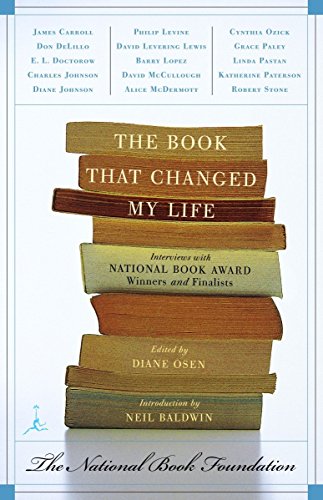
The Book That Changed My Life: Interviews with National Book Award Winners and Finalists - Softcover
Inhaltsangabe
Every reader can name at least one book that changed his or her life—and many more beloved titles will surely come to mind as well. In The Book That Changed My Life, fifteen of America’s most influential authors discuss their own special literary choices. These unique interviews with National Book Award winners and finalists offer new insights into the many ways in which the experience of reading shapes the act of writing. Robert Stone on Joseph Conrad’s Victory, Cynthia Ozick on Henry James’s Washington Square, Charles Johnson on Jack London’s The Sea-Wolf—each approaches the question of literary influence, while offering rich and wonderful revelations about his or her own writing career. James Carroll, Don DeLillo, E. L. Doctorow, Diane Johnson, Philip Levine, David Levering Lewis, Barry Lopez, David McCullough, Alice McDermott, Grace Paley, Linda Pastan, and Katherine Paterson are the other distinguished contributors to this collection of informed, insightful interviews.
Die Inhaltsangabe kann sich auf eine andere Ausgabe dieses Titels beziehen.
Über die Autorin bzw. den Autor
Diane Osen is a freelance writer and editor specializing in the arts, and has worked with dozens of National Book Award authors during her fourteen-year association with the National Book Foundation. Co-editor of The Writing Life, an NBA anthology published by Random House in 1996, she is also the author of Royal Scandals and the co-author of Great Interview.
Neil Baldwin is the executive director of the National Book Foundation and the sponsor of the National Book Awards. He has written several books, including, most recently, Henry Ford and the Jews.
Von der hinteren Coverseite
Every reader can name at least one book that changed his or her life--and many more beloved titles will surely come to mind as well. In "The Book That Changed My Life, fifteen of America's most influential authors discuss their own special literary choices. These unique interviews with National Book Award winners and finalists offer new insights into the many ways in which the experience of reading shapes the act of writing. Robert Stone on Joseph Conrad's "Victory, Cynthia Ozick on Henry James's "Washington Square, Charles Johnson on Jack London's "The Sea-Wolf--each approaches the question of literary influence, while offering rich and wonderful revelations about his or her own writing career. James Carroll, Don DeLillo, E. L. Doctorow, Diane Johnson, Philip Levine, David Levering Lewis, Barry Lopez, David McCullough, Alice McDermott, Grace Paley, Linda Pastan, and Katherine Paterson are the other distinguished contributors to this collection of informed, insightful interviews.
Aus dem Klappentext
can name at least one book that changed his or her life and many more beloved titles will surely come to mind as well. In The Book That Changed My Life, fifteen of America s most influential authors discuss their own special literary choices. These unique interviews with National Book Award winners and finalists offer new insights into the many ways in which the experience of reading shapes the act of writing. Robert Stone on Joseph Conrad s Victory, Cynthia Ozick on Henry James s Washington Square, Charles Johnson on Jack London s The Sea-Wolf each approaches the question of literary influence, while offering rich and wonderful revelations about his or her own writing career. James Carroll, Don DeLillo, E. L. Doctorow, Diane Johnson, Philip Levine, David Levering Lewis, Barry Lopez, David McCullough, Alice McDermott, Grace Paley, Linda Pastan, and Katherine Paterson are the other distinguished contributors to thi
Auszug. © Genehmigter Nachdruck. Alle Rechte vorbehalten.
Chapter 1
James Carroll
James Carroll, Winner of the 1996 National Book Award for his memoir An American Requiem: God, My Father, and the War That Came Between Us, was born in Chicago in 1943 and grew up outside Washington, D.C., where his father worked as an FBI agent. After joining the military, his father became a lieutenant general in the air force and director of the Defense Intelligence Agency. Carroll attended Georgetown University before entering St. Paul's College, the Paulist Fathers' seminary in Washington, D.C. After his ordination to the priesthood in 1969, he served as the Catholic Chaplain at Boston University for five years before leaving the priesthood and pursuing a career as a writer. In the years since, he has published nine novels, including Mortal Friends, Prince of Peace, and The City Below, and written a weekly op-ed column for The Boston Globe. In his most recent book, the critically acclaimed Constantine's Sword: The Church and the Jews, he chronicles the two-thousand-year-old battle of the Church against Judaism, while confronting the crisis of faith this tragedy has provoked in his own life.
A Fellow of the American Academy of Arts and Sciences and a member of its Committee for International Security Studies, Carroll is a former chair and current member of the council of PEN/New England, as well as a Trustee of the Boston Public Library and a member of the Advisory Board of the International Center for Ethics, Justice, and Public Life at Brandeis University. He has held fellowships at the Kennedy School of Government at Harvard University and at Harvard Divinity School. He remains an Associate of Harvard's Belfer Center for Science and International Affairs, where he is at work on a history of the Pentagon. His tenth novel will be published in 2003. He lives in Boston with his wife, the novelist Alexandra Marshall, and their two grown children.
Hailed by the judges of the 1996 National Book Awards as a "flawlessly executed" memoir, An American Requiem tells the story of James Carroll's transformation from a passive, politically conservative seminarian into an outspoken critic of the war in Vietnam and proponent of civil rights-a transformation that divides him from his father even as it brings him closer to God. An unforgettable account of a son's struggle to claim his own political and religious identity, An American Requiem reveals that, in the author's words, the "very act of storytelling, of arranging memory and invention according to the structure of narrative, is by definition holy. . . . Telling our stories is what saves us; the story is enough."
Diane Osen: You write in An American Requiem that as a young seminarian you started composing poems and stories to help salve your soul. Why do you suppose you turned to writing, instead of something else, to find that relief and release?
James Carroll: It was the accident, I suppose, of being in a setting in which reading and writing were at the heart of what I was doing, as opposed, for example, to being in the world of business, or the military, or some other career. I wasn't raised to be a book person, and to find myself in a world where I was expected to read seriously and write seriously in an academic setting, well, it was a first-time experience for me. Before entering the seminary, I had not encountered the life-changing potential of reading as a source of meaning, as a way of ordering one's inner life, and being rooted in the world.
DO: What are some of the books that had, for you, that kind of life-changing potential?
JC: I was very moved by The Confessions of Saint Augustine, which I was required to read. To my surprise, I identified with this great figure, as I recognized the details of his ordinary life in my own. The great self-accusation that Augustine brings to bear isn't of a crime; it isn't even what people often think it is, the sin of sexual license as a young man. It is the relatively mundane offense of taking an apple from somebody's orchard. This challenge to his conscience is the beginning of a journey from that mundane experience to a very profound intuition about the place of human beings in the world.
To read Plato and Aristotle, to track the ways in which they affected the thinkers of the West-largely Christian thinkers-was a really life-changing experience for me. I was changed again by reading the Existentialists, and Albert Camus was especially important to me. The tragic quality of his life was irresistible to a young man like me, but there were patterns even in his experience that I had learned how to look for.
For example, The Confessions is structured in such a way that the climax comes when Augustine's mother dies, and he is numb, paralyzed, frozen. He's unable to weep for her, and he recognizes his own great flaw: his inability to accept his mother's love. He looks back on his whole life and sees that it's been one long flight from her. That epiphany breaks open the emotional paralysis, and he finally weeps for her. And in allowing his love for his mother to overwhelm him, and at last to feel her love, he recognizes that all along this has been God's love. Augustine goes on to take that experience of human love and develop the first great theology of the Trinity. The gospel of John had said that God is love, but Augustine describes exactly what that could mean.
I went from The Confessions to Camus's novel L'Etranger, where the main character is accused of murder, but what he understands to be his real crime is that his mother has just died and he was unable to weep at her funeral. Whether Camus was consciously using this image he shares with a fellow North African from 1,700 years before or not, my discovery of this common, simple intuition about the importance of love-well, for a young man who was full of feelings but not sure what to make of them, it was a liberation. To feel licensed to have these powerful feelings of openness to life, and to be told, first by Augustine, that it's sacred, and then, by Camus, that it goes to the heart of secular human life, was a tremendous liberation-especially since I'd grown up in a Puritan culture where the basic message is that such feelings are not to be trusted.
It seems odd, but to be in a room, alone, with the door closed, reading books, encountering books, and then to understand that you can leave the room and be the person that you've been wanting to be all along-it was a great thing. And to go from something like that into a theological exploration of who God is-it was an unbelievably exhilarating time, and every book you read in such a context would send you into two more books.
DO: You've been writing novels for many years now. What inspired you at this point in your life to write a memoir?
JC: Two things: the aging and deaths of my parents, and the coming to maturity of my children. It seemed very important to me that my children should come into adulthood with a fuller sense of who their grandparents were, and in particular, of what my father's struggle was. My children knew my father as a senile old man. That was such a source of grief to me-to see my son Patrick's eyes cloud with fear at my father's arrival.
I later understood that there were larger movements, as well. It's no coincidence that while I was at work on that book, the United States of America was at the final stage of lifting the embargo on Vietnam. It took us twenty years to accomplish that, and my work was simply one person's version of that broad, national movement. Ending the war, and my own experience of it, was also part of the motive. What I was trying to do was write this very particular story of the people of my generation, who came of age with, first, the paranoia about communism, the assumptions of the Cold War, and the dread of nuclear conflict; and then, the civil...
„Über diesen Titel“ kann sich auf eine andere Ausgabe dieses Titels beziehen.
Suchergebnisse für The Book That Changed My Life: Interviews with National...

Beispielbild für diese ISBN
The Book That Changed My Life: Interviews with National Book Award Winners and Finalists
Verlag:
Random House Publishing Group, 2002
ISBN 10: 0679783512
ISBN 13: 9780679783510
Gebraucht
Softcover
Anbieter: World of Books (was SecondSale), Montgomery, IL, USA
Verkäuferbewertung 5 von 5 Sternen

Zustand: Good. Item in good condition. Textbooks may not include supplemental items i.e. CDs, access codes etc. Bestandsnummer des Verkäufers 00058022806
Gebraucht kaufen
EUR 5,86
Versand gratis
Versand innerhalb von USA
Versand innerhalb von USA
Anzahl: 3 verfügbar
Beispielbild für diese ISBN
The Book That Changed My Life: Interviews with National Book Award Winners and Finalists
Anbieter: ThriftBooks-Dallas, Dallas, TX, USA
Verkäuferbewertung 5 von 5 Sternen
Paperback. Zustand: Very Good. No Jacket. May have limited writing in cover pages. Pages are unmarked. ~ ThriftBooks: Read More, Spend Less. Bestandsnummer des Verkäufers G0679783512I4N00
Gebraucht kaufen
EUR 5,87
Versand gratis
Versand innerhalb von USA
Versand innerhalb von USA
Anzahl: 1 verfügbar
Beispielbild für diese ISBN
The Book That Changed My Life: Interviews with National Book Award Winners and Finalists
Verlag:
Random House Publishing Group, 2002
ISBN 10: 0679783512
ISBN 13: 9780679783510
Gebraucht
paperback
Anbieter: HPB-Ruby, Dallas, TX, USA
Verkäuferbewertung 5 von 5 Sternen
paperback. Zustand: Very Good. Connecting readers with great books since 1972! Used books may not include companion materials, and may have some shelf wear or limited writing. We ship orders daily and Customer Service is our top priority! Bestandsnummer des Verkäufers S_476160200
Gebraucht kaufen
EUR 2,71
EUR 3,30 Versand
Versand innerhalb von USA
Versand innerhalb von USA
Anzahl: 1 verfügbar
Beispielbild für diese ISBN
The Book That Changed My Life: Interviews with National Book Award Winners and Finalists
Verlag:
Random House Publishing Group, 2002
ISBN 10: 0679783512
ISBN 13: 9780679783510
Gebraucht
Softcover
Anbieter: Wonder Book, Frederick, MD, USA
Verkäuferbewertung 5 von 5 Sternen
Zustand: Very Good. Very Good condition. A copy that may have a few cosmetic defects. May also contain light spine creasing or a few markings such as an owner's name, short gifter's inscription or light stamp. Bestandsnummer des Verkäufers U13N-00782
Gebraucht kaufen
EUR 6,33
Versand gratis
Versand innerhalb von USA
Versand innerhalb von USA
Anzahl: 1 verfügbar
Beispielbild für diese ISBN
The Book That Changed My Life: Interviews with National Book Award Winners and Finalists
Verlag:
Random House Publishing Group, 2002
ISBN 10: 0679783512
ISBN 13: 9780679783510
Gebraucht
paperback
Anbieter: The Maryland Book Bank, Baltimore, MD, USA
Verkäuferbewertung 5 von 5 Sternen
paperback. Zustand: Very Good. 2002 Modern Library pbk. ed edition. Used - Very Good. Bestandsnummer des Verkäufers 3-H-4-3105
Gebraucht kaufen
EUR 2,24
EUR 4,12 Versand
Versand innerhalb von USA
Versand innerhalb von USA
Anzahl: 2 verfügbar
Beispielbild für diese ISBN
The Book That Changed My Life : Interviews with National Book Award Winners and Finalists
Verlag:
Random House Publishing Group, 2002
ISBN 10: 0679783512
ISBN 13: 9780679783510
Gebraucht
Softcover
Anbieter: Better World Books, Mishawaka, IN, USA
Verkäuferbewertung 5 von 5 Sternen
Zustand: Good. 2002 Modern Library Pbk. Ed. Pages intact with minimal writing/highlighting. The binding may be loose and creased. Dust jackets/supplements are not included. Stock photo provided. Product includes identifying sticker. Better World Books: Buy Books. Do Good. Bestandsnummer des Verkäufers GRP70474784
Gebraucht kaufen
EUR 7,10
Versand gratis
Versand innerhalb von USA
Versand innerhalb von USA
Anzahl: 1 verfügbar
Beispielbild für diese ISBN
The Book That Changed My Life : Interviews with National Book Award Winners and Finalists
Verlag:
Random House Publishing Group, 2002
ISBN 10: 0679783512
ISBN 13: 9780679783510
Gebraucht
Softcover
Anbieter: Better World Books, Mishawaka, IN, USA
Verkäuferbewertung 5 von 5 Sternen
Zustand: Very Good. 2002 Modern Library Pbk. Ed. Pages intact with possible writing/highlighting. Binding strong with minor wear. Dust jackets/supplements may not be included. Stock photo provided. Product includes identifying sticker. Better World Books: Buy Books. Do Good. Bestandsnummer des Verkäufers 12231066-6
Gebraucht kaufen
EUR 7,10
Versand gratis
Versand innerhalb von USA
Versand innerhalb von USA
Anzahl: 1 verfügbar
Beispielbild für diese ISBN
The Book That Changed My Life: Interviews with National Book Award Winners and Finalists
Anbieter: World of Books Inc, Montgomery, IL, USA
Verkäuferbewertung 2 von 5 Sternen

Paperback. Zustand: Good. Every reader can name at least one book that changed his or her life--and many more beloved titles will surely come to mind as well. In The Book That Changed My Life, fifteen of America's most influential authors discuss their own special literary choices. These unique interviews with National Book Award winners and finalists offer new insights into the many ways in which the experience of reading shapes the act of writing. Robert Stone on Joseph Conrad's Victory, Cynthia Ozick on Henry James's Washington Square, Charles Johnson on Jack London's The Sea-Wolf--each approaches the question of literary influence, while offering rich and wonderful revelations about his or her own writing career. James Carroll, Don DeLillo, E. L. Doctorow, Diane Johnson, Philip Levine, David Levering Lewis, Barry Lopez, David McCullough, Alice McDermott, Grace Paley, Linda Pastan, and Katherine Paterson are the other distinguished contributors to this collection of informed, insightful interviews. Bestandsnummer des Verkäufers CIN0679783512G
Gebraucht kaufen
EUR 7,67
Versand gratis
Versand innerhalb von USA
Versand innerhalb von USA
Anzahl: 3 verfügbar
Beispielbild für diese ISBN
Book That Changed My Life : Interviews With National Book Award Winners and Finalists
Verlag:
Random House Inc September 2002, 2002
ISBN 10: 0679783512
ISBN 13: 9780679783510
Gebraucht
Paper Back
Anbieter: Dunaway Books, St. Louis, MO, USA
Verkäuferbewertung 4 von 5 Sternen

Paper Back. Zustand: Acceptable. Bestandsnummer des Verkäufers 92299
Gebraucht kaufen
EUR 4,53
EUR 3,52 Versand
Versand innerhalb von USA
Versand innerhalb von USA
Anzahl: 1 verfügbar
Beispielbild für diese ISBN
The Book That Changed My Life: Interviews with National Book Award Winners and Finalists
Anbieter: Midtown Scholar Bookstore, Harrisburg, PA, USA
Verkäuferbewertung 5 von 5 Sternen
Paperback. Zustand: Very Good. Very Good paperback with light shelfwear - NICE! Standard-sized. Bestandsnummer des Verkäufers mon0000067570
Gebraucht kaufen
EUR 3,62
EUR 5,27 Versand
Versand innerhalb von USA
Versand innerhalb von USA
Anzahl: 1 verfügbar