
Verwandte Artikel zu First Things First: To Live, to Love, to Learn, to...
Inhaltsangabe
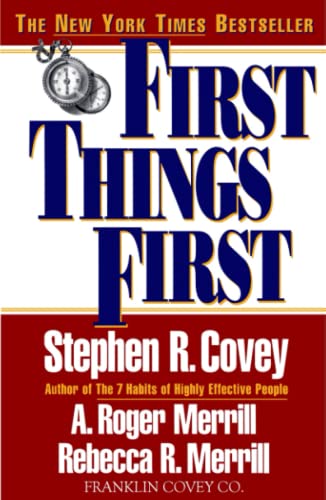
From the author that brought you the New York Times bestseller The 7 Habits of Highly Effective People comes a guide to prioritizing your personal and professional goals.
I'm getting more done in less time, but where are the rich relationships, the inner peace, the balance, the confidence that I'm doing what matters most and doing it well?
Does this nagging question haunt you, even when you feel you are being your most efficient? If so, First Things First can help you understand why we so often prioritize things that are unimportant to both our larger goals and our inner happiness. From the author that brought you the New York Times bestseller The 7 Habits of Highly Effective People comes a guide to building your work on the principles of effectiveness so that your life can spent cultivating genuine relationships, investing in pursuits you enjoy, and achieving balance in both your personal and professional lives.
In First Things First, Stephen M. R. Covey advocates categorizing tasks by urgency and importance so that you can focus on what actually needs to be done in the limited amount of time that you have. Using personal examples and insight from years of business experience, he argues for a new way of looking at your “to-do” list. Rather than offering you another clock, First Things First provides you with a compass, because where you're headed is more important than how fast you're going.
Die Inhaltsangabe kann sich auf eine andere Ausgabe dieses Titels beziehen.
Über die Autorinnen und Autoren
Recognized as one of Time magazine’s twenty-five most influential Americans, Stephen R. Covey (1932–2012) was an internationally respected leadership authority, family expert, teacher, organizational consultant, and author. His books have sold more than twenty-five million copies in thirty-eight languages, and The 7 Habits of Highly Effective People was named the #1 Most Influential Business Book of the Twentieth Century. After receiving an MBA from Harvard and a doctorate degree from Brigham Young University, he became the cofounder and vice chairman of FranklinCovey, a leading global training firm.
A. Roger Merrill, cofounder of the Covey Leadership Center (now FranklinCovey), has more than forty years of experience as a line manager, senior executive, executive coach, consultant, and teacher. Roger is the author of Connections: Quadrant II Time Management, coauthor of The Nature of Leadership and Life Matters: Creating a Dynamic Balance of Work, Family, Time, and Money.
Rebecca A. Merrill has served in numerous leadership positions in community, education, and women’s organizations. Coauthor of Connections: Quadrant II Time Management, she also assisted Stephen R. Covey on The 7 Habits Highly Effective People.
Auszug. © Genehmigter Nachdruck. Alle Rechte vorbehalten.
Chapter 1: How Many People on Their Deathbed Wish They'd Spent More Time at the Office?
The enemy of the "best" is the "good,"
We're constantly making choices about the way we spend our rime, from the major seasons to the individual moments in out lives. We're also living with the consequences of those choices. And many of us don't like those consequences -- especially when we feel there's a gap between how we're spending our rime and what we feel is deeply important in out lives.
My life is hectic! I'm running all day -- meetings, phone calls, paperwork, appointments. I push myself to the limit, fall into bed exhausted, and get up early the next morning to do it all again. My output is tremendous; I'm getting a lot done. But I get this feeling inside sometimes, "So what? What are you doing that really counts?" I have to admit, I don't know.
I feel like I'm being torn apart. My family is important to me; so is my work. I live with constant conflict, trying to juggle the demands of both. Is it possible to be really successful -- and happy -- at the office and at home?
There is simply too little of me to go around. The board and shareholders are on me like a swarm of bees for our declining share prices. I'm constantly playing referee in turf wars between members of my executive team. I feel tremendous pressure to be leading our organization's quality improvement initiative. The morale among out employees is low and I feel guilty for no/ge/ring out with them and listening more. On top of all this, despite our family vacations, my family has all but written me off because they never see me.
I don't feel in control of my life. I try to figure out what's important and set goals to do it, but other people -- my boss, my work associates, my spouse -- continually throw wrenches into the works. What I set out to do is blocked by what other people want me to do for them. What's important to me is getting swept away in the current of what's important to everybody else.
Everyone tells me I'm highly successful, I've worked and scraped and sacrificed, and I've made it to the top. But I'm not happy. Way down inside I have this empty feeling. It's like the song says, "Is that all there is?"
Most of the time, I just don't enjoy life. For every one thing I do, I can think of ten things I don't do, and it makes me feel guilty. The constant stress of trying to decide what I should do in the middle of all I could do creates a constant tension. How can I know what's most important? How can I do it? How can I enjoy it?
I feel like I have some sense of what I should do with my life. I've written down what I feel is really important and I set goals to make it happen. But somewhere between my vision and my daily action, I lose it. How can I translate what really counts into my daily life?
Putting first things first is an issue at the very heart of life. Almost all of us feel torn by the things we want to do, by the demands placed on us, by the many responsibilities we have. We all feel challenged by the day-to-day and moment-by-moment decisions we must make regarding the best use of our time.
Decisions are easier when it's a question of "good" or "bad." We can easily see how some ways we could spend our time are wasteful, mind-numbing, even destructive. But for most of us, the issue is not between the "good" and the "bad," but between the "good" and the "best." So often, the enemy of the best is the good.
Stephen: I knew a man who was asked to be the new dean of the College of Business of a large university. When he first arrived, he studied the situation the college faced and felt that what it needed most was money. He recognized that he had a unique capacity to raise money, and he developed a real sense of vision about fund-raising as his primary function.
This created a problem in the college because past deans had focused mainly on meeting day-to-day faculty needs. This new dean was never there. He was running around the country trying to raise money for research, scholarships, and other endowments. But he was not attending to the day-to-day things as the previous dean had. The faculty had to work through his administrative assistant, which was demeaning to many of them who were used to working with the person at the top.
The faculty became so upset with his absence that they sent a delegation to the president of the university to demand a new dean or a fundamental change in his leadership style. The president, who knew what the dean was doing, said, "Relax. He has a good administrative assistant. Give him some more time."
Within a short rime, the money started pouring in and the faculty began to recognize the vision. It wasn't long until every time they saw the dean, they would say, "Get out of here! We don't want to see you. Go out and bring in more funds. Your administrative assistant runs this office better than anyone else."
This man admitted to me later that the mistake he made was in not doing enough team building, enough explaining, enough educating about what he was trying to accomplish. I'm sure he could have done better, but I learned a powerful lesson from him. We need to constantly be asking ourselves, "What is needed out there, and what is my unique strength, my gift?"
It would have been easy for this man to meet the urgent expectations of others. He could have had a career at the university filled with many good things. But had he not discerned both the real needs and his own unique capacities, and carried out the vision he developed, he would never have achieved the best for him, the faculty, or the college.
What is "best" for you? What keeps you from giving those "best" things the rime and energy you want to give them? Are too many "good" things getting in the way? For many people, they are. And the result is the unsettling feeling that they're not putting first things first in their lives.
THE CLOCK AND THE COMPASS
Our struggle to put first things first can be characterized by the contrast between two powerful tools that direct us: the clock and the compass. The clock represents out commitments, appointments, schedules, goals, activities -- what we do with, and how we manage our time. The compass represents out vision, values, principles, mission, conscience, direction -- what we feel is important and how we lead our lives.
The struggle comes when we sense a gap between the clock and the compass -- when what we do doesn't contribute to what is most important in out lives.
For some of us, the pain of the gap is intense. We can't seem to walk out talk. We feel trapped, controlled by other people or situations. We're always responding to crises. We're constantly caught up in "the thick of thin things" -- putting out fires and never making time to do what we know would make a difference. We feel as though out lives are being lived for us.
For others of us, the pain is a vague discomfort. We just can't get what we feel we should do, what we want to do, and what we actually do all together. We're caught in dilemmas. We feel so guilty over what we're not doing, we can't enjoy what we do.
Some of us feel empty. We've defined happiness solely in terms of professional or financial achievement, and we find that our "success" did not bring us the satisfaction we thought it would. We've painstakingly climbed the "ladder of success" rung by rung -- the diploma, the late nights, the promotions -- only to discover as we reached the top rung that the ladder is leaning against the wrong wall. Absorbed in the ascent, we've left a trail of shattered relationships or missed moments of deep, rich living in the wake of the intense, overfocused effort. In out race up the rungs, we simply did not take the time to do what really...
„Über diesen Titel“ kann sich auf eine andere Ausgabe dieses Titels beziehen.
Suchergebnisse für First Things First: To Live, to Love, to Learn, to...

Beispielbild für diese ISBN
First Things First
Verlag:
Prentice Hall (a Pearson Education company), 1996
ISBN 10: 0684802031
ISBN 13: 9780684802039
Gebraucht
Paperback
Anbieter: World of Books (was SecondSale), Montgomery, IL, USA
Verkäuferbewertung 5 von 5 Sternen

Paperback. Zustand: Fair. First Things First is a revolutionary guide to managing your time by learning how to balance your life. Traditional time management suggests that working harder, smarter, and faster will help you gain control over your life, and that increased control will bring peace and fulfillment. But in the first real breakthrough in time management in years, the authors of First Things First apply the insights of The 7 Habits of Highly Effective People to our daily problems of struggling with the ever-increasing demands of work and home life. Rather than focusing on time and things, First Things First emphasizes relationships and results. And instead of efficiency, this new approach emphasizes effectiveness. It tells us: * Why we feel a gap between how we spend our time and what's deeply important to us * How focusing on efficiency and control increases the gap instead of closing it * How to determine if what you're doing is really important -- or only urgent * How to overcome the tremendous gravity of habit * How to put people ahead of schedules * How to lead your life, not just manage your time Offering a principle-centered approach and the wisdom and insight that made The 7 Habits of Highly Effective People a #1 bestseller, First Things First empowers listeners to define what is truly important; to accomplish worthwhile goals; and to lead rich, rewarding, and balanced lives. Bestandsnummer des Verkäufers 00087685400
Gebraucht kaufen
EUR 3,71
Versand gratis
Versand innerhalb von USA
Versand innerhalb von USA
Anzahl: Mehr als 20 verfügbar
Beispielbild für diese ISBN
First Things First
Verlag:
Prentice Hall (a Pearson Education company), 1996
ISBN 10: 0684802031
ISBN 13: 9780684802039
Gebraucht
Paperback
Anbieter: World of Books (was SecondSale), Montgomery, IL, USA
Verkäuferbewertung 5 von 5 Sternen
Paperback. Zustand: Very Good. First Things First is a revolutionary guide to managing your time by learning how to balance your life. Traditional time management suggests that working harder, smarter, and faster will help you gain control over your life, and that increased control will bring peace and fulfillment. But in the first real breakthrough in time management in years, the authors of First Things First apply the insights of The 7 Habits of Highly Effective People to our daily problems of struggling with the ever-increasing demands of work and home life. Rather than focusing on time and things, First Things First emphasizes relationships and results. And instead of efficiency, this new approach emphasizes effectiveness. It tells us: * Why we feel a gap between how we spend our time and what's deeply important to us * How focusing on efficiency and control increases the gap instead of closing it * How to determine if what you're doing is really important -- or only urgent * How to overcome the tremendous gravity of habit * How to put people ahead of schedules * How to lead your life, not just manage your time Offering a principle-centered approach and the wisdom and insight that made The 7 Habits of Highly Effective People a #1 bestseller, First Things First empowers listeners to define what is truly important; to accomplish worthwhile goals; and to lead rich, rewarding, and balanced lives. Bestandsnummer des Verkäufers 00108076053
Gebraucht kaufen
EUR 3,71
Versand gratis
Versand innerhalb von USA
Versand innerhalb von USA
Anzahl: Mehr als 20 verfügbar
Beispielbild für diese ISBN
First Things First
Verlag:
Prentice Hall (a Pearson Education company), 1996
ISBN 10: 0684802031
ISBN 13: 9780684802039
Gebraucht
Paperback
Anbieter: World of Books (was SecondSale), Montgomery, IL, USA
Verkäuferbewertung 5 von 5 Sternen
Paperback. Zustand: Good. First Things First is a revolutionary guide to managing your time by learning how to balance your life. Traditional time management suggests that working harder, smarter, and faster will help you gain control over your life, and that increased control will bring peace and fulfillment. But in the first real breakthrough in time management in years, the authors of First Things First apply the insights of The 7 Habits of Highly Effective People to our daily problems of struggling with the ever-increasing demands of work and home life. Rather than focusing on time and things, First Things First emphasizes relationships and results. And instead of efficiency, this new approach emphasizes effectiveness. It tells us: * Why we feel a gap between how we spend our time and what's deeply important to us * How focusing on efficiency and control increases the gap instead of closing it * How to determine if what you're doing is really important -- or only urgent * How to overcome the tremendous gravity of habit * How to put people ahead of schedules * How to lead your life, not just manage your time Offering a principle-centered approach and the wisdom and insight that made The 7 Habits of Highly Effective People a #1 bestseller, First Things First empowers listeners to define what is truly important; to accomplish worthwhile goals; and to lead rich, rewarding, and balanced lives. Bestandsnummer des Verkäufers 00064174421
Gebraucht kaufen
EUR 3,71
Versand gratis
Versand innerhalb von USA
Versand innerhalb von USA
Anzahl: Mehr als 20 verfügbar
Beispielbild für diese ISBN
First Things First
Anbieter: Gulf Coast Books, Cypress, TX, USA
Verkäuferbewertung 5 von 5 Sternen
Paperback. Zustand: Good. Bestandsnummer des Verkäufers 0684802031-3-20630422
Gebraucht kaufen
EUR 3,76
Versand gratis
Versand innerhalb von USA
Versand innerhalb von USA
Anzahl: 1 verfügbar
Beispielbild für diese ISBN
First Things First
Anbieter: Your Online Bookstore, Houston, TX, USA
Verkäuferbewertung 5 von 5 Sternen
Paperback. Zustand: Very Good. Bestandsnummer des Verkäufers 0684802031-2-19554336
Gebraucht kaufen
EUR 3,76
Versand gratis
Versand innerhalb von USA
Versand innerhalb von USA
Anzahl: 3 verfügbar
Beispielbild für diese ISBN
First Things First
Anbieter: Gulf Coast Books, Cypress, TX, USA
Verkäuferbewertung 5 von 5 Sternen
Paperback. Zustand: Fair. Bestandsnummer des Verkäufers 0684802031-4-20311392
Gebraucht kaufen
EUR 3,76
Versand gratis
Versand innerhalb von USA
Versand innerhalb von USA
Anzahl: 1 verfügbar
Beispielbild für diese ISBN
First Things First
Anbieter: Orion Tech, Kingwood, TX, USA
Verkäuferbewertung 5 von 5 Sternen
Paperback. Zustand: Good. Bestandsnummer des Verkäufers 0684802031-3-18590269
Gebraucht kaufen
EUR 3,76
Versand gratis
Versand innerhalb von USA
Versand innerhalb von USA
Anzahl: 1 verfügbar
Beispielbild für diese ISBN
First Things First
Anbieter: Orion Tech, Kingwood, TX, USA
Verkäuferbewertung 5 von 5 Sternen
Paperback. Zustand: Very Good. Bestandsnummer des Verkäufers 0684802031-2-18568066
Gebraucht kaufen
EUR 3,76
Versand gratis
Versand innerhalb von USA
Versand innerhalb von USA
Anzahl: 5 verfügbar
Beispielbild für diese ISBN
First Things First
Anbieter: Gulf Coast Books, Cypress, TX, USA
Verkäuferbewertung 5 von 5 Sternen
Paperback. Zustand: Very Good. Bestandsnummer des Verkäufers 0684802031-2-19803174
Gebraucht kaufen
EUR 3,76
Versand gratis
Versand innerhalb von USA
Versand innerhalb von USA
Anzahl: 5 verfügbar
Beispielbild für diese ISBN
First Things First
Anbieter: Your Online Bookstore, Houston, TX, USA
Verkäuferbewertung 5 von 5 Sternen
Paperback. Zustand: Fair. Bestandsnummer des Verkäufers 0684802031-4-22028742
Gebraucht kaufen
EUR 3,76
Versand gratis
Versand innerhalb von USA
Versand innerhalb von USA
Anzahl: 3 verfügbar