
Verwandte Artikel zu Teaching the New Basic Skills: Principles for Educating...
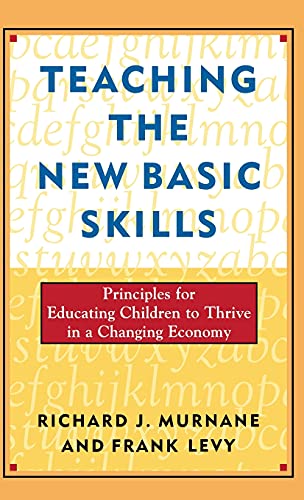
Teaching the New Basic Skills: Principles for Educating Children to Thrive in a Changing Economy - Softcover
Inhaltsangabe
Fifteen years ago, a U.S. high school diploma was a ticket to the middle class. No longer. The skills required to earn a decent income have changed radically. The skills taught in most U.S. schools have not. Today the average 30-year-old person with a high school diploma earns $20,200, and the nation faces a future of growing inequality and division. Teaching the New Basic Skills shows how to avoid such a future. By telling stories of real people in real businesses and real schools, the book shows the skills students need to get decent jobs and how schools can change to teach those skills. Richard Murnane and Frank Levy begin by describing the hiring processes of best practice firms like Northwestern Mutual Life and Honda of America. In today's competitive economy, these firms search for applicants with the New Basic Skills - the mix of hard and soft skills that all high-wage employers now require. Murnane and Levy then shift their analysis to schools, asking how they can more effectively teach these New Basic Skills. By using case studies the authors show that popular school reform proposals - higher standards, school choice, national standards, charter schools, more money - can only be the first half of a solution to the nation's school problem. When they work as advertised, they force a school to change the way it does business. But each of these reforms needs a second half, a strategy for guiding schools toward the changes that raise student skills. The authors show how that strategy rests on five management principles that focus a school on student achievement. These principles grow out of the experiences of real schools doing the dirty work of educational reform: an elementary school in East Austin, Texas organizing low-income Hispanic parents around higher educational performance, an affluent New England community retraining its teachers, the state of Vermont devising new ways to measure t
Die Inhaltsangabe kann sich auf eine andere Ausgabe dieses Titels beziehen.
Über die Autorin bzw. den Autor
Richard J. Murnane is a Professor at the Harvard Graduate School of Education. Frank Levy is the Daniel Rose Professor of Urban Economics at MIT. Both authors live in Newton, Massachusetts.
Von der hinteren Coverseite
Fifteen years ago, a U.S. high school diploma was a ticket to the middle class. No longer. The skills required to earn a decent income have changed radically. The skills taught in most U.S. schools have not. Today the average 30-year-old person with a high school diploma earns $20,200, and the nation faces of future of growing inequality and division. Teaching the New Basic Skills shows how to avoid such a future. By telling stories of real people in real businesses and real schools, the book shows the skills students need to get decent jobs and how schools can change to teach those skills. Richard Murnane and Frank Levy begin by describing the hiring processes of best practice firms like Northwestern Mutual Life and Honda of America. In today's competitive economy, these firms search for applicants with the New Basic Skills - the mix of hard and soft skills that all high-wage employers now require. Murnane and Levy then shift their analysis to schools, asking how they can more effectively teach these New Basic Skills. By using case studies the authors show that popular school reform proposals - higher standards, school choice, national standards, charter schools, more money - can only be the first half of a solution to the nation's school problem. When they work as advertised, they force a school to change the way it does business. But each of these reforms needs a second half, a strategy for guiding schools toward the changes that raise student skills. The authors show how that strategy rests on five management principles that focus a school on student achievement. These principles grow out of the experiences of real schools doing the dirty work of educational reform: an elementaryschool in East Austin, Texas organizing low-income Hispanic parents around higher educational performance, an affluent New England community retraining its teachers, the state of Vermont devising new ways to measure the math skills employers require, a Boston high school creating incentives for low-income minority students to devote more time and attention to schoolwork.
Auszug. © Genehmigter Nachdruck. Alle Rechte vorbehalten.
Chapter 1
Preparing to Meet the Future
East Austin, Texas. Zavala Elementary School is a two-story yellow-brick structure built in 1936 and now connected by walkways to 18 portable classrooms. The school sits on tree-lined Robert Martinez Jr. Street between Santa Rita Courts and Chalmers Courts, two Hispanic public housing projects.
T. A. Vasquez lives around the corner from Zavala Elementary. All four of her children went to school there. Her third child, Cynthia, had a solid B average in first-grade math, and T. A. assumed Cynthia was doing well. Nobody at Zavala Elementary told T. A. that Cynthia and most of her classmates were scoring at the fifteenth percentile on the Texas statewide mathematics test. The problem was real but things would get better.
Cabot, Massachusetts. Audubon Elementary School is a long way from Zavala Elementary both in terms of miles (about 1,900) and in terms of money. The average Zavala family makes about $12,000 per year; the average Audubon family makes $90,000. Still, Audubon Elementary had its problems.
Sharon Wright was picking her way through broken light bulbs on the floor of her fifth-grade classroom. Earlier in the year, Sharon and seven other Cabot fifth-grade teachers took a 10-week afterschool course designed just for them. The teachers thought they would learn to lead fifth-graders in hands-on experiments on the physics of light. Instead, they got two-hour lectures on theory that kept them prisoners in their chairs. They had no chance to try the experiments they were eventually supposed to lead. Now as Sharon walked among her class of 23, with extension cords crisscrossing the floor, she winced as yet another light bulb broke. The problems were real but things would get better.
This book is about the skills students now need to succeed in the economy and how schools can change to teach those skills. We begin by visiting a set of U.S. factories and offices -- two automobile factories, an insurance company, a sporting-goods wholesaler. We will see the skills required of employees and the management principles under which they work. In most of these firms, skilled employees and good management go hand in hand: a skilled person assigned to a dumb job will produce little and earn less.
Then we will visit a set of places where people are learning how to teach the skills good employers require -- poor schools, rich schools, a hospital pathology laboratory, a teachers' summer "camp" in Vermont. In these places, teachers like Sharon Wright and parents like T. A. Vasquez are doing the dirty work of school improvement: building a constituency for higher standards, constructing better incentives for students, moving teacher training beyond one-day workshops, creating tests that measure what students need to learn. Much of their work also involves management principles. To raise student skills, T. A. Vasquez, Sharon Wright, and others we will meet are making an effort comparable to reengineering a midsize business. An important part of America's future depends on how well they succeed.
THE COST OF COMPETITIVENESS
During the past 20 years, the skills required to succeed in the economy have changed radically, but the skills taught in most schools have changed very little. As a result of the ever-growing mismatch between the skills of most graduates and the skills required by high-wage employers, a U.S. high school diploma is no longer a ticket to the U.S. middle class.
As late as 1979, a 30-year-old man with a U.S. high school diploma earned a yearly average of $27,700, in 1993 dollars. That income, combined with a wife's earnings from a part-time lob, secured the family a solid place in the middle class. Then, almost without warning, the economy changed. By 1983 U.S. manufacturing, threatened by imports, was rapidly downsizing, and a 30-year-old man with a high school diploma earned an average of $23,000 a year, in 1993 dollars. By 1993, with computers transforming both U.S. manufacturing and U.S. services, a 30-year-old man with a high school diploma earned an average of $20,000. The significance of this decline in earnings becomes all the greater when we realize that in 1993 half of all 30-year-old men had not gone beyond high school.
By the early 1990s, the need for a quality education extended beyond high school graduates. At all levels, the economy was forcing people to become economic free agents, constantly prepared to prove their worth in the market. Today's firms increasingly set pay based on an employee's recent performance, not long-term relationships. Jobs at IBM and AT&T now end abruptly and people must resell themselves. In this world you go to war every day, and short of being a millionaire, a very good education is your best armor.
Viewed from a distance, the economy's changes represent progress, the rebuilding of the nation's economic efficiency. In both 1994 and 1995, the United States was rated the most competitive economy in the world, a ranking unthinkable a decade earlier.
But rebuilding efficiency has exacted big human costs. The costs are clearest among men and women who have not gone beyond high school, but uncertainty now affects men and women at every level. The issue is not that U.S. educational quality has declined -- standardized test scores are modestly higher today than in the early 1980s. But the economy is changing much faster than the schools have improved. Many people -- including roughly half of recent graduates -- have an education that is no longer in demand.
The nation cannot absorb change of this magnitude without political consequences. The consequences began in the 1994 elections when all aspects of competitiveness were on display. In aggregate terms, the economy was booming: unemployment had fallen below 5.5 percent; inflation was a low 2.7 percent; labor productivity, the ultimate measure of the economy's efficiency, was growing faster than in the two previous decades. But the wages of high school graduates -- younger and older, men and women -- did not increase. And some men and women with college diplomas found their jobs eliminated through downsizing. For many voters, hope turned to anger, and the elections offered a variety of targets for blame: the president, Congress, welfare mothers, affirmative action, multinational corporations.
Missing from this list was a growing determinant of incomes -- the quality of U.S. schools. Schools were not a high-priority issue, not even among voters with school-age children. The reason why begins in public opinion polls.
In the case of schools, American public opinion is best described as schizophrenic. When Americans are asked about schools in general, the verdict is negative. In 1995, only 20 percent of Americans rated the nation's public schools as A or B, down from 27 percent in 1986. But when American parents with children in public schools are asked about their children's schools, the picture is much brighter. In 1995, 65 percent of parents gave a rating of A or B to the school attended by their oldest child, a figure as high as in 1986. When pressed to name a problem in their local public schools, 11 percent of public school parents cited poor discipline and 8 percent cited violence. Only 4 percent faulted educational quality.r
Parental satisfaction is important because when parents are dissatisfied with their children's schools, the politicians notice and the schools can change. In the last 15 years, parents of handicapped children have pushed to get their children moved into regular classes, and schools have responded. Large numbers of parents have pushed schools to teach about drug abuse, smoking, and, in some cases, AIDS; and the schools have responded. Compared to these issues, higher student skills attracted little parental interest. From a political...
„Über diesen Titel“ kann sich auf eine andere Ausgabe dieses Titels beziehen.
Suchergebnisse für Teaching the New Basic Skills: Principles for Educating...

Beispielbild für diese ISBN
Teaching the New Basic Skills: Principles for Educating Children to Thrive in a Changing Economy
Anbieter: More Than Words, Waltham, MA, USA
Verkäuferbewertung 5 von 5 Sternen

Zustand: Good. A sound copy with only light wear. Overall a solid copy at a great price! Bestandsnummer des Verkäufers BOS-M-02b-01516
Gebraucht kaufen
EUR 0,92
EUR 3,55 Versand
Versand innerhalb von USA
Versand innerhalb von USA
Anzahl: 1 verfügbar
Beispielbild für diese ISBN
Teaching the New Basic Skills
Anbieter: World of Books (was SecondSale), Montgomery, IL, USA
Verkäuferbewertung 5 von 5 Sternen
Hardback. Zustand: Good. Fifteen years ago, a U.S. high school diploma was a ticket to the middle class. No longer. The skills required to earn a decent income have changed radically. The skills taught in most U.S. schools have not. Today the average 30-year-old person with a high school diploma earns $20,200, and the nation faces a future of growing inequality and division. Teaching the New Basic Skills shows how to avoid such a future. By telling stories of real people in real businesses and real schools, the book shows the skills students need to get decent jobs and how schools can change to teach those skills. Richard Murnane and Frank Levy begin by describing the hiring processes of best practice firms like Northwestern Mutual Life and Honda of America. In today's competitive economy, these firms search for applicants with the New Basic Skills -- the mix of hard and soft skills that all high-wage employers now require. Murnane and Levy then shift their analysis to schools, asking how they can more effectively teach these New Basic Skills. By using case studies the authors show that popular school reform proposals -- higher standards, school choice, national standards, charter schools, more money -- can only be the first half of a solution to the nation's school problem. When they work as advertised, they force a school to change the way it does business. But each of these reforms needs a second half, a strategy for guiding schools toward the changes that raise student skills. The authors show how that strategy rests on five management principles that focus a school on student achievement. These principles grow out of the experiences of real schools doing the dirty work of educational reform: an elementary school in East Austin, Texas organizing low-income Hispanic parents around higher educational performance, an affluent New England community retraining its teachers, the state of Vermont devising new ways to measure the math skills employers require, a Boston high school creating incentives for low-income minority students to devote more time and attention to schoolwork. Superintendents, governors and business leaders agree on the importance of this book as evidenced in the forewords by Robert Galvin, Chairman of Motorola, and Thomas Payzant, school superintendent of Boston. For those who care about the success of U.S. schools, Teaching the New Basic Skills is an optimistic guide to the future and a must read. Bestandsnummer des Verkäufers 00104674230
Gebraucht kaufen
EUR 4,55
Versand gratis
Versand innerhalb von USA
Versand innerhalb von USA
Anzahl: 1 verfügbar
Beispielbild für diese ISBN
Teaching the New Basic Skills
Anbieter: World of Books (was SecondSale), Montgomery, IL, USA
Verkäuferbewertung 5 von 5 Sternen
Hardback. Zustand: Fair. Fifteen years ago, a U.S. high school diploma was a ticket to the middle class. No longer. The skills required to earn a decent income have changed radically. The skills taught in most U.S. schools have not. Today the average 30-year-old person with a high school diploma earns $20,200, and the nation faces a future of growing inequality and division. Teaching the New Basic Skills shows how to avoid such a future. By telling stories of real people in real businesses and real schools, the book shows the skills students need to get decent jobs and how schools can change to teach those skills. Richard Murnane and Frank Levy begin by describing the hiring processes of best practice firms like Northwestern Mutual Life and Honda of America. In today's competitive economy, these firms search for applicants with the New Basic Skills -- the mix of hard and soft skills that all high-wage employers now require. Murnane and Levy then shift their analysis to schools, asking how they can more effectively teach these New Basic Skills. By using case studies the authors show that popular school reform proposals -- higher standards, school choice, national standards, charter schools, more money -- can only be the first half of a solution to the nation's school problem. When they work as advertised, they force a school to change the way it does business. But each of these reforms needs a second half, a strategy for guiding schools toward the changes that raise student skills. The authors show how that strategy rests on five management principles that focus a school on student achievement. These principles grow out of the experiences of real schools doing the dirty work of educational reform: an elementary school in East Austin, Texas organizing low-income Hispanic parents around higher educational performance, an affluent New England community retraining its teachers, the state of Vermont devising new ways to measure the math skills employers require, a Boston high school creating incentives for low-income minority students to devote more time and attention to schoolwork. Superintendents, governors and business leaders agree on the importance of this book as evidenced in the forewords by Robert Galvin, Chairman of Motorola, and Thomas Payzant, school superintendent of Boston. For those who care about the success of U.S. schools, Teaching the New Basic Skills is an optimistic guide to the future and a must read. Bestandsnummer des Verkäufers 00106680357
Gebraucht kaufen
EUR 4,55
Versand gratis
Versand innerhalb von USA
Versand innerhalb von USA
Anzahl: 1 verfügbar
Beispielbild für diese ISBN
Teaching the New Basic Skills: Principles for Educating Children to Thrive in a Changing Economy
Anbieter: Orion Tech, Kingwood, TX, USA
Verkäuferbewertung 5 von 5 Sternen
paperback. Zustand: Very Good. Bestandsnummer des Verkäufers 0684827395-2-37835911
Gebraucht kaufen
EUR 4,56
Versand gratis
Versand innerhalb von USA
Versand innerhalb von USA
Anzahl: 1 verfügbar
Beispielbild für diese ISBN
Teaching the New Basic Skills: Principles for Educating Children to Thrive in a Changing Economy
Anbieter: BooksRun, Philadelphia, PA, USA
Verkäuferbewertung 5 von 5 Sternen
Paperback. Zustand: Good. With dust jacket. It's a preowned item in good condition and includes all the pages. It may have some general signs of wear and tear, such as markings, highlighting, slight damage to the cover, minimal wear to the binding, etc., but they will not affect the overall reading experience. Ex-Library. Bestandsnummer des Verkäufers 0684827395-11-1-12_29
Gebraucht kaufen
EUR 5,51
Versand gratis
Versand innerhalb von USA
Versand innerhalb von USA
Anzahl: 1 verfügbar
Beispielbild für diese ISBN
Teaching the New Basic Skills
Anbieter: World of Books Inc, Montgomery, IL, USA
Verkäuferbewertung 4 von 5 Sternen

Hardback. Zustand: Good. Fifteen years ago, a U.S. high school diploma was a ticket to the middle class. No longer. The skills required to earn a decent income have changed radically. The skills taught in most U.S. schools have not. Today the average 30-year-old person with a high school diploma earns $20,200, and the nation faces a future of growing inequality and division. Teaching the New Basic Skills shows how to avoid such a future. By telling stories of real people in real businesses and real schools, the book shows the skills students need to get decent jobs and how schools can change to teach those skills. Richard Murnane and Frank Levy begin by describing the hiring processes of best practice firms like Northwestern Mutual Life and Honda of America. In today's competitive economy, these firms search for applicants with the New Basic Skills -- the mix of hard and soft skills that all high-wage employers now require. Murnane and Levy then shift their analysis to schools, asking how they can more effectively teach these New Basic Skills. By using case studies the authors show that popular school reform proposals -- higher standards, school choice, national standards, charter schools, more money -- can only be the first half of a solution to the nation's school problem. When they work as advertised, they force a school to change the way it does business. But each of these reforms needs a second half, a strategy for guiding schools toward the changes that raise student skills. The authors show how that strategy rests on five management principles that focus a school on student achievement. These principles grow out of the experiences of real schools doing the dirty work of educational reform: an elementary school in East Austin, Texas organizing low-income Hispanic parents around higher educational performance, an affluent New England community retraining its teachers, the state of Vermont devising new ways to measure the math skills employers require, a Boston high school creating incentives for low-income minority students to devote more time and attention to schoolwork. Superintendents, governors and business leaders agree on the importance of this book as evidenced in the forewords by Robert Galvin, Chairman of Motorola, and Thomas Payzant, school superintendent of Boston. For those who care about the success of U.S. schools, Teaching the New Basic Skills is an optimistic guide to the future and a must read. Bestandsnummer des Verkäufers CIN0684827395G
Gebraucht kaufen
EUR 6,39
Versand gratis
Versand innerhalb von USA
Versand innerhalb von USA
Anzahl: 1 verfügbar
Beispielbild für diese ISBN
Teaching the New Basic Skills
Anbieter: World of Books Inc, Montgomery, IL, USA
Verkäuferbewertung 4 von 5 Sternen
Hardback. Zustand: Fair. Fifteen years ago, a U.S. high school diploma was a ticket to the middle class. No longer. The skills required to earn a decent income have changed radically. The skills taught in most U.S. schools have not. Today the average 30-year-old person with a high school diploma earns $20,200, and the nation faces a future of growing inequality and division. Teaching the New Basic Skills shows how to avoid such a future. By telling stories of real people in real businesses and real schools, the book shows the skills students need to get decent jobs and how schools can change to teach those skills. Richard Murnane and Frank Levy begin by describing the hiring processes of best practice firms like Northwestern Mutual Life and Honda of America. In today's competitive economy, these firms search for applicants with the New Basic Skills -- the mix of hard and soft skills that all high-wage employers now require. Murnane and Levy then shift their analysis to schools, asking how they can more effectively teach these New Basic Skills. By using case studies the authors show that popular school reform proposals -- higher standards, school choice, national standards, charter schools, more money -- can only be the first half of a solution to the nation's school problem. When they work as advertised, they force a school to change the way it does business. But each of these reforms needs a second half, a strategy for guiding schools toward the changes that raise student skills. The authors show how that strategy rests on five management principles that focus a school on student achievement. These principles grow out of the experiences of real schools doing the dirty work of educational reform: an elementary school in East Austin, Texas organizing low-income Hispanic parents around higher educational performance, an affluent New England community retraining its teachers, the state of Vermont devising new ways to measure the math skills employers require, a Boston high school creating incentives for low-income minority students to devote more time and attention to schoolwork. Superintendents, governors and business leaders agree on the importance of this book as evidenced in the forewords by Robert Galvin, Chairman of Motorola, and Thomas Payzant, school superintendent of Boston. For those who care about the success of U.S. schools, Teaching the New Basic Skills is an optimistic guide to the future and a must read. Bestandsnummer des Verkäufers CIN0684827395A
Gebraucht kaufen
EUR 6,39
Versand gratis
Versand innerhalb von USA
Versand innerhalb von USA
Anzahl: 1 verfügbar
Beispielbild für diese ISBN
Teaching the New Basic Skills
Anbieter: Better World Books: West, Reno, NV, USA
Verkäuferbewertung 5 von 5 Sternen
Zustand: Very Good. Former library copy. Pages intact with possible writing/highlighting. Binding strong with minor wear. Dust jackets/supplements may not be included. Includes library markings. Stock photo provided. Product includes identifying sticker. Better World Books: Buy Books. Do Good. Bestandsnummer des Verkäufers 49695844-6
Gebraucht kaufen
EUR 7,20
Versand gratis
Versand innerhalb von USA
Versand innerhalb von USA
Anzahl: 1 verfügbar
Beispielbild für diese ISBN
Teaching the New Basic Skills
Anbieter: ThriftBooks-Dallas, Dallas, TX, USA
Verkäuferbewertung 5 von 5 Sternen
Hardcover. Zustand: Good. No Jacket. Pages can have notes/highlighting. Spine may show signs of wear. ~ ThriftBooks: Read More, Spend Less. Bestandsnummer des Verkäufers G0684827395I3N00
Gebraucht kaufen
EUR 7,25
Versand gratis
Versand innerhalb von USA
Versand innerhalb von USA
Anzahl: 1 verfügbar
Beispielbild für diese ISBN
Teaching the New Basic Skills
Verlag:
Free Press, New York, NY, 1996
ISBN 10: 0684827395
ISBN 13: 9780684827391
Gebraucht
Hardcover
Anbieter: 2Vbooks, Derwood, MD, USA
Verkäuferbewertung 4 von 5 Sternen
Hard cover. Zustand: Fine. No dust jacket. Sewn binding. Cloth over boards. 272 p. Audience: General/trade. No previous owner's name HC 191. Bestandsnummer des Verkäufers Alibris.0025142
Gebraucht kaufen
EUR 3,11
EUR 4,44 Versand
Versand innerhalb von USA
Versand innerhalb von USA
Anzahl: 1 verfügbar