
Verwandte Artikel zu The Denial of Death
Inhaltsangabe
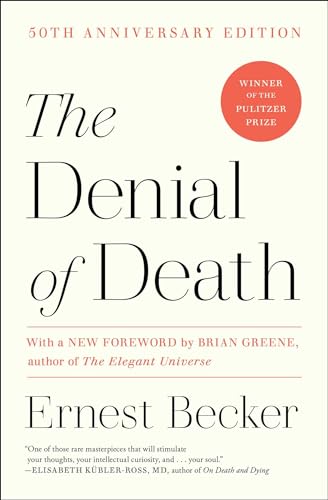
Winner of the Pulitzer prize in 1974 and the culmination of a life's work, The Denial of Death is Ernest Becker's brilliant and impassioned answer to the "why" of human existence. In bold contrast to the predominant Freudian school of thought, Becker tackles the problem of the vital lie -- man's refusal to acknowledge his own mortality. In doing so, he sheds new light on the nature of humanity and issues a call to life and its living that still resonates more than twenty years after its writing.
Die Inhaltsangabe kann sich auf eine andere Ausgabe dieses Titels beziehen.
Über die Autorin bzw. den Autor
After receiving a PhD in cultural anthropology from Syracuse University, Dr. Ernest Becker (1924–1974) taught at the University of California at Berkeley, San Francisco State College, and Simon Fraser University, Canada. He is survived by his wife, Marie, and a foundation that bears his name—The Ernest Becker Foundation.
Auszug. © Genehmigter Nachdruck. Alle Rechte vorbehalten.
The Denial of Death Foreword
The first words Ernest Becker said to me when I walked into his hospital room were: “You are catching me in extremis. This is a test of everything I’ve written about death. And I’ve got a chance to show how one dies, the attitude one takes. Whether one does it in a dignified, manly way; what kinds of thoughts one surrounds it with; how one accepts his death.”
When The Denial of Death arrived at Psychology Today in late 1973 and was placed on my desk for consideration it took me less than an hour to decide that I wanted to interview Ernest Becker. On December 6th, I called his home in Vancouver to see if he would do a conversation for the magazine. His wife, Marie, told me he had just been taken to the hospital and was in the terminal stage of cancer and was not expected to live for more than a week Unexpectedly, she called the next day to say that Ernest would like to do the conversation if I could get there while he still had strength and clarity. So I went to Vancouver with speed and trembling, knowing that the only thing more presumptuous than intruding into the private world of the dying would be to refuse his invitation.
Although we had never met, Ernest and I fell immediately into deep conversation. The nearness of his death and the severe limits of his energy stripped away the impulse to chatter. We talked about death in the face of death; about evil in the presence of cancer. At the end of the day Ernest had no more energy, so there was no more time. We lingered awkwardly for a few minutes, because saying “goodbye” for the last time is hard and we both knew he would not live to see our conversation in print. A paper cup of medicinal sherry on the night stand, mercifully, provided us a ritual for ending. We drank the wine together and I left.
That day a quarter of a century ago was a pivotal event in shaping my relationship to the mystery of my death and, therefore, my life. I will carry for a lifetime the images of Ernest’s courage, his clarity purchased at the cost of enduring pain, and the manner in which his passion for ideas held death at bay for a season. It is a privilege to have witnessed such a man in the heroic agony of his dying.
In the years since his death, Becker has been widely recognized as one of the great spiritual cartographers of our age and a wise physician of the soul. Gradually, reluctantly, we are beginning to acknowledge that the bitter medicine he prescribes—contemplation of the horror of our inevitable death—is, paradoxically, the tincture that adds sweetness to mortality.
Becker’s philosophy as it emerges in Denial of Death and Escape from Evil is a braid woven from four strands.
The first strand. The world is terrifying. To say the least, Becker’s account of nature has little in common with Walt Disney. Mother Nature is a brutal bitch, red in tooth and claw, who destroys what she creates. We live, he says, in a creation in which the routine activity for organisms is “tearing others apart with teeth of all types—biting, grinding flesh, plant stalks, bones between molars, pushing the pulp greedily down the gullet with delight, incorporating its essence into one’s own organization, and then excreting with foul stench and gasses the residue.”
The second strand. The basic motivation for human behavior is our biological need to control our basic anxiety, to deny the terror of death. Human beings are naturally anxious because we are ultimately helpless and abandoned in a world where we are fated to die. “This is the terror: to have emerged from nothing, to have a name, consciousness of self, deep inner feelings, an excruciating inner yearning for life and self-expression—and with all this yet to die.”
Elizabeth Kubler-Ross and Ernest Becker were strange allies in fomenting the cultural revolution that brought death and dying out of the closet. At the same time that Kubler-Ross gave us permission to practice the art of dying gracefully, Becker taught us that awe, fear, and ontological anxiety were natural accompaniments to our contemplation of the fact of death.
The third strand. Since the terror of death is so overwhelming we conspire to keep it unconscious. “The vital lie of character” is the first line of defense that protects us from the painful awareness of our helplessness. Every child borrows power from adults and creates a personality by introjecting the qualities of the godlike being. If I am like my all-powerful father I will not die. So long as we stay obediently within the defense mechanisms of our personality, what Wilhelm Reich called “character armor” we feel safe and are able to pretend that the world is manageable. But the price we pay is high. We repress our bodies to purchase a soul that time cannot destroy; we sacrifice pleasure to buy immortality; we encapsulate ourselves to avoid death. And life escapes us while we huddle within the defended fortress of character.
Society provides the second line of defense against our natural impotence by creating a hero system that allows us to believe that we transcend death by participating in something of lasting worth. We achieve ersatz immortality by sacrificing ourselves to conquer an empire, to build a temple, to write a book, to establish a family, to accumulate a fortune, to further progress and prosperity, to create an information-society and global free market. Since the main task of human life is to become heroic and transcend death, every culture must provide its members with an intricate symbolic system that is covertly religious. This means that ideological conflicts between cultures are essentially battles between immortality projects, holy wars.
One of Becker’s lasting contributions to social psychology has been to help us understand that corporations and nations may be driven by unconscious motives that have little to do with their stated goals. Making a killing in business or on the battlefield frequently has less to do with economic need or political reality than with the need for assuring ourselves that we have achieved something of lasting worth. Consider, for instance, the recent war in Vietnam in which the United States was driven not by any realistic economic or political interest but by the overwhelming need to defeat “atheistic communism.”
The fourth strand. Our heroic projects that are aimed at destroying evil have the paradoxical effect of bringing more evil into the world. Human conflicts are life and death struggles—my gods against your gods, my immortality project against your immortality project. The root of humanly caused evil is not man’s animal nature, not territorial aggression, or innate selfishness, but our need to gain self-esteem, deny our mortality, and achieve a heroic self-image. Our desire for the best is the cause of the worst. We want to clean up the world, make it perfect, keep it safe for democracy or communism, purify it of the enemies of god, eliminate evil, establish an alabaster city undimmed by human tears, or a thousand year Reich.
Perhaps Becker’s greatest achievement has been to create a science of evil. He has given us a new way to understand how we create surplus evil—warfare, ethnic cleansing, genocide. From the beginning of time, humans have dealt with what Carl Jung called their shadow side—feelings of inferiority, self-hate, guilt, hostility—by projecting it onto an enemy. It has remained for Becker to make crystal clear the way in which warfare is a social ritual for purification of the world in which the enemy is assigned the role of being dirty, dangerous, and atheistic. Dachau, Capetown and Mi Lai, Bosnia, Rwanda, give grim testimony to the universal need for a...
„Über diesen Titel“ kann sich auf eine andere Ausgabe dieses Titels beziehen.
Weitere beliebte Ausgaben desselben Titels

Suchergebnisse für The Denial of Death

Beispielbild für diese ISBN
The Denial of Death
Verlag:
Free Press (edition First Free Press Paperbacks Edition), 1997
ISBN 10: 0684832402
ISBN 13: 9780684832401
Gebraucht
Paperback
Anbieter: BooksRun, Philadelphia, PA, USA
Verkäuferbewertung 5 von 5 Sternen

Paperback. Zustand: Very Good. First Free Press Paperbacks Edition. It's a well-cared-for item that has seen limited use. The item may show minor signs of wear. All the text is legible, with all pages included. It may have slight markings and/or highlighting. Bestandsnummer des Verkäufers 0684832402-11-1
Gebraucht kaufen
EUR 8,64
Versand gratis
Versand innerhalb von USA
Versand innerhalb von USA
Anzahl: 2 verfügbar
Beispielbild für diese ISBN
The Denial of Death
Anbieter: Half Price Books Inc., Dallas, TX, USA
Verkäuferbewertung 5 von 5 Sternen
Paperback. Zustand: Very Good. Connecting readers with great books since 1972! Used books may not include companion materials, and may have some shelf wear or limited writing. We ship orders daily and Customer Service is our top priority! Bestandsnummer des Verkäufers S_478284049
Gebraucht kaufen
EUR 8,02
EUR 3,02 Versand
Versand innerhalb von USA
Versand innerhalb von USA
Anzahl: 1 verfügbar
Beispielbild für diese ISBN
Denial of Death
Anbieter: Open Books West Loop, Chicago, IL, USA
Verkäuferbewertung 3 von 5 Sternen

Trade Paperback. Zustand: Used. Bestandsnummer des Verkäufers 1183109
Gebraucht kaufen
EUR 8,48
EUR 4,33 Versand
Versand innerhalb von USA
Versand innerhalb von USA
Anzahl: 1 verfügbar
Beispielbild für diese ISBN
Denial of Death
Verlag:
Free Press May 1997, 1997
ISBN 10: 0684832402
ISBN 13: 9780684832401
Gebraucht
Trade Paperback
Anbieter: Plot Twist Used Books, Chicago, IL, USA
Verkäuferbewertung 3 von 5 Sternen
Trade Paperback. Zustand: Used. Bestandsnummer des Verkäufers 11814
Gebraucht kaufen
EUR 8,21
EUR 4,76 Versand
Versand innerhalb von USA
Versand innerhalb von USA
Anzahl: 1 verfügbar
Beispielbild für diese ISBN
The Denial of Death
Anbieter: Better World Books, Mishawaka, IN, USA
Verkäuferbewertung 5 von 5 Sternen
Zustand: Good. Pages intact with minimal writing/highlighting. The binding may be loose and creased. Dust jackets/supplements are not included. Stock photo provided. Product includes identifying sticker. Better World Books: Buy Books. Do Good. Bestandsnummer des Verkäufers 4474312-6
Gebraucht kaufen
EUR 13,25
Versand gratis
Versand innerhalb von USA
Versand innerhalb von USA
Anzahl: 3 verfügbar
Beispielbild für diese ISBN
The Denial of Death
Anbieter: Better World Books, Mishawaka, IN, USA
Verkäuferbewertung 5 von 5 Sternen
Zustand: Very Good. Pages intact with possible writing/highlighting. Binding strong with minor wear. Dust jackets/supplements may not be included. Stock photo provided. Product includes identifying sticker. Better World Books: Buy Books. Do Good. Bestandsnummer des Verkäufers 5350811-6
Gebraucht kaufen
EUR 13,25
Versand gratis
Versand innerhalb von USA
Versand innerhalb von USA
Anzahl: 2 verfügbar
Beispielbild für diese ISBN
The Denial of Death
Anbieter: World of Books (was SecondSale), Montgomery, IL, USA
Verkäuferbewertung 5 von 5 Sternen
Zustand: Good. Item in good condition. Textbooks may not include supplemental items i.e. CDs, access codes etc. Bestandsnummer des Verkäufers 00107888016
Gebraucht kaufen
EUR 13,36
Versand gratis
Versand innerhalb von USA
Versand innerhalb von USA
Anzahl: 2 verfügbar
Beispielbild für diese ISBN
The Denial of Death
Anbieter: World of Books (was SecondSale), Montgomery, IL, USA
Verkäuferbewertung 5 von 5 Sternen
Zustand: Acceptable. Item in acceptable condition! Textbooks may not include supplemental items i.e. CDs, access codes etc. Bestandsnummer des Verkäufers 00107979442
Gebraucht kaufen
EUR 13,36
Versand gratis
Versand innerhalb von USA
Versand innerhalb von USA
Anzahl: 1 verfügbar
Beispielbild für diese ISBN
The Denial of Death
Anbieter: GCCebooks, Salinas, CA, USA
Verkäuferbewertung 4 von 5 Sternen

Paperback. Zustand: Good. First Free Press Paperbacks Edition. Bestandsnummer des Verkäufers mon-ug-0684832402
Gebraucht kaufen
EUR 9,98
EUR 3,46 Versand
Versand innerhalb von USA
Versand innerhalb von USA
Anzahl: 1 verfügbar
Beispielbild für diese ISBN
The Denial of Death
Anbieter: Duru Media, Tallahassee, FL, USA
Verkäuferbewertung 5 von 5 Sternen
paperback. Zustand: New. Bestandsnummer des Verkäufers 01KRDV9DB5W1RWA
Neu kaufen
EUR 13,39
EUR 2,60 Versand
Versand innerhalb von USA
Versand innerhalb von USA
Anzahl: 1 verfügbar