
Verwandte Artikel zu Freedom's Daughters: The Unsung Heroines of the...
Inhaltsangabe
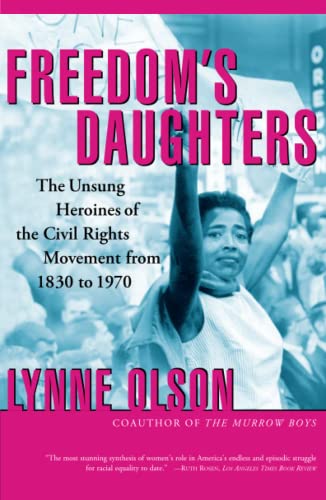
The first comprehensive history of the vital role women—both black and white—played in the civil rights movement.
In this groundbreaking and absorbing book, credit finally goes where credit is due—to the bold women who were crucial to the success of the civil rights movement. From the Montgomery bus boycott to the lunch counter sit-ins to the Freedom Rides, Lynne Olson skillfully tells the long-overlooked story of the extraordinary women who were among the most fearless, resourceful, and tenacious leaders of the civil rights movement.
Freedom's Daughters includes portraits of more than sixty women—many until now forgotten and some never before written about—from key figures like Ida B. Wells, Eleanor Roosevelt, Ella Baker, and Septima Clark to some of the smaller players who represent the hundreds of women who each came forth to do her own small part and who together ultimately formed the mass movements that made the difference. Freedom's Daughters puts a human face on the civil rights struggle—and shows that that face was often female.
Die Inhaltsangabe kann sich auf eine andere Ausgabe dieses Titels beziehen.
Über die Autorin bzw. den Autor
Lynne Olson has been a reporter and writer since 1970. After working for the AP and the Baltimore Sun for a decade, Olson became a freelance writer in 1981, writing for American Heritage, Smithsonian, Working Woman, Los Angeles Times Magazine, Ms., Elle, Glamour, and Baltimore Magazine. She is the author of eight books, including the New York Times bestseller Madame Fourcade’s Secret War, as well as Last Hope Island and Citizens of London. She lives in Washington D.C. with her husband, with whom she has co-authored two books.
Auszug. © Genehmigter Nachdruck. Alle Rechte vorbehalten.
Chapter One: "Far More Terrible for Women"
It was April 22, 1944, a warm Saturday in Washington, D.C. The skies threatened rain, but the cherry trees near the Jefferson Memorial were in bloom, and hundreds of people, many of them soldiers and sailors in uniform, strolled the banks of the Tidal Basin to admire the lacy pink and white foam of the blossoms. News from the war was mostly good: The Marines had recently captured blood-soaked Iwo Jima, the Fifth Army was about to liberate Rome. In the capital city of the United States, however, a small, thin black woman named Pauli Murray had a different sort of liberation in mind.
Murray, due to graduate in June from Howard University Law School, was standing with some other Howard students outside Thompson's cafeteria, a few blocks northeast of the Tidal Basin. She watched as her fellow students slipped, two and three at a time, inside the cafeteria. Finally, Murray took a deep breath and joined them. Once inside, she picked up a tray and entered the serving line. When the stone-faced employees behind the steam tables refused to serve her, as they refused to serve any black, Murray silently carried her empty tray to a table and sat down among the other black students who had been turned away.
The silent demonstration at Thompson's cafeteria, led by Murray and three other Howard activists on a cloudy afternoon in wartime Washington, was a harbinger. But it did more than prefigure many similar actions almost two decades later. It also symbolized the importance of women to a movement that always seemed to be dominated by men. Of the approximately fifty black students who sat in that day at Thompson's, most were women, and all of the leaders were. Together, they had stepped from behind a historical curtain and, for the moment, were deferring to no one. Sitting at Thompson's table, waiting to be served, they read textbooks and poetry. Some were glancing at the latest issue of the liberal tabloid newspaper P.M. Others watched apprehensively through the windows as a crowd of whites gathered on the sidewalk, where another group of students walked a picket line, carrying placards. One of the placards read: "Are You for HITLER'S Way (Race Supremacy) or the AMERICAN Way (Equality)? Make Up Your Mind!" And another: "We Die Together. Why Can't We Eat Together?" Some soldiers jeered and taunted the pickets. A woman spat at them. Through it all, "[o]ur demonstrators were thoroughly disciplined," Murray wrote to her friend Eleanor Roosevelt several days later. "No response was made to any taunt....We clamped down on our teeth and kept our eyes straight ahead."
The manager of Thompson's pleaded with the students to leave, but they replied, politely, that they would stay till they could eat. By dinnertime, the cafeteria's trade had dropped by half. After several desperate telephone calls from Thompson's manager to his superiors, an order finally came down from the chain's national headquarters: Serve the demonstrators. Even with that, two of Thompson's waitresses refused, so the manager and the chain's district supervisor quickly filled in. For the first time since Reconstruction, a downtown whites-only eating establishment in Washington, D.C., was serving black customers.
"It is difficult to describe the exhilaration of that brief moment of victory," Murray wrote long afterward. The sit-in at Thompson's was the culmination of months of intense planning and training. The participating students had been carefully selected, then rigorously schooled in the nonviolent principles and tactics of Mahatma Gandhi. Each student had signed a pledge not to retaliate against harassment or violence. And it had all worked! Soon, however, the glow of victory vanished. The press wasn't much interested, and the president of Howard University, fearing a backlash from a Congress dominated by Southern racists, ordered the students to suspend further action. Murray was furious that the students' "brief act of imaginative defiance, a commando raid against entrenched racism...which, if expanded, could have brought new hope to millions of black Americans," was so abruptly and completely throttled. But throttled it was, and, with the pressure lifted, Thompson's went back to "no Negroes allowed."
Not until sixteen years later would civil rights demonstrators use the same kind of nonviolent resistance employed by Murray and her fellow students. By then most activists didn't even know who Pauli Murray was. When Eleanor Holmes, a brilliant young Yale law student and member of the Student Nonviolent Coordinating Committee, returned to Yale for classes after a summer of civil rights work in 1963, she met Murray, who was then studying for her doctorate in law. Holmes, who as Eleanor Holmes Norton would later become a noted civil rights lawyer and the chair of the Equal Employment Opportunity Commission, had never heard of the 1944 Howard sit-in. She recalled being stunned on learning about the "nerve and bravery of this little woman who had already done what we were only beginning to do [but without] the safety and protection of the full-blown movement and reformist national mood that cushioned our risk."
Important as Murray was to the history of the early civil rights movement in the United States, she and the other Howard women with whom she demonstrated were merely in the middle of a long line of female soldiers of change, black and white, that stretched from the nineteenth-century abolitionist movement forward to twentieth-century civil rights and feminism. Indeed, the interconnections between race and gender, and between racism and misogyny, have helped place women at the very center of social ferment and conflict over the last two centuries of American history. Pauli Murray thus stands as a bridge between present and past. The granddaughter of a slave and great-granddaughter of a slave owner, she sprang from a family whose history, like the histories of countless others, illustrates how far the United States has come since the days of slavery, unbridled racism, and pernicious sexism -- and how far it has still to go.
From the beginning, from the days of slavery and the drive for abolition, women of both races were deeply involved. Wrote Frederick Douglass in 1881: "When the true history of the antislavery cause shall be written, woman will occupy a large space in its pages; for the cause of the slave has been peculiarly woman's cause." For women, there was a particular spur, a special urgency in the nineteenth-century struggle to abolish slavery. Harriet Jacobs, an escaped slave who wrote a book about her experiences in captivity, put it this way: "Slavery is terrible for men; but it is far more terrible for women. Superadded to the burden common to all, they have wrongs, and suffering, and mortifications peculiarly their own."
Slave women were expected to work as diligently and as long as men in the fields, but they also had to bear children, raise them, cook, sew, clean, and perform other household chores for their families. Because the field work was so harsh, and medical care and nutrition so poor, miscarriages and stillbirths were all too common. Many women were weak and in constant physical pain, many looked and seemed old by the time they reached their twenties and thirties. Nor did their gender shield women from whippings and the other brutal punishments and treatments of slavery. If their children managed to survive babyhood, they still could be lost forever at the whim of a master who decided to sell them. "Babies was snatched from deir mother's breasts and sold to speculators," one old ex-slave recalled after the Civil War. "Chillens was separated from sisters and brothers and never saw each other again. I could tell you about it all day, but even den you couldn't guess de awfulness of it."
Yet brutality and degradation were not the...
„Über diesen Titel“ kann sich auf eine andere Ausgabe dieses Titels beziehen.
Weitere beliebte Ausgaben desselben Titels

Suchergebnisse für Freedom's Daughters: The Unsung Heroines of the...

Foto des Verkäufers
Freedom's Daughters: The Unsung Heroines of the Civil Rights Movement from 1830 to 1970
Anbieter: Dream Books Co., Denver, CO, USA
Verkäuferbewertung 5 von 5 Sternen

Zustand: very_good. Pages are clean with no markings. May show minor signs of wear or cosmetic defects marks, cuts, bends, or scuffs on the cover, spine, pages, or dust jacket. May have remainder marks on edges. Bestandsnummer des Verkäufers DBV.0684850133.VG
Gebraucht kaufen
EUR 3,85
Versand gratis
Versand innerhalb von USA
Versand innerhalb von USA
Anzahl: 2 verfügbar
Beispielbild für diese ISBN
Freedom's Daughters: The Unsung Heroines of the Civil Rights Movement from 1830 to 1970
Anbieter: World of Books (was SecondSale), Montgomery, IL, USA
Verkäuferbewertung 5 von 5 Sternen
Zustand: Acceptable. Item in acceptable condition! Textbooks may not include supplemental items i.e. CDs, access codes etc. Bestandsnummer des Verkäufers 00103841182
Gebraucht kaufen
EUR 3,91
Versand gratis
Versand innerhalb von USA
Versand innerhalb von USA
Anzahl: 1 verfügbar
Beispielbild für diese ISBN
Freedom's Daughters: The Unsung Heroines of the Civil Rights Movement from 1830 to 1970
Anbieter: World of Books (was SecondSale), Montgomery, IL, USA
Verkäuferbewertung 5 von 5 Sternen
Zustand: Very Good. Item in very good condition! Textbooks may not include supplemental items i.e. CDs, access codes etc. Bestandsnummer des Verkäufers 00103134463
Gebraucht kaufen
EUR 3,91
Versand gratis
Versand innerhalb von USA
Versand innerhalb von USA
Anzahl: 1 verfügbar
Beispielbild für diese ISBN
Freedom's Daughters: The Unsung Heroines of the Civil Rights Movement from 1830 to 1970
Anbieter: World of Books (was SecondSale), Montgomery, IL, USA
Verkäuferbewertung 5 von 5 Sternen
Zustand: Good. Item in good condition. Textbooks may not include supplemental items i.e. CDs, access codes etc. Bestandsnummer des Verkäufers 00089500496
Gebraucht kaufen
EUR 3,91
Versand gratis
Versand innerhalb von USA
Versand innerhalb von USA
Anzahl: 4 verfügbar
Foto des Verkäufers
Freedom's Daughters: The Unsung Heroines of the Civil Rights Movement from 1830 to 1970
Anbieter: Dream Books Co., Denver, CO, USA
Verkäuferbewertung 5 von 5 Sternen
Zustand: good. Gently used with minimal wear on the corners and cover. A few pages may contain light highlighting or writing, but the text remains fully legible. Dust jacket may be missing, and supplemental materials like CDs or codes may not be included. May be ex-library with library markings. Ships promptly! Bestandsnummer des Verkäufers DBV.0684850133.G
Gebraucht kaufen
EUR 4,22
Versand gratis
Versand innerhalb von USA
Versand innerhalb von USA
Anzahl: 1 verfügbar
Beispielbild für diese ISBN
Freedom's Daughters: The Unsung Heroines of the Civil Rights Movement from 1830 to 1970
Anbieter: World of Books (was SecondSale), Montgomery, IL, USA
Verkäuferbewertung 5 von 5 Sternen
Zustand: Good. Item in good condition and has highlighting/writing on text. Used texts may not contain supplemental items such as CDs, info-trac etc. Bestandsnummer des Verkäufers 00104189181
Gebraucht kaufen
EUR 5,37
Versand gratis
Versand innerhalb von USA
Versand innerhalb von USA
Anzahl: 1 verfügbar
Beispielbild für diese ISBN
Freedom's Daughters: The Unsung Heroines of the Civil Rights Movement from 1830 to 1970
Verlag:
Scribner (edition Reprint), 2002
ISBN 10: 0684850133
ISBN 13: 9780684850139
Gebraucht
Paperback
Anbieter: BooksRun, Philadelphia, PA, USA
Verkäuferbewertung 5 von 5 Sternen
Paperback. Zustand: Very Good. Reprint. It's a well-cared-for item that has seen limited use. The item may show minor signs of wear. All the text is legible, with all pages included. It may have slight markings and/or highlighting. Bestandsnummer des Verkäufers 0684850133-11-18
Gebraucht kaufen
EUR 5,82
Versand gratis
Versand innerhalb von USA
Versand innerhalb von USA
Anzahl: 1 verfügbar
Beispielbild für diese ISBN
Freedom's Daughters: The Unsung Heroines of the Civil Rights Movement from 1830 to 1970
Anbieter: ThriftBooks-Reno, Reno, NV, USA
Verkäuferbewertung 5 von 5 Sternen
Paperback. Zustand: Good. No Jacket. Pages can have notes/highlighting. Spine may show signs of wear. ~ ThriftBooks: Read More, Spend Less. Bestandsnummer des Verkäufers G0684850133I3N00
Gebraucht kaufen
EUR 5,84
Versand gratis
Versand innerhalb von USA
Versand innerhalb von USA
Anzahl: 1 verfügbar
Beispielbild für diese ISBN
Freedom's Daughters: The Unsung Heroines of the Civil Rights Movement from 1830 to 1970
Anbieter: ThriftBooks-Reno, Reno, NV, USA
Verkäuferbewertung 5 von 5 Sternen
Paperback. Zustand: Fair. No Jacket. Readable copy. Pages may have considerable notes/highlighting. ~ ThriftBooks: Read More, Spend Less. Bestandsnummer des Verkäufers G0684850133I5N00
Gebraucht kaufen
EUR 5,84
Versand gratis
Versand innerhalb von USA
Versand innerhalb von USA
Anzahl: 1 verfügbar
Beispielbild für diese ISBN
Freedom's Daughters: The Unsung Heroines of the Civil Rights Movement from 1830 to 1970
Anbieter: ThriftBooks-Atlanta, AUSTELL, GA, USA
Verkäuferbewertung 5 von 5 Sternen
Paperback. Zustand: Fair. No Jacket. Readable copy. Pages may have considerable notes/highlighting. ~ ThriftBooks: Read More, Spend Less. Bestandsnummer des Verkäufers G0684850133I5N00
Gebraucht kaufen
EUR 5,86
Versand gratis
Versand innerhalb von USA
Versand innerhalb von USA
Anzahl: 1 verfügbar