
Verwandte Artikel zu Damascus Gate
Inhaltsangabe
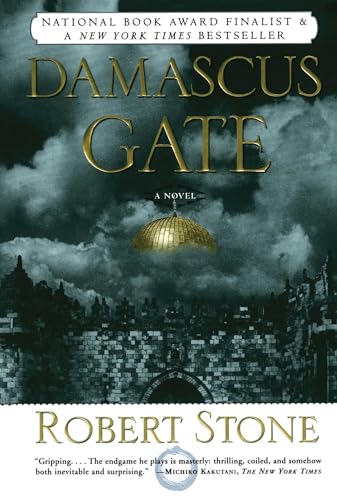
On the cusp of the millennium, Jerusalem has become a battleground in the race for redemption. American journalist Christopher Lucas is investigating religious fanatics when he discovers a plot to bomb the sacred Temple Mount. A violent confrontation in the Gaza Strip, a race through riot-filled streets, a cat-and-mouse game in an underground maze -- as Lucas follows his leads, he uncovers an attempt to seize political advantage that reveals duplicity and depravity on all sides of Jerusalem's sacred struggle.
Ambitious, passionate, darkly comic, Damascus Gate is not only Robert Stone's biggest and best novel to date, but a timely and brilliant story of belief, power, salvation, and apocalypse.
Die Inhaltsangabe kann sich auf eine andere Ausgabe dieses Titels beziehen.
Über die Autorin bzw. den Autor
Robert Stone is the author of A Flag for Sunrise, Children of Light, and Outerbridge Reach. He won the National Book Award for Dog Soldiers and the Faulkner Foundation Award for his first novel, A Hall of Mirrors. He lives with his wife in Connecticut.
Auszug. © Genehmigter Nachdruck. Alle Rechte vorbehalten.
Chapter One
Jerusalem, 1992
That morning Lucas was awakened by bells, sounding across the Shoulder of Hinnom from the Church of the Dormition. At first light there had been a muezzin's call in Silwan, insisting that prayer was better than sleep. The city was well supplied with divine services.
He climbed out of bed and went into the kitchen to brew Turkish coffee. As he stood at the window drinking it, the first train of the day rattled past, bound over the hills for Tel Aviv. It was a slow, decorous colonial train, five cars of nearly empty coaches with dusty windows. Its diminishing rhythms made him aware of his own solitude.
When the train was gone, he saw the old man who lived in one of the Ottoman houses beside the tracks watering a crop of kale in the early morning shade. The kale was deep green and fleshy against the limestone rubble from which it somehow grew. The old man wore a black peaked cap. He had high cheekbones and a ruddy face like a Slavic peasant's. The sight of him made Lucas imagine vast summer fields along which trains ran, long lines of gray boxcars against a far horizon. Once Lucas dreamed of him.
He had grapefruit and toast for breakfast and read the morning's Jerusalem Post. A border policeman had been stabbed in the Nuseirat camp in the Gaza Strip but was expected to recover. Three Palestinians had been shot to death by Shin Bet hit squads, one in Rafah, two in Gaza City. Haredim in Jerusalem had demonstrated against the Hebrew University's archeological dig near the Dung Gate; ancient Jewish burial sites were being uncovered. Jesse Jackson was threatening to organize a boycott against major league baseball. In India, Hindus and Muslims were fighting over a shrine that probably predated both of their religions. And, in a story from Yugoslavia, he saw again the phrase "ethnic cleansing." He had come across the evocative expression once or twice during the winter.
There was also a full-page story on the number of foreign pilgrims visiting the country for Passover and Western Holy Week. Lucas was surprised to find himself overtaken by the holidays.
He dressed and took a second cup of coffee out on his tiny balcony. The day was innocently glorious; spring sunlight scented the pines and sparkled on the stone walls of Emek Refaim. For weeks he had been postponing work on an article about the Sinai he had contracted to write for Condé Nast. The deadline had passed the previous Friday, and before long they would be phoning him for it. Still, the fine weather inclined him to truancy. When at last he went to his desk, his open appointment book confirmed the date: Easter Sunday in the Latin church and also the sixteenth of Nisan. Passover had arrived the day before. On a sudden impulse Lucas decided to go over to the Church of the Holy Sepulchre.
Bethlehem Road was nearly free of traffic. In spite of its elderly population, Lucas's neighborhood in the German Colony was the most secular in the city and its atmosphere was never one of piety. Old couples strolled in the spring sunshine. The day before, he had seen a few young families loading their Volvos for camping trips in the desert or the Galilee. But walking up the nearly deserted avenue, past the terraces of the Cinematheque, under the ramparts of the Church of Scotland Hospice adorned with its bonny blue flag, he could feel the gravity of the ancient city across the canyon. A hundred tour buses were parked in the streets under the Old City walls. At the distant Jaffa Gate, he could see the swaying forms of mounted policemen herding a pressing crowd of bright pilgrims. At the other end of the fortress, a line of devotees toiled single file up the slope to the Zion Gate.
He walked down into the shadow of the valley, over the bridge by the Sultan's Pool and past the Koranic verse carved in the shell of the Ottoman fountain. "All that is created comes of water," it read. Then, humbled by the looming walls, he trudged up the ascent to Zion.
On the path to Zion Gate, he walked mainly among Orthodox Jewish men in black, bound for the Western Wall. Some of the Jews tried to converse with each other as they climbed, scrambling along the shoulder to keep pace. Besides the haredim, there were a few German Catholics on the path because the Dormition Abbey above them was a German church. These pilgrims were of the era before Germans had become once again thin and handsome; many were florid and overweight, too bulkily dressed and perspiring freely. Yet they seemed happy. Most of the men looked plain and decent; they wore sodality pins and carried missals. Some of the women had sweet angelic faces. If they were sixty, Lucas calculated...born 1932, thirteen at the end of the war. He had picked up the habit of calculating Germans' ages from the Israelis.
It was a cheerful climb, with a smell of sage and jasmine on the wind and desiccated wildflowers underfoot and voices in Hebrew, Yiddish, German. The great walls reduced everyone, confounding all kingdoms. As he neared the ridge, the bells began again.
Following the file toward the gate, he thought of a prophecy, in a Midrash someone had related to him. At the End of Days, multitudes would try to cross the Valley of Hinnom to the holy city. Christians, traversing a bridge of stone, would fall to perdition. Muslims, on a wooden bridge, would follow them. Then the Jews would cross, glorified, on a bridge of gossamer. What about me, Lucas wondered, not for the first time.
The top of the trail was paved and provided for by the Jews of Canada. At its end, the mild children of wicked Edom and the pious men of Israel parted in sweet mutual oblivion, the Germans to their hugely unfortunate yellow abbey, the Jews toward the Western Wall. Lucas went his own way, north on Armenian Patriarchate Road. There he encountered more haredim headed for the Wall, putting the confusions of Easter behind them. In front of St. James's Cathedral, teenage Armenian acolytes were dressing their ranks for a Sunday procession.
On this conjunction of sacred seasons, the Jews and the Armenians in the crowded street pretended each other's invisibility without colliding. A half-caste apologizing his way through the crush, Lucas was visited by a notion: that only he could see both sects. That where only the unseen mattered, he was reduced to mere utility, to petty observations and staying out of the way.
Passing under an arch where tilesmiths kept shop, he stopped to examine the posters on the wall beside it. They were all in Armenian and many showed the picture of the new president of the Armenian republic. There were also pictures of armed guerrillas with rifles and bandoliers and black-bordered photographs of young martyrs, slain far away in the Azerbaijani war. It was the season of martyrdom in a banner year for martyrs.
In the main street of the Christian Quarter, a promiscuous babble of pilgrims hurried down the sloping cobbled pavement. One group of Japanese followed a sandaled Japanese friar who held a green pennant aloft. There was a party of Central American Indians of uniform size and shape who stared with blissful incomprehension into the unconvincing smiles of merchants offering knickknacks. There were Sicilian villagers and Boston Irish, Filipinos, more Germans, Breton women in native dress, Spaniards, Brazilians, Québecois.
Palestinian hustlers hissed suggestively, offering guidance. Lucas noticed that the Caravan Bar, his favorite beer joint in the Old City, was shuttered. He had heard something about threats. Cutting through the New Bazaar, he became aware of another closing. Above one of the embroidery shops there had been a loft that once sold not only brass pipes and nargilehs but excellent hashish to smoke in them. Now both shop and loft were derelict. Since the intifada, Lucas had taken to buying his hashish where the thin, handsome German...
„Über diesen Titel“ kann sich auf eine andere Ausgabe dieses Titels beziehen.
Suchergebnisse für Damascus Gate

Beispielbild für diese ISBN
Damascus Gate
Verlag:
Prentice Hall (a Pearson Education company), 1999
ISBN 10: 0684859114
ISBN 13: 9780684859118
Gebraucht
Paperback
Anbieter: World of Books (was SecondSale), Montgomery, IL, USA
Verkäuferbewertung 5 von 5 Sternen

Paperback. Zustand: Good. On the cusp of the millennium, Jerusalem has become a battleground in the race for redemption. American journalist Christopher Lucas is investigating religious fanatics when he discovers a plot to bomb the sacred Temple Mount. A violent confrontation in the Gaza Strip, a race through riot-filled streets, a cat-and-mouse game in an underground maze -- as Lucas follows his leads, he uncovers an attempt to seize political advantage that reveals duplicity and depravity on all sides of Jerusalem's sacred struggle. Ambitious, passionate, darkly comic, Damascus Gate is not only Robert Stone's biggest and best novel to date, but a timely and brilliant story of belief, power, salvation, and apocalypse. Bestandsnummer des Verkäufers 00020748519
Gebraucht kaufen
EUR 4,69
Versand gratis
Versand innerhalb von USA
Versand innerhalb von USA
Anzahl: Mehr als 20 verfügbar
Beispielbild für diese ISBN
Damascus Gate
Verlag:
Prentice Hall (a Pearson Education company), 1999
ISBN 10: 0684859114
ISBN 13: 9780684859118
Gebraucht
Paperback
Anbieter: World of Books (was SecondSale), Montgomery, IL, USA
Verkäuferbewertung 5 von 5 Sternen
Paperback. Zustand: Fair. On the cusp of the millennium, Jerusalem has become a battleground in the race for redemption. American journalist Christopher Lucas is investigating religious fanatics when he discovers a plot to bomb the sacred Temple Mount. A violent confrontation in the Gaza Strip, a race through riot-filled streets, a cat-and-mouse game in an underground maze -- as Lucas follows his leads, he uncovers an attempt to seize political advantage that reveals duplicity and depravity on all sides of Jerusalem's sacred struggle. Ambitious, passionate, darkly comic, Damascus Gate is not only Robert Stone's biggest and best novel to date, but a timely and brilliant story of belief, power, salvation, and apocalypse. Bestandsnummer des Verkäufers 00094218223
Gebraucht kaufen
EUR 4,69
Versand gratis
Versand innerhalb von USA
Versand innerhalb von USA
Anzahl: 10 verfügbar
Beispielbild für diese ISBN
Damascus Gate
Anbieter: Orion Tech, Kingwood, TX, USA
Verkäuferbewertung 5 von 5 Sternen
paperback. Zustand: Very Good. Bestandsnummer des Verkäufers 0684859114-2-36826376
Gebraucht kaufen
EUR 4,70
Versand gratis
Versand innerhalb von USA
Versand innerhalb von USA
Anzahl: 1 verfügbar
Foto des Verkäufers
Damascus Gate
Anbieter: Greenworld Books, Arlington, TX, USA
Verkäuferbewertung 5 von 5 Sternen
Zustand: very_good. Fast Free Shipping â" Very Good condition book with a firm cover and clean pages. Shows normal use and some light wear or limited notes markings. A solid, nice copy to enjoy. Bestandsnummer des Verkäufers GWV.0684859114.VG
Gebraucht kaufen
EUR 4,71
Versand gratis
Versand innerhalb von USA
Versand innerhalb von USA
Anzahl: 2 verfügbar
Foto des Verkäufers
Damascus Gate
Anbieter: ZBK Books, Carlstadt, NJ, USA
Verkäuferbewertung 5 von 5 Sternen
Zustand: very_good. Fast & Free Shipping â" Very Good condition book with a firm cover and clean pages. Shows normal use and some light wear or limited notes markings. A solid, nice copy to enjoy. Bestandsnummer des Verkäufers ZWV.0684859114.VG
Gebraucht kaufen
EUR 4,71
Versand gratis
Versand innerhalb von USA
Versand innerhalb von USA
Anzahl: 1 verfügbar
Beispielbild für diese ISBN
Damascus Gate
Anbieter: More Than Words, Waltham, MA, USA
Verkäuferbewertung 5 von 5 Sternen
Zustand: Good. A sound copy with only light wear. Overall a solid copy at a great price! Bestandsnummer des Verkäufers BOS-B-08h-01655
Gebraucht kaufen
EUR 1,16
EUR 3,57 Versand
Versand innerhalb von USA
Versand innerhalb von USA
Anzahl: 4 verfügbar
Beispielbild für diese ISBN
Damascus Gate
Anbieter: Gulf Coast Books, Cypress, TX, USA
Verkäuferbewertung 5 von 5 Sternen
Paperback. Zustand: As New. Bestandsnummer des Verkäufers 0684859114-1-19100229
Gebraucht kaufen
EUR 4,93
Versand gratis
Versand innerhalb von USA
Versand innerhalb von USA
Anzahl: 1 verfügbar
Beispielbild für diese ISBN
Damascus Gate
Verlag:
Simon & Schuster, New York, 1999
ISBN 10: 0684859114
ISBN 13: 9780684859118
Gebraucht
Trade Paperback
Anbieter: Faith In Print, Cumming, GA, USA
Verkäuferbewertung 5 von 5 Sternen
Trade Paperback. Zustand: Good. No Jacket. good clean flat paperback with only very light overall wear. pages clean and unmarked. price sticker on back cover. Bestandsnummer des Verkäufers 020862
Gebraucht kaufen
EUR 1,83
EUR 3,13 Versand
Versand innerhalb von USA
Versand innerhalb von USA
Anzahl: 1 verfügbar
Beispielbild für diese ISBN
Damascus Gate
Verlag:
Touchstone (edition Reprint), 1999
ISBN 10: 0684859114
ISBN 13: 9780684859118
Gebraucht
Paperback
Anbieter: BooksRun, Philadelphia, PA, USA
Verkäuferbewertung 5 von 5 Sternen
Paperback. Zustand: Fair. Reprint. The item might be beaten up but readable. May contain markings or highlighting, as well as stains, bent corners, or any other major defect, but the text is not obscured in any way. Bestandsnummer des Verkäufers 0684859114-7-1
Gebraucht kaufen
EUR 4,98
Versand gratis
Versand innerhalb von USA
Versand innerhalb von USA
Anzahl: 2 verfügbar
Beispielbild für diese ISBN
Damascus Gate
Anbieter: Evergreen Goodwill, Seattle, WA, USA
Verkäuferbewertung 5 von 5 Sternen
paperback. Zustand: Good. Bestandsnummer des Verkäufers mon0000768131
Gebraucht kaufen
EUR 1,52
EUR 3,57 Versand
Versand innerhalb von USA
Versand innerhalb von USA
Anzahl: 2 verfügbar