
Verwandte Artikel zu 2 Corinthians (Abingdon New Testament Commentaries):...
2 Corinthians (Abingdon New Testament Commentaries): Second Corinthians - Softcover
Buch 2 von 20: Abingdon New Testament Commentaries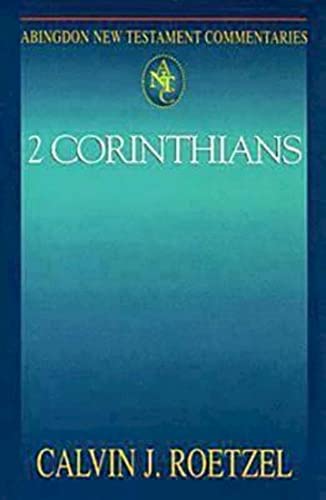
Inhaltsangabe
From the second century to the present, 2 Corinthians offers its riches grudgingly, if at all; and even then it demands only the most careful and attentive inquiries.
Die Inhaltsangabe kann sich auf eine andere Ausgabe dieses Titels beziehen.
Über die Autorin bzw. den Autor
Sundet Professor of New Testament and Christian Studies, Department of Classical & Near Eastern Studies, College of Liberal Arts, University of Minnesota-Twin Cities
Auszug. © Genehmigter Nachdruck. Alle Rechte vorbehalten.
Abingdon New Testament Commentaries: 2 Corinthians
By Calvin J. RoetzelAbingdon Press
Copyright © 2007 Abingdon Press
All rights reserved.
ISBN: 978-0-687-05677-4All rights reserved.
Contents
Foreword,
Preface,
List of Abbreviations,
Introduction,
Commentary,
Select Bibliography,
Scripture Index,
Subject Index,
CHAPTER 1
Commentary
A Letter of Appeal for the Offering (8:1-24)
Introduction
Before Paul responded in an earlier letter to Corinthian questions about the offering (1 Cor 16:1-11), there was a long prehistory. Already in Gal 2:1, 2, and 6-10, Paul wrote of an agreement he made with the Jerusalem apostles to promote the offering for the Jerusalem "poor." In exchange for the endorsement of his Gentile mission by the "pillar apostles" (Peter, James, and John), Paul eagerly agreed to "remember the poor" in Jerusalem (Gal 2:10). More than a quid pro quo, this gesture had a strong eschatological warrant from the prophets who envisioned a procession of Gentiles with offerings brought and confessions made to Israel's God in the last days. Paul obviously saw in the conversion of Gentiles to the Jesus movement and their reception of the spirit being poured out on all flesh (Joel 2:28-29) a premonitory sign of the approaching end when Jew and Gentile would be gathered together as Abraham's children.
Since the Corinthians certainly knew about the offering, Paul hardly needed to describe or defend the project in his earlier letter (1 Cor 16:1-11). Nevertheless, his subsequent push to complete the project begun "last year" hints that the Corinthians were lukewarm and dilatory about the effort (2 Cor 8:10-11; Hurd 1965, 202). Their tepid response moved Paul to lay out a strategy for its completion. Embedded in this strategy was much more than a relief effort, though it was that; it was a witness to God's reconciling action that is either stated or implied throughout 2 Corinthians. Each Sunday they were to set aside what they could so that when he arrived a sizeable token would be ready (1 Cor 16:1-3).
His vigorous promotion of the collection, however, raised eyebrows. Being victimized by scam artists dressed up as teachers, the mostly poor Corinthians were rightfully suspicious. Might Paul be just another huckster breezing into town, collecting money for "the poor among the saints" hundreds of miles away in Jerusalem, and then lining his own pockets with ill-gotten gain? Did they suspect Paul of duplicity as he, on the one hand, refused their support with a claim to high-minded self-sufficiency while, on the other hand, was taking money from the Philippian church (Phil 4:15, 16, 19)? Were they simply insulted that he would accept gifts from Macedonia but refuse them from Corinth? The sting of those allegations lingered and provoked Paul's defiant defense of his integrity (1 Cor 9:3-17). With the later dispatch of Titus and "the brother who is famous among all the churches" to complete the offering, he hoped to fend off criticism and suspicion (2 Cor 8:16-19): "We intend that no one should blame us about this generous gift that we are administering, for we intend to do what is right not only in the Lord's sight but also in the sight of others" (2 Cor 8:20-21). When that effort failed, he still later protested vehemently: "Let it be assumed that I did not burden you. Nevertheless (you say) since I was crafty, I took you in by deceit" (2 Cor 12:16).
Paul invested so much energy and spiritual capital in the promotion of the offering because it carried such profound eschatological, symbolic, and social significance. In Romans 15:16, which closely followed 2 Corinthians 9, Paul invoked a classic priestly metaphor to describe the presentation of the "offering of the Gentiles" as "a priestly service of the gospel." While Paul nowhere appeals to Isaiah or Micah, as he might have done, as a warrant for this trip to Jerusalem as an eschatological pilgrimage of Gentiles, his characterization of this project as the "offering of the Gentiles" (Rom 15:16) is alive with scriptural overtones (Rom 15:9-12 echoing Ps 18:49; Deut 32:43; Ps 117, and Isa 2:2–3; 45:14; 60:5-7, 10-14; 11:10 and 52:15; Mic 4:1-2, 13). These passages invoke an eschatological drama whose scope and implications are breathtaking. As the axis mundi and core symbol of the religion of Israel, Jerusalem would open her gates to welcome a continuous procession of kings professing obeisance to Yahweh and pledging their ministrations. The Jesus people, Paul claimed, stood on the cusp of this grand eschatological reversal and joyous celebration. That time was pregnant with dread and possibility and inspired a revolutionary vision of a partnership and reciprocity between Jewish and Gentile followers of Jesus.
While the socio-economic dimension of this effort is clear, that alone hardly explains why the exclusive focus of this offering was the poor among the saints in Jerusalem. Most urban centers harbored significant numbers of poor, even desperately poor folk. These stark realities doubtless leapt out at Paul at every step along the way. While presumably a significant number of the Jesus people in Jerusalem were impoverished, it was the combination of their need and the apocalyptic vision of the gathering of God's people that suffused the offering with symbolic power and offered a dramatic sign of the arrival of the new age when believing Gentiles would be welcomed into God's elect, and Jew and Gentile would be placed on an equal footing.
An Appeal for Generosity (8:1-15)
When Paul penned or dictated 2 Cor 8 he opened it with a traditional salutation to open the door to the conversation to follow. Originally, it might have run something like, "Paul, an apostle of Christ Jesus by the will of God, and Timothy and Silvanus, our brothers, to the assembly of God which is in Corinth: Grace to you and peace from God our father and the Lord Jesus Christ." Though one of the most stable elements of the letter, Paul always adapted it to fit his purpose for writing.
In all cases except Galatians a thanksgiving or blessing followed that alerted the addressees to the purpose of the letter and the key issues it would address. This precursor of the letter's agenda might have read, "I thank God always for the gifts of grace (charis) you have received from God in Jesus Christ, am thankful for your partnership in the gospel and your labors of love, and am persuaded that every gracious work begun in you will come to completion on the day of the Lord Jesus." The thanksgiving most often is positive and offers an ideal construction of their gifts and graces that may be in question. In the immediately preceding 1 Corinthians, for example, Paul thanks God that the Corinthians have been enriched in speech and knowledge (1 Cor 1:5-6), but later corrects expressions of those gifts that are sharply divisive. In this letter also the thanksgiving would have expressed not only praise for their gifts but also in that praise was implicit a fervent expectation that the Corinthians would complete the languishing offering project.
Since Paul's letters would only decades later be recognized as scriptural, a later editor who faced new challenges would have been free to excise these traditional epistolary elements to fit chapter 8 into the larger letter construct we know as 2 Corinthians. According to this admittedly hypothetical construction, what remains is the body of the letter transmitting Paul's request, his commendation of Titus and the "brothers," and his supporting exhortations.
Paul opens the letter with an appeal to the...
„Über diesen Titel“ kann sich auf eine andere Ausgabe dieses Titels beziehen.
Suchergebnisse für 2 Corinthians (Abingdon New Testament Commentaries):...

Beispielbild für diese ISBN
Abingdon New Testament Commentaries: 2 Corinthians
Anbieter: HPB-Red, Dallas, TX, USA
Verkäuferbewertung 5 von 5 Sternen

paperback. Zustand: Good. Connecting readers with great books since 1972! Used textbooks may not include companion materials such as access codes, etc. May have some wear or writing/highlighting. We ship orders daily and Customer Service is our top priority! Bestandsnummer des Verkäufers S_402174388
Gebraucht kaufen
EUR 14,67
EUR 3,35 Versand
Versand innerhalb von USA
Versand innerhalb von USA
Anzahl: 1 verfügbar
Beispielbild für diese ISBN
Second Corinthians: Second Corinthians
Anbieter: World of Books (was SecondSale), Montgomery, IL, USA
Verkäuferbewertung 5 von 5 Sternen
Paperback. Zustand: Very Good. From the second century to the present, 2 Corinthians offers its riches grudgingly,if at all; and even then it demands only the most careful and attentive inquiries.The Abingdon New Testament Commentaries series provides compact, critical commentaries on the writings of the New Testament. These commentaries are written with special attention to the needs and interests of theological students, but they will also be useful for students in upper-level college or university settings, as well as for pastors and other religious leaders. In addition to providing basic information about the New Testament texts and insights into their meanings, these commentaries are intended to exemplify the tasks and procedures of careful, critical biblical exegesis."2 Corinthians is a treasure hidden in a thorny thicket. It is so rich, so full of theological insight, so packed with hope and possibility, so aware of dark human tendencies and human vulnerability, and so radical in its reevaluation of what is true and real." From the Introduction. Bestandsnummer des Verkäufers 00099496592
Gebraucht kaufen
EUR 18,11
Versand gratis
Versand innerhalb von USA
Versand innerhalb von USA
Anzahl: 1 verfügbar
Beispielbild für diese ISBN
Second Corinthians: Second Corinthians
Anbieter: World of Books Inc, Montgomery, IL, USA
Verkäuferbewertung 4 von 5 Sternen

Paperback. Zustand: Very Good. From the second century to the present, 2 Corinthians offers its riches grudgingly,if at all; and even then it demands only the most careful and attentive inquiries.The Abingdon New Testament Commentaries series provides compact, critical commentaries on the writings of the New Testament. These commentaries are written with special attention to the needs and interests of theological students, but they will also be useful for students in upper-level college or university settings, as well as for pastors and other religious leaders. In addition to providing basic information about the New Testament texts and insights into their meanings, these commentaries are intended to exemplify the tasks and procedures of careful, critical biblical exegesis."2 Corinthians is a treasure hidden in a thorny thicket. It is so rich, so full of theological insight, so packed with hope and possibility, so aware of dark human tendencies and human vulnerability, and so radical in its reevaluation of what is true and real." From the Introduction. Bestandsnummer des Verkäufers CIN0687056772VG
Gebraucht kaufen
EUR 19,95
Versand gratis
Versand innerhalb von USA
Versand innerhalb von USA
Anzahl: 1 verfügbar
Beispielbild für diese ISBN
2 Corinthians (Abingdon New Testament Commentaries)
Anbieter: Lakeside Books, Benton Harbor, MI, USA
Verkäuferbewertung 5 von 5 Sternen
Zustand: New. Brand New! Not Overstocks or Low Quality Book Club Editions! Direct From the Publisher! We're not a giant, faceless warehouse organization! We're a small town bookstore that loves books and loves it's customers! Buy from Lakeside Books! Bestandsnummer des Verkäufers OTF-Y-9780687056774
Neu kaufen
EUR 17,98
EUR 3,56 Versand
Versand innerhalb von USA
Versand innerhalb von USA
Anzahl: Mehr als 20 verfügbar
Foto des Verkäufers
2 Corinthians
Anbieter: GreatBookPrices, Columbia, MD, USA
Verkäuferbewertung 5 von 5 Sternen
Zustand: New. Bestandsnummer des Verkäufers 1768772-n
Neu kaufen
EUR 19,21
EUR 2,36 Versand
Versand innerhalb von USA
Versand innerhalb von USA
Anzahl: Mehr als 20 verfügbar
Foto des Verkäufers
2 Corinthians (Paperback or Softback)
Verlag:
Abingdon Press 10/1/2007, 2007
ISBN 10: 0687056772
ISBN 13: 9780687056774
Neu
Paperback or Softback
Anbieter: BargainBookStores, Grand Rapids, MI, USA
Verkäuferbewertung 5 von 5 Sternen
Paperback or Softback. Zustand: New. 2 Corinthians. Book. Bestandsnummer des Verkäufers BBS-9780687056774
Foto des Verkäufers
2 Corinthians
Anbieter: GreatBookPrices, Columbia, MD, USA
Verkäuferbewertung 5 von 5 Sternen
Zustand: As New. Unread book in perfect condition. Bestandsnummer des Verkäufers 1768772
Gebraucht kaufen
EUR 22,32
EUR 2,36 Versand
Versand innerhalb von USA
Versand innerhalb von USA
Anzahl: Mehr als 20 verfügbar
Foto des Verkäufers
Second Corinthians
Anbieter: Rarewaves.com USA, London, LONDO, Vereinigtes Königreich
Verkäuferbewertung 5 von 5 Sternen
Paperback. Zustand: New. Bestandsnummer des Verkäufers LU-9780687056774
Neu kaufen
EUR 26,87
Versand gratis
Versand von Vereinigtes Königreich nach USA
Versand von Vereinigtes Königreich nach USA
Anzahl: Mehr als 20 verfügbar
Beispielbild für diese ISBN
2 Corinthians
Print-on-DemandAnbieter: Chiron Media, Wallingford, Vereinigtes Königreich
Verkäuferbewertung 5 von 5 Sternen
PF. Zustand: New. This item is printed on demand. Brand new book, sourced directly from publisher. Dispatch time is 6-7 days from our warehouse. Book will be sent in robust, secure packaging to ensure it reaches you securely. Bestandsnummer des Verkäufers 6666-IUK-9780687056774
Neu kaufen
EUR 21,53
EUR 5,36 Versand
Versand von Vereinigtes Königreich nach USA
Versand von Vereinigtes Königreich nach USA
Anzahl: 20 verfügbar
Beispielbild für diese ISBN
Abingdon New Testament Commentaries: 2 Corinthians
Print-on-DemandAnbieter: PBShop.store US, Wood Dale, IL, USA
Verkäuferbewertung 5 von 5 Sternen
PAP. Zustand: New. New Book. Shipped from UK. THIS BOOK IS PRINTED ON DEMAND. Established seller since 2000. Bestandsnummer des Verkäufers L0-9780687056774
Neu kaufen
EUR 27,04
Versand gratis
Versand innerhalb von USA
Versand innerhalb von USA
Anzahl: Mehr als 20 verfügbar