
Verwandte Artikel zu Ethics Systematic Theology Vol. 1: Ethics (Revised...
Ethics Systematic Theology Vol. 1: Ethics (Revised Edition) (Systematic Theology (Abingdon), Band 1) - Softcover
Inhaltsangabe
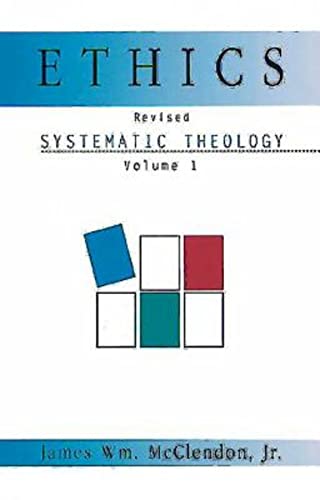
When it first appeared in 1986, James McClendon's Ethics laid claim to two compelling theological ideas. First, that a highly distinctive theological perspective characterizes the inheritors of the sixteenth century's radical reformation. At the heart of this perspective is what McClendon calls the baptist vision, a way of understanding the gospel that emphasizes the church's distinction from the world, and its continuity with the church of the New Testament. Second, that because of its emphasis on the centrality of discipleship, this radical-reformation outlook insists that theology's first task is to discover and explore the shape of the church's common life as the body of Christ; hence McClendon's novel decision to begin the task of writing a systematic theology with a volume on ethics. Since its first publication, Ethics has been followed by Doctrine (1994) and Witness (2000). The completion of the overall work has brought into sharper focus many of the theological and ethical issues and concerns central to the baptist tradition. In this revised edition of Ethics, McClendon infuses his claim for the priority of ethics within the theological task with a new urgency, born of the fuller, more complete definition of the baptist vision that Doctrine and Witness have made possible. Ethics is central, he reminds us, because biblical faith rests on a set of distinctive practices that arise from our placement within a larger Christian story. In his revisions McClendon offers a more complete explanation of how the interaction of faithful practices and gospel story give rise to a way of life that is distinctively Christian.
Die Inhaltsangabe kann sich auf eine andere Ausgabe dieses Titels beziehen.
Über die Autorin bzw. den Autor
James McClendon, Jr. was Distinguished Scholar in Residence, Fuller Theological Seminary, Pasadena, California. He passed away in October of 2000.
Auszug. © Genehmigter Nachdruck. Alle Rechte vorbehalten.
Ethics
Systematic Theology
By James WM. Mcclendon Jr.Abingdon Press
Copyright © 2002 Abingdon Press
All rights reserved.
ISBN: 978-0-687-09087-7All rights reserved.
Contents
PROSPECT,
CHAPTER ONE HOW THEOLOGY MATTERS,
CHAPTER TWO WHAT SORT OF ETHICS?,
PART I: EMBODIED WITNESS,
Introduction to Part I,
CHAPTER THREE BODY ETHICS,
CHAPTER FOURSARAH AND JONATHAN EDWARDS,
CHAPTER FIVEEROS—TOWARD AN ETHIC OF SEXUAL LOVE,
PART II: A COMMUNITY OF CARE,
Introduction to Part II,
CHAPTER SIX SOCIAL ETHICS AND CHRISTIAN COMMUNITY,
CHAPTER SEVEN DIETRICH BONHOEFFER,
CHAPTER EIGHT THE POLITICS OF FORGIVENESS,
PART III: THE SPHERE OF THE ANASTATIC,
CHAPTER NINERESURRECTION ETHICS,
CHAPTER TEN DOROTHY DAY,
CHAPTER ELEVEN A FUTURE FOR PEACE?,
RETROSPECT,
CHAPTER TWELVE WHY NARRATIVE ETHICS?,
BIBLIOGRAPHY OF CLASSICAL AND OFTEN-CITED WORKS,
BIBLIOGRAPHY OF OTHER WORKS CITED,
INDEX OF NAMES AND TOPICS,
BIBLICAL INDEX,
CHAPTER 1
How Theology Matters
Theology means struggle. It may begin as Bonhoeffer said in silence, but when the silence is broken, a battle begins. This seems regrettable; in matters of great moment, the human heart yearns ceaselessly for secure truth, and it is easy for us to believe that unchallenged beliefs are self-evident truths. A little reflection, however, will show that this is not so; in fact we very often have believed without doubt or contradiction what turn out to be mere falsehoods. (It is small enough comfort to know that other people do the same.) Thus when we set out upon Christian theology or ethics we must be reconciled to the fact that here as elsewhere hard truth is not available without hard struggles.
The struggle begins with the humble fact that the church is not the world. This means that Christians face an interior struggle, inasmuch as the line between church and world passes right through each Christian heart. It nevertheless means that the standpoint, the basic point of view, the theology of the church is not the standpoint, basic point of view, theology of the world. The church's story will not interpret the world to the world's satisfaction. Hence there is a temptation (no weaker word will do) for the church to deny her "counter, original, spare, strange" starting point in Abraham and Jesus and to give instead a self-account or theology that will seem true to the world on the world's own terms. Surely, this temptation murmurs, the salvation of the world must rest on some better foundation than tales about an ancient nomad and stories of a Jewish healer? The strength of this worldly appeal lies in its claim to the universal—an appeal which faith must also make in its own way. The vice in the world's approach to universal truth is that it abandons the truth available to Christians, which is that the church is not the world, its story not the world's accepted story, its theology not the world's theology. If we yield this point, conspiring to conceal the difference between church and world, we may in the short run entice the world, but we will do so only by betraying the church.
A second humble fact is that Christianity itself is not one congruent whole. If the world is divided, so is the church. Who can recite the great unity passages such as Ephesians 4:5, "One Lord, one faith, one baptism," without being reminded of the historical reality: A thousand warring sects, schism and heresy, division and excommunication, all justified in the name of the aforesaid one Lord. And if someone sees in this variety and struggle no great scandal but instead a healthy living diversity of religion; or if someone claims to see here and there in the diversity some true Christian essence now and again appearing; or if someone claims by whatever means to discern amidst the variety some true path of historic faithfulness, some True Church, with other paths relegated to heterodoxy; or if someone sees the great variety of ways grouped according to a few main types, each bearing witness to a part of the Christian truth but no type witnessing to all the truth—in each case the main difficulty remains. A divided Christianity yields divided theologies. Friedrich Schleiermacher (1768–1834), whose systematic approach to theology entitles him to the role of father of modern theology, argued that any given theology must represent and refer to the doctrine of some particular Christian body at some particular time. (It fell to successors more modern but less theological than Schleiermacher to abstract from church to individual, making theology mere organized subjectivity.) He said that since there was in his day no "systematic connection" between Catholic and Protestant doctrine, a theology could not be Christian in general, but must in the West be either Catholic or Protestant (Schleiermacher, CF §19).
Some might hope that Schleiermacher was wrong and that theology today has overcome denominational barriers. Yet the facts now (and then) are even more complex than he said. For example, there is Eastern Orthodoxy, maintaining a traditional life nearly two millennia old, with a rich theology of image and mystery remote from the understanding of the West, though some Westerners imagine they find in it a perfect fit. Then there is the Anglican tradition, claiming to be both Catholic and Protestant. And there are the younger churches in mission lands, propagated or cross-bred from earlier communions in fertile cultural environments that make in each case their own living contribution to these theologies. Arthur Piepkorn in his massive four-volume survey of religious bodies (1977– 79) counted at that time more than five hundred "bodies" or denominations of Christians in the United States and Canada alone!
Yet of these five hundred bodies nearly one hundred, according to Piepkorn, are "Churches with origins in the Radical Reformation," while almost 300 more are Holiness and Pentecostal, Evangelical and Fundamentalist bodies—many of which have roots in that same radical soil. This statistic may underline the schismatic tendency of these strains of church life, but it also underlines the difficulty of the theological task—shall there be close to four hundred different theologies for these alone in each theological generation? Surely, though, what Schleiermacher had in mind by distinct "churches" was more nearly akin to Piepkorn's broad divisions, such as "Lutheran Churches," "Reformed and Presbyterian Churches," and (of special interest here) "the Churches of the Radical Reformation." A Christian theology, we may say provisionally, must have a community of reference that cannot without confusion be subsumed under some more general ecclesial type; it must be Orthodox or Protestant or Catholic or the like. Historical scholarship since Schleiermacher's day has made it certain that the Christian bodies of the Radical Reformation do in fact constitute such a distinctive type. At the center of the Radical Reformation—a term made familiar by George H. Williams (1992)—are the Wiedertäufer (Anabaptists, i.e., those who it was said "illegitimately repeated" baptism), or, as they preferred to say, brethren, or Täufer (in standard English, simply baptists). My project will be especially related to this baptist focus of Christian life. Others have with reason named this community of reference the "Free Church" (Littell, 1952; Westin, 1954), or the "Believers' Church" (Durnbaugh, 1968; Garrett, ed., 1969), or the "Left Wing" of...
„Über diesen Titel“ kann sich auf eine andere Ausgabe dieses Titels beziehen.
Suchergebnisse für Ethics Systematic Theology Vol. 1: Ethics (Revised...

Beispielbild für diese ISBN
Systematic Theol Vol 1: Ethics (Rev)
Anbieter: World of Books (was SecondSale), Montgomery, IL, USA
Verkäuferbewertung 5 von 5 Sternen

Paperback. Zustand: Good. When it first appeared in 1986, James McClendon's Ethics laid claim to two compelling theological ideas. First, that a highly distinctive theological perspective characterizes the inheritors of the sixteenth century's radical reformation. At the heart of this perspective is what McClendon calls the baptist vision, a way of understanding the gospel that emphasizes the church's distinction from the world, and its continuity with the church of the New Testament. Second, that because of its emphasis on the centrality of discipleship, this radical-reformation outlook insists that theology's first task is to discover and explore the shape of the church's common life as the body of Christ; hence McClendon's novel decision to begin the task of writing a systematic theology with a volume on ethics. Since its first publication, Ethics has been followed by Doctrine (1994) and Witness (2000). The completion of the overall work has brought into sharper focus many of the theological and ethical issues and concerns central to the baptist tradition. In this revised edition of Ethics, McClendon infuses his claim for the priority of ethics within the theological task with a new urgency, born of the fuller, more complete definition of the baptist vision that Doctrine and Witness have made possible. Ethics is central, he reminds us, because biblical faith rests on a set of distinctive practices that arise from our placement within a larger Christian story. In his revisions McClendon offers a more complete explanation of how the interaction of faithful practices and gospel story give rise to a way of life that is distinctively Christian. Bestandsnummer des Verkäufers 00107173970
Gebraucht kaufen
EUR 4,58
Versand gratis
Versand innerhalb von USA
Versand innerhalb von USA
Anzahl: 2 verfügbar
Foto des Verkäufers
Systematic Theology, Vol. 1: Ethics
Anbieter: -OnTimeBooks-, Phoenix, AZ, USA
Verkäuferbewertung 5 von 5 Sternen
Zustand: good. A copy that has been read, remains in good condition. All pages are intact, and the cover is intact. The spine and cover show signs of wear. Pages can include notes and highlighting and show signs of wear, and the copy can include "From the library of" labels or previous owner inscriptions. 100% GUARANTEE! Shipped with delivery confirmation, if you're not satisfied with purchase please return item! Ships via media mail. Bestandsnummer des Verkäufers OTV.0687090873.G
Gebraucht kaufen
EUR 6,42
Versand gratis
Versand innerhalb von USA
Versand innerhalb von USA
Anzahl: 1 verfügbar
Beispielbild für diese ISBN
Systematic Theol Vol 1: Ethics (Rev)
Anbieter: World of Books Inc, Montgomery, IL, USA
Verkäuferbewertung 4 von 5 Sternen

Paperback. Zustand: Good. When it first appeared in 1986, James McClendon's Ethics laid claim to two compelling theological ideas. First, that a highly distinctive theological perspective characterizes the inheritors of the sixteenth century's radical reformation. At the heart of this perspective is what McClendon calls the baptist vision, a way of understanding the gospel that emphasizes the church's distinction from the world, and its continuity with the church of the New Testament. Second, that because of its emphasis on the centrality of discipleship, this radical-reformation outlook insists that theology's first task is to discover and explore the shape of the church's common life as the body of Christ; hence McClendon's novel decision to begin the task of writing a systematic theology with a volume on ethics. Since its first publication, Ethics has been followed by Doctrine (1994) and Witness (2000). The completion of the overall work has brought into sharper focus many of the theological and ethical issues and concerns central to the baptist tradition. In this revised edition of Ethics, McClendon infuses his claim for the priority of ethics within the theological task with a new urgency, born of the fuller, more complete definition of the baptist vision that Doctrine and Witness have made possible. Ethics is central, he reminds us, because biblical faith rests on a set of distinctive practices that arise from our placement within a larger Christian story. In his revisions McClendon offers a more complete explanation of how the interaction of faithful practices and gospel story give rise to a way of life that is distinctively Christian. Bestandsnummer des Verkäufers CIN0687090873G
Gebraucht kaufen
EUR 6,42
Versand gratis
Versand innerhalb von USA
Versand innerhalb von USA
Anzahl: 2 verfügbar
Foto des Verkäufers
Systematic Theology, Vol. 1: Ethics
Anbieter: clickgoodwillbooks, Indianapolis, IN, USA
Verkäuferbewertung 4 von 5 Sternen
Zustand: acceptable. Used - Acceptable: All pages and the cover are intact, but shrink wrap, dust covers, or boxed set case may be missing. Pages may include limited notes, highlighting, or minor water damage but the text is readable. Item may be missing bundled media. Bestandsnummer des Verkäufers CSIV.0687090873.A
Gebraucht kaufen
EUR 3,66
EUR 3,56 Versand
Versand innerhalb von USA
Versand innerhalb von USA
Anzahl: 1 verfügbar
Beispielbild für diese ISBN
Ethics: Systematic Theology Volume 1, Revised
Anbieter: ThriftBooks-Dallas, Dallas, TX, USA
Verkäuferbewertung 5 von 5 Sternen
Paperback. Zustand: Very Good. No Jacket. May have limited writing in cover pages. Pages are unmarked. ~ ThriftBooks: Read More, Spend Less. Bestandsnummer des Verkäufers G0687090873I4N00
Gebraucht kaufen
EUR 7,32
Versand gratis
Versand innerhalb von USA
Versand innerhalb von USA
Anzahl: 1 verfügbar
Beispielbild für diese ISBN
Systematic Theology, Vol. 1: Ethics
Anbieter: HPB-Red, Dallas, TX, USA
Verkäuferbewertung 5 von 5 Sternen
paperback. Zustand: Acceptable. Connecting readers with great books since 1972. Used textbooks may not include companion materials such as access codes, etc. May have condition issues including wear and notes/highlighting. We ship orders daily and Customer Service is our top priority! Bestandsnummer des Verkäufers S_454100074
Gebraucht kaufen
EUR 4,59
EUR 3,34 Versand
Versand innerhalb von USA
Versand innerhalb von USA
Anzahl: 1 verfügbar
Foto des Verkäufers
Systematic Theology, Vol. 1: Ethics
Anbieter: Gate City Books, GREENSBORO, NC, USA
Verkäuferbewertung 5 von 5 Sternen
Zustand: acceptable. USED book in ACCEPTABLE condition. Cover and pages are in tact but may show creases, tears, water damage, handwriting, underlining, or highlighting. May be missing dust jacket. Supplemental items such as access codes and CDs not guaranteed. Bestandsnummer des Verkäufers GCM.3T2V
Gebraucht kaufen
EUR 19,07
Versand gratis
Versand innerhalb von USA
Versand innerhalb von USA
Anzahl: 1 verfügbar
Beispielbild für diese ISBN
Systematic Theology, Vol. 1: Ethics
Anbieter: Lakeside Books, Benton Harbor, MI, USA
Verkäuferbewertung 5 von 5 Sternen
Zustand: New. Brand New! Not Overstocks or Low Quality Book Club Editions! Direct From the Publisher! We're not a giant, faceless warehouse organization! We're a small town bookstore that loves books and loves it's customers! Buy from Lakeside Books! Bestandsnummer des Verkäufers OTF-S-9780687090877
Neu kaufen
EUR 30,01
EUR 3,56 Versand
Versand innerhalb von USA
Versand innerhalb von USA
Anzahl: Mehr als 20 verfügbar
Beispielbild für diese ISBN
Ethics : Systematic Theology
Anbieter: GreatBookPrices, Columbia, MD, USA
Verkäuferbewertung 5 von 5 Sternen
Zustand: New. Bestandsnummer des Verkäufers 737437-n
Neu kaufen
EUR 31,24
EUR 2,35 Versand
Versand innerhalb von USA
Versand innerhalb von USA
Anzahl: Mehr als 20 verfügbar
Beispielbild für diese ISBN
Systematic Theology, Vol. 1: Ethics
Anbieter: MyLibraryMarket, Waynesville, OH, USA
Verkäuferbewertung 5 von 5 Sternen
paperback. Zustand: As New. 2nd. ***Please Read*** No marks on text - My shelf location BN7-B-41. Bestandsnummer des Verkäufers 250220008
Gebraucht kaufen
EUR 29,39
EUR 4,90 Versand
Versand innerhalb von USA
Versand innerhalb von USA
Anzahl: 1 verfügbar