Convex Analysis (Princeton Landmarks in Mathematics and Physics): (PMS-28) (Princeton Mathematical Series, 28) - Softcover
Buch 4 von 12: Princeton Landmarks in Mathematics and Physics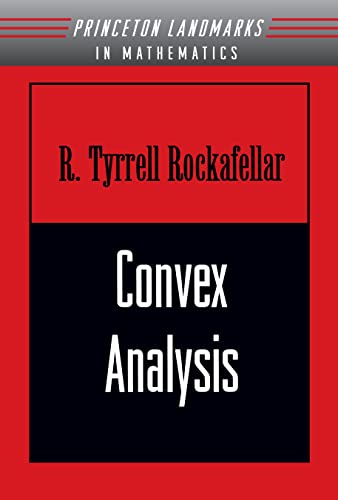
Inhaltsangabe
Available for the first time in paperback, R. Tyrrell Rockafellar's classic study presents readers with a coherent branch of nonlinear mathematical analysis that is especially suited to the study of optimization problems. Rockafellar's theory differs from classical analysis in that differentiability assumptions are replaced by convexity assumptions. The topics treated in this volume include: systems of inequalities, the minimum or maximum of a convex function over a convex set, Lagrange multipliers, minimax theorems and duality, as well as basic results about the structure of convex sets and the continuity and differentiability of convex functions and saddle- functions. This book has firmly established a new and vital area not only for pure mathematics but also for applications to economics and engineering. A sound knowledge of linear algebra and introductory real analysis should provide readers with sufficient background for this book. There is also a guide for the reader who may be using the book as an introduction, indicating which parts are essential and which may be skipped on a first reading.
Die Inhaltsangabe kann sich auf eine andere Ausgabe dieses Titels beziehen.
Über die Autorin bzw. den Autor
R. Tyrrell Rockafellar
Auszug. © Genehmigter Nachdruck. Alle Rechte vorbehalten.
Convex Analysis
By R. Tyrrell RockafellarPRINCETON UNIVERSITY PRESS
Copyright © 1970 Princeton University Press
All rights reserved.
ISBN: 978-0-691-01586-6All rights reserved.
Contents
Preface, vii,
Introductory Remarks: a Guide for the Reader, xi,
PART I: BASIC CONCEPTS,
§1. Affine Sets, 3,
§2. Convex Sets and Cones, 10,
§3. The Algebra of Convex Sets, 16,
§4. Convex Functions, 23,
§5. Functional Operations, 32,
PART II: TOPOLOGICAL PROPERTIES,
§6. Relative Interiors of Convex Sets, 43,
§7. Closures of Convex Functions, 51,
§8. Recession Cones and Unboundedness, 60,
§9. Some Closedness Criteria, 72,
§10. Continuity of Convex Functions, 82,
PART III: DUALITY CORRESPONDENCES,
§11. Separation Theorems, 95,
§12. Conjugates of Convex Functions, 102,
§13. Support Functions, 112,
§14. Polars of Convex Sets, 121,
§15. Polars of Convex Functions, 128,
§16. Dual Operations, 140,
PART IV: REPRESENTATION AND INEQUALITIES,
§17. Caratheodory's Theorem, 153,
§18. Extreme Points and Faces of Convex Sets, 162,
§19. Polyhedral Convex Sets and Functions, 170,
§20. Some Applications of Polyhedral Convexity, 179,
§21. Helly's Theorem and Systems of Inequalities, 185,
§22. Linear Inequalities, 198,
PART V: DIFFERENTIAL THEORY,
§23. Directional Derivatives and Subgradients, 213,
§24. Differential Continuity and Monotonicity, 227,
§25. Differentiability of Convex Functions, 241,
§26. The Legendre Transformation, 251,
PART VI: CONSTRAINED EXTREMUM PROBLEMS,
§27. The Minimum of a Convex Function, 263,
§28. Ordinary Convex Programs and Lagrange Multipliers, 273,
§29. Bifunctions and Generalized Convex Programs, 291,
§30. Adjoint Bifunctions and Dual Programs, 307,
§31. Fenchel's Duality Theorem, 327,
§32. The Maximum of a Convex Function, 342,
PART VII: SADDLE-FUNCTIONS AND MINIMAX THEORY,
§33. Saddle-Functions, 349,
§34. Closures and Equivalence Classes, 359,
§35. Continuity and Differentiability of Saddle-functions, 370,
§36. Minimax Problems, 379,
§37. Conjugate Saddle-functions and Minimax Theorems, 388,
PART VIII: CONVEX ALGEBRA,
§38. The Algebra of Bifunctions, 401,
§39. Convex Processes, 413,
Comments and References, 425,
Bibliography, 433,
Index, 447,
CHAPTER 1
SECTION 1
Affine Sets
Throughout this book, R denotes the real number system, and Rn is the usual vector space of real n-tuples x = ([xi]1 ..., [xi]n). Everything takes place in Rn unless otherwise specified. The inner product of two vectors x and x* in Rn is expressed by
[MATHEMATICAL EXPRESSION NOT REPRODUCIBLE IN ASCII]
The same symbol A is used to denote an m X n real matrix A and the corresponding linear transformation x -> Ax from Rn to Rn. The transpose matrix and the corresponding adjoint linear transformation from Rn to Rn are denoted by A*, so that one has the identity
= .
(In a symbol denoting a vector, * has no operational significance; all vectors are to be regarded as column vectors for purposes of matrix multiplication. Vector symbols involving * are used from time to time merely to bring out the familiar duality between vectors considered as points and vectors considered as the coefficient n-tuples of linear functions.) The end of a proof is signalled by [parallel].
If x and y are different points in Rn, the set of points of the form
(1 - λ)x + λy = x + λ(y - x), λ [member of] R,
is called the line through x and y. A subset M of Rn is called an affine set if (1 - λ)x + λy [member of] M for every x [member of] M, y [member of] M and A [member of] R. (Synonyms for "affine set" used by other authors are "affine manifold," "affine variety," "linear variety" or "flat.")
The empty set Ø and the space Rn itself are extreme examples of affine sets. Also covered by the definition is the case where M consists of a solitary point. In general, an affine set has to contain, along with any two different points, the entire line through those points. The intuitive picture is that of an endless uncurved structure, like a line or a plane in space.
The formal geometry of affine sets may be developed from the theorems of linear algebra about subspaces of Rn. The exact correspondence between affine sets and subspaces is described in the two theorems which follow.
Theorem 1.1. The subspaces of Rn are the affine sets which contain the origin.
Proof. Every subspace contains 0 and, being closed under addition and scalar multiplication, is in particular an affine set.
Conversely, suppose M is an affine set containing 0. For any x [member of] M and λ [member of] R, we have
λx = (1 - λ)0 + λx [member of] M,
so M is closed under scalar multiplication. Now, if x [member of] M and y [member of] M, we have
1/2 (x + y) = 1/2x + (1 - 1/2)y [member of] M,
and hence
x + y = 2(|1/2 + y)) [member of] M.
Thus M is also closed under addition and is a subspace. [parallel]|
For M [subset] Rn and a [member of] Rn, the translate of M by a is defined to be the set
M + a=-{x + a\x [member of] M}.
A translate of an affine set is another affine set, as is easily verified.
An affine set M is said to be parallel to an affine set L if M = L + a for some a. Evidently "M is parallel to L" is an equivalence relation on the collection of affine subsets of Rn. Note that this definition of parallelism is more restrictive than the everyday one, in that it does not include the idea of a line being parallel to a plane. One has to speak of a line which is parallel to another line within a given plane, and so forth.
Theorem 1.2. Each non-empty affine set M is parallel to a unique subspace L. This L is given by
L = M - M = {x - y\ x [member of] M, y [member of] M}.
Proof. Let us show first that M cannot be parallel to two different subspaces. Subspaces L1 and L2 parallel to M would be parallel to each other, so that L2 = L1 + a for some a. Since 0 [member of] L2, we would then have - a [member of L1, and hence a [member of] L1. But then L1 [contains] + a = L2. By a similar argument L2L1, so L1 = L2. This establishes the uniqueness. Now observe that, for any y [member of] M, M - y = M + (-y) is a translate of M containing 0. By Theorem 1.1 and what we have just proved, this affine set must be the unique subspace L parallel to M. Since L = M - y no matter which y [member of] M is chosen, we actually have L = M - M. [parallel]|
The dimension of a non-empty affine set is defined as the dimension of the subspace parallel to it. (The dimension of Ø is -1 by convention.) Naturally,...
„Über diesen Titel“ kann sich auf eine andere Ausgabe dieses Titels beziehen.
Suchergebnisse für Convex Analysis (Princeton Landmarks in Mathematics...

Internationale Ausgabe
Convex Analysis
Verlag:
Ewing, New Jersey, U.S.A.: Princeton Univ Pr, 1996
ISBN 10: 0691015864
ISBN 13: 9780691015866
Neu
Soft cover
Anbieter: Sizzler Texts, SAN GABRIEL, CA, USA
Verkäuferbewertung 5 von 5 Sternen

Soft cover. Zustand: New. Zustand des Schutzumschlags: New. International Edition. **INTERNATIONAL EDITION** Read carefully before purchase: This book is the international edition in mint condition with the different ISBN and book cover design, the major content is printed in full English as same as the original North American edition. The book printed in black and white, generally send in twenty-four hours after the order confirmed. All shipments go through via USPS/UPS/DHL with tracking numbers. Great professional textbook selling experience and expedite shipping service. Bestandsnummer des Verkäufers ABE-8048884381
Neu kaufen
EUR 26,35
EUR 8,53 shipping
Versand innerhalb von USA
Versand innerhalb von USA
Anzahl: Mehr als 20 verfügbar
Internationale Ausgabe
Convex Analysis
Internationale AusgabeAnbieter: Aideo Books, San Marino, CA, USA
Verkäuferbewertung 5 von 5 Sternen
Soft cover. Zustand: New. Zustand des Schutzumschlags: New. International Edition. ***INTERNATIONAL EDITION*** Read carefully before purchase: This book is the international edition in mint condition with the different ISBN and book cover design, the major content is printed in full English as same as the original North American edition. The book printed in black and white, generally send in twenty-four hours after the order confirmed. All shipments contain tracking numbers. Great professional textbook selling experience and expedite shipping service. Trade paperback (US). Glued binding. 469 p. Contains: Illustrations, black & white. Princeton Landmarks in Mathematics and Physics. Audience: General/trade. Bestandsnummer des Verkäufers K542A0000766
Neu kaufen
EUR 30,77
EUR 4,23 shipping
Versand innerhalb von USA
Versand innerhalb von USA
Anzahl: Mehr als 20 verfügbar

Foto des Verkäufers
Convex Analysis (Princeton Landmarks in Mathematics and Physics)
Verlag:
Princeton University Press, 1996
ISBN 10: 0691015864
ISBN 13: 9780691015866
Gebraucht
Softcover
Anbieter: Zoom Books East, Glendale Heights, IL, USA
Verkäuferbewertung 5 von 5 Sternen
Zustand: good. Book is in good condition and may include underlining highlighting and minimal wear. The book can also include "From the library of" labels. May not contain miscellaneous items toys, dvds, etc. . We offer 100% money back guarantee and 24 7 customer service. Bestandsnummer des Verkäufers ZEV.0691015864.G
Gebraucht kaufen
EUR 51,44
Versand gratis
Versand innerhalb von USA
Versand innerhalb von USA
Anzahl: 1 verfügbar
Beispielbild für diese ISBN
Convex Analysis: (PMS-28) (Princeton Landmarks in Mathematics and Physics)
Verlag:
Princeton University Press, 1996
ISBN 10: 0691015864
ISBN 13: 9780691015866
Gebraucht
Paperback
Anbieter: HPB-Red, Dallas, TX, USA
Verkäuferbewertung 5 von 5 Sternen
Paperback. Zustand: Good. Connecting readers with great books since 1972! Used textbooks may not include companion materials such as access codes, etc. May have some wear or writing/highlighting. We ship orders daily and Customer Service is our top priority! Bestandsnummer des Verkäufers S_418557299
Gebraucht kaufen
EUR 49,58
EUR 3,20 shipping
Versand innerhalb von USA
Versand innerhalb von USA
Anzahl: 1 verfügbar
Beispielbild für diese ISBN
Convex Analysis: (PMS-28) (Princeton Landmarks in Mathematics and Physics, 36)
Anbieter: Labyrinth Books, Princeton, NJ, USA
Verkäuferbewertung 5 von 5 Sternen
Zustand: New. Bestandsnummer des Verkäufers 126880
Neu kaufen
EUR 65,10
EUR 3,84 shipping
Versand innerhalb von USA
Versand innerhalb von USA
Anzahl: 3 verfügbar
Foto des Verkäufers
Convex Analysis
Anbieter: GreatBookPrices, Columbia, MD, USA
Verkäuferbewertung 5 von 5 Sternen
Zustand: New. Bestandsnummer des Verkäufers 402289-n
Neu kaufen
EUR 93,01
EUR 2,26 shipping
Versand innerhalb von USA
Versand innerhalb von USA
Anzahl: Mehr als 20 verfügbar
Beispielbild für diese ISBN
Convex Analysis
Anbieter: PBShop.store US, Wood Dale, IL, USA
Verkäuferbewertung 5 von 5 Sternen
PAP. Zustand: New. New Book. Shipped from UK. Established seller since 2000. Bestandsnummer des Verkäufers WP-9780691015866
Beispielbild für diese ISBN
Convex Analysis
Anbieter: PBShop.store UK, Fairford, GLOS, Vereinigtes Königreich
Verkäuferbewertung 5 von 5 Sternen
PAP. Zustand: New. New Book. Shipped from UK. Established seller since 2000. Bestandsnummer des Verkäufers WP-9780691015866
Neu kaufen
EUR 90,29
EUR 5,76 shipping
Versand von Vereinigtes Königreich nach USA
Versand von Vereinigtes Königreich nach USA
Anzahl: 15 verfügbar
Beispielbild für diese ISBN
Convex Analysis (Princeton Landmarks in Mathematics and Physics)
Verlag:
Princeton University Press, 1996
ISBN 10: 0691015864
ISBN 13: 9780691015866
Gebraucht
Paperback
Anbieter: Wrigley Books, Austin, TX, USA
Verkäuferbewertung 5 von 5 Sternen
Paperback. Zustand: very good. Used items may not include media like access codes or CDs. Fast shipping! Expedited orders take 1-3 business days! Media mail may take up to 5 business days. Bestandsnummer des Verkäufers 3C-9780691015866-V
Gebraucht kaufen
EUR 93,97
EUR 2,14 shipping
Versand innerhalb von USA
Versand innerhalb von USA
Anzahl: 1 verfügbar
Foto des Verkäufers
Convex Analysis
Verlag:
Princeton University Press, 1996
ISBN 10: 0691015864
ISBN 13: 9780691015866
Gebraucht
Softcover
Anbieter: GreatBookPrices, Columbia, MD, USA
Verkäuferbewertung 5 von 5 Sternen
Zustand: As New. Unread book in perfect condition. Bestandsnummer des Verkäufers 402289
Gebraucht kaufen
EUR 108,65
EUR 2,26 shipping
Versand innerhalb von USA
Versand innerhalb von USA
Anzahl: Mehr als 20 verfügbar