
Verwandte Artikel zu Collected Works of C.G. Jung, Volume 12: Psychology...
Collected Works of C.G. Jung, Volume 12: Psychology and Alchemy (Collected Works of Carl G. Jung, 12, Band 12) - Softcover
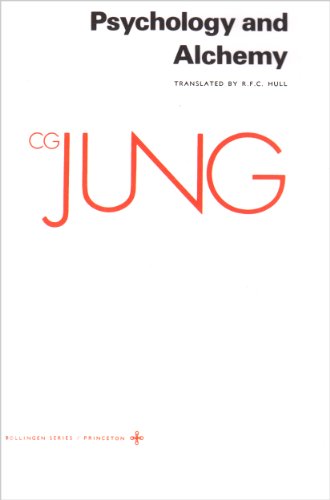
Inhaltsangabe
Jung’s landmark account of the connections between alchemy, its symbolism, the collective unconscious, and modern psychology
Psychology and Alchemy is one of Jung’s most influential works. In a prefatory note, he says: “In this present study of alchemy I have taken a particular example of symbol-formation, extending in all over some seventeen centuries, and have subjected it to intensive examination, linking it at the same time with an actual series of dreams recorded by a modern European not under my direct supervision and having no knowledge of what the symbols appearing in the dream might mean. It is by such intensive comparisons as this (and not one but many) that the hypothesis of the collective unconscious—of an activity in the human psyche making for the spiritual development of the individual human being—may be scientifically established.”
This is the second, completely revised edition. The book features 270 illustrations, drawn largely from old alchemical books and manuscripts, many of which were in Jung’s personal collection.
Die Inhaltsangabe kann sich auf eine andere Ausgabe dieses Titels beziehen.
Über die Autorin bzw. den Autor
C. G. Jung (1875–1961) was one of the most important psychologists of the twentieth century.
Von der hinteren Coverseite
In this present study of alchemy the author has taken a particular example of symbol-formation, extending in all over some seventeen centuries, and have subjected it to intensive examination, linking it at the same time with an actual series of dreams recorded by a modern European not under his direct supervision and having no knowledge of what the symbols appearing in the dreams might mean.
Auszug. © Genehmigter Nachdruck. Alle Rechte vorbehalten.
PSYCHOLOGY AND ALCHEMY
By C. G. JUNG, GERHARD ADLER, R. F. C. HULLPRINCETON UNIVERSITY PRESS
Copyright © 1968 BOLLINGEN FOUNDATION
All rights reserved.
ISBN: 978-0-691-01831-7All rights reserved.
Contents
PREFATORY NOTE TO THE ENGLISH EDITION, v,
EDITORIAL NOTE TO THE FIRST EDITION, vxi,
EDITORIAL NOTE TO THE SECOND EDITION, viii,
TRANSLATOR'S NOTE, ix,
FOREWORD TO THE SWISS EDITION, x,
LIST OF ILLUSTRATIONS, xv,
PART I INTRODUCTION TO THE RELIGIOUS AND PSYCHOLOGICAL PROBLEMS OF ALCHEMY,
PART II INDIVIDUAL DREAM SYMBOLISM IN RELATION TO ALCHEMY,
Chapter 1. Introduction,
Chapter 2. The Initial Dreams, 47,
Chapter 3. The Symbolism of the Mandala,
PART III RELIGIOUS IDEAS IN ALCHEMY,
Chapter 1. Basic Concepts of Alchemy,
Chapter 2. The Psychic Nature of the Alchemical Work,
Chapter 3. The Work,
Chapter 4. The Prima Materia,
Chapter 5. The Lapis-Christ Parallel,
Chapter 6. Alchemical Symbolism in the History of Religion,
EPILOGUE, 473,
BIBLIOGRAPHY, 485,
INDEX, 525,
CHAPTER 1
INTRODUCTION TO THE RELIGIOUS AND PSYCHOLOGICAL PROBLEMS OF ALCHEMY
Calamum quassatum non conteret, et linum fumigans non extinguet....
—Isaias 42:3
The bruised reed he shall not break, and the smoking flax he shall not quench.... (D.V.)
1 For the reader familiar with analytical psychology, there is no need of any introductory remarks to the subject of the following study. But for the reader whose interest is not professional and who comes to this book unprepared, some kind of preface will probably be necessary. The concepts of alchemy and the individuation process are matters that seem to lie very far apart, so that the imagination finds it impossible at first to conceive of any bridge between them. To this reader I owe an explanation, more particularly as I have had one or two experiences since the publication of my recent lectures which lead me to infer a certain bewilderment in my critics.
2 What I now have to put forward as regards the nature of the human psyche is based first and foremost on my observations of people. It has been objected that these observations deal with experiences that are either unknown or barely accessible. It is a remarkable fact, which we come across again and again, that absolutely everybody, even the most unqualified layman, thinks he knows all about psychology as though the psyche were something that enjoyed the most universal understanding. But anyone who really knows the human psyche will agree with me when I say that it is one of the darkest and most mysterious regions of our experience. There is no end to what can be learned in this field. Hardly a day passes in my practice but I come across something new and unexpected. True enough, my experiences are not commonplaces lying on the surface of life. They are, however, within easy reach of every psychotherapist working in this particular field. It is therefore rather absurd, to say the least, that ignorance of the experiences I have to offer should be twisted into an accusation against me. I do not hold myself responsible for the shortcomings in the lay public's knowledge of psychology.
3 There is in the analytical process, that is to say in the dialectical discussion between the conscious mind and the unconscious, a development or an advance towards some goal or end, the perplexing nature of which has engaged my attention for many years. Psychological treatment may come to an end at any stage in the development without one's always or necessarily having the feeling that a goal has also been reached. Typical and temporary terminations may occur (1) after receiving a piece of good advice; (2) after making a fairly complete but nevertheless adequate confession; (3) after having recognized some hitherto unconscious but essential psychic content whose realization gives a new impetus to one's life and activity; (4) after a hard-won separation from the childhood psyche; (5) after having worked out a new and rational mode of adaptation to perhaps difficult or unusual circumstances and surroundings; (6) after the disappearance of painful symptoms; (7) after some positive turn of fortune such as an examination, engagement, marriage, divorce, change of profession, etc.; (8) after having found one's way back to the church or creed to which one previously belonged, or after a conversion; and finally, (9) after having begun to build up a practical philosophy of life (a "philosophy" in the classical sense of the word).
4 Although the list could admit of many more modifications and additions, it ought to define by and large the main situations in which the analytical or psychotherapeutic process reaches a temporary or sometimes even a definitive end. Experience shows, however, that there is a relatively large number of patients for whom the outward termination of work with the doctor is far from denoting the end of the analytical process. It is rather the case that the dialectical discussion with the unconscious still continues, and follows much the same course as it does with those who have not given up their work with the doctor. Occasionally one meets such patients again after several years and hears the often highly remarkable account of their subsequent development. It was experiences of this kind which first confirmed me in my belief that there is in the psyche a process that seeks its own goal independently of external factors, and which freed me from the worrying feeling that I myself might be the sole cause of an unreal—and perhaps unnatural—process in the psyche of the patient. This apprehension was not altogether misplaced inasmuch as no amount of argument based on any of the nine categories mentioned above—not even a religious conversion or the most startling removal of neurotic symptoms—can persuade certain patients to give up their analytical work. It was these cases that finally convinced me that the treatment of neurosis opens up a problem which goes far beyond purely medical considerations and to which medical knowledge alone cannot hope to do justice.
5 Although the early days of analysis now lie nearly half a century behind us, with their pseudo-biological interpretations and their depreciation of the whole process of psychic development, memories die hard and people are still very fond of describing a lengthy analysis as "running away from life," "unresolved transference," "auto-eroticism"—and by other equally unpleasant epithets. But since there are two sides to everything, it is legitimate to condemn this so-called "hanging on" as negative to life only if it can be shown that it really does contain nothing positive. The very understandable impatience felt by the doctor does not prove anything in itself. Only through infinitely patient research has the new science succeeded in building up a profounder knowledge of the nature of the psyche, and if there have been certain unexpected therapeutic results, these are due to the self-sacrificing perseverance of the doctor. Unjustifiably negative judgments are easily come by and at times harmful; moreover they arouse the suspicion of being a mere cloak for ignorance if not an attempt to evade the responsibility of a thorough-going analysis. For since the analytical work must inevitably lead sooner or later to a fundamental discussion between "I" and "You" and "You" and "I" on a plane stripped of all human pretences, it is very likely, indeed it is almost certain, that not only the patient but the doctor as well will find the situation "getting under his skin."...
„Über diesen Titel“ kann sich auf eine andere Ausgabe dieses Titels beziehen.
Suchergebnisse für Collected Works of C.G. Jung, Volume 12: Psychology...

Foto des Verkäufers
Psychology and Alchemy (Collected Works of C.G. Jung Vol.12)
Verlag:
Princeton University Press, 1980
ISBN 10: 0691018316
ISBN 13: 9780691018317
Gebraucht
Softcover
Anbieter: Solr Books, Lincolnwood, IL, USA
Verkäuferbewertung 5 von 5 Sternen

Zustand: acceptable. This book is in Acceptable condition. All pages are intact, but may have lots of notes, water damage or other issues and be ex library. Bestandsnummer des Verkäufers BCV.0691018316.A
Gebraucht kaufen
EUR 19,60
EUR 6,91 Versand
Versand innerhalb von USA
Versand innerhalb von USA
Anzahl: 1 verfügbar
Beispielbild für diese ISBN
Psychology and Alchemy (Collected Works of C.G. Jung Vol.12)
Anbieter: Lakeside Books, Benton Harbor, MI, USA
Verkäuferbewertung 5 von 5 Sternen
Zustand: New. Brand New! Not Overstocks or Low Quality Book Club Editions! Direct From the Publisher! We're not a giant, faceless warehouse organization! We're a small town bookstore that loves books and loves it's customers! Buy from Lakeside Books! Bestandsnummer des Verkäufers OTF-S-9780691018317
Neu kaufen
EUR 26,75
EUR 3,46 Versand
Versand innerhalb von USA
Versand innerhalb von USA
Anzahl: 5 verfügbar
Beispielbild für diese ISBN
Collected Works of C.G. Jung, Volume 12: Psychology and Alchemy Format: Paperback
Verlag:
Princeton University Press, 1980
ISBN 10: 0691018316
ISBN 13: 9780691018317
Gebraucht
Softcover
Anbieter: INDOO, Avenel, NJ, USA
Verkäuferbewertung 5 von 5 Sternen
Zustand: As New. Unread copy in mint condition. Bestandsnummer des Verkäufers PG9780691018317
Gebraucht kaufen
EUR 30,39
Versand gratis
Versand innerhalb von USA
Versand innerhalb von USA
Anzahl: Mehr als 20 verfügbar
Beispielbild für diese ISBN
Collected Works of C.G. Jung, Volume 12: Psychology and Alchemy Format: Paperback
Anbieter: INDOO, Avenel, NJ, USA
Verkäuferbewertung 5 von 5 Sternen
Zustand: New. Brand New. Bestandsnummer des Verkäufers 9780691018317
Neu kaufen
EUR 30,48
Versand gratis
Versand innerhalb von USA
Versand innerhalb von USA
Anzahl: Mehr als 20 verfügbar
Beispielbild für diese ISBN
Psychology and Alchemy (Collected Works of C.G. Jung Vol.12)
Anbieter: California Books, Miami, FL, USA
Verkäuferbewertung 4 von 5 Sternen

Zustand: New. Bestandsnummer des Verkäufers I-9780691018317
Foto des Verkäufers
Collected Works of C. G. Jung, Volume 12
Verlag:
Princeton University Press, US, 1980
ISBN 10: 0691018316
ISBN 13: 9780691018317
Neu
Paperback
Anbieter: Rarewaves USA, HEBRON, KY, USA
Verkäuferbewertung 5 von 5 Sternen
Paperback. Zustand: New. A study of the analogies between alchemy, Christian dogma, and psychological symbolism. Revised translation, with new bibliography and index. Bestandsnummer des Verkäufers LU-9780691018317
Beispielbild für diese ISBN
Collected Works of C.G. Jung, Volume 12 - Psychology and Alchemy (Collected Works of Carl G. Jung, 12)
Verlag:
Princeton University Press, 1993
ISBN 10: 0691018316
ISBN 13: 9780691018317
Gebraucht
Soft cover
Anbieter: Redbrick Books, Springfield, MA, USA
Verkäuferbewertung 4 von 5 Sternen
Soft cover. Zustand: Very Good. 2nd Edition. trade paperback with light wear, 8th printing of revised edion. Bestandsnummer des Verkäufers 014427
Gebraucht kaufen
EUR 31,22
EUR 5,85 Versand
Versand innerhalb von USA
Versand innerhalb von USA
Anzahl: 1 verfügbar
Foto des Verkäufers
Collected Works of C. G. Jung, Volume 12 (Paperback)
Verlag:
Princeton University Press, New Jersey, 1980
ISBN 10: 0691018316
ISBN 13: 9780691018317
Neu
Paperback
Anbieter: Grand Eagle Retail, Bensenville, IL, USA
Verkäuferbewertung 5 von 5 Sternen
Paperback. Zustand: new. Paperback. A study of the analogies between alchemy, Christian dogma, and psychological symbolism. Revised translation, with new bibliography and index. A study of the analogies between alchemy, Christian dogma, and psychological symbolism. Shipping may be from multiple locations in the US or from the UK, depending on stock availability. Bestandsnummer des Verkäufers 9780691018317
Foto des Verkäufers
Psychology and Alchemy
Verlag:
Princeton University Press, 1993
ISBN 10: 0691018316
ISBN 13: 9780691018317
Gebraucht
Softcover
Anbieter: Elder's Bookstore, Nashville, TN, USA
Verkäuferbewertung 2 von 5 Sternen

Softcover. Zustand: Very Good. Zustand des Schutzumschlags: No Dust Jacket. Second Edition; Eighth Printing. Translated by R. F. C. Hull. Volume 12. Very Good softcover. Some shelf wear. Old pricing sticker on back cover. Some foxing to edges. Interior is Like New, no noticeable markings or underlining.; Bollinger Series XX; 6" x 9"; 571 pages. Bestandsnummer des Verkäufers 45217
Gebraucht kaufen
EUR 34,78
EUR 9,09 Versand
Versand innerhalb von USA
Versand innerhalb von USA
Anzahl: 1 verfügbar
Beispielbild für diese ISBN
Psychology and Alchemy (Collected Works of C.G. Jung Vol.12)
Anbieter: Russell Books, Victoria, BC, Kanada
Verkäuferbewertung 5 von 5 Sternen
Paperback. Zustand: New. Special order direct from the distributor. Bestandsnummer des Verkäufers ING9780691018317
Neu kaufen
EUR 39,24
EUR 17,31 Versand
Versand von Kanada nach USA
Versand von Kanada nach USA
Anzahl: 10 verfügbar