
Verwandte Artikel zu The Concept Of Irony With Continual Reference To Socrates...
The Concept Of Irony With Continual Reference To Socrates / Notes Of Schelling's Berlin Lectures - Softcover
Buch 18 von 21: Kierkegaard's Writings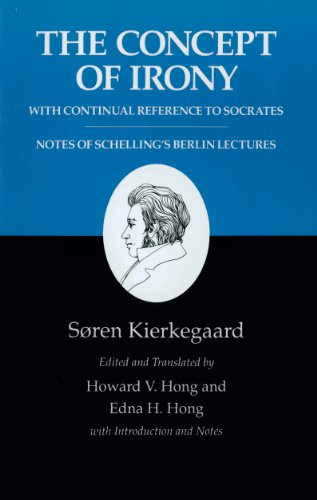
Inhaltsangabe
A work that "not only treats of irony but is irony," wrote a contemporary reviewer of The Concept of Irony, with Continual Reference to Socrates. Presented here with Kierkegaard's notes of the celebrated Berlin lectures on "positive philosophy" by F.W.J. Schelling, the book is a seedbed of Kierkegaard's subsequent work, both stylistically and thematically. Part One concentrates on Socrates, the master ironist, as interpreted by Xenophon, Plato, and Aristophanes, with a word on Hegel and Hegelian categories. Part Two is a more synoptic discussion of the concept of irony in Kierkegaard's categories, with examples from other philosophers and with particular attention given to A. W. Schlegel's novel Lucinde as an epitome of romantic irony. The Concept of Irony and the Notes of Schelling's Berlin Lectures belong to the momentous year 1841, which included not only the completion of Kierkegaard's university work and his sojourn in Berlin, but also the end of his engagement to Regine Olsen and the initial writing of Either/Or.
Die Inhaltsangabe kann sich auf eine andere Ausgabe dieses Titels beziehen.
Über die Autorin bzw. den Autor
Søren Kierkegaard Edited by Howard V. Hong & Edna H. Hong
Auszug. © Genehmigter Nachdruck. Alle Rechte vorbehalten.
The Concept of Irony with Continual Reference to Socrates
By Søren Kierkegaard, Howard V. Hong, Edna H. HongPRINCETON UNIVERSITY PRESS
Copyright © 1989 Howard V. Hong
All rights reserved.
ISBN: 978-0-691-02072-3All rights reserved.
Contents
Historical Introduction,
The Concept of Irony, with Continual Reference to Socrates,
Theses,
Part One THE POSITION OF SOCRATES VIEWED AS IRONY,
Introduction,
I The View Made Possible,
II The Actualization of the View,
III The View Made Necessary,
Appendix Hegel's View of Socrates,
Part Two THE CONCEPT OF IRONY,
Introduction,
Observations for Orientation,
The World-Historical Validity of Irony, the Irony of Socrates,
Irony after Fichte,
Irony as a Controlled Element, the Truth of Irony,
Addendum NOTES OF SCHELLING'S BERLIN LECTURES,
Supplement,
Key to References,
Original Title Pages of The Concept of Irony,
Original First Page (manuscript) of Notes of Schelling's Berlin Lectures,
Selected Entries from Kierkegaard's Journals and Papers Pertaining to The Concept of Irony,
Editorial Appendix,
Acknowledgments,
Collation of The Concept of Irony in the Danish Editions of Kierkegaard's Collected Works,
Notes,
Bibliographical Note,
Index,
CHAPTER 1
The View Made Possible [XIII 109]
We shall now move to a summary of the views of Socrates provided by his closest contemporaries. In this respect there are three who command our attention: Xenophon, Plato, and Aristophanes. I cannot fully agree with Baur, who thinks that, along with Plato, Xenophon should be most highly regarded. Xenophon stopped with Socrates' immediacy and thus has definitely misunderstood him in many ways; whereas Plato and Aristophanes have blazed a trail through [XIII 110] the tough exterior to a view of the infinity that is incommensurable with the multifarious events of his life. Thus it can be said of Socrates that just as he walked through life continually between a caricature and the ideal, so after his death he continues to stroll between those two. As for the relation between Xenophon and Plato, Baur is correct in saying on page 123: "Zwischen diesen Beiden tritt uns aber sogleich eine Differenz entgegen, die in mancher Hinsicht mit dem bekannten Verhältnisz verglichen werden kann, welches zwischen den synoptischen Evangelien und dem des Johannes stattfindet. Wie die synoptischen Evangelien zunächst mehr nur die äussere, mit der jüdischen Messias-Idee zusammenhängende, Seite der Erscheinung Christi darstellen, das johanneische aber vor allem seine höhere Natur und das unmittelbar Göttliche in ihm ins Auge faszt, so hat auch der platonische Sokrates eine weit höhere ideellere Bedeutung als der xenophontische, mit welchem wir uns im Grunde immer nur auf dem Boden der Verhältnisse des unmittelbaren praktischen Lebens befinden [Yet we instantly encounter a difference between these two that in many respects may be likened to the well-known relation between the Synoptic Gospels and the Gospel of John. Just as the Synoptic Gospels present primarily only the external aspect of Christ's appearance, the aspect connected with the Jewish idea of the Messiah, whereas the Gospel of John above all captures his higher nature and the immediately divine within him, so also the Platonic Socrates does indeed have an ideal significance far higher than the Xenophontic Socrates, with whom we in effect always find ourselves on the flat and even level of conditions belonging to the immediate practical life]." Baur's comment is not only striking but also to the point when one remembers that Xenophon's view of Socrates differs from the Synoptic Gospels in that the latter merely recorded the immediate, accurate picture of Christ's immediate existence (which, please note, did not signify anything else than what it was), and insofar as Matthew's seeming to have an apologetic objective, the [XIII 111] question at that time was to reconcile Christ's life with the idea of the Messiah, whereas Xenophon is dealing with a man whose immediate existence means something else than meets the eye at first glance, and insofar as he mounts a defense of him, he does this only in the form of an appeal to a subtilizing, right-honorable age. On the other hand, the comment about Plato's relation to John is also correct if one simply holds fast to the position that John found and immediately perceived in Christ everything that he, precisely by restraining himself to silence, presents in all its objectivity, because his eyes were opened to the immediate divinity in Christ; whereas Plato creates his Socrates by means of poetic productivity, since Socrates, precisely in his immediate existence, was only negative.
But first an exposition of each one separately.
XENOPHON
As a preliminary, we must recall that Xenophon had an objective (this is already a deficiency or an irksome redundancy) — namely, to show what a scandalous injustice it was for the Athenians to condemn Socrates to death. Indeed, Xenophon succeeded in this to such a singular degree that one would be more inclined to believe that it was Xenophon's objective to prove that it was foolishness or an error on the part of the Athenians to condemn Socrates, for Xenophon defends Socrates in such a way that he renders him not only innocent but also altogether innocuous — so much so that we wonder greatly about what kind of daimon must have bewitched the Athenians to such a degree that [XIII 112] they were able to see more in him than in any other good-natured, garrulous, droll character who does neither good nor evil, does not stand in anyone's way, and is so fervently well-intentioned toward the whole world if only it will listen to his slipshod nonsense. And what harmonia praestahilita [preestablished harmony] in lunacy, what higher unity in madness is there not inherent in Plato's and the Athenians' uniting to put to death and immortalize such a good-natured bourgeois as that? This, after all, would be an incomparable irony upon the world. Plato and the Athenians must have felt almost as uncomfortable with Xenophon's irenic intervention as one feels at times in an argument when — just as the point in dispute, precisely by being brought to a head, begins to be interesting — a helpful third party kindly takes it upon himself to reconcile the disputants, to take the whole matter back to a triviality. Finally, by eliminating all that was dangerous in Socrates, Xenophon actually reduced him totally in absurdum, in recompense, probably, for Socrates' having done this so often to others.
What makes it even more difficult to get a clear notion of Socrates' personality from Xenophon's account is the total lack of situation. The base on which the specific conversation moves is just as invisible and shallow as a straight line, just as monotonous as the single-color background that children and Nürnberg painters customarily use in their pictures. Yet situation was immensely important to Socrates' personality, which must have given an intimation of itself precisely by a secretive presence in and a mystical floating over the multicolored variety of exuberant Athenian life and which must have been explained by a duplexity of existence, much as the flying fish in relation to fish and birds. This emphasis on situation was especially significant in order to indicate that the true center for Socrates was not a fixed point but an ubique et nusquam [everywhere and nowhere], in...
„Über diesen Titel“ kann sich auf eine andere Ausgabe dieses Titels beziehen.
Ihre gesetzlichen Garantierechte: Alle Verbraucher:innen in der EU profitieren von mindestens 2 Jahren gesetzlichem Garantieschutz für alle in der EU verkauften Konsumgüter. Mehr erfahren
Suchergebnisse für The Concept Of Irony With Continual Reference To Socrates...

Beispielbild für diese ISBN
The Concept of Irony, with Continual Reference to Socrates. Notes of Schelling's Berlin Lectures.
Verlag:
Princeton University Press, Princeton, 1992
ISBN 10: 0691020728
ISBN 13: 9780691020723
Gebraucht
Orignal decorated wrappers
Erstausgabe
Anbieter: Literary Cat Books, Machynlleth, Powys, WALES, Vereinigtes Königreich
Verkäuferbewertung 3 von 5 Sternen

Orignal decorated wrappers. Zustand: Near Fine. Zustand des Schutzumschlags: No Dust Jacket. First Edition; First Impression. Light wear to cover, corners and spine.; Kierkegaard's Writings; 2; 21.5x14x4.5cm; 664 pages. Bestandsnummer des Verkäufers LCH48748
Gebraucht kaufen
EUR 12,29
EUR 17,90 Versand
Versand von Vereinigtes Königreich nach USA
Versand von Vereinigtes Königreich nach USA
Anzahl: 1 verfügbar
Beispielbild für diese ISBN
The Concept of Irony, with Continual Reference to Socrates/Notes of Schelling's Berlin Lectures
Verlag:
Princeton University Press, 1992
ISBN 10: 0691020728
ISBN 13: 9780691020723
Gebraucht
Paperback
Anbieter: Textbook Bookie, Little Rock, AR, USA
Verkäuferbewertung 4 von 5 Sternen

Paperback. Zustand: Good. Book in Good condition. Bestandsnummer des Verkäufers 9780691020723-good
Gebraucht kaufen
EUR 27,68
EUR 4,55 Versand
Versand innerhalb von USA
Versand innerhalb von USA
Anzahl: 1 verfügbar
Beispielbild für diese ISBN
The Concept of Irony, with Continual Reference to Socrates/Notes of Schelling's Berlin Lectures
Verlag:
Princeton University Press, 1992
ISBN 10: 0691020728
ISBN 13: 9780691020723
Gebraucht
Paperback
Anbieter: World of Books (was SecondSale), Montgomery, IL, USA
Verkäuferbewertung 5 von 5 Sternen

Paperback. Zustand: Very Good. Presented with Kierkegaard's notes of the celebrated Berlin lectures on positive philosophy by FWJ Schelling, this book is a seedbed of Kierkegaard's subsequent work, both stylistically and thematically. It concentrates on Socrates, as interpreted by Xenophon, Plato, and Aristophanes, with a word on Hegel and Hegelian categories. Bestandsnummer des Verkäufers CIN0691020728VG
Gebraucht kaufen
EUR 32,36
Versand gratis
Versand innerhalb von USA
Versand innerhalb von USA
Anzahl: 1 verfügbar
Foto des Verkäufers
The Concept of Irony, with Continual Reference to Socrates/Notes of Schelling's Berlin Lectures
Verlag:
Princeton University Press, 1992
ISBN 10: 0691020728
ISBN 13: 9780691020723
Gebraucht
Paperback
Anbieter: Walden Books, London, Vereinigtes Königreich
Verkäuferbewertung 4 von 5 Sternen
Paperback. Zustand: Very Good+. Second Printing with corrections. Card covers are bright and unmarked, corners minimally bumped; binding is tight; pages are unmarked.; Kierkegaard's Writings, 2; 5.5 X 1.25 X 8.5 inches; 634 pages. Bestandsnummer des Verkäufers 62380
Gebraucht kaufen
EUR 14,75
EUR 17,90 Versand
Versand von Vereinigtes Königreich nach USA
Versand von Vereinigtes Königreich nach USA
Anzahl: 1 verfügbar
Foto des Verkäufers
The Concept of Irony, With Continual Reference to Socrates - and - Notes of Schelling's Berlin Lectures
Verlag:
Princeton University Press, 1992
ISBN 10: 0691020728
ISBN 13: 9780691020723
Gebraucht
Paperback
Anbieter: The Haunted Bookshop, LLC, Iowa City, IA, USA
Verkäuferbewertung 4 von 5 Sternen
Paperback. Zustand: Good+. Clean pages except for pale foxing around outside edges; no owners' marks; the soft cover bears a long crease at the left rear, a short crease at the top left rear corner, a partial vertical crease on the spine, and light chipping at spine ends, otherwise sound. xxv, 634pp. incl. index. Bestandsnummer des Verkäufers 00085108
Gebraucht kaufen
EUR 30,04
EUR 5,01 Versand
Versand innerhalb von USA
Versand innerhalb von USA
Anzahl: 1 verfügbar
Beispielbild für diese ISBN
The Concept of Irony/Schelling Lecture Notes : Kierkegaard's Writings, Vol. 2
Anbieter: Labyrinth Books, Princeton, NJ, USA
Verkäuferbewertung 4 von 5 Sternen
Zustand: New. Bestandsnummer des Verkäufers 038885
Neu kaufen
EUR 37,53
EUR 4,10 Versand
Versand innerhalb von USA
Versand innerhalb von USA
Anzahl: 6 verfügbar
Beispielbild für diese ISBN
Kierkegaard's Writings, II: The Concept of Irony, with Continual Reference to Socrates/Notes of Schelling's Berlin Lectures: Concept of Irony, with . of Schelling's Berlin Lectures v. 2
Verlag:
Princeton University Press, 1992
ISBN 10: 0691020728
ISBN 13: 9780691020723
Gebraucht
Paperback
Anbieter: Greener Books, London, Vereinigtes Königreich
Verkäuferbewertung 4 von 5 Sternen
Paperback. Zustand: Used; Very Good. **SHIPPED FROM UK** We believe you will be completely satisfied with our quick and reliable service. All orders are dispatched as swiftly as possible! Buy with confidence! Greener Books. Bestandsnummer des Verkäufers 4760385
Gebraucht kaufen
EUR 20,67
EUR 23,87 Versand
Versand von Vereinigtes Königreich nach USA
Versand von Vereinigtes Königreich nach USA
Anzahl: 1 verfügbar
Beispielbild für diese ISBN
The Concept of Irony with Continual Reference to Socrates
Verlag:
Kierkegaard's Writings Paperb 1992-01, 1992
ISBN 10: 0691020728
ISBN 13: 9780691020723
Gebraucht
Softcover/Paperback
Anbieter: LittleBookNook, Gillette, WY, USA
Verkäuferbewertung 3 von 5 Sternen
Softcover/Paperback. Zustand: Fine. A work that 'not only treats of irony but is irony' wrote a contemporary reviewer of The Concept of Irony with Continual Reference to Socrates. Presented here with Kierkegaard's notes of the celebrated Berlin lectures on 'positive philosophy' by F.W.J. Schelling the book is a seedbed of Kierkegaard's subsequent work both stylistically and thematically. Part One concentrates on Socrates the master ironist as interpreted by Xenophon Plato and Aristophanes with a word on Hegel and Hegelian categories. Part Two is a more synoptic discussion of the concept of irony in Kierkegaard's categories with examples from other philosophers and with particular attention given to A. W. Schlegel's novel Lucinde as an epitome of romantic irony. The Concept of Irony and the Notes of Schelling's Berlin Lectures belong to the momentous year 1841 which included not only the completion of Kierkegaard's university work and his sojourn in Berlin but also the end of his engagement to Regine Olsen and the initial writing of Either/Or. | Pages: 634. Bestandsnummer des Verkäufers BK-CJRK3N
Gebraucht kaufen
EUR 43,74
EUR 3,87 Versand
Versand innerhalb von USA
Versand innerhalb von USA
Anzahl: 1 verfügbar
Foto des Verkäufers
The Concept of Irony/Schelling Lecture Notes : Kierkegaard's Writings, Vol. 2 (Kierkegaard's Writings, 2)
Verlag:
Princeton University Press, 1992
ISBN 10: 0691020728
ISBN 13: 9780691020723
Gebraucht
Soft cover
Anbieter: Pastor Mike, Guttenberg, IA, USA
Verkäuferbewertung 5 von 5 Sternen
Soft cover. Zustand: As New. Bestandsnummer des Verkäufers ABE-1723685158647
Gebraucht kaufen
EUR 42,25
EUR 6,38 Versand
Versand innerhalb von USA
Versand innerhalb von USA
Anzahl: 1 verfügbar
Foto des Verkäufers
Concept of Irony : With Continual Reference to Socrates Together With Notes of Schellings Berlin Lectures
Anbieter: GreatBookPrices, Columbia, MD, USA
Verkäuferbewertung 5 von 5 Sternen
Zustand: New. Bestandsnummer des Verkäufers 402028-n
Neu kaufen
EUR 51,72
EUR 2,41 Versand
Versand innerhalb von USA
Versand innerhalb von USA
Anzahl: 14 verfügbar