
Verwandte Artikel zu Recursive Models of Dynamic Linear Economies (The Gorman...
Recursive Models of Dynamic Linear Economies (The Gorman Lectures in Economics) - Hardcover
Buch 4 von 5: The Gorman Lectures in Economics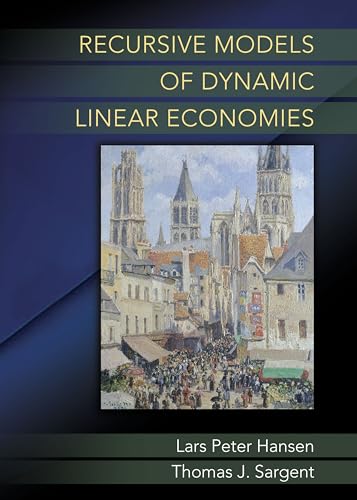
Inhaltsangabe
A guide to the economic modeling of household preferences, from two leaders in the field A common set of mathematical tools underlies dynamic optimization, dynamic estimation, and filtering. In Recursive Models of Dynamic Linear Economies, Lars Peter Hansen and Thomas Sargent use these tools to create a class of econometrically tractable models of prices and quantities. They present examples from microeconomics, macroeconomics, and asset pricing. The models are cast in terms of a representative consumer. While Hansen and Sargent demonstrate the analytical benefits acquired when an analysis with a representative consumer is possible, they also characterize the restrictiveness of assumptions under which a representative household justifies a purely aggregative analysis. Hansen and Sargent unite economic theory with a workable econometrics while going beyond and beneath demand and supply curves for dynamic economies. They construct and apply competitive equilibria for a class of linear-quadratic-Gaussian dynamic economies with complete markets. Their book, based on the 2012 Gorman lectures, stresses heterogeneity, aggregation, and how a common structure unites what superficially appear to be diverse applications. An appendix describes MATLAB programs that apply to the book's calculations.
Die Inhaltsangabe kann sich auf eine andere Ausgabe dieses Titels beziehen.
Über die Autorin bzw. den Autor
Lars Peter Hansen is the David Rockefeller Distinguished Service Professor at the University of Chicago, where he is also the research director of the Becker Friedman Institute. Thomas J. Sargent is professor of economics at New York University and a senior fellow at the Hoover Institution at Stanford University. His books include Rational Expectations and Inflation and The Conquest of American Inflation (both Princeton). Hansen and Sargent are the coauthors of Robustness (Princeton). Sargent was awarded the Nobel Prize in economics in 2011 and Hansen received it in 2013.
Von der hinteren Coverseite
"This is the ideal book for those who want to study, understand, and work with linear-quadratic dynamic economies. Providing a thorough, authoritative, yet accessible treatment, it contains a superb analysis of the connections between various linear-quadratic dynamic programming problems, the general equilibrium properties of these economies, the type of aggregation applicable to them, and the time-series implications for quantities and prices. A great book by two giants of the field."--Fernando Alvarez, University of Chicago
"In this tour-de-force of modern macroeconomics, Hansen and Sargent have written the definitive text on linear-quadratic economies that illustrate the connection between preferences and technology and the appropriate time-series representation. This gem of a book not only provides a thorough review of mathematical methods and related computational issues, but also includes cutting-edge economic models. It will be the required reference for anybody who works in modern dynamic macroeconomic problems."--Rodolfo E. Manuelli, Washington University in St. Louis
"Modern macroeconomics relies on dynamic equilibrium modeling and the statistical analysis of time-series data. This superb book teaches both techniques hands-on. It guides readers towards mastering a library of computer programs that work for many practical problems, a library that readers will then build on in their own macroeconomic research."--Martin Schneider, Stanford University
"It is nearly impossible to think of a better set of coauthors for this subject. I read their superior book with great pleasure and learned much from it."--Jesus Fernandez-Villaverde, University of Pennsylvania
"Drawing strong connections between mathematics and economic intuition, this rigorous and insightful book contains an extremely broad set of applications, treated from the same consistent framework. The exposition of the benchmark model is outstanding and unique."--John Stachurski, Australian National University
Aus dem Klappentext
"This is the ideal book for those who want to study, understand, and work with linear-quadratic dynamic economies. Providing a thorough, authoritative, yet accessible treatment, it contains a superb analysis of the connections between various linear-quadratic dynamic programming problems, the general equilibrium properties of these economies, the type of aggregation applicable to them, and the time-series implications for quantities and prices. A great book by two giants of the field."--Fernando Alvarez, University of Chicago
"In this tour-de-force of modern macroeconomics, Hansen and Sargent have written the definitive text on linear-quadratic economies that illustrate the connection between preferences and technology and the appropriate time-series representation. This gem of a book not only provides a thorough review of mathematical methods and related computational issues, but also includes cutting-edge economic models. It will be the required reference for anybody who works in modern dynamic macroeconomic problems."--Rodolfo E. Manuelli, Washington University in St. Louis
"Modern macroeconomics relies on dynamic equilibrium modeling and the statistical analysis of time-series data. This superb book teaches both techniques hands-on. It guides readers towards mastering a library of computer programs that work for many practical problems, a library that readers will then build on in their own macroeconomic research."--Martin Schneider, Stanford University
"It is nearly impossible to think of a better set of coauthors for this subject. I read their superior book with great pleasure and learned much from it."--Jesus Fernandez-Villaverde, University of Pennsylvania
"Drawing strong connections between mathematics and economic intuition, this rigorous and insightful book contains an extremely broad set of applications, treated from the same consistent framework. The exposition of the benchmark model is outstanding and unique."--John Stachurski, Australian National University
Auszug. © Genehmigter Nachdruck. Alle Rechte vorbehalten.
Recursive Models of Dynamic Linear Economies
By Lars Peter Hansen, Thomas J. SargentPRINCETON UNIVERSITY PRESS
Copyright © 2014 Princeton University Press
All rights reserved.
ISBN: 978-0-691-04277-0All rights reserved.
Contents
| Preface.................................................................... | xiii |
| Acknowledgments............................................................ | xv |
| Part I: Overview........................................................... | |
| 1. Theory and Econometrics................................................. | 3 |
| Part II: Tools............................................................. | |
| 2. Linear Stochastic Difference Equations.................................. | 15 |
| 3. Efficient Computations.................................................. | 33 |
| Part III: Components of Economies.......................................... | |
| 4. Economic Environments................................................... | 61 |
| 5. Optimal Resource Allocations............................................ | 79 |
| 6. A Commodity Space....................................................... | 125 |
| 7. Competitive Economies................................................... | 131 |
| Part IV: Representations and Properties.................................... | |
| 8. Statistical Representations............................................. | 153 |
| 9. Canonical Household Technologies........................................ | 191 |
| 10. Examples............................................................... | 217 |
| 11. Permanent Income Models................................................ | 233 |
| 12. Gorman Heterogeneous Households........................................ | 253 |
| 13. Complete Markets Aggregation........................................... | 269 |
| 14. Periodic Models of Seasonality......................................... | 291 |
| A. MATLAB Programs......................................................... | 327 |
| References................................................................. | 379 |
| Subject Index.............................................................. | 393 |
| Author Index............................................................... | 397 |
| MATLAB Index............................................................... | 399 |
CHAPTER 1
Theory and Econometrics
Complete market economies are all alike....— Robert E. Lucas, Jr. (1989)
1.1. Introduction
Economic theory identifies patterns that unite apparently diverse subjects. Considerthe following models:
1. Ryoo and Rosen's (2004) partial equilibrium model of the market for engineers;
2. Rosen, Murphy, and Scheinkman's (1994) model of cattle cycles;
3. Lucas's (1978) model of asset prices;
4. Brock and Mirman's (1972) and Hall's (1978) model of the permanent incometheory of consumption;
5. Time-to-build models of business cycles;
6. Siow's (1984) model of occupational choice;
7. Topel and Rosen's (1988) model of the dynamics of house prices and quantities;
8. Theories of dynamic demand curves;
9. Theories of dynamic supply curves;
10. Lucas and Prescott's (1971) model of investment under uncertainty.
These models and many more have identical structures because all describecompetitive equilibria with complete markets. This is the meaning of words ofRobert E. Lucas, Jr., with which we have chosen to begin this chapter. Lucasrefers to the fact that complete markets models are cast in terms of a commonset of objects and a common set of assumptions about how those objects fittogether, namely:
1. Descriptions of flows of information over time, of endowments of resources,and of commodities that can be traded
2. A technology for transforming endowments into commodities and an associatedset of feasible allocations
3. A list of people and their preferences over feasible allocations
4. An assignment of endowments to people, a price system, and a single budgetconstraint for each person
5. An equilibrium concept that uses prices to reconcile decisions of diverseprice-taking agents
This book is about constructing and applying competitive equilibria for aclass of linear-quadratic-Gaussian dynamic economies with complete markets.For us, an economy will consist of a list of matrices that describe people's householdtechnologies, their preferences over consumption services, their productiontechnologies, and their information sets. Competitive equilibrium allocationsand prices satisfy some equations that are easy to write down and solve. Thesecompetitive equilibrium outcomes have representations that are convenient torepresent and estimate econometrically.
Practical and analytical advantages flow from identifying an underlyingstructure that unites a class of economies. Practical advantages come from recognizingthat apparently different applications can be formulated and estimatedusing the same tools simply by replacing one list of matrices with another. Analyticaladvantages and deeper understandings come from appreciating the rolesplayed by key assumptions such as completeness of markets and structures ofheterogeneity.
1.2. A Class of Economies
We constructed our class of economies by using (1) a theory of recursive dynamiccompetitive economies, (2) linear optimal control theory, (3) methods for estimatingand interpreting vector autoregressions, and (4) a computer languagefor rapidly manipulating linear systems. Our economies have competitive equilibriawith representations in terms of vector autoregressions that can be swiftlycomputed, simulated, and estimated econometrically. The models thus mergeeconomic theory with dynamic econometrics. The computer language MATLABimplements the computations. It has a structure and vocabulary that economizetime and effort. Better yet, dynare has immensely improved, accelerated, andeased practical applications.
We formulated this class of models because practical difficulties of computingand estimating more general recursive competitive equilibrium modelscontinue to limit their use as tools for thinking about applied problems. Recursivecompetitive equilibria were developed as useful special cases of the Arrow-Debreucompetitive equilibrium model. Relative to the more general Arrow-Debreusetting, the great advantage of recursive competitive equilibria is thatthey can be computed by solving discounted dynamic programming problems.Furthermore, under some additional conditions, a competitive equilibrium canbe represented as a Markov process. When that Markov process has a uniqueinvariant distribution, there exists a vector autoregressive representation. Thus,the theory of recursive competitive equilibria holds out the promise of makingeasier contact with econometric theory than did previous formulations ofequilibrium theory.
Two computational difficulties continue to leave some of this promise unrealized.The first is a "curse of dimensionality" that makes dynamic programminga costly procedure with even small numbers of state variables. The second isthat after a...
„Über diesen Titel“ kann sich auf eine andere Ausgabe dieses Titels beziehen.
Suchergebnisse für Recursive Models of Dynamic Linear Economies (The Gorman...

Beispielbild für diese ISBN
Recursive Models of Dynamic Linear Economies
Verlag:
Princeton University Press, 2013
ISBN 10: 0691042772
ISBN 13: 9780691042770
Gebraucht
Hardcover
Anbieter: World of Books (was SecondSale), Montgomery, IL, USA
Verkäuferbewertung 5 von 5 Sternen

Hardback. Zustand: Good. Demonstrates the analytical benefits acquired when an analysis with a representative consumer is possible, they also characterize the restrictiveness of assumptions under which a representative household justifies a purely aggregative analysis. Bestandsnummer des Verkäufers 00105429340
Gebraucht kaufen
EUR 19,93
Versand gratis
Versand innerhalb von USA
Versand innerhalb von USA
Anzahl: 1 verfügbar
Beispielbild für diese ISBN
Recursive Models of Dynamic Linear Economies (The Gorman Lectures in Economics)
Verlag:
Princeton University Press (edition 1), 2013
ISBN 10: 0691042772
ISBN 13: 9780691042770
Gebraucht
Hardcover
Anbieter: BooksRun, Philadelphia, PA, USA
Verkäuferbewertung 5 von 5 Sternen
Hardcover. Zustand: Very Good. 1. With dust jacket. It's a well-cared-for item that has seen limited use. The item may show minor signs of wear. All the text is legible, with all pages included. It may have slight markings and/or highlighting. Bestandsnummer des Verkäufers 0691042772-8-1-29
Gebraucht kaufen
EUR 19,94
Versand gratis
Versand innerhalb von USA
Versand innerhalb von USA
Anzahl: 1 verfügbar
Beispielbild für diese ISBN
Recursive Models of Dynamic Linear Economies
Verlag:
Princeton University Press, 2013
ISBN 10: 0691042772
ISBN 13: 9780691042770
Gebraucht
Hardcover
Anbieter: World of Books Inc, Montgomery, IL, USA
Verkäuferbewertung 4 von 5 Sternen

Hardback. Zustand: Good. Demonstrates the analytical benefits acquired when an analysis with a representative consumer is possible, they also characterize the restrictiveness of assumptions under which a representative household justifies a purely aggregative analysis. Bestandsnummer des Verkäufers CIN0691042772G
Gebraucht kaufen
EUR 21,74
Versand gratis
Versand innerhalb von USA
Versand innerhalb von USA
Anzahl: 1 verfügbar
Beispielbild für diese ISBN
Recursive Models of Dynamic Linear Economies
Verlag:
Oxford University Press, Incorporated, 2013
ISBN 10: 0691042772
ISBN 13: 9780691042770
Gebraucht
Hardcover
Anbieter: Better World Books, Mishawaka, IN, USA
Verkäuferbewertung 5 von 5 Sternen
Zustand: Very Good. Pages intact with possible writing/highlighting. Binding strong with minor wear. Dust jackets/supplements may not be included. Stock photo provided. Product includes identifying sticker. Better World Books: Buy Books. Do Good. Bestandsnummer des Verkäufers 67954841-6
Gebraucht kaufen
EUR 23,89
Versand gratis
Versand innerhalb von USA
Versand innerhalb von USA
Anzahl: 1 verfügbar
Beispielbild für diese ISBN
Recursive Models of Dynamic Linear Economies (The Gorman Lectures in Economics)
Anbieter: Labyrinth Books, Princeton, NJ, USA
Verkäuferbewertung 5 von 5 Sternen
Zustand: New. Bestandsnummer des Verkäufers 158683
Neu kaufen
EUR 32,56
EUR 3,95 Versand
Versand innerhalb von USA
Versand innerhalb von USA
Anzahl: 8 verfügbar
Foto des Verkäufers
RECURSIVE MODELS OF DYNAMIC LINEAR ECONOMIES THE GORMAN LECTURES IN ECONOMICS
Anbieter: Antártica, Madrid, M, Spanien
Verkäuferbewertung 5 von 5 Sternen
Cartoné (tapa dura cartón). Zustand: New. Zustand des Schutzumschlags: Nuevo. 01. LIBRO. Bestandsnummer des Verkäufers 557468
Neu kaufen
EUR 30,00
EUR 20,00 Versand
Versand von Spanien nach USA
Versand von Spanien nach USA
Anzahl: 1 verfügbar
Foto des Verkäufers
Recursive Models of Dynamic Linear Economies
Anbieter: GreatBookPrices, Columbia, MD, USA
Verkäuferbewertung 5 von 5 Sternen
Zustand: New. Bestandsnummer des Verkäufers 401281-n
Neu kaufen
EUR 50,41
EUR 2,32 Versand
Versand innerhalb von USA
Versand innerhalb von USA
Anzahl: 2 verfügbar
Beispielbild für diese ISBN
Recursive Models of Dynamic Linear Economies
Anbieter: PBShop.store US, Wood Dale, IL, USA
Verkäuferbewertung 5 von 5 Sternen
HRD. Zustand: New. New Book. Shipped from UK. Established seller since 2000. Bestandsnummer des Verkäufers WP-9780691042770
Beispielbild für diese ISBN
Recursive Models of Dynamic Linear Economies
Anbieter: PBShop.store UK, Fairford, GLOS, Vereinigtes Königreich
Verkäuferbewertung 5 von 5 Sternen
HRD. Zustand: New. New Book. Shipped from UK. Established seller since 2000. Bestandsnummer des Verkäufers WP-9780691042770
Neu kaufen
EUR 50,53
EUR 7,86 Versand
Versand von Vereinigtes Königreich nach USA
Versand von Vereinigtes Königreich nach USA
Anzahl: 1 verfügbar
Foto des Verkäufers
Recursive Models of Dynamic Linear Economies
Verlag:
Princeton University Press, 2013
ISBN 10: 0691042772
ISBN 13: 9780691042770
Gebraucht
Hardcover
Anbieter: GreatBookPrices, Columbia, MD, USA
Verkäuferbewertung 5 von 5 Sternen
Zustand: As New. Unread book in perfect condition. Bestandsnummer des Verkäufers 401281
Gebraucht kaufen
EUR 57,02
EUR 2,32 Versand
Versand innerhalb von USA
Versand innerhalb von USA
Anzahl: 2 verfügbar