
Verwandte Artikel zu Topics in Mathematical Modeling
Inhaltsangabe
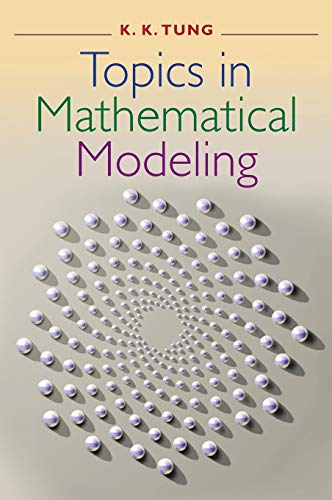
Topics in Mathematical Modeling is an introductory textbook on mathematical modeling. The book teaches how simple mathematics can help formulate and solve real problems of current research interest in a wide range of fields, including biology, ecology, computer science, geophysics, engineering, and the social sciences. Yet the prerequisites are minimal: calculus and elementary differential equations. Among the many topics addressed are HIV; plant phyllotaxis; global warming; the World Wide Web; plant and animal vascular networks; social networks; chaos and fractals; marriage and divorce; and El Niño. Traditional modeling topics such as predator-prey interaction, harvesting, and wars of attrition are also included. Most chapters begin with the history of a problem, follow with a demonstration of how it can be modeled using various mathematical tools, and close with a discussion of its remaining unsolved aspects. Designed for a one-semester course, the book progresses from problems that can be solved with relatively simple mathematics to ones that require more sophisticated methods. The math techniques are taught as needed to solve the problem being addressed, and each chapter is designed to be largely independent to give teachers flexibility. The book, which can be used as an overview and introduction to applied mathematics, is particularly suitable for sophomore, junior, and senior students in math, science, and engineering.
Die Inhaltsangabe kann sich auf eine andere Ausgabe dieses Titels beziehen.
Über die Autorin bzw. den Autor
K. K. Tung
Von der hinteren Coverseite
"This book has a refreshing style that should appeal to undergraduates. Indeed, the author has produced a textbook that might well achieve his goal of teaching applied mathematics without those being taught noticing!"--Andrew Wathen, University of Oxford
"With courses in mathematical modeling getting ever more popular, this book will make a valuable addition to the subject. It deals with topics that should be appealing even to students not majoring in math or science, and the level of mathematical sophistication is carefully increased throughout the book."--Henrik Kalisch, University of Bergen, Norway
Aus dem Klappentext
"This book has a refreshing style that should appeal to undergraduates. Indeed, the author has produced a textbook that might well achieve his goal of teaching applied mathematics without those being taught noticing!"--Andrew Wathen, University of Oxford
"With courses in mathematical modeling getting ever more popular, this book will make a valuable addition to the subject. It deals with topics that should be appealing even to students not majoring in math or science, and the level of mathematical sophistication is carefully increased throughout the book."--Henrik Kalisch, University of Bergen, Norway
Auszug. © Genehmigter Nachdruck. Alle Rechte vorbehalten.
Topics in Mathematical Modeling
By K. K. TungPRINCETON UNIVERSITY PRESS
Copyright © 2007 Ka-Kit Tung
All rights reserved.
ISBN: 978-0-691-11642-6All rights reserved.
Contents
Preface, xiii,
1 Fibonacci Numbers, the Golden Ratio, and Laws of Nature?,
2 Scaling Laws of Life, the Internet, and Social Networks,
3 Modeling Change One Step at a Time,
4 Differential Equation Models: Carbon Dating, Age of the Universe, HIV Modeling,
5 Modeling in the Physical Sciences, Kepler, Newton, and Calculus,
6 Nonlinear Population Models: An Introduction to Qualitative Analysis Using Phase Planes,
7 Discrete Time Logistic Map, Periodic and Chaotic Solutions,
8 Snowball Earth and Global Warming,
9 Interactions: Predator–Prey, Spraying of Pests, Carnivores in Australia,
10 Marriage and Divorce,
11 Chaos in Deterministic Continuous Systems, Poincaré and Lorenz,
12 El Niño and the Southern Oscillation,
13 Age of the Earth: Lord Kelvin's Model,
14 Collapsing Bridges: Broughton and Tacoma Narrows,
APPENDIX A: Differential Equations and Their Solutions,
APPENDIX B: MATLAB Codes,
Bibliography, 287,
Index, 293,
CHAPTER 1
Fibonacci Numbers, the Golden Ratio, and Laws of Nature?
Mathematics required:
high school algebra, geometry, and trigonometry; concept of limits from precalculus
Mathematics introduced:
difference equations with constant coefficients and their solution; rational approximation to irrational numbers; continued fractions
1.1 Leonardo Fibonacci
Leonardo of Pisa (1175–1250), better known to later Italian mathematicians as Fibonacci (Figure 1.1), was born in Pisa, Italy, and in 1192 went to North Africa (Bugia, Algeria) to live with his father, a customs officer for the Pisan trading colony. His father arranged for the son's instruction in calculational techniques, intending for Leonardo to become a merchant. Leonardo learned the Hindu-Arabic numerals (Figure 1.2) from one of his "excellent" Arab instructors. He further broadened his mathematical horizons on business trips to Egypt, Syria, Greece, Sicily, and Provence. Fibonacci returned to Pisa in 1200 and published a book in 1202 entitled Liber Abaci (Book of the Abacus), which contains a compilation of mathematics known since the Greeks. The book begins with the first introduction to the Western business world of the decimal number system:
These are the nine figures of the Indians: 9, 8, 7, 6, 5, 4, 3, 2, 1. With these nine figures, and with the sign 0, which in Arabic is called zephirum, any number can be written, as will be demonstrated.
Since we have ten fingers and ten toes, one may think that there should be nothing more natural than to count in tens, but that was not the case in Europe at the time. Fibonacci himself was doing calculations using the Babylonian system of base 60! (It is not as strange as it seems; the remnant of the sexagesimal system can still be found in our measures of angles and time.)
The third section of Liber Abaci contains a puzzle:
A certain man put a pair of rabbits in a place surrounded on all sides by a wall. How many pairs of rabbits can be produced from that pair in a year if it is supposed that each month each pair begets a new pair which from the second month on becomes productive?
In solving this problem, a sequence of numbers, 1, 1, 2, 3, 5, 8, 13, 21, 34, 55, ..., emerges, as we will show in a moment. This sequence is now known as the Fibonacci sequence.
The above problem involving incestuous rabbits is admittedly unrealistic, but similar problems can be phrased in more plausible contexts: A plant (tree) has to grow two months before it branches, and then it branches every month. The new shoot also has to grow for two months before it branches (see Figure 1.3). The number of branches, including the original trunk, is, if one counts from the bottom in intervals of one month's growth: 1, 1, 2, 3, 5, 8, 13,. ... The plant Achillea ptarmica, the "sneezewort," is observed to grow in this pattern.
The Fibonacci sequence also appears in the family tree of honey bees. The male bee, called the drone, develops from the unfertilized egg of the queen bee. Other than the queen, female bees do not reproduce. They are the worker bees. Female bees are produced when the queen mates with the drones. The queen bee develops when a female bee is fed the royal jelly, a special form of honey. So a male bee has only one parent, a mother, while a female bee, be it the queen or a worker bee, has both a mother and a father. If we count the number of parents and grandparents and great grandparents, etc., of a male bee, we will get 1, 1, 2, 3, 5, 8, ..., a Fibonacci sequence.
Let's return to the original mathematical problem posed by Fibonacci, which we haven't yet quite solved. We actually want to solve it more generally, to find the number of pairs of rabbits n months after the first pair was introduced. Let this quantity be denoted by Fn. We assume that the initial pair of rabbits is one month old and that we count rabbits just before newborns arrive.
One way to proceed is simply to enumerate, thus generating a sequence of numbers. Once we have a sufficiently long sequence, we would hopefully be able to see the now famous Fibonacci pattern (Figure 1.4).
After one month, the first pair becomes two months old and is ready to reproduce, but the census is taken before the birth. So F1 = 1, but F2 = 2; by the time they are counted, the newborns are already one month old. The parents are ready to give birth again, but the one-month-old offspring are too young to reproduce. Thus F3 = 3. At the end of three months, both the original pair and its offspring are productive, although the births are counted in the next period. Thus F4 = 5. A month later, an additional pair becomes productive. The three productive pairs add three new pairs of offspring to the population. Thus F5 = 8. At five months, there are five productive pairs: the first-generation parents, four second-generation adults, and one third-generation pair born in the second month. Thus F6 = 13. It now gets more difficult to keep track of all the rabbits, but one can use the aid of a table to keep account of the ages of the offspring. With some difficulty, we obtain the following sequence for the number of rabbit pairs after n months, for n = 0, 1, 2, 3, 4, 5, 6, 7, 8, 9, 10, 11, 12, ...: 1, 1, 2, 3, 5, 8, 13, 21, 34, 55, 89, 144, 233, 377,....
This is the sequence first generated by Fibonacci. The answer to his original question is F12 = 233.
If we had decided to count rabbits after the newborns arrive instead of before, we would have to deal with three types of rabbits: newborns, one-month-olds, and mature (two-month-old or older) rabbits. In this case, the Fibonacci sequence would have shifted by one, to: 1, 2, 3, 5, 8, 13, 21, 34, 55, 89, 144, 233,. ... The initial 1 is missing, which, however, can be added back if we assume that the first pair introduced is newborn. It then takes two months for them to become productive. The discussion below works with either convention.
To find Fn for a general positive integer n, we hope that we can see a pattern in the sequence of numbers already found. A sharp eye can now detect that any number in the sequence is always the sum of the two numbers preceding it. That is,
Fn+2 = Fn+1 + Fn, for n = 0, 1, 2, 3,. ... (1.1)
A second way of...
„Über diesen Titel“ kann sich auf eine andere Ausgabe dieses Titels beziehen.
Suchergebnisse für Topics in Mathematical Modeling

Beispielbild für diese ISBN
Topics in Mathematical Modeling
Verlag:
Princeton University Press, 2007
ISBN 10: 0691116423
ISBN 13: 9780691116426
Gebraucht
Hardcover
Anbieter: World of Books (was SecondSale), Montgomery, IL, USA
Verkäuferbewertung 5 von 5 Sternen

Hardback. Zustand: Good. Teaches how simple mathematics can help formulate and solve real problems of research interest in a range of fields, including biology, ecology, computer science, geophysics, engineering, and the social sciences. This book also includes traditional modeling topics such as predator-prey interaction, harvesting, and wars of attrition. Bestandsnummer des Verkäufers 00108580960
Gebraucht kaufen
EUR 3,88
Versand gratis
Versand innerhalb von USA
Versand innerhalb von USA
Anzahl: 1 verfügbar
Beispielbild für diese ISBN
Topics in Mathematical Modeling
Verlag:
Princeton University Press, 2007
ISBN 10: 0691116423
ISBN 13: 9780691116426
Gebraucht
Hardcover
Anbieter: World of Books Inc, Montgomery, IL, USA
Verkäuferbewertung 4 von 5 Sternen

Hardback. Zustand: Good. Teaches how simple mathematics can help formulate and solve real problems of research interest in a range of fields, including biology, ecology, computer science, geophysics, engineering, and the social sciences. This book also includes traditional modeling topics such as predator-prey interaction, harvesting, and wars of attrition. Bestandsnummer des Verkäufers CIN0691116423G
Gebraucht kaufen
EUR 5,71
Versand gratis
Versand innerhalb von USA
Versand innerhalb von USA
Anzahl: 1 verfügbar
Beispielbild für diese ISBN
Topics in Mathematical Modeling
Verlag:
Princeton University Press, 2007
ISBN 10: 0691116423
ISBN 13: 9780691116426
Gebraucht
Hardcover
Anbieter: Evergreen Goodwill, Seattle, WA, USA
Verkäuferbewertung 5 von 5 Sternen
hardcover. Zustand: Good. Bestandsnummer des Verkäufers mon0000816324
Gebraucht kaufen
EUR 2,75
EUR 3,55 Versand
Versand innerhalb von USA
Versand innerhalb von USA
Anzahl: 1 verfügbar
Beispielbild für diese ISBN
Topics in Mathematical Modeling
Verlag:
Princeton University Press, 2007
ISBN 10: 0691116423
ISBN 13: 9780691116426
Gebraucht
Hardcover
Anbieter: ThriftBooks-Atlanta, AUSTELL, GA, USA
Verkäuferbewertung 5 von 5 Sternen
Hardcover. Zustand: Good. No Jacket. Pages can have notes/highlighting. Spine may show signs of wear. ~ ThriftBooks: Read More, Spend Less. Bestandsnummer des Verkäufers G0691116423I3N00
Gebraucht kaufen
EUR 6,39
Versand gratis
Versand innerhalb von USA
Versand innerhalb von USA
Anzahl: 1 verfügbar
Beispielbild für diese ISBN
Topics in Mathematical Modeling
Verlag:
Princeton University Press, 2007
ISBN 10: 0691116423
ISBN 13: 9780691116426
Gebraucht
Hardcover
Anbieter: ThriftBooks-Dallas, Dallas, TX, USA
Verkäuferbewertung 5 von 5 Sternen
Hardcover. Zustand: Good. No Jacket. Pages can have notes/highlighting. Spine may show signs of wear. ~ ThriftBooks: Read More, Spend Less. Bestandsnummer des Verkäufers G0691116423I3N00
Gebraucht kaufen
EUR 6,39
Versand gratis
Versand innerhalb von USA
Versand innerhalb von USA
Anzahl: 1 verfügbar
Beispielbild für diese ISBN
Topics in Mathematical Modeling
Verlag:
Princeton University Press, 2007
ISBN 10: 0691116423
ISBN 13: 9780691116426
Gebraucht
Hardcover
Anbieter: HPB-Red, Dallas, TX, USA
Verkäuferbewertung 5 von 5 Sternen
Hardcover. Zustand: Good. Connecting readers with great books since 1972! Used textbooks may not include companion materials such as access codes, etc. May have some wear or writing/highlighting. We ship orders daily and Customer Service is our top priority! Bestandsnummer des Verkäufers S_425408838
Gebraucht kaufen
EUR 4,58
EUR 3,33 Versand
Versand innerhalb von USA
Versand innerhalb von USA
Anzahl: 1 verfügbar
Foto des Verkäufers
Topics in Mathematical Modeling
Verlag:
Princeton University Press, 2007
ISBN 10: 0691116423
ISBN 13: 9780691116426
Gebraucht
Hardcover
Anbieter: Goodwill Books, Hillsboro, OR, USA
Verkäuferbewertung 5 von 5 Sternen
Zustand: acceptable. Fairly worn, but readable and intact. If applicable: Dust jacket, disc or access code may not be included. Bestandsnummer des Verkäufers GICWV.0691116423.A
Gebraucht kaufen
EUR 4,58
EUR 3,55 Versand
Versand innerhalb von USA
Versand innerhalb von USA
Anzahl: 1 verfügbar
Beispielbild für diese ISBN
Topics in Mathematical Modeling
Verlag:
Princeton University Press, 2007
ISBN 10: 0691116423
ISBN 13: 9780691116426
Gebraucht
Hardcover
Anbieter: SVFOL Bookstore, Sierra Vista, AZ, USA
Verkäuferbewertung 4 von 5 Sternen
hardcover. Zustand: Good. GOOD - Dust jacket is not included LIKE NEW / VERY GOOD - No missing or damaged pages LIKE NEW / VERY GOOD - No text or writing on the pages or in the margins LIKE NEW / VERY GOOD - No underlining or highlighting of text VERY GOOD - Cover has very minimal wear and tear with no obvious damage VERY GOOD - Zero to Limited corner dings and/or curled corners. Bestandsnummer des Verkäufers mon0000008455
Gebraucht kaufen
EUR 7,55
EUR 5,10 Versand
Versand innerhalb von USA
Versand innerhalb von USA
Anzahl: 1 verfügbar
Beispielbild für diese ISBN
Topics in Mathematical Modeling
Verlag:
Princeton University Press, 2007
ISBN 10: 0691116423
ISBN 13: 9780691116426
Gebraucht
Hardcover
Anbieter: HPB-Diamond, Dallas, TX, USA
Verkäuferbewertung 5 von 5 Sternen
Hardcover. Zustand: Very Good. Connecting readers with great books since 1972! Used books may not include companion materials, and may have some shelf wear or limited writing. We ship orders daily and Customer Service is our top priority! Bestandsnummer des Verkäufers S_486210612
Gebraucht kaufen
EUR 18,30
EUR 3,33 Versand
Versand innerhalb von USA
Versand innerhalb von USA
Anzahl: 1 verfügbar
Beispielbild für diese ISBN
Topics in Mathematical Modeling
Verlag:
Princeton University Press, 2007
ISBN 10: 0691116423
ISBN 13: 9780691116426
Gebraucht
Hardcover
Anbieter: Anybook.com, Lincoln, Vereinigtes Königreich
Verkäuferbewertung 5 von 5 Sternen
Zustand: Good. This is an ex-library book and may have the usual library/used-book markings inside.This book has hardback covers. In good all round condition. Please note the Image in this listing is a stock photo and may not match the covers of the actual item,900grams, ISBN:9780691116426. Bestandsnummer des Verkäufers 9973665
Gebraucht kaufen
EUR 13,14
EUR 15,34 Versand
Versand von Vereinigtes Königreich nach USA
Versand von Vereinigtes Königreich nach USA
Anzahl: 1 verfügbar