
Verwandte Artikel zu Complex Adaptive Systems: An Introduction to Computational...
Complex Adaptive Systems: An Introduction to Computational Models of Social Life (Princeton Studies in Complexity) - Softcover
Buch 2 von 16: Princeton Studies in Complexity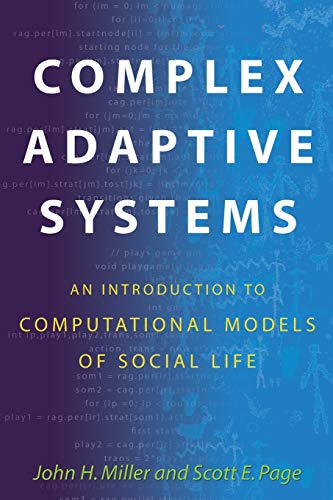
Inhaltsangabe
This book provides the first clear, comprehensive, and accessible account of complex adaptive social systems, by two of the field's leading authorities. Such systems--whether political parties, stock markets, or ant colonies--present some of the most intriguing theoretical and practical challenges confronting the social sciences. Engagingly written, and balancing technical detail with intuitive explanations, Complex Adaptive Systems focuses on the key tools and ideas that have emerged in the field since the mid-1990s, as well as the techniques needed to investigate such systems. It provides a detailed introduction to concepts such as emergence, self-organized criticality, automata, networks, diversity, adaptation, and feedback. It also demonstrates how complex adaptive systems can be explored using methods ranging from mathematics to computational models of adaptive agents. John Miller and Scott Page show how to combine ideas from economics, political science, biology, physics, and computer science to illuminate topics in organization, adaptation, decentralization, and robustness. They also demonstrate how the usual extremes used in modeling can be fruitfully transcended.
Die Inhaltsangabe kann sich auf eine andere Ausgabe dieses Titels beziehen.
Über die Autorin bzw. den Autor
John H. Miller is professor of economics and social sciences at Carnegie Mellon University. Scott E. Page is professor of complex systems, political science, and economics at the University of Michigan. He is the author of The Difference (Princeton).
Von der hinteren Coverseite
"The use of computational, especially agent-based, models has already shown its value in illuminating the study of economic and other social processes. Miller and Page have written an orientation to this field that is a model of motivation and insight, making clear the underlying thinking and illustrating it by varied and thoughtful examples. It conveys with remarkable clarity the essentials of the complex systems approach to the embarking researcher."--Kenneth J. Arrow, winner of the Nobel Prize in economics
"In Complex Adaptive Systems, two masters of this burgeoning field provide a highly readable and novel restatement of the logic of social interactions, linking individually based micro processes to macrosocial outcomes, ranging from Adam Smith's invisible hand to Thomas Schelling's models of standing ovations. The book combines the vision of a new Santa Fe school of computational, social, and behavioral science with essential 'how to' advice for apprentice modelers."--Samuel Bowles, author of Microeconomics: Behavior, Institutions, Evolution
"This is a wonderful book that will be read by graduate students, faculty, and policymakers. The authors write in an extraordinarily clear manner about topics that are very technical and difficult for many people. I sat down to begin thumbing through and found myself deeply engaged."--Elinor Ostrom, author of Understanding Institutional Diversity
Auszug. © Genehmigter Nachdruck. Alle Rechte vorbehalten.
Complex Adaptive Systems
AN INTRODUCTION TO COMPUTATIONAL MODELS OF SOCIAL LIFEBy John H. Miller Scott E. PagePRINCETON UNIVERSITY PRESS
Copyright © 2007 John H. Miller and Scott E. PageAll right reserved.
ISBN: 978-0-691-12702-6
Contents
List of Figures............................................................xiiiList of Tables.............................................................xvPreface....................................................................xviiPart I Introduction........................................................11 Introduction.............................................................32 Complexity in Social Worlds..............................................9Part II Preliminaries......................................................333 Modeling.................................................................354 On Emergence.............................................................44Part III Computational Modeling............................................555 Computation as Theory....................................................576 Why Agent-Based Objects?.................................................78Part IV Models of Complex Adaptive Social Systems..........................917 A Basic Framework........................................................938 Complex Adaptive Social Systems in One Dimension.........................1149 Social Dynamics..........................................................14110 Evolving Automata.......................................................17811 Some Fundamentals of Organizational Decision Making.....................200Part V Conclusions.........................................................21112 Social Science in Between...............................................213Epilogue...................................................................227A An Open Agenda For Complex Adaptive Social Systems.......................231B Practices for Computational Modeling.....................................245Bibliography...............................................................255Index......................................................................261
Chapter One
IntroductionThe goal of science is to make the wonderful and complex understandable and simple—but not less wonderful. —Herb Simon, Sciences of the Artificial
The process of scientific discovery is, in effect, a continual flight from wonder. —Albert Einstein, Autobiographical Notes
Adaptive social systems are composed of interacting, thoughtful (but perhaps not brilliant) agents. It would be difficult to date the exact moment that such systems first arose on our planet—perhaps it was when early single-celled organisms began to compete with one another for resources or, more likely, much earlier when chemical interactions in the primordial soup began to self-replicate. Once these adaptive social systems emerged, the planet underwent a dramatic change where, as Charles Darwin noted, "from so simple a beginning endless forms most beautiful and most wonderful have been, and are being, evolved." Indeed, we find ourselves at the beginning of a new millennium being not only continually surprised, delighted, and confounded by the unfolding of social systems with which we are well acquainted, but also in the enviable position of creating and crafting novel adaptive social systems such as those arising in computer networks.
What it takes to move from an adaptive system to a complex adaptive system is an open question and one that can engender endless debate. At the most basic level, the field of complex systems challenges the notion that by perfectly understanding the behavior of each component part of a system we will then understand the system as a whole. One and one may well make two, but to really understand two we must know both about the nature of "one" and the meaning of "and."
The hope is that we can build a science of complexity (an obvious misnomer, given the quest for simplicity that drives the scientific enterprise, though alternative names are equally egregious). Rather than venturing further on the well-trodden but largely untracked morass that attempts to define complex systems, for the moment we will rely on Supreme Court Justice Stewart's words in his concurring decision on a case dealing with obscenity (Jacobellis v. Ohio, 1964): "I shall not today attempt further to define the kinds of material I understand to be embraced within that shorthand description; and perhaps I could never succeed in intelligibly doing so. But I know it when I see it."
The field of complex systems must direct its "flight from wonder" toward discoveries that "make the wonderful and complex understandable and simple." We hope that there is a complex systems equivalent of Newton's Laws of Motion that will one day make our current computer simulations appear to us as archaic as machines implementing Ptolemy's epicycles. Even when the fundamental laws of complex adaptive social systems are uncovered, however, it is unlikely that our flight from wonder will be complete. Knowing Newton's Laws of Motion reveals a key simplicity in the world around us, and while we may take delight in the power of so simple an idea to explain the motion of our universe, the thrill of the discovery quickly wanes with the mundaneness of the outcome. Laws emerging from complex adaptive systems have an entirely different character—knowing Darwin's theory of evolution in no way diminishes the wonder that ensues as we observe its implications.
Writings on complexity in the social sciences go back hundreds of years, with Adam Smith's The Wealth of Nations (1776) representing one of the earliest and most cohesive discussions of the topic (see figure 1.1). One of the prime drivers of economic theory over the past two centuries has been Smith's concept of an "invisible hand" leading collections of self-interested agents into well-formed structures that are no part of any single agent's intention. Although much theoretical progress has been made on this idea, for example, the elegant proofs of existence given by Arrow and Debreu or the various contributions based on fanciful mechanisms like Walrasian auctioneers, the actual mechanisms behind the invisible hand still remain largely, dare we say, invisible.
Indeed, the tools and ideas that have been developed over the past decade hint at a new world of scientific possibilities for understanding complex adaptive social systems. While our ability to theorize about social systems has always been vast, the set of tools available for pursuing these theories has often constrained our theoretical dreams either implicitly or explicitly. Smith faced few limits while writing about the complexity of the world around him, whereas Arrow and Debreu's existence proof required a much more constrained view of social behavior. Often, tools get mistaken for theories with unfortunate consequences; elaborate computer programs (perhaps with lovely graphics) or mathematical derivations are occasionally assumed to make a real scientific statement, regardless of their scientific underpinnings. Indeed, entire literatures have undergone successive refinements and scientific degradation, during each generation of which the original theoretical notions driving the investigation are crowded out by an increasing focus on tool adeptness. This often results in science...
„Über diesen Titel“ kann sich auf eine andere Ausgabe dieses Titels beziehen.
Suchergebnisse für Complex Adaptive Systems: An Introduction to Computational...

Beispielbild für diese ISBN
Complex Adaptive Systems: An Introduction to Computational Models of Social Life
Verlag:
Princeton University Press, 2007
ISBN 10: 0691127026
ISBN 13: 9780691127026
Gebraucht
Paperback
Anbieter: World of Books (was SecondSale), Montgomery, IL, USA
Verkäuferbewertung 5 von 5 Sternen

Paperback. Zustand: Good. This book provides the first clear, comprehensive, and accessible account of complex adaptive social systems, by two of the field's leading authorities. Such systems--whether political parties, stock markets, or ant colonies--present some of the most intriguing theoretical and practical challenges confronting the social sciences. Engagingly written, and balancing technical detail with intuitive explanations, Complex Adaptive Systems focuses on the key tools and ideas that have emerged in the field since the mid-1990s, as well as the techniques needed to investigate such systems. It provides a detailed introduction to concepts such as emergence, self-organized criticality, automata, networks, diversity, adaptation, and feedback. It also demonstrates how complex adaptive systems can be explored using methods ranging from mathematics to computational models of adaptive agents. John Miller and Scott Page show how to combine ideas from economics, political science, biology, physics, and computer science to illuminate topics in organization, adaptation, decentralization, and robustness. They also demonstrate how the usual extremes used in modeling can be fruitfully transcended. Bestandsnummer des Verkäufers 00110167535
Gebraucht kaufen
EUR 11,22
Versand gratis
Versand innerhalb von USA
Versand innerhalb von USA
Anzahl: 2 verfügbar
Beispielbild für diese ISBN
Complex Adaptive Systems: An Introduction to Computational Models of Social Life
Verlag:
Princeton University Press, 2007
ISBN 10: 0691127026
ISBN 13: 9780691127026
Gebraucht
Paperback
Anbieter: World of Books (was SecondSale), Montgomery, IL, USA
Verkäuferbewertung 5 von 5 Sternen
Paperback. Zustand: Fair. This book provides the first clear, comprehensive, and accessible account of complex adaptive social systems, by two of the field's leading authorities. Such systems--whether political parties, stock markets, or ant colonies--present some of the most intriguing theoretical and practical challenges confronting the social sciences. Engagingly written, and balancing technical detail with intuitive explanations, Complex Adaptive Systems focuses on the key tools and ideas that have emerged in the field since the mid-1990s, as well as the techniques needed to investigate such systems. It provides a detailed introduction to concepts such as emergence, self-organized criticality, automata, networks, diversity, adaptation, and feedback. It also demonstrates how complex adaptive systems can be explored using methods ranging from mathematics to computational models of adaptive agents. John Miller and Scott Page show how to combine ideas from economics, political science, biology, physics, and computer science to illuminate topics in organization, adaptation, decentralization, and robustness. They also demonstrate how the usual extremes used in modeling can be fruitfully transcended. Bestandsnummer des Verkäufers 00110381581
Gebraucht kaufen
EUR 11,22
Versand gratis
Versand innerhalb von USA
Versand innerhalb von USA
Anzahl: 1 verfügbar
Foto des Verkäufers
Complex Adaptive Systems: An Introduction to Computational Models of Social Life (Princeton Studies in Complexity)
Verlag:
Princeton University Press, 2007
ISBN 10: 0691127026
ISBN 13: 9780691127026
Gebraucht
Softcover
Anbieter: Gate City Books, GREENSBORO, NC, USA
Verkäuferbewertung 5 von 5 Sternen
Zustand: acceptable. USED book in ACCEPTABLE condition. Cover and pages are in tact but may show creases, tears, water damage, handwriting, underlining, or highlighting. May be missing dust jacket. Supplemental items such as access codes and CDs not guaranteed. Bestandsnummer des Verkäufers GCM.3LX1
Gebraucht kaufen
EUR 11,22
Versand gratis
Versand innerhalb von USA
Versand innerhalb von USA
Anzahl: 1 verfügbar
Beispielbild für diese ISBN
Complex Adaptive Systems: An Introduction to Computational Models of Social Life (Princeton Studies in Complexity)
Verlag:
Princeton University Press (edition ), 2007
ISBN 10: 0691127026
ISBN 13: 9780691127026
Gebraucht
Paperback
Anbieter: BooksRun, Philadelphia, PA, USA
Verkäuferbewertung 5 von 5 Sternen
Paperback. Zustand: Very Good. It's a well-cared-for item that has seen limited use. The item may show minor signs of wear. All the text is legible, with all pages included. It may have slight markings and/or highlighting. Bestandsnummer des Verkäufers 0691127026-11-1
Gebraucht kaufen
EUR 11,27
Versand gratis
Versand innerhalb von USA
Versand innerhalb von USA
Anzahl: 1 verfügbar
Beispielbild für diese ISBN
Complex Adaptive Systems: An Introduction to Computational Models of Social Life (Princeton Studies in Complexity)
Verlag:
Princeton University Press, 2007
ISBN 10: 0691127026
ISBN 13: 9780691127026
Gebraucht
Paperback
Anbieter: HPB-Red, Dallas, TX, USA
Verkäuferbewertung 5 von 5 Sternen
Paperback. Zustand: Good. Connecting readers with great books since 1972! Used textbooks may not include companion materials such as access codes, etc. May have some wear or writing/highlighting. We ship orders daily and Customer Service is our top priority! Bestandsnummer des Verkäufers S_463225641
Gebraucht kaufen
EUR 9,56
EUR 3,34 Versand
Versand innerhalb von USA
Versand innerhalb von USA
Anzahl: 1 verfügbar
Beispielbild für diese ISBN
Complex Adaptive Systems: An Introduction to Computational Models of Social Life
Verlag:
Princeton University Press, 2007
ISBN 10: 0691127026
ISBN 13: 9780691127026
Gebraucht
Paperback
Anbieter: World of Books Inc, Montgomery, IL, USA
Verkäuferbewertung 4 von 5 Sternen

Paperback. Zustand: Good. This book provides the first clear, comprehensive, and accessible account of complex adaptive social systems, by two of the field's leading authorities. Such systems--whether political parties, stock markets, or ant colonies--present some of the most intriguing theoretical and practical challenges confronting the social sciences. Engagingly written, and balancing technical detail with intuitive explanations, Complex Adaptive Systems focuses on the key tools and ideas that have emerged in the field since the mid-1990s, as well as the techniques needed to investigate such systems. It provides a detailed introduction to concepts such as emergence, self-organized criticality, automata, networks, diversity, adaptation, and feedback. It also demonstrates how complex adaptive systems can be explored using methods ranging from mathematics to computational models of adaptive agents. John Miller and Scott Page show how to combine ideas from economics, political science, biology, physics, and computer science to illuminate topics in organization, adaptation, decentralization, and robustness. They also demonstrate how the usual extremes used in modeling can be fruitfully transcended. Bestandsnummer des Verkäufers CIN0691127026G
Gebraucht kaufen
EUR 13,05
Versand gratis
Versand innerhalb von USA
Versand innerhalb von USA
Anzahl: 2 verfügbar
Beispielbild für diese ISBN
Complex Adaptive Systems: An Introduction to Computational Models of Social Life
Verlag:
Princeton University Press, 2007
ISBN 10: 0691127026
ISBN 13: 9780691127026
Gebraucht
Paperback
Anbieter: World of Books Inc, Montgomery, IL, USA
Verkäuferbewertung 4 von 5 Sternen
Paperback. Zustand: Fair. This book provides the first clear, comprehensive, and accessible account of complex adaptive social systems, by two of the field's leading authorities. Such systems--whether political parties, stock markets, or ant colonies--present some of the most intriguing theoretical and practical challenges confronting the social sciences. Engagingly written, and balancing technical detail with intuitive explanations, Complex Adaptive Systems focuses on the key tools and ideas that have emerged in the field since the mid-1990s, as well as the techniques needed to investigate such systems. It provides a detailed introduction to concepts such as emergence, self-organized criticality, automata, networks, diversity, adaptation, and feedback. It also demonstrates how complex adaptive systems can be explored using methods ranging from mathematics to computational models of adaptive agents. John Miller and Scott Page show how to combine ideas from economics, political science, biology, physics, and computer science to illuminate topics in organization, adaptation, decentralization, and robustness. They also demonstrate how the usual extremes used in modeling can be fruitfully transcended. Bestandsnummer des Verkäufers CIN0691127026A
Gebraucht kaufen
EUR 13,05
Versand gratis
Versand innerhalb von USA
Versand innerhalb von USA
Anzahl: 1 verfügbar
Foto des Verkäufers
Complex Adaptive Systems: An Introduction to Computational Models of Social Life (Princeton Studies in Complexity)
Verlag:
Princeton University Press, 2007
ISBN 10: 0691127026
ISBN 13: 9780691127026
Gebraucht
Softcover
Anbieter: clickgoodwillbooks, Indianapolis, IN, USA
Verkäuferbewertung 4 von 5 Sternen
Zustand: acceptable. Used - Acceptable: All pages and the cover are intact, but shrink wrap, dust covers, or boxed set case may be missing. Pages may include limited notes, highlighting, or minor water damage but the text is readable. Item may be missing bundled media. Bestandsnummer des Verkäufers 3O6JUN001G7L_ns
Gebraucht kaufen
EUR 9,57
EUR 3,55 Versand
Versand innerhalb von USA
Versand innerhalb von USA
Anzahl: 1 verfügbar
Beispielbild für diese ISBN
Complex Adaptive Systems: An Introduction to Computational Models of Social Life: An Introduction to Computational Models of Social Life
Verlag:
Princeton University Press, 2007
ISBN 10: 0691127026
ISBN 13: 9780691127026
Gebraucht
Paperback
Anbieter: ThriftBooks-Atlanta, AUSTELL, GA, USA
Verkäuferbewertung 5 von 5 Sternen
Paperback. Zustand: Very Good. No Jacket. May have limited writing in cover pages. Pages are unmarked. ~ ThriftBooks: Read More, Spend Less. Bestandsnummer des Verkäufers G0691127026I4N00
Gebraucht kaufen
EUR 13,23
Versand gratis
Versand innerhalb von USA
Versand innerhalb von USA
Anzahl: 1 verfügbar
Beispielbild für diese ISBN
Complex Adaptive Systems: An Introduction to Computational Models of Social Life (Princeton Studies in Complexity)
Verlag:
Princeton University Press, 2007
ISBN 10: 0691127026
ISBN 13: 9780691127026
Gebraucht
Paperback
Anbieter: HPB-Emerald, Dallas, TX, USA
Verkäuferbewertung 5 von 5 Sternen
Paperback. Zustand: Very Good. Connecting readers with great books since 1972! Used books may not include companion materials, and may have some shelf wear or limited writing. We ship orders daily and Customer Service is our top priority! Bestandsnummer des Verkäufers S_483360793
Gebraucht kaufen
EUR 10,99
EUR 3,34 Versand
Versand innerhalb von USA
Versand innerhalb von USA
Anzahl: 1 verfügbar