
Verwandte Artikel zu How Many Languages Do We Need?: The Economics of Linguistic...
Inhaltsangabe
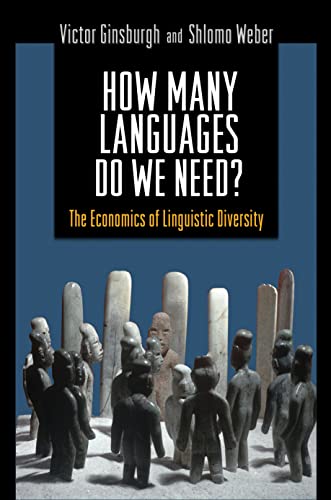
In the global economy, linguistic diversity influences economic and political development as well as public policies in positive and negative ways. It leads to financial costs, communication barriers, divisions in national unity, and, in some extreme cases, conflicts and war--but it also produces benefits related to group and individual identity. What are the specific advantages and disadvantages of linguistic diversity and how does it influence social and economic progress? This book examines linguistic diversity as a global social phenomenon and considers what degree of linguistic variety might result in the greatest economic good.
Victor Ginsburgh and Shlomo Weber look at linguistic proximity between groups and between languages. They describe and use simple economic, linguistic, and statistical tools to measure diversity's impact on growth, development, trade, the quality of institutions, translation issues, voting patterns in multinational competitions, and the likelihood and intensity of civil conflicts. They address the choosing of core languages in a multilingual community, such as the European Union, and argue that although too many official languages might harm cohesiveness, efficiency, and communication, reducing their number brings about alienation and disenfranchisement of groups.
Demonstrating that the value and drawbacks of linguistic diversity are universal, How Many Languages Do We Need? suggests ways for designing appropriate linguistic policies for today's multilingual world.
Die Inhaltsangabe kann sich auf eine andere Ausgabe dieses Titels beziehen.
Über die Autorin bzw. den Autor
Victor Ginsburgh is professor of economics emeritus, member of the European Center for Advanced Research in Economics and Statistics, Brussels, and member of the Center of Operations Research and Econometrics, Louvain-la-Neuve, Belgium. Shlomo Weber is the Robert H. and Nancy Dedman Trustee Professor of Economics at Southern Methodist University and professor of economics at the New Economic School, Moscow.
Von der hinteren Coverseite
"A language is both a means of communication and a repository of culture. By limiting the number of languages, we make it easier for people to understand one another, but we leave the world a less interesting place. Victor Ginsburgh and Shlomo Weber explore this trade-off and much else in their rich and fascinating book."--Eric S. Maskin, Nobel Laureate in Economics
"The authors succeed brilliantly in laying out a coherent framework that explains the critical and substantive issues for the economics of linguistic diversity."--Antonio Merlo, University of Pennsylvania
"Language is what unifies people. It is also what divides them. This paradox was first observed in the Biblical story of the Tower of Babel, and the contradiction continues to plague modern times. Ginsburgh and Weber provide a brilliant analysis of this persistent and urgent problem, and they explore this vital question: given that linguistic diversity has costs, how much diversity can we afford in today's world?"--Dean Keith Simonton, University of California, Davis
"This book's argument is straightforward, the volume of literature assembled is impressive, and the econometric contribution is excellent. The authors prove that econometric methods can be expanded into a field as challenging as linguistic diversity."--Michael Hutter, Technische Universität Berlin
"While there has been a great deal of work on linguistic diversity in economics over the last twenty years, no book has emerged on the topic to date. Examining matters from ethnography to labor, political, cultural, and trade issues, this accessible and important book fills the void."--Jacques Melitz, Heriot-Watt University
"There are few subjects as complex and sensitive as the use of languages in a society. The affection of an individual for his language reflects on the whole social group and the language becomes the property of the clan, tribe, territory, and nation. This book describes the range of issues that this raises and the complexities of the trade-off between protecting languages and the possible gains that would result from a reduction of their number."--Michel Vanden Abeele, former director general, Directorate-General for Translation of the European Commission
Auszug. © Genehmigter Nachdruck. Alle Rechte vorbehalten.
HOW MANY LANGUAGES DO WE NEED?
THE ECONOMICS OF LINGUISTIC DIVERSITYBy Victor Ginsburgh Shlomo WeberPRINCETON UNIVERSITY PRESS
Copyright © 2011 Princeton University PressAll right reserved.
ISBN: 978-0-691-13689-9
Contents
Acknowledgments................................................................................ixIntroduction...................................................................................11 My Language Is My Homeland...................................................................72 Linguistic Policies, Disenfranchisement, and Standardization.................................163 Linguistic, Genetic, and Cultural Distances: How Far Is Nostratic?...........................294 Distances Matter.............................................................................565 Individual Communicative Benefits............................................................846 Diversity and Disenfranchisement Indices.....................................................1087 Diversity and Disenfranchisement: Applications...............................................1428 Multilingualism in the European Union: A Case Study in Linguistic Policy.....................162Conclusions....................................................................................201Bibliography...................................................................................205Index..........................................................................................223
Chapter One
MY LANGUAGE IS MY HOMELANDMinha pátria é minha lengua. —Fernando Pessoa
Russian and Swahili. The authors of this book have two different native languages, Swahili and Russian. A few years ago, the Russian native speaker accompanied the Swahili native speaker on a trip to Belarus in search of traces of the latter's father, born in Vitebsk (as was Marc Chagall, at approximately the same time). The hotel receptionist was totally confused by the fact that the traveler with a Russian–Jewish name (the Swahili speaker) could not utter a word of Russian, while the other, with a German name, spoke fluent Russian. This was without the receptionist's knowing that the visitor with whom she was unable to communicate was a native Swahili speaker. The fruits of globalization, as we say. We live in a world where individuals, families, and communities often uproot themselves, voluntarily or involuntary, and move to another place, country, or even continent. In fact, both of the authors have gone through this experience at different stages of their lives. One of us was given less than a week to collect his belongings before leaving his native country. What does one take on a journey to a distant, unfamiliar land? Books,memories, records? A verymoving response to that dilemma is given by Ariel Dorfman, whose work was mentioned in the introduction. Dorfman (2002, 89) recalls Gabriel García Márquez's story of entire Colombian villages that migrated:
Fleeing from catastrophes, plagues perhaps, or recurrent floods, or merely the desolation of being caught in the middle of civil wars, inhabitants of these villages decided, at some point in history, to uproot themselves, moving to a remote location in search of peace. As they packed every belonging that could be transported, they did not forget what was most important to them: their dead. According to García Márquez, these villagers, on the verge of becoming nomads, dug up the bones in the cemetery and, in effect, carried their ancestors into the unknown, probably animated by the need to defy the fluctuations of time and geography with the illusion that something from the past permeates the present, forming a hard physical link to memory at a time of devastating change.
Even though the desire to sustain links with the past is not always expressed in such a dramatic form, an important part of cultural history and heritage is invariably linked with language. The sensitivity of linguistic identity is forcefully underlined by Henry Bretton (1976, 447):
Language then may indeed be the most explosive issue universally and over time. This mainly because language alone, unlike all other concerns associated with nationalism and ethnocentrism ... is so closely tied to the individual self. Fear of being deprived of communicating skills seems to raise political passions to a fever pitch.
When moving to distant lands, migrants take with them their language and begin a never-ending romance with it. Dorfman (2002, 90) continues:
That language, which contains the seeds of their most intimate identity, will be put to the test when the voyage is over, especially if the migrants are moving to a foreign land. This is because those who await them at the new location have their own dead, their own ceremonies and cemeteries, and, of course, their own tongue.
The voyage, even if accomplished successfully (whatever this means), leaves deep marks and scars. We learn different languages, assume different linguistic identities that may confuse others and sometimes ourselves.
The threat to the survival of values, practices, and history that is posed by migrations is not limited to individuals and communities. History is full of examples (and we discuss some of them in subsequent chapters) of linguistic groups and regions whose experiences include language conflict, inherent incompatibilities between language communities, reluctance of the majority group to concede linguistic rights to minorities, the power of civil servants to protect their linguistic privileges, and the important and unpredictable material and symbolic consequences of linguistic choices (Pool 1991).
Even entire countries can feel insecure about their linguistic survival under threats coming from outside. Consider Iceland, one of the few monolingual countries in the world and practically the only surviving example in Europe of a linguistically homogeneous nation-state. Almost every Icelander speaks Icelandic as a first language and uses it as the dominant language in all spheres of life (Vikor 2000). Even without an internal linguistic issue, however, the country still felt compelled to protect its own identity, closely linked with its language. For about four hundred years there were numerous attempts to purge the Icelandic language of foreign, mostly Danish, influence. More recently, the dominance of English has become a serious threat to Icelandic identity, which developed through centuries of isolation, literary works, and the fostering of independent cultural values. The protection of their language included the successful attempt by Icelanders to persuade Microsoft to add Icelandic to the list of languages supported by Windows. It took more than six years of persistent lobbying by Icelandic authorities to overturn an initial refusal by Microsoft, but in 2004 the company produced an Icelandic version of Windows XP and the Office Packet of associated programs (Corgan 2004). In the beginning of the twenty-first century Iceland was still spending about 3 percent of its gross domestic product on activities related to the promotion and defense of its language, including translating and printing an astonishing number of foreign textbooks and fiction. Recently, Iceland engaged in serious attempts to become a member of the EU. While the survival of the language is not usually listed as a reason for the European shift in the...
„Über diesen Titel“ kann sich auf eine andere Ausgabe dieses Titels beziehen.
Suchergebnisse für How Many Languages Do We Need?: The Economics of Linguistic...

Beispielbild für diese ISBN
How Many Languages Do We Need? The Economics of Linguistic Diversity
Verlag:
Princeton University Press, 2011
ISBN 10: 0691136890
ISBN 13: 9780691136899
Gebraucht
Hardcover
Anbieter: Mesquite Booksellers, Tucson, AZ, USA
Verkäuferbewertung 5 von 5 Sternen

Hardcover. Zustand: Very Good. Hardcover. With jacket. viii+232pp. Very good condition. This is an ex-library copy, so expect the usual associated markings and stickers (most of which are affixed to the plastic wrap of the jacket). The book itself is in exceptionally good condition, entirely free of markings, with crisp pages. Spine tight, binding sound. Apart from "Allen County Public Library" stamped at the top edge and a small date stamp on the lower left corner of the half-title, you could be entirely free of the library markings were you to remove the jacket's plastic wrap. (If you order this from outside the United States, we are likely to request an additional payment to help cover the postage.) Every order includes tracking and is wrapped and robustly packaged with care in Tucson, AZ. ~Mesquite Booksellers. Bestandsnummer des Verkäufers 74003
Gebraucht kaufen
EUR 25,69
EUR 2,58 Versand
Versand innerhalb von USA
Versand innerhalb von USA
Anzahl: 1 verfügbar
Beispielbild für diese ISBN
How Many Languages Do We Need?
Anbieter: PBShop.store US, Wood Dale, IL, USA
Verkäuferbewertung 5 von 5 Sternen
HRD. Zustand: New. New Book. Shipped from UK. Established seller since 2000. Bestandsnummer des Verkäufers WP-9780691136899
Beispielbild für diese ISBN
How Many Languages Make Sense? Economics of Linguistic Diversity The Economics of Linguistic Diversity Format: Hardcover
Verlag:
Princeton University Press, 2011
ISBN 10: 0691136890
ISBN 13: 9780691136899
Gebraucht
Hardcover
Anbieter: INDOO, Avenel, NJ, USA
Verkäuferbewertung 5 von 5 Sternen
Zustand: As New. Unread copy in mint condition. Bestandsnummer des Verkäufers PG9780691136899
Gebraucht kaufen
EUR 55,83
Versand gratis
Versand innerhalb von USA
Versand innerhalb von USA
Anzahl: Mehr als 20 verfügbar
Beispielbild für diese ISBN
How Many Languages Make Sense? Economics of Linguistic Diversity The Economics of Linguistic Diversity Format: Hardcover
Anbieter: INDOO, Avenel, NJ, USA
Verkäuferbewertung 5 von 5 Sternen
Zustand: New. Brand New. Bestandsnummer des Verkäufers 9780691136899
Neu kaufen
EUR 55,92
Versand gratis
Versand innerhalb von USA
Versand innerhalb von USA
Anzahl: Mehr als 20 verfügbar
Foto des Verkäufers
How Many Languages Do We Need?
Verlag:
Princeton University Press, US, 2011
ISBN 10: 0691136890
ISBN 13: 9780691136899
Neu
Hardcover
Anbieter: Rarewaves.com USA, London, LONDO, Vereinigtes Königreich
Verkäuferbewertung 5 von 5 Sternen
Hardback. Zustand: New. In the global economy, linguistic diversity influences economic and political development as well as public policies in positive and negative ways. It leads to financial costs, communication barriers, divisions in national unity, and, in some extreme cases, conflicts and war--but it also produces benefits related to group and individual identity. What are the specific advantages and disadvantages of linguistic diversity and how does it influence social and economic progress? This book examines linguistic diversity as a global social phenomenon and considers what degree of linguistic variety might result in the greatest economic good. Victor Ginsburgh and Shlomo Weber look at linguistic proximity between groups and between languages. They describe and use simple economic, linguistic, and statistical tools to measure diversity's impact on growth, development, trade, the quality of institutions, translation issues, voting patterns in multinational competitions, and the likelihood and intensity of civil conflicts.They address the choosing of core languages in a multilingual community, such as the European Union, and argue that although too many official languages might harm cohesiveness, efficiency, and communication, reducing their number brings about alienation and disenfranchisement of groups. Demonstrating that the value and drawbacks of linguistic diversity are universal, How Many Languages Do We Need? suggests ways for designing appropriate linguistic policies for today's multilingual world. Bestandsnummer des Verkäufers LU-9780691136899
Neu kaufen
EUR 57,03
Versand gratis
Versand von Vereinigtes Königreich nach USA
Versand von Vereinigtes Königreich nach USA
Anzahl: 1 verfügbar
Beispielbild für diese ISBN
How Many Languages Do We Need?: The Economics of Linguistic Diversity
Anbieter: Kennys Bookshop and Art Galleries Ltd., Galway, GY, Irland
Verkäuferbewertung 5 von 5 Sternen
Zustand: New. In the global economy, linguistic diversity influences economic and political development as well as public policies in positive and negative ways. This title examines linguistic diversity as a global social phenomenon and considers what degree of linguistic variety might result in the greatest economic good. Num Pages: 256 pages, 2 line illus. 34 tables. BIC Classification: CF; JFFS; KCA. Category: (P) Professional & Vocational; (U) Tertiary Education (US: College). Dimension: 240 x 163 x 21. Weight in Grams: 484. . 2011. Hardcover. . . . . Bestandsnummer des Verkäufers V9780691136899
Neu kaufen
EUR 49,91
EUR 9,50 Versand
Versand von Irland nach USA
Versand von Irland nach USA
Anzahl: 1 verfügbar
Beispielbild für diese ISBN
How Many Languages Do We Need?
Anbieter: PBShop.store UK, Fairford, GLOS, Vereinigtes Königreich
Verkäuferbewertung 5 von 5 Sternen
HRD. Zustand: New. New Book. Shipped from UK. Established seller since 2000. Bestandsnummer des Verkäufers WP-9780691136899
Neu kaufen
EUR 54,77
EUR 5,84 Versand
Versand von Vereinigtes Königreich nach USA
Versand von Vereinigtes Königreich nach USA
Anzahl: 2 verfügbar
Beispielbild für diese ISBN
How many languages do we need? the economics of linguistic diversity
Verlag:
Princeton University Press, New Jersey, 2011
ISBN 10: 0691136890
ISBN 13: 9780691136899
Neu
Hardcover
Anbieter: MARCIAL PONS LIBRERO, MADRID, M, Spanien
Verkäuferbewertung 4 von 5 Sternen

TAPA DURA. Zustand: New. Bestandsnummer des Verkäufers 100886529
Neu kaufen
EUR 40,76
EUR 21,00 Versand
Versand von Spanien nach USA
Versand von Spanien nach USA
Anzahl: 1 verfügbar
Foto des Verkäufers
How Many Languages Do We Need?
Verlag:
Princeton University Press, US, 2011
ISBN 10: 0691136890
ISBN 13: 9780691136899
Neu
Hardcover
Anbieter: Rarewaves USA, HEBRON, KY, USA
Verkäuferbewertung 5 von 5 Sternen
Hardback. Zustand: New. In the global economy, linguistic diversity influences economic and political development as well as public policies in positive and negative ways. It leads to financial costs, communication barriers, divisions in national unity, and, in some extreme cases, conflicts and war--but it also produces benefits related to group and individual identity. What are the specific advantages and disadvantages of linguistic diversity and how does it influence social and economic progress? This book examines linguistic diversity as a global social phenomenon and considers what degree of linguistic variety might result in the greatest economic good. Victor Ginsburgh and Shlomo Weber look at linguistic proximity between groups and between languages. They describe and use simple economic, linguistic, and statistical tools to measure diversity's impact on growth, development, trade, the quality of institutions, translation issues, voting patterns in multinational competitions, and the likelihood and intensity of civil conflicts.They address the choosing of core languages in a multilingual community, such as the European Union, and argue that although too many official languages might harm cohesiveness, efficiency, and communication, reducing their number brings about alienation and disenfranchisement of groups. Demonstrating that the value and drawbacks of linguistic diversity are universal, How Many Languages Do We Need? suggests ways for designing appropriate linguistic policies for today's multilingual world. Bestandsnummer des Verkäufers LU-9780691136899
Beispielbild für diese ISBN
How Many Languages Do We Need?: The Economics of Linguistic Diversity
Anbieter: Kennys Bookstore, Olney, MD, USA
Verkäuferbewertung 5 von 5 Sternen
Zustand: New. In the global economy, linguistic diversity influences economic and political development as well as public policies in positive and negative ways. This title examines linguistic diversity as a global social phenomenon and considers what degree of linguistic variety might result in the greatest economic good. Num Pages: 256 pages, 2 line illus. 34 tables. BIC Classification: CF; JFFS; KCA. Category: (P) Professional & Vocational; (U) Tertiary Education (US: College). Dimension: 240 x 163 x 21. Weight in Grams: 484. . 2011. Hardcover. . . . . Books ship from the US and Ireland. Bestandsnummer des Verkäufers V9780691136899
Neu kaufen
EUR 61,58
EUR 9,03 Versand
Versand innerhalb von USA
Versand innerhalb von USA
Anzahl: 1 verfügbar