
Verwandte Artikel zu Why Did Europe Conquer the World? (Princeton Economic...
Why Did Europe Conquer the World? (Princeton Economic History of the Western World) - Hardcover
Buch 28 von 58: The Princeton Economic History of the Western World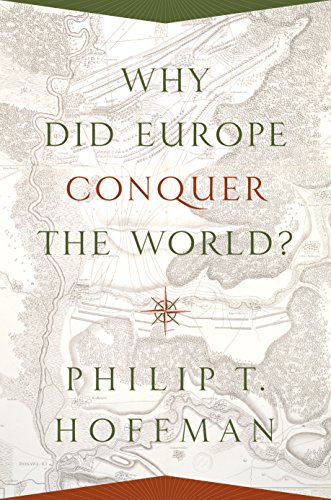
Inhaltsangabe
Between 1492 and 1914, Europeans conquered 84 percent of the globe. But why did Europe rise to the top, when for centuries the Chinese, Japanese, Ottomans, and South Asians were far more advanced? Why didnt these powers establish global dominance? In Why Did Europe Conquer the World?, distinguished economic historian Philip Hoffman demonstrates that conventional responses - such as geography, epidemic disease, and the Industrial Revolution - fail to provide answers. Arguing instead for the pivotal role of economic and political history, Hoffman shows that if variables had been at all different, Europe would not have achieved critical military innovations, and another power could have become master of the world.
Die Inhaltsangabe kann sich auf eine andere Ausgabe dieses Titels beziehen.
Über die Autorin bzw. den Autor
Philip T. Hoffman is professor of business economics and professor of history at the California Institute of Technology.
Von der hinteren Coverseite
"Beginning with the Spanish and Portuguese in the late fifteenth century, technological military superiority appears to have been the proximate cause of Europe’s ever-expanding military dominance for the next five centuries. Where did this technological superiority come from? The answer provided in this convincing and tightly argued book is interesting and as definitive as such answers get."--Stergios Skaperdas, University of California, Irvine
Aus dem Klappentext
"Beginning with the Spanish and Portuguese in the late fifteenth century, technological military superiority appears to have been the proximate cause of Europe s ever-expanding military dominance for the next five centuries. Where did this technological superiority come from? The answer provided in this convincing and tightly argued book is interesting and as definitive as such answers get."--Stergios Skaperdas, University of California, Irvine
Auszug. © Genehmigter Nachdruck. Alle Rechte vorbehalten.
Why Did Europe Conquer the World?
By Philip T. HoffmanPRINCETON UNIVERSITY PRESS
Copyright © 2015 Princeton University Press
All rights reserved.
ISBN: 978-0-691-13970-8All rights reserved.
Contents
Chapter 1 Introduction, 1,
Chapter 2 How the Tournament in Early Modern Europe Made Conquest Possible, 19,
Chapter 3 Why the Rest of Eurasia Fell Behind, 67,
Chapter 4 Ultimate Causes: Explaining the Difference between Western Europe and the Rest of Eurasia, 104,
Chapter 5 From the Gunpowder Technology to Private Expeditions, 154,
Chapter 6 Technological Change and Armed Peace in Nineteenth-Century Europe, 179,
Chapter 7 Conclusion: The Price of Conquest, 205,
Appendix A Model of War and Technical Change via Learning by Doing, 215,
Appendix B Using Prices to Measure Productivity Growth in the Military Sector, 228,
Appendix C Model of Political Learning, 231,
Appendix D Data for Tables 4.1 and 4.2, 233,
Appendix E Model of Armed Peace and Technical Change via Research, 234,
Acknowledgments, 239,
Bibliography, 241,
Index, 263,
CHAPTER 1
Introduction
Imagine that a time machine could carry you back to the year 900 and land you anywhere on earth for an extended stay. Where would you go live?
As you consider the possibilities, you might want a bit of useful advice—namely, avoid western Europe at all costs. Why reside there, when it was poor, violent, politically chaotic, and by almost any yardstick, hopelessly backward? There were no cities, apart from Córdoba, but it was part of the Muslim world. Luxuries (silks, perfume, and spices, which flavored an otherwise bland cuisine and served as the health food of the day) were scarce and extremely expensive. To get them, you had to trade with Middle Eastern merchants and sell the few western goods they deigned to purchase, such as furs or slaves. And if you were not careful—if, say, you wandered down to the beach in Italy—you yourself might be captured and delivered into slavery.
Choosing Europe would, in short, be like opting to move to Afghanistan today. You would be far better off picking the Muslim Middle East, for back in 900 it was richer and more advanced, culturally and technologically, and would be a much more inviting destination. It had cities; markets brimming with goods from around the world, from Indian sandalwood to Chinese ceramics; and scholars who were extending works of ancient Greek science that were still unknown in western Europe. Or instead of the Middle East, you could opt for southern China, where political regimes would soon stabilize after a period of turmoil, allowing agriculture to advance and trade in tea, silk, and porcelain to flourish. Western Europeans, by contrast, had nothing that promising on the horizon—only continued raids by marauding Vikings.
Now let your time machine whisk you forward to 1914. How startled you would be to discover that the once pitiful Europeans had taken over the world. Their influence would be everywhere, no matter where you stop. Somehow, they had gained control of 84 percent of the globe and they ruled colonies on every other inhabited continent (figure 1.1). While some of their possessions, such as the United States, had gained independence, they had spread their languages and ideas around the earth, and they wielded military power everywhere. Aside from the United States, a European clone, there was in fact only one non-European power that would dare stand up to their armies and navies—Japan, which was busy borrowing their technology and military know-how. No one would have expected that a thousand years ago.
Why were the Europeans the ones who ended up subjugating the world? Why not the Chinese, Japanese, Ottomans from the Middle East, or South Asians? All at one time or another could boast of powerful civilizations, and unlike Africans, Native Americans, and the inhabitants of Australia and the Pacific Islands, they all had access early on to the same weapons the Europeans used. And if you go back into the past, they would all seem to be stronger candidates than the Europeans. So why didn't they end up in control?
Finding out why is clearly important. After all, it determined who got colonial empires and who ran the slave trade. And it even helps explain who was the first to industrialize. But so far this question remains an unanswered riddle, and a particularly bedeviling one at that.
Now you might think that the answer is obvious: it was industrialization itself that paved the way for Europe's takeover. The Industrial Revolution began in Europe and gave Europeans tools—from repeating rifles to steam-powered gunboats—that assured their military supremacy. World conquest was then easy.
But things are not that simple, for if we step back a century, to 1800, the Industrial Revolution was scarcely under way in Britain and it had yet to touch the rest of Europe. Yet the Europeans already held sway over 35 percent of the globe, and their ships were preying on maritime traffic as far away as Southeast Asia and had been doing so for three hundred years. Why were they the ones with armed ships on every ocean, and with foreign fortresses and colonies on every inhabited continent, all well before the Industrial Revolution?
This question, once you begin pondering it, swiftly becomes a fascinating intellectual riddle, because the standard answers do not get to the bottom of the issue. Or they just fall apart once you begin to scrutinize them.
What then are those standard answers? There are really just two: disease and gunpowder technology.
Disease
The first of the standard answers points to the epidemics of smallpox, measles, and other crowd diseases that slaughtered natives of the Americas, Australia, and the Pacific Islands after the Europeans came ashore. The Europeans themselves were unaffected because they had been exposed to these diseases and were therefore resistant. Their immunity was what let them conquer the Americas and the Aztec and Inca Empires in particular.
The Europeans, however, were not the only people with this biological edge, for all the major Middle Eastern and Asian civilizations had the same advantage. Why had they too—and not just Europeans—been exposed to the crowd diseases? The reason (as the biologist Jared Diamond has explained) is simply that there were more easily domesticated plants and animals in Eurasia than in the Americas and fewer geographical and ecological barriers to the diffusion of crops, livestock, and agricultural technology. That meant earlier agriculture in Eurasia, and with agriculture came villages, herds of animals, and ultimately cities, all of which served as breeding grounds for disease, and also trade, which spread epidemics. So if Chinese, Japanese, South Asian, or Middle Eastern invaders had reached the Americas, they too would have survived, and Native Americans would still have perished. In short, even if disease is the crux of the matter, we still have to explain why it was the Europeans who were pursuing conquest, and not other Eurasians.
The claims about disease also fail to explain how the Portuguese could gain a foothold in South Asia at the turn of the sixteenth century and then successfully prey upon oceangoing trade. The South Asians were immune too, so disease gave the Portuguese no edge. They got no edge either from the easily domesticated plants and animals that Diamond has emphasized, for the Chinese, Japanese, Ottomans, and South Asians had them early on too.
There are other...
„Über diesen Titel“ kann sich auf eine andere Ausgabe dieses Titels beziehen.
Suchergebnisse für Why Did Europe Conquer the World? (Princeton Economic...

Beispielbild für diese ISBN
Why Did Europe Conquer the World? (The Princeton Economic History of the Western World)
Verlag:
Princeton University Press, 2015
ISBN 10: 0691139709
ISBN 13: 9780691139708
Gebraucht
Hardcover
Anbieter: World of Books (was SecondSale), Montgomery, IL, USA
Verkäuferbewertung 5 von 5 Sternen

Zustand: Good. Item in good condition. Textbooks may not include supplemental items i.e. CDs, access codes etc. Bestandsnummer des Verkäufers 00106765940
Gebraucht kaufen
EUR 11,26
Versand gratis
Versand innerhalb von USA
Versand innerhalb von USA
Anzahl: 1 verfügbar
Foto des Verkäufers
Why Did Europe Conquer the World? (The Princeton Economic History of the Western World)
Verlag:
Princeton University Press, 2015
ISBN 10: 0691139709
ISBN 13: 9780691139708
Gebraucht
Hardcover
Anbieter: Gate City Books, GREENSBORO, NC, USA
Verkäuferbewertung 5 von 5 Sternen
Zustand: very_good. Used - Very Good: Item may have minor cosmetic defects. Bestandsnummer des Verkäufers GCM.3OY1
Gebraucht kaufen
EUR 13,72
Versand gratis
Versand innerhalb von USA
Versand innerhalb von USA
Anzahl: 1 verfügbar
Beispielbild für diese ISBN
Why Did Europe Conquer the World?
Verlag:
Princeton University Press, 2015
ISBN 10: 0691139709
ISBN 13: 9780691139708
Gebraucht
Hardcover
Anbieter: Better World Books, Mishawaka, IN, USA
Verkäuferbewertung 5 von 5 Sternen
Zustand: Good. Pages intact with minimal writing/highlighting. The binding may be loose and creased. Dust jackets/supplements are not included. Stock photo provided. Product includes identifying sticker. Better World Books: Buy Books. Do Good. Bestandsnummer des Verkäufers 15483193-6
Gebraucht kaufen
EUR 13,81
Versand gratis
Versand innerhalb von USA
Versand innerhalb von USA
Anzahl: 1 verfügbar
Foto des Verkäufers
Why Did Europe Conquer the World? (The Princeton Economic History of the Western World)
Verlag:
Princeton University Press, 2015
ISBN 10: 0691139709
ISBN 13: 9780691139708
Gebraucht
Hardcover
Anbieter: Coas Books, Las Cruces, NM, USA
Verkäuferbewertung 5 von 5 Sternen
Zustand: acceptable. Cover image may vary. Dust jacket is worn. Item has staining. Binding is split. Hardcover. Bestandsnummer des Verkäufers COBV.0691139709.A
Gebraucht kaufen
EUR 11,28
EUR 3,48 Versand
Versand innerhalb von USA
Versand innerhalb von USA
Anzahl: 1 verfügbar
Beispielbild für diese ISBN
Why Did Europe Conquer the World?
Verlag:
Princeton University Press, 2015
ISBN 10: 0691139709
ISBN 13: 9780691139708
Gebraucht
Hardcover
Anbieter: ThriftBooks-Atlanta, AUSTELL, GA, USA
Verkäuferbewertung 5 von 5 Sternen
Hardcover. Zustand: Good. No Jacket. Missing dust jacket; Pages can have notes/highlighting. Spine may show signs of wear. ~ ThriftBooks: Read More, Spend Less. Bestandsnummer des Verkäufers G0691139709I3N01
Gebraucht kaufen
EUR 14,85
Versand gratis
Versand innerhalb von USA
Versand innerhalb von USA
Anzahl: 1 verfügbar
Foto des Verkäufers
Why Did Europe Conquer the World? (The Princeton Economic History of the Western World)
Verlag:
Princeton University Press, 2015
ISBN 10: 0691139709
ISBN 13: 9780691139708
Gebraucht
Hardcover
Anbieter: Goodwill of Greater Milwaukee and Chicago, Racine, WI, USA
Verkäuferbewertung 5 von 5 Sternen
Zustand: good. Book is considered to be in good or better condition. The actual cover image may not match the stock photo. Hard cover books may show signs of wear on the spine, cover or dust jacket. Paperback book may show signs of wear on spine or cover as well as having a slight bend, curve or creasing to it. Book should have minimal to no writing inside and no highlighting. Pages should be free of tears or creasing. Stickers should not be present on cover or elsewhere, and any CD or DVD expected with the book is included. Book is not a former library copy. Bestandsnummer des Verkäufers SEWV.0691139709.G
Gebraucht kaufen
EUR 16,27
EUR 2,61 Versand
Versand innerhalb von USA
Versand innerhalb von USA
Anzahl: 1 verfügbar
Beispielbild für diese ISBN
Why Did Europe Conquer the World? (The Princeton Economic History of the Western World)
Verlag:
Princeton University Press, 2015
ISBN 10: 0691139709
ISBN 13: 9780691139708
Gebraucht
Hardcover
Anbieter: A Squared Books (Don Dewhirst), South Lyon, MI, USA
Verkäuferbewertung 5 von 5 Sternen
hardcover. Zustand: As New. Zustand des Schutzumschlags: Like New. 2015. Beige cloth covered boards with brown spine titles; jacket has light shelf wear; 8vo - over 7 3/4" to 9 3/4" tall; Interior is clean and unmarked; 272 pages. Bestandsnummer des Verkäufers SKU1181285
Gebraucht kaufen
EUR 22,43
EUR 5,65 Versand
Versand innerhalb von USA
Versand innerhalb von USA
Anzahl: 1 verfügbar
Beispielbild für diese ISBN
Why Did Europe Conquer the World? (The Princeton Economic History of the Western World)
Anbieter: GoldBooks, Denver, CO, USA
Verkäuferbewertung 5 von 5 Sternen
Hardcover. Zustand: new. New Copy. Customer Service Guaranteed. Bestandsnummer des Verkäufers 90H77_81_0691139709
Neu kaufen
EUR 48,80
EUR 4,79 Versand
Versand innerhalb von USA
Versand innerhalb von USA
Anzahl: 1 verfügbar
Foto des Verkäufers
Why Did Europe Conquer the World? (The Princeton Economic History of the Western World)
Verlag:
Princeton University Press, 2015
ISBN 10: 0691139709
ISBN 13: 9780691139708
Gebraucht
Hardcover
Erstausgabe
Anbieter: Southampton Books, Sag Harbor, NY, USA
Verkäuferbewertung 5 von 5 Sternen
Hardcover. Zustand: Like New. First Edition. First Edition, First Printing. Published by Princeton University Press, 2015. Octavo. Hardcover. Book is like new. Dust jacket is like new. Bestandsnummer des Verkäufers 539101
Gebraucht kaufen
EUR 49,35
EUR 4,35 Versand
Versand innerhalb von USA
Versand innerhalb von USA
Anzahl: 1 verfügbar
Beispielbild für diese ISBN
Why Did Europe Conquer the World?
Anbieter: Revaluation Books, Exeter, Vereinigtes Königreich
Verkäuferbewertung 5 von 5 Sternen
Hardcover. Zustand: Brand New. 288 pages. 9.50x6.50x1.00 inches. In Stock. Bestandsnummer des Verkäufers 0691139709
Neu kaufen
EUR 86,49
EUR 14,58 Versand
Versand von Vereinigtes Königreich nach USA
Versand von Vereinigtes Königreich nach USA
Anzahl: 1 verfügbar