
Verwandte Artikel zu Mathematical Analysis of Deterministic and Stochastic...
Mathematical Analysis of Deterministic and Stochastic Problems in Complex Media Electromagnetics (Princeton Series in Applied Mathematics) - Hardcover
Buch 17 von 33: Princeton Series in Applied Mathematics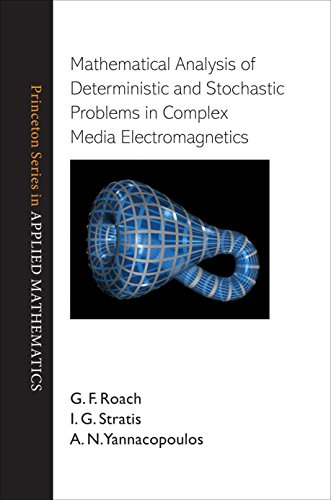
Inhaltsangabe
Designed for researchers and advanced graduate students in applied mathematics, electrical engineering, and physics, this book introduces the electromagnetics of complex media through a systematic, state-of-the-art account of their mathematical theory. The book combines the study of well posedness, homogenization, and controllability of Maxwell equations complemented with constitutive relations describing complex media. The book treats deterministic and stochastic problems both in the frequency and time domains. It also covers computational aspects and scattering problems, among other important topics. Detailed appendices make the book self-contained in terms of mathematical prerequisites, and accessible to engineers and physicists as well as mathematicians.
Die Inhaltsangabe kann sich auf eine andere Ausgabe dieses Titels beziehen.
Über die Autorin bzw. den Autor
G. F. Roach is professor emeritus in the Department of Mathematics and Statistics at the University of Strathclyde. I. G. Stratis is professor in the Department of Mathematics at the National and Kapodistrian University, Athens. A. N. Yannacopoulos is professor in the Department of Statistics at the Athens University of Economics and Business.
Von der hinteren Coverseite
"This is an outstanding book that has the potential to become a real classic. It is the first to systematically address the mathematics of electromagnetic wave propagation in complex media. It will be useful not only to mathematicians but also graduate students, physicists, and engineers who want to get a state-of-the-art picture of scattering by complex media."--Gerhard Kristensson, Lund University, Sweden
Aus dem Klappentext
"This is an outstanding book that has the potential to become a real classic. It is the first to systematically address the mathematics of electromagnetic wave propagation in complex media. It will be useful not only to mathematicians but also graduate students, physicists, and engineers who want to get a state-of-the-art picture of scattering by complex media."--Gerhard Kristensson, Lund University, Sweden
Auszug. © Genehmigter Nachdruck. Alle Rechte vorbehalten.
Mathematical Analysis of Deterministic and Stochastic Problems in Complex Media Electromagnetics
By G. F. Roach I. G. Stratis A. N. YannacopoulosPRINCETON UNIVERSITY PRESS
Copyright © 2012 Princeton University PressAll right reserved.
ISBN: 978-0-691-14217-3
Contents
Preface.............................................................................xiPART 1. MODELLING AND MATHEMATICAL PRELIMINARIES....................................1Chapter 1. Complex Media............................................................3Chapter 2. The Maxwell Equations and Constitutive Relations.........................9Chapter 3. Spaces and Operators.....................................................38PART 2. TIME-HARMONIC DETERMINISTIC PROBLEMS........................................59Chapter 4. Well Posedness...........................................................61Chapter 5. Scattering Problems: Beltrami Fields and Solvability.....................83Chapter 6. Scattering Problems: A Variety of Topics.................................112PART 3. TIME-DEPENDENT DETERMINISTIC PROBLEMS.......................................149Chapter 7. Well Posedness...........................................................151Chapter 8. Controllability..........................................................163Chapter 9. Homogenisation...........................................................180Chapter 10. Towards a Scattering Theory.............................................212Chapter 11. Nonlinear Problems......................................................231PART 4. STOCHASTIC PROBLEMS.........................................................245Chapter 12. Well Posedness..........................................................247Chapter 13. Controllability.........................................................263Chapter 14. Homogenisation..........................................................275PART 5. APPENDICES..................................................................291Appendix A. Some Facts from Functional Analysis.....................................293Appendix B. Some Facts from Stochastic Analysis.....................................316Appendix C. Some Facts from Elliptic Homogenisation Theory..........................327Appendix D. Some Facts from Dyadic Analysis (by George Dassios).....................334Appendix E. Notation and abbreviations..............................................341Bibliography........................................................................343Index...............................................................................377
Chapter One
Complex Media
In recent years technology has replaced Hercules as far as the labours are concerned: the progress in theoretical studies, followed by impressive experimental work and achievements, is reaching the everyday lives of ordinary people and is rapidly changing our habits and lives.
A big part of this technological revolution, which emerged in the late twentieth century and is propagating with increasing speed and expanding front, is the result of complex media. Complex media are artificial materials exhibiting properties, based on their structure rather than their composition, superior to those in naturally existing materials. Nevertheless, there certainly do exist materials in nature displaying "exotic" properties.
A characteristic of a fast-growing research area, such as the one concerned with the study of complex media, is its interdisciplinary nature; scientists from a wide provenance spectrum, including electrical engineering, electromagnetics, solid state physics, microwave and antenna engineering, optoelectronics, classical optics, materials science, semiconductor engineering, and nanoscience, are engaged in this field. Of course, mathematics has its usual share, as well!
A discrimination between left and right has proved to be a fertile concept in the many branches of science that feed into electromagnetics: handedness is a term that is used extensively in the complex media literature. There are actually three notions of handedness of interest in electromagnetics:
Left-handedness: The term left-handed as a description of a certain class of metamaterials springs from the handedness of the vector triplet (E, H, K) (E being the electric field, H the magnetic field, and K the wave vector, respectively) of a linearly polarised wave propagating in such media. This type of left-handedness refers to materials whose electric permittivity and magnetic permeability are both negative. The theoretical prediction of their existence was made by V. Veselago in 1964.
Handedness of a circularly polarised wave: In the electrical engineering community, handedness is manifested in relation to polarisation, which refers to the direction and behaviour of the electric field vector, which in the case of circular (or elliptical) polarisation exhibits a form of helicity (or handedness). The wave propagates in a certain direction, and (for isotropic media) the electric field is transverse. In the transverse plane, the temporal oscillations of the field vector are described by an ellipse or a circle (in the case of linear polarisation, the ellipse shrinks to a straight line). Along its direction of propagation, the wave may rotate to the left or to the right. Of course, these notions are meaningless unless one of them is properly defined: according to the U.S. Federal Standard 1037C (http://www.its.bldrdoc.gov/fs-1037/), the polarisation is defined as right-handed if the temporal rotation is clockwise when viewed from the transmitter (in the propagation direction) and left-handed if the rotation is counterclockwise. By contrast, astronomers look towards the source (transmitter), and therefore in the direction opposite that in which the wave propagates; hence the terms "clockwise" and "counterclockwise" attribute meanings opposite to right- and left-handedness. Nevertheless, the handedness of a specific object remains invariant under orthogonal transformations.
Chirality and geometry: Handedness is a characteristic of material objects, such as corkscrews, doors, cookers, sinks, computer mice, keyboards, scissors, and a variety of construction tools. The mirror image of a right-handed object is the same as the original except that it is left-handed (the original image cannot be superimposed on its mirror image.) A nonhanded object remains the same within this mirror-image operation since, after imaging, it can be brought into congruence with the original by simple translations and rotations. A handed object is called chiral (a term coined in 1888 by Kelvin, from the Greek word [TEXT NOT REPRODUCIBLE IN ASCII.], meaning "hand"). Chiral media possess optical activity, or the ability to rotate the plane of polarisation of a beam of light passing through them. The relation between the chiral (micro)structure and the (macroscopic) optical rotation was discovered by Pasteur in the 1840s. The mirror-image operation is also called parity transformation (all spatial axes are reversed when parity is changed); it is a fundamental property of physics that parity symmetry is broken in subatomic interactions. On several different scales and levels of nature, parity is not balanced. From amino acids through bacteria, winding plants and right-handed human beings to spiral galaxies, one of the handednesses dominates the other. The handedness of an optically active substance is called dextrorotary (resp., levorotary) if polarised light is rotated clockwise (resp.,...
„Über diesen Titel“ kann sich auf eine andere Ausgabe dieses Titels beziehen.
Suchergebnisse für Mathematical Analysis of Deterministic and Stochastic...

Beispielbild für diese ISBN
Mathematical Analysis of Deterministic and Stochastic Problems in Complex Media Electromagnetics (Princeton Series in Applied Mathematics)
Verlag:
Princeton University Press, 2012
ISBN 10: 0691142173
ISBN 13: 9780691142173
Gebraucht
Hardcover
Anbieter: Anybook.com, Lincoln, Vereinigtes Königreich
Verkäuferbewertung 5 von 5 Sternen

Zustand: Good. This is an ex-library book and may have the usual library/used-book markings inside.This book has hardback covers. In good all round condition. No dust jacket. Please note the Image in this listing is a stock photo and may not match the covers of the actual item,750grams, ISBN:9780691142173. Bestandsnummer des Verkäufers 4349462
Gebraucht kaufen
EUR 31,32
EUR 15,82 Versand
Versand von Vereinigtes Königreich nach USA
Versand von Vereinigtes Königreich nach USA
Anzahl: 1 verfügbar
Beispielbild für diese ISBN
Mathematical Analysis of Deterministic and Stochastic Problems in Complex Media Electromagnetics (Princeton Series in Applied Mathematics (42))
Anbieter: Labyrinth Books, Princeton, NJ, USA
Verkäuferbewertung 5 von 5 Sternen
Zustand: New. Bestandsnummer des Verkäufers 141675
Neu kaufen
EUR 47,04
EUR 3,95 Versand
Versand innerhalb von USA
Versand innerhalb von USA
Anzahl: 13 verfügbar
Beispielbild für diese ISBN
Mathematical Analysis of Deterministic and Stochastic Problems in Complex Media Electromagnetics
Anbieter: Revaluation Books, Exeter, Vereinigtes Königreich
Verkäuferbewertung 5 von 5 Sternen
Hardcover. Zustand: Brand New. 400 pages. 9.30x6.10x1.30 inches. In Stock. Bestandsnummer des Verkäufers zk0691142173
Neu kaufen
EUR 78,89
EUR 14,54 Versand
Versand von Vereinigtes Königreich nach USA
Versand von Vereinigtes Königreich nach USA
Anzahl: 1 verfügbar
Beispielbild für diese ISBN
Mathematical Analysis of Deterministic and Stochastic Problems in Complex Media Electromagnetics Format: Hardcover
Verlag:
Princeton University Press, 2012
ISBN 10: 0691142173
ISBN 13: 9780691142173
Gebraucht
Hardcover
Anbieter: INDOO, Avenel, NJ, USA
Verkäuferbewertung 5 von 5 Sternen
Zustand: As New. Unread copy in mint condition. Bestandsnummer des Verkäufers PG9780691142173
Gebraucht kaufen
EUR 141,46
Versand gratis
Versand innerhalb von USA
Versand innerhalb von USA
Anzahl: 12 verfügbar
Beispielbild für diese ISBN
Mathematical Analysis of Deterministic and Stochastic Problems in Complex Media Electromagnetics Format: Hardcover
Anbieter: INDOO, Avenel, NJ, USA
Verkäuferbewertung 5 von 5 Sternen
Zustand: New. Brand New. Bestandsnummer des Verkäufers 9780691142173
Neu kaufen
EUR 141,55
Versand gratis
Versand innerhalb von USA
Versand innerhalb von USA
Anzahl: 12 verfügbar