
Verwandte Artikel zu Circles Disturbed: The Interplay of Mathematics and...
Inhaltsangabe
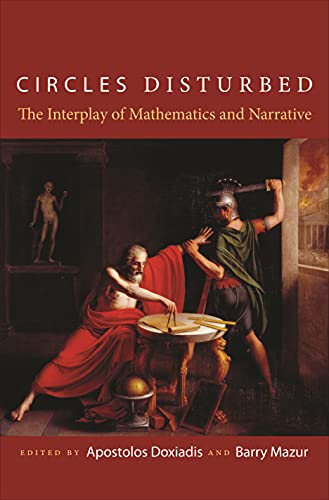
Circles Disturbed brings together important thinkers in mathematics, history, and philosophy to explore the relationship between mathematics and narrative. The book's title recalls the last words of the great Greek mathematician Archimedes before he was slain by a Roman soldier--"Don't disturb my circles"--words that seem to refer to two radically different concerns: that of the practical person living in the concrete world of reality, and that of the theoretician lost in a world of abstraction. Stories and theorems are, in a sense, the natural languages of these two worlds--stories representing the way we act and interact, and theorems giving us pure thought, distilled from the hustle and bustle of reality. Yet, though the voices of stories and theorems seem totally different, they share profound connections and similarities.
Die Inhaltsangabe kann sich auf eine andere Ausgabe dieses Titels beziehen.
Über die Autorin bzw. den Autor
Apostolos Doxiadis is a writer whose books include Uncle Petros and Goldbach's Conjecture and Logicomix.
Barry Mazur is the Gerhard Gade University Professor in the Department of Mathematics at Harvard University. His books include Imagining Numbers and Arithmetic Moduli of Elliptic Curves (Princeton).
Von der hinteren Coverseite
"Circles Disturbed offers a range of possibilities for how narrative can function in mathematics and how narratives themselves show signs of a mathematical structure. An intelligent, exploratory collection of writings by a distinguished group of contributors."--Theodore Porter, University of California, Los Angeles
"This collection is a pioneering effort to trace the hidden connections between mathematics and narrative. It succeeds magnificently, and represents a very significant contribution that will appeal to the professional mathematician as well as the general educated reader. The articles are written by top authorities in their fields."--Doron Zeilberger, Rutgers University
"The idea of a volume devoted to mathematics and narrative is a good one. The strength of the present volume is the breadth of its outlook, and I would imagine a fairly diverse readership from a wide variety of perspectives."--Robert Osserman, professor emeritus, Stanford University
Aus dem Klappentext
"Circles Disturbed offers a range of possibilities for how narrative can function in mathematics and how narratives themselves show signs of a mathematical structure. An intelligent, exploratory collection of writings by a distinguished group of contributors."--Theodore Porter, University of California, Los Angeles
"This collection is a pioneering effort to trace the hidden connections between mathematics and narrative. It succeeds magnificently, and represents a very significant contribution that will appeal to the professional mathematician as well as the general educated reader. The articles are written by top authorities in their fields."--Doron Zeilberger, Rutgers University
"The idea of a volume devoted to mathematics and narrative is a good one. The strength of the present volume is the breadth of its outlook, and I would imagine a fairly diverse readership from a wide variety of perspectives."--Robert Osserman, professor emeritus, Stanford University
Auszug. © Genehmigter Nachdruck. Alle Rechte vorbehalten.
CIRCLES DISTURBED
THE INTERPLAY OF MATHEMATICS AND NARRATIVEPRINCETON UNIVERSITY PRESS
Copyright © 2012 Princeton University PressAll right reserved.
ISBN: 978-0-691-14904-2
Contents
Introduction.............................................................................................................................................vii1 From Voyagers to Martyrs: Toward a Storied History of Mathematics AMIR ALEXANDER......................................................................12 Structure of Crystal, Bucket of Dust PETER GALISON....................................................................................................523 Deductive Narrative and the Epistemological Function of Belief in Mathematics: On Bombelli and Imaginary Numbers FEDERICA LA NAVE.....................794 Hilbert on Theology and Its Discontents: The Origin Myth of Modern Mathematics COLIN MCLARTY..........................................................1055 Do Androids Prove Theorems in Their Sleep? MICHAEL HARRIS.............................................................................................1306 Visions, Dreams, and Mathematics BARRY MAZUR..........................................................................................................1837 Vividness in Mathematics and Narrative TIMOTHY GOWERS.................................................................................................2118 Mathematics and Narrative: Why Are Stories and Proofs Interesting? BERNARD TEISSIER...................................................................2329 Narrative and the Rationality of Mathematical Practice DAVID CORFIELD.................................................................................24410 A Streetcar Named (among Other Things) Proof: From Storytelling to Geometry, via Poetry and Rhetoric APOSTOLOS DOXIADIS..............................28111 Mathematics and Narrative: An Aristotelian Perspective G. E. R. LLOYD................................................................................38912 Adventures of the Diagonal: Non-Euclidean Mathematics and Narrative ARKADY PLOTNITSKY................................................................40713 Formal Models in Narrative Analysis DAVID HERMAN.....................................................................................................44714 Mathematics and Narrative: A Narratological Perspective URI MARGOLIN.................................................................................48115 Tales of Contingency, Contingencies of Telling: Toward an Algorithm of Narrative Subjectivity JAN CHRISTOPH MEISTER..................................508Contributors.............................................................................................................................................541Index....................................................................................................................................................545
Chapter One
From Voyagers to MartyrsToward a Storied History of Mathematics
AMIR ALEXANDER
1. Introduction
Sometime in the fifth century BC, the Pythagorean philosopher Hippasus of Metapontum proved that the side of a square is incommensurable with its diagonal. The discovery was quickly recognized to have far-reaching implications, for it thoroughly challenged the Pythagorean belief that everything in the world could be described by whole numbers and their ratios. Sadly for Hippasus, he did not live long enough to enjoy the fame of his mathematical breakthrough. Shortly after making his discovery, he traveled aboard ship and was lost at sea.
Since that time, different versions of the story have come down to us. In some, Hippasus's "shipwreck" was contrived by his own Pythagorean brothers; in others he was not killed but only expelled from the brotherhood for his indiscretion in revealing its most profound secrets. But whatever version one adopts, it is clear that the story of Hippasus is not meant to be an accurate chronicle of a tragic event that took place 2,500 years ago. Rather, it is a morality tale, intended to convey deeply held truths about the meaning of mathematics and its potential dangers. In this, it was an early example of a "mathematical story," a narrative type that has accompanied the study of mathematics from the very beginning.
Other stories soon followed. Pythagoras himself reportedly sacrificed an ox upon his discovery of what became known as the Pythagorean theorem, and Euclid, according to another popular tale, admonished King Ptolemy that "there is no royal road to mathematics." Archimedes ran naked through the streets of Syracuse shouting "Eureka!" and was killed years later when, oblivious to the sack of the city going on all around him, he asked a Roman soldier to stand aside while he worked out a problem in geometry. In later times stories abounded about mathematicians as heroic explorers or tragic young geniuses. The recent popularity of movies such as A Beautiful Mind and Good Will Hunting strongly suggests that stories remain the constant companions of mathematical studies to this day.
Like all stories, mathematical tales are meant to amuse and entertain. They draw on an existing world that is familiar to their audience, reflecting its historical and cultural realities. Ancient Greek philosophers, for example, were indeed frequent maritime voyagers, and Hippasus's tragic end is far from implausible. Archimedes did die during the fall of Syracuse in 212 BC, many early modern mathematicians were deeply involved in voyages of geographic exploration, and so on. But in addition to mirroring the actual conditions in which mathematical work was carried out, the stories also convey important lessons about what mathematics is and how it should be practiced. Hippasus's tale suggests the dangers of pursuing mathematics to its ultimate conclusions, and Archimedes' death is emblematic of the clash between the pure realm of mathematics and the barbarism of war. Centuries later, the description of mathematicians as enterprising explorers is not only a reflection of their professional affiliations but also a prescription for how mathematics itself should be practiced.
Mathematical tales, in other words, are both descriptive and prescriptive, drawing on the historical conditions of their times while seeking to define the meaning and practice of mathematics itself. On the one hand, like all popular stories, they are firmly anchored in a particular time and place; on the other, they reach out toward the seemingly insular practice of mathematics itself, defining its meaning, its purpose, and how it should be practiced. Anchored firmly in human culture and history while straining toward the ethereal realms of high mathematics, such stories are uniquely positioned to span the great divide that looms between mathematical practices and the cultural realities in which they arose.
This is no small feat. All too often in writing the history of mathematics, mathematical developments are treated as fundamentally separate from their historical culture. Mathematics, in these accounts, has a history only in the sense that different mathematicians in different eras glimpsed different parts of the eternal and unchanging truth that is mathematics. The precise historical circumstances in which these discoveries took place are completely irrelevant to the actual substance of the mathematics, which would be exactly the same no matter when or where it was discovered. When historical circumstances do make their appearance in these accounts, they are...
„Über diesen Titel“ kann sich auf eine andere Ausgabe dieses Titels beziehen.
Suchergebnisse für Circles Disturbed: The Interplay of Mathematics and...

Beispielbild für diese ISBN
Circles Disturbed: The Interplay of Mathematics and Narrative
Verlag:
Princeton University Press, 2012
ISBN 10: 0691149046
ISBN 13: 9780691149042
Gebraucht
Hardcover
Anbieter: ThriftBooks-Dallas, Dallas, TX, USA
Verkäuferbewertung 5 von 5 Sternen

Hardcover. Zustand: Very Good. No Jacket. May have limited writing in cover pages. Pages are unmarked. ~ ThriftBooks: Read More, Spend Less. Bestandsnummer des Verkäufers G0691149046I4N00
Gebraucht kaufen
EUR 29,75
Versand gratis
Versand innerhalb von USA
Versand innerhalb von USA
Anzahl: 1 verfügbar
Beispielbild für diese ISBN
Circles Disturbed: The Interplay of Mathematics and Narrative
Verlag:
Princeton University Press, 2012
ISBN 10: 0691149046
ISBN 13: 9780691149042
Gebraucht
Hardcover
Anbieter: Zubal-Books, Since 1961, Cleveland, OH, USA
Verkäuferbewertung 5 von 5 Sternen
Zustand: Fine. first edition; 552 pp., Hardcover, fine in a very good dust jacket. - If you are reading this, this item is actually (physically) in our stock and ready for shipment once ordered. We are not bookjackers. Buyer is responsible for any additional duties, taxes, or fees required by recipient's country. Bestandsnummer des Verkäufers ZB1349901
Gebraucht kaufen
EUR 25,77
EUR 4,00 Versand
Versand innerhalb von USA
Versand innerhalb von USA
Anzahl: 1 verfügbar
Beispielbild für diese ISBN
Circles Disturbed: The Interplay of Mathematics and Narrative
Verlag:
Princeton University Press, 2012
ISBN 10: 0691149046
ISBN 13: 9780691149042
Gebraucht
Hardcover
Erstausgabe
Anbieter: Bookensteins, Las Vegas, NV, USA
Verkäuferbewertung 5 von 5 Sternen
Hardcover. Zustand: Near Fine. Zustand des Schutzumschlags: Good. 1st Edition. Dust jacket is bumped at the corners and at the top and bottom of the spine. Back bottom left corner is bumped with a one inch tear. Back dust jacket edge in bumped along the top edge. Dust jacket is now protected in mylar. Book pages are clean with no marks. Bookseller Inventory BS/BS10482 01/2021. Bestandsnummer des Verkäufers 010482
Gebraucht kaufen
EUR 34,77
EUR 4,89 Versand
Versand innerhalb von USA
Versand innerhalb von USA
Anzahl: 1 verfügbar
Foto des Verkäufers
Circles Disturbed : The Interplay of Mathematics and Narrative
Anbieter: GreatBookPrices, Columbia, MD, USA
Verkäuferbewertung 5 von 5 Sternen
Zustand: New. Bestandsnummer des Verkäufers 9221186-n
Neu kaufen
EUR 65,36
EUR 2,35 Versand
Versand innerhalb von USA
Versand innerhalb von USA
Anzahl: 7 verfügbar
Beispielbild für diese ISBN
Circles Disturbed
Anbieter: PBShop.store US, Wood Dale, IL, USA
Verkäuferbewertung 5 von 5 Sternen
HRD. Zustand: New. New Book. Shipped from UK. Established seller since 2000. Bestandsnummer des Verkäufers WP-9780691149042
Beispielbild für diese ISBN
Circles Disturbed: The Interplay of Mathematics and Narrative
Anbieter: Kennys Bookshop and Art Galleries Ltd., Galway, GY, Irland
Verkäuferbewertung 5 von 5 Sternen
Zustand: New. Recalls the last words of the great Greek mathematician Archimedes before he was slain by a Roman soldier - "Don't disturb my circles" - words that seem to refer to two radically different concerns: that of the practical person living in the concrete world of reality, and that of the theoretician lost in a world of abstraction. Editor(s): Doxiadis, Apostolos; Mazur, Barry. Num Pages: 552 pages, 91 line illus. BIC Classification: PBX. Category: (P) Professional & Vocational; (U) Tertiary Education (US: College). Dimension: 165 x 241 x 43. Weight in Grams: 972. . 2012. Hardcover. . . . . Bestandsnummer des Verkäufers V9780691149042
Neu kaufen
EUR 61,13
EUR 9,50 Versand
Versand von Irland nach USA
Versand von Irland nach USA
Anzahl: 1 verfügbar
Foto des Verkäufers
Circles Disturbed : The Interplay of Mathematics and Narrative
Verlag:
Princeton University Press, 2012
ISBN 10: 0691149046
ISBN 13: 9780691149042
Gebraucht
Hardcover
Anbieter: GreatBookPrices, Columbia, MD, USA
Verkäuferbewertung 5 von 5 Sternen
Zustand: As New. Unread book in perfect condition. Bestandsnummer des Verkäufers 9221186
Gebraucht kaufen
EUR 71,01
EUR 2,35 Versand
Versand innerhalb von USA
Versand innerhalb von USA
Anzahl: 7 verfügbar
Beispielbild für diese ISBN
Circles Disturbed - The Interplay of Mathematics and Narrative (eng)
Anbieter: Brook Bookstore On Demand, Napoli, NA, Italien
Verkäuferbewertung 5 von 5 Sternen
Zustand: new. Bestandsnummer des Verkäufers d5313332f070490e7c50dc0ff4b45cf3
Neu kaufen
EUR 66,80
EUR 8,00 Versand
Versand von Italien nach USA
Versand von Italien nach USA
Anzahl: 6 verfügbar
Beispielbild für diese ISBN
Circles Disturbed
Anbieter: PBShop.store UK, Fairford, GLOS, Vereinigtes Königreich
Verkäuferbewertung 5 von 5 Sternen
HRD. Zustand: New. New Book. Shipped from UK. Established seller since 2000. Bestandsnummer des Verkäufers WP-9780691149042
Neu kaufen
EUR 67,62
EUR 7,97 Versand
Versand von Vereinigtes Königreich nach USA
Versand von Vereinigtes Königreich nach USA
Anzahl: 6 verfügbar
Foto des Verkäufers
Circles Disturbed
Verlag:
Princeton University Press, US, 2012
ISBN 10: 0691149046
ISBN 13: 9780691149042
Neu
Hardcover
Anbieter: Rarewaves.com USA, London, LONDO, Vereinigtes Königreich
Verkäuferbewertung 5 von 5 Sternen
Hardback. Zustand: New. Circles Disturbed brings together important thinkers in mathematics, history, and philosophy to explore the relationship between mathematics and narrative. The book's title recalls the last words of the great Greek mathematician Archimedes before he was slain by a Roman soldier--"Don't disturb my circles"--words that seem to refer to two radically different concerns: that of the practical person living in the concrete world of reality, and that of the theoretician lost in a world of abstraction. Stories and theorems are, in a sense, the natural languages of these two worlds--stories representing the way we act and interact, and theorems giving us pure thought, distilled from the hustle and bustle of reality. Yet, though the voices of stories and theorems seem totally different, they share profound connections and similarities.A book unlike any other, Circles Disturbed delves into topics such as the way in which historical and biographical narratives shape our understanding of mathematics and mathematicians, the development of "myths of origins" in mathematics, the structure and importance of mathematical dreams, the role of storytelling in the formation of mathematical intuitions, the ways mathematics helps us organize the way we think about narrative structure, and much more. In addition to the editors, the contributors are Amir Alexander, David Corfield, Peter Galison, Timothy Gowers, Michael Harris, David Herman, Federica La Nave, G.E.R. Lloyd, Uri Margolin, Colin McLarty, Jan Christoph Meister, Arkady Plotnitsky, and Bernard Teissier. Bestandsnummer des Verkäufers LU-9780691149042
Neu kaufen
EUR 79,75
Versand gratis
Versand von Vereinigtes Königreich nach USA
Versand von Vereinigtes Königreich nach USA
Anzahl: 3 verfügbar