
Verwandte Artikel zu The Princeton Guide to Evolution
Inhaltsangabe
The essential one-volume reference to evolution
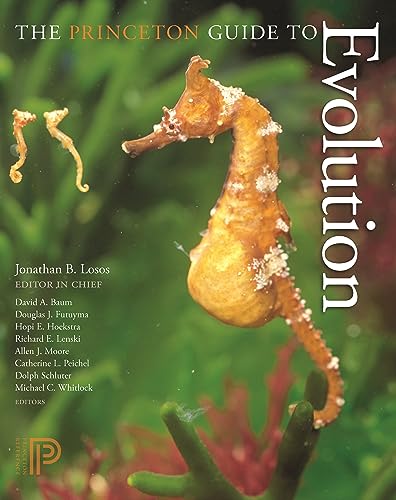
The Princeton Guide to Evolution is a comprehensive, concise, and authoritative reference to the major subjects and key concepts in evolutionary biology, from genes to mass extinctions. Edited by a distinguished team of evolutionary biologists, with contributions from leading researchers, the guide contains some 100 clear, accurate, and up-to-date articles on the most important topics in seven major areas: phylogenetics and the history of life; selection and adaptation; evolutionary processes; genes, genomes, and phenotypes; speciation and macroevolution; evolution of behavior, society, and humans; and evolution and modern society. Complete with more than 100 illustrations (including eight pages in color), glossaries of key terms, suggestions for further reading on each topic, and an index, this is an essential volume for undergraduate and graduate students, scientists in related fields, and anyone else with a serious interest in evolution.
- Explains key topics in some 100 concise and authoritative articles written by a team of leading evolutionary biologists
- Contains more than 100 illustrations, including eight pages in color
- Each article includes an outline, glossary, bibliography, and cross-references
- Covers phylogenetics and the history of life; selection and adaptation; evolutionary processes; genes, genomes, and phenotypes; speciation and macroevolution; evolution of behavior, society, and humans; and evolution and modern society
Die Inhaltsangabe kann sich auf eine andere Ausgabe dieses Titels beziehen.
Über die Autorin bzw. den Autor
Jonathan B. Losos is the Monique and Philip Lehner Professor for the Study of Latin America and professor of organismic and evolutionary biology at Harvard University.
Von der hinteren Coverseite
"The marvelous new tools and theoretical approaches that have so greatly deepened our understanding of evolution over the past few decades are clearly and concisely presented in this splendid new guide, which should be of use to everyone involved in the field."--Peter H. Raven, president emeritus of the Missouri Botanical Garden, St. Louis
Auszug. © Genehmigter Nachdruck. Alle Rechte vorbehalten.
The Princeton Guide to Evolution
By Jonathan B. LososPRINCETON UNIVERSITY PRESS
Copyright © 2014 Princeton University Press
All rights reserved.
ISBN: 978-0-691-14977-6All rights reserved.
Contents
| Preface.................................................................... | vii |
| Contributors............................................................... | ix |
| Section I Introduction..................................................... | 1 |
| Section II Phylogenetics and the History of Life........................... | 47 |
| Section III Natural Selection and Adaptation............................... | 189 |
| Section IV Evolutionary Processes.......................................... | 305 |
| Section V Genes, Genomes, Phenotypes....................................... | 363 |
| Section VI Speciation and Macroevolution................................... | 483 |
| Section VII Evolution of Behavior, Society, and Humans..................... | 605 |
| Section VIII Evolution and Modern Society.................................. | 727 |
| Index...................................................................... | 837 |
CHAPTER 1
Introduction
I.1
What Is Evolution?
Jonathan Losos
OUTLINE
1. What is evolution?
2. Evolution: Pattern versus process
3. Evolution: More than changes in thegene pool
4. In the light of evolution
5. Critiques and the evidence for evolution
6. The pace of evolution
7. Evolution, humans, and society
Evolution refers to change through time as species becomemodified and diverge to produce multiple descendantspecies. Evolution and natural selection are oftenconflated, but evolution is the historical occurrence ofchange, and natural selection is one mechanism—in mostcases the most important—that can cause it. Recentyears have seen a flowering in the field of evolutionarybiology, and much has been learned about the causes andconsequences of evolution. The two main pillars of ourknowledge of evolution come from knowledge of thehistorical record of evolutionary change, deduced directlyfrom the fossil record and inferred from examination ofphylogeny, and from study of the process of evolutionarychange, particularly the effect of natural selection. It isnow apparent that when selection is strong, evolution canproceed considerably more rapidly than was generallyenvisioned by Darwin. As a result, scientists are realizingthat it is possible to conduct evolutionary experiments inreal time. Recent developments in many areas, includingmolecular and developmental biology, have greatly expandedour knowledge and reaffirmed evolution's centralplace in the understanding of biological diversity.
GLOSSARY
Evolution. Descent with modification; transformationof species through time, including both changes thatoccur within species, as well as the origin of newspecies.
Natural Selection. The process in which individuals witha particular trait tend to leave more offspring in thenext generation than do individuals with a differenttrait.
Approximately 375 million years ago, a large and vaguelysalamander-like creature plodded from its aquatichome and began the vertebrate invasion of land, settingforth the chain of evolutionary events that led to the birdsthat fill our skies, the beasts that walk our soil, me writingthis chapter, and you reading it. This was, of course, justone episode in life's saga: millions of years earlier, plantshad come ashore, followed soon thereafter—or perhapssimultaneously—by arthropods. We could go back muchearlier, 4 billion years or so, to that fateful day when thefirst molecule replicated itself, an important milestone inthe origin of life and the beginning of the evolutionarypageant. Moving forward, the last few hundred millionyears have also had their highs and lows: the origins offrogs and trees, the end-Permian extinction when 90percent of all species perished, and the rise and fall of thedinosaurs.
These vignettes are a few of many waypoints in theevolutionary chronicle of life on earth. Evolutionarybiologists try to understand this history, explaining howand why life has taken its particular path. But the studyof evolution involves more than looking backward to tryto understand the past. Evolution is an ongoing process,one possibly operating at a faster rate now than in timespast in this human-dominated world. Consequently,evolutionary biology is also forward looking: it includesthe study of evolutionary processes in action today—howthey operate, what they produce—as well as investigationof how evolution is likely to proceed in thefuture. Moreover, evolutionary biology is not solely anacademic matter; evolution affects humans in manyways, from coping with the emergence of agriculturalpests and disease-causing organisms to understandingthe workings of our own genome. Indeed, evolutionaryscience has broad relevance, playing an important role inadvances in many areas, from computer programmingto medicine to engineering.
1. WHAT IS EVOLUTION?
Lookup the word "evolution" in the online version of theOxford English Dictionary, and you will find 11 definitionsand numerous subdefinitions, ranging from mathematical("the successive transformation of a curve bythe alteration of the conditions which define it") to chemical("the emission or release of gas, heat, light, etc.") tomilitary ("a manoeuvre executed by troops or ships toadopt a different tactical formation"). Even with referenceto biology, there are several definitions, including"emergence or release from an envelope or enclosingstructure; (also) protrusion, evagination," not to mention"rare" and "historical" usage related to the conceptof preformation of embryos. Even among evolutionarybiologists, evolution is defined in different ways. Forexample, one widely read textbook refers to evolution as"changes in the properties of groups of organisms overthe course of generations" (Futuyma 2005), whereasanother defines it as "changes in allele frequencies overtime" (Freeman and Herron 2007).
One might think that—as in so many other areas ofevolutionary biology—we could look to Darwin forclarity. But in the first edition of On the Origin of Species,the term "evolution" never appears (though the lastword of the book is "evolved"); not until the sixth editiondoes Darwin use "evolution." Rather, Darwin'sterm of choice is "descent with modification," a simplephrase that captures the essence of what evolutionarybiology is all about: the study of the transformation ofspecies through time, including both changes that occurwithin species, as well as the origin of new species.
2. EVOLUTION: PATTERN VERSUS PROCESS
Many people—sometimes even biologists—equate evolutionwith natural selection, but the two are not thesame. Natural selection is one process that can causeevolutionary change, but natural selection can occurwithout producing evolutionary change. Conversely,processes other than natural selection can lead toevolution.
Natural selection within populations refers to the situationin which individuals with one variant of a trait(say, blue eyes) tend to leave more offspring that arehealthy and fertile in the next generation than do individualswith an alternative variant of the trait. Suchselection can occur in many ways, for example,...
„Über diesen Titel“ kann sich auf eine andere Ausgabe dieses Titels beziehen.
Suchergebnisse für The Princeton Guide to Evolution

Beispielbild für diese ISBN
The Princeton Guide to Evolution
Verlag:
Princeton University Press, 2013
ISBN 10: 0691149771
ISBN 13: 9780691149776
Gebraucht
Hardcover
Anbieter: Better World Books: West, Reno, NV, USA
Verkäuferbewertung 5 von 5 Sternen

Zustand: Very Good. Former library copy. Pages intact with possible writing/highlighting. Binding strong with minor wear. Dust jackets/supplements may not be included. Includes library markings. Stock photo provided. Product includes identifying sticker. Better World Books: Buy Books. Do Good. Bestandsnummer des Verkäufers 18632396-6
Gebraucht kaufen
EUR 67,92
Versand gratis
Versand innerhalb von USA
Versand innerhalb von USA
Anzahl: 1 verfügbar
Beispielbild für diese ISBN
The Princeton Guide to Evolution
Verlag:
Princeton University Press, 2013
ISBN 10: 0691149771
ISBN 13: 9780691149776
Gebraucht
Hardcover
Anbieter: Better World Books: West, Reno, NV, USA
Verkäuferbewertung 5 von 5 Sternen
Zustand: Very Good. Pages intact with possible writing/highlighting. Binding strong with minor wear. Dust jackets/supplements may not be included. Stock photo provided. Product includes identifying sticker. Better World Books: Buy Books. Do Good. Bestandsnummer des Verkäufers 754303-6
Gebraucht kaufen
EUR 67,92
Versand gratis
Versand innerhalb von USA
Versand innerhalb von USA
Anzahl: 1 verfügbar
Foto des Verkäufers
The Princeton Guide to Evolution
Verlag:
Princeton University Press, 2013
ISBN 10: 0691149771
ISBN 13: 9780691149776
Gebraucht
Hardcover
Anbieter: Bay State Book Company, North Smithfield, RI, USA
Verkäuferbewertung 5 von 5 Sternen
Zustand: very_good. Bestandsnummer des Verkäufers BSM.19F4N
Gebraucht kaufen
EUR 95,97
Versand gratis
Versand innerhalb von USA
Versand innerhalb von USA
Anzahl: 1 verfügbar
Beispielbild für diese ISBN
THE PRINCETON GUIDE TO EVOLUTION
Anbieter: Basi6 International, Irving, TX, USA
Verkäuferbewertung 5 von 5 Sternen
Zustand: Brand New. New. US edition. Expediting shipping for all USA and Europe orders excluding PO Box. Excellent Customer Service. Bestandsnummer des Verkäufers ABEOCT25-107280
Beispielbild für diese ISBN
Princeton Guide to Evolution
Anbieter: GreatBookPrices, Columbia, MD, USA
Verkäuferbewertung 5 von 5 Sternen
Zustand: New. Bestandsnummer des Verkäufers 10621434-n
Neu kaufen
EUR 118,04
EUR 2,35 Versand
Versand innerhalb von USA
Versand innerhalb von USA
Anzahl: 6 verfügbar
Beispielbild für diese ISBN
The Princeton Guide to Evolution
Anbieter: PBShop.store US, Wood Dale, IL, USA
Verkäuferbewertung 5 von 5 Sternen
HRD. Zustand: New. New Book. Shipped from UK. Established seller since 2000. Bestandsnummer des Verkäufers WP-9780691149776
Beispielbild für diese ISBN
The Princeton Guide to Evolution
Anbieter: Kennys Bookshop and Art Galleries Ltd., Galway, GY, Irland
Verkäuferbewertung 5 von 5 Sternen
Zustand: New. Contains some articles on the important topics in seven major areas: phylogenetics and the history of life; selection and adaptation; evolutionary processes; genes, genomes, and phenotypes; speciation and macroevolution; evolution of behavior, society, and humans; and evolution and modern society. Editor(s): Baum, David A.; Futuyma, Douglas J.; Hoekstra, Hopi E.; Moore, Allen J.; Peichel, Catherine Lynn; Schluter, Dolph; Whitlock, Michael. Num Pages: 872 pages, 16 color illus. 4 halftones. 97 line illus. 23 tables. 1 map. BIC Classification: PSAJ. Category: (P) Professional & Vocational; (U) Tertiary Education (US: College). Dimension: 264 x 203 x 45. Weight in Grams: 1946. . 2013. Hardcover. . . . . Bestandsnummer des Verkäufers V9780691149776
Neu kaufen
EUR 114,70
EUR 9,50 Versand
Versand von Irland nach USA
Versand von Irland nach USA
Anzahl: 1 verfügbar
Beispielbild für diese ISBN
Princeton Guide to Evolution (eng)
Anbieter: Brook Bookstore On Demand, Napoli, NA, Italien
Verkäuferbewertung 5 von 5 Sternen
Zustand: new. Bestandsnummer des Verkäufers aad83ec72a90c726128e5624f61582ef
Neu kaufen
EUR 119,00
EUR 13,50 Versand
Versand von Italien nach USA
Versand von Italien nach USA
Anzahl: 6 verfügbar
Beispielbild für diese ISBN
The Princeton Guide to Evolution
Anbieter: PBShop.store UK, Fairford, GLOS, Vereinigtes Königreich
Verkäuferbewertung 5 von 5 Sternen
HRD. Zustand: New. New Book. Shipped from UK. Established seller since 2000. Bestandsnummer des Verkäufers WP-9780691149776
Neu kaufen
EUR 121,24
EUR 13,07 Versand
Versand von Vereinigtes Königreich nach USA
Versand von Vereinigtes Königreich nach USA
Anzahl: 6 verfügbar
Foto des Verkäufers
Princeton Guide to Evolution
Verlag:
Princeton University Press, 2013
ISBN 10: 0691149771
ISBN 13: 9780691149776
Gebraucht
Hardcover
Anbieter: GreatBookPrices, Columbia, MD, USA
Verkäuferbewertung 5 von 5 Sternen
Zustand: As New. Unread book in perfect condition. Bestandsnummer des Verkäufers 10621434
Gebraucht kaufen
EUR 132,52
EUR 2,35 Versand
Versand innerhalb von USA
Versand innerhalb von USA
Anzahl: 6 verfügbar