
Verwandte Artikel zu Life Exposed: Biological Citizens after Chernobyl....
Inhaltsangabe
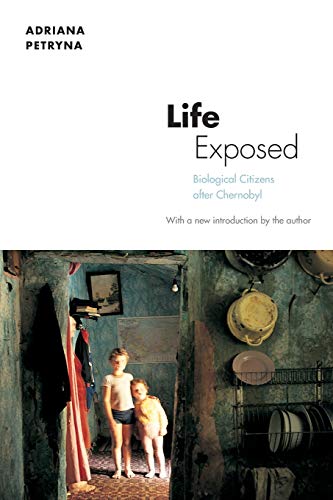
On April 26, 1986, Unit Four of the Chernobyl nuclear reactor exploded in then Soviet Ukraine. More than 3.5 million people in Ukraine alone, not to mention many citizens of surrounding countries, are still suffering the effects. Life Exposed is the first book to comprehensively examine the vexed political, scientific, and social circumstances that followed the disaster. Tracing the story from an initial lack of disclosure to post-Soviet democratizing attempts to compensate sufferers, Adriana Petryna uses anthropological tools to take us into a world whose social realities are far more immediate and stark than those described by policymakers and scientists. She asks: What happens to politics when state officials fail to inform their fellow citizens of real threats to life? What are the moral and political consequences of remedies available in the wake of technological disasters?
Die Inhaltsangabe kann sich auf eine andere Ausgabe dieses Titels beziehen.
Über die Autorin bzw. den Autor
Adriana Petryna is the Edmund J. and Louise W. Kahn Term Professor in Anthropology at the University of Pennsylvania. She is the author of When Experiments Travel: Clinical Trials and the Global Search for Human Subjects and the coeditor of When People Come First: Critical Studies in Global Health (both Princeton).
Von der hinteren Coverseite
"An ethnographic triumph. Life Exposed is as powerful an analysis of national technical processes of managing risks as I have ever read. Yet it is also a moving meditation on the aftermath of disaster, including the moral and medical morass faced by those who negotiate its world of disability."--Arthur Kleinman, Harvard University
Auszug. © Genehmigter Nachdruck. Alle Rechte vorbehalten.
Life Exposed
Biological Citizens after Chernobyl
By Adriana PetrynaPRINCETON UNIVERSITY PRESS
Copyright © 2003 Princeton University Press
All rights reserved.
ISBN: 978-0-691-15166-3All rights reserved.
Contents
| List of Figures and Tables................................................. | xi |
| Introduction to the 2013 Edition........................................... | xiii |
| Acknowledgments............................................................ | xxxiii |
| Note on Transliteration.................................................... | xxxvii |
| Chapter 1 Life Politics Chernobyl.......................................... | 1 |
| Chapter 2 Technical Error: Measures of Life and Risk....................... | 34 |
| Chapter 3 Chernobyl in Historical Light.................................... | 63 |
| Chapter 4 Illness as Work: Human Market Transition......................... | 82 |
| Chapter 5 Biological Citizenship........................................... | 115 |
| Chapter 6 Local Science and Organic Processes.............................. | 149 |
| Chapter 7 Self and Social Identity in Transition........................... | 191 |
| Chapter 8 Conclusion....................................................... | 215 |
| Notes...................................................................... | 221 |
| Bibliography............................................................... | 239 |
| Index...................................................................... | 253 |
Excerpt
CHAPTER 1
Life Politics after Chernobyl
Time Lapse
On April 26, 1986, Unit Four of the Chernobyl nuclear reactor explodedin Ukraine, damaging human immunities and the genetic structure ofcells, contaminating soils and waterways. The main reason for the accidentis by now well known. Soviet engineers wanted to test how longgenerators of Unit Four could operate without steam supply in the case ofa power failure. During the test, operators sharply reduced power andblocked steam to the reactor's generators and disabled many of its safetysystems. A huge power surge followed, and at 1:23 A.M. the unit explodedonce and then again. Large-scale pressure gradients carried the radioactiveplume to as high as eight kilometers by some estimates. The graphitecore burned for days. Helicopter pilots dropped over five thousand tonsof boron carbide, dolomite, sand, clay, and lead in an attempt to suffocatethe flames of the reactor's burning core. These interventions are nowknown to have compounded risk and uncertainty. With suffocation, thetemperature of the nuclear core increased. This in turn caused radioactivesubstances to ascend more rapidly, forming a radioactive cloud thatspread over Belarus, Ukraine, Russia, Western Europe, and other areas ofthe Northern Hemisphere.
Eighteen days elapsed before Mikhail Gorbachev, then general secretary,appeared on Soviet television and acknowledged the nuclear releaseto the populace. Within that period, tens of thousands of people wereeither knowingly or unknowingly exposed to radioactive iodine-131,absorbed rapidly in the thyroid and resulting, among other things, in asudden and massive onset of thyroid cancers in children and adults assoon as four years later. Such onsets could have been curtailed had thegovernment distributed nonradioactive iodine pills within the first weekof the disaster. S Contradicting assessments generated by English andAmerican meteorological groups, Soviet administrators downplayed theextent of the plume and characterized Chernobyl as a controlled biomedicalcrisis. Soviet medical efforts focused on a group of 237 victims selectedat the disaster site by Dr. Angelina Guskova; they were airlifted tothe acute radiation sickness ward of the Institute of Biophysics in Moscow.Of those, 134 were diagnosed with acute radiation syndrome. Officialreports set the death toll at thirty-one workers (IAEA 1991, WHO1996). Behind such seemingly definite numbers lies a web of scientific,moral, and political uncertainties.
The fact is that over the years, 600,000 or more soldiers, firemen, andother workers, men and women, continued to be exposed to radiation.Many were dispatched to the disaster site to carry out cleanup work rangingfrom bulldozing contaminated topsoil and disposing it as waste toworking in one-minute intervals on the roof of an adjacent unit and shovelingradioactive debris into the mouth of the ruined one. Some of theseso-called volunteers referred to themselves as "bio-robots," a term whichsuggests that the one-minute rule was not well enforced. Others were relativelywell paid to construct the so-called Sarcophagus (Sarkofag, nowsimply called the Shelter), a structure enclosing the ruined fourth unit ofthe reactor and containing 216 tons of uranium and plutonium. Currently,fifteen thousand people work at the now decommissioned powerplant or are paid to provide technical assistance in the Zone of Exclusion.The Zone is an area thirty kilometers in diameter circumscribing the disastersite. Access to the Zone is restricted to the plant's maintenanceworkers, engineers, health professionals, and researchers.
In 1992, during my first field trip to Ukraine, I mer one of the maintenanceworkers who was on a two-week break from work in the Zone. Helived in a housing complex in Kyiv, Ukraine's capital, located abouteighty miles south of the disaster site. Filled with anger, he said, "NowI'm a 'sufferer.'" He used the word "sufferer" in reference to a legalcategory introduced the previous year by a newly independent Ukrainianstate for persons affected by the Chernobyl disaster. "I get five dollars amonth compensation. What can I buy for that?" He said he had no otheroption but to continue working in the Zone. Because of his work history,no firm outside the Zone would hire him. "This is from radiation," hesaid. He lifted his pant-leg and stuck his cigarette through skin that hadpuckered up to form a ring above his ankle. It was the result, he said, ofdirect contact with a radiation source, and what clinicians would call a"local skin burn." "This happened in the Zone ... We're people no oneunderstands, in hospitals, in clinics." He characterized himself as one ofthe "living dead." "Our memory is gone. You forget everything—wewalk like corpses."
In spite of the country's publicized efforts to improve safety standardsin the Zone, a director of the Shelter complex told me in an interview,"there are no norms of radiation safety here." The country's Ministry ofHealth sets annual allowable norms of dose exposures, but, according tothe director, these norms are not strictly adhered to. That is because inUkraine's current period of sharp economic decline, employment in theZone is considered premium. Referring to the plant workers, he told me,"Taking this risk is their individual problem. No one else is responsiblefor it." When I asked him to compare his country's enforcement ofworker safety norms with those of Western Europe, he told me quitesomberly, "No one has ever defined the price of a dose exposure here. Noone has ever defined the value of a person here." In a situation whereeconomic forces drive people to become preoccupied with physical survival,the effects of leaving the value of a person undefined are far-reaching.In such a world, physical risks, abuses, and uncertainties escalate.The labor of the...
„Über diesen Titel“ kann sich auf eine andere Ausgabe dieses Titels beziehen.
Suchergebnisse für Life Exposed: Biological Citizens after Chernobyl....

Foto des Verkäufers
Life Exposed: Biological Citizens after Chernobyl
Verlag:
Princeton University Press, 2013
ISBN 10: 0691151660
ISBN 13: 9780691151663
Gebraucht
Softcover
Anbieter: Dream Books Co., Denver, CO, USA
Verkäuferbewertung 5 von 5 Sternen

Zustand: good. Gently used with minimal wear on the corners and cover. A few pages may contain light highlighting or writing, but the text remains fully legible. Dust jacket may be missing, and supplemental materials like CDs or codes may not be included. May be ex-library with library markings. Ships promptly! Bestandsnummer des Verkäufers DBV.0691151660.G
Gebraucht kaufen
EUR 3,88
Versand gratis
Versand innerhalb von USA
Versand innerhalb von USA
Anzahl: 1 verfügbar
Beispielbild für diese ISBN
Life Exposed: Biological Citizens After Chernobyl
Verlag:
Princeton University Press, 2013
ISBN 10: 0691151660
ISBN 13: 9780691151663
Gebraucht
Paperback
Anbieter: ThriftBooks-Atlanta, AUSTELL, GA, USA
Verkäuferbewertung 5 von 5 Sternen
Paperback. Zustand: Good. No Jacket. Pages can have notes/highlighting. Spine may show signs of wear. ~ ThriftBooks: Read More, Spend Less. Bestandsnummer des Verkäufers G0691151660I3N00
Gebraucht kaufen
EUR 5,94
Versand gratis
Versand innerhalb von USA
Versand innerhalb von USA
Anzahl: 1 verfügbar
Beispielbild für diese ISBN
Life Exposed: Biological Citizens After Chernobyl
Verlag:
Princeton University Press, 2013
ISBN 10: 0691151660
ISBN 13: 9780691151663
Gebraucht
Paperback
Anbieter: ThriftBooks-Dallas, Dallas, TX, USA
Verkäuferbewertung 5 von 5 Sternen
Paperback. Zustand: Fair. No Jacket. Readable copy. Pages may have considerable notes/highlighting. ~ ThriftBooks: Read More, Spend Less. Bestandsnummer des Verkäufers G0691151660I5N00
Gebraucht kaufen
EUR 5,94
Versand gratis
Versand innerhalb von USA
Versand innerhalb von USA
Anzahl: 1 verfügbar
Foto des Verkäufers
Life Exposed: Biological Citizens after Chernobyl
Verlag:
Princeton University Press, 2013
ISBN 10: 0691151660
ISBN 13: 9780691151663
Gebraucht
Softcover
Anbieter: -OnTimeBooks-, Phoenix, AZ, USA
Verkäuferbewertung 5 von 5 Sternen
Zustand: good. A copy that has been read, remains in good condition. All pages are intact, and the cover is intact. The spine and cover show signs of wear. Pages can include notes and highlighting and show signs of wear, and the copy can include "From the library of" labels or previous owner inscriptions. 100% GUARANTEE! Shipped with delivery confirmation, if you're not satisfied with purchase please return item! Ships via media mail. Bestandsnummer des Verkäufers OTV.0691151660.G
Gebraucht kaufen
EUR 6,26
Versand gratis
Versand innerhalb von USA
Versand innerhalb von USA
Anzahl: 1 verfügbar
Beispielbild für diese ISBN
Life Exposed: Biological Citizens after Chernobyl
Verlag:
Princeton University Press (edition Revised), 2013
ISBN 10: 0691151660
ISBN 13: 9780691151663
Gebraucht
Paperback
Anbieter: BooksRun, Philadelphia, PA, USA
Verkäuferbewertung 5 von 5 Sternen
Paperback. Zustand: Very Good. Revised. It's a well-cared-for item that has seen limited use. The item may show minor signs of wear. All the text is legible, with all pages included. It may have slight markings and/or highlighting. Bestandsnummer des Verkäufers 0691151660-11-1
Gebraucht kaufen
EUR 6,58
Versand gratis
Versand innerhalb von USA
Versand innerhalb von USA
Anzahl: 1 verfügbar
Beispielbild für diese ISBN
Life Exposed: Biological Citizens after Chernobyl
Verlag:
Princeton University Press, 2013
ISBN 10: 0691151660
ISBN 13: 9780691151663
Gebraucht
Paperback
Anbieter: HPB-Emerald, Dallas, TX, USA
Verkäuferbewertung 5 von 5 Sternen
Paperback. Zustand: Very Good. Connecting readers with great books since 1972! Used books may not include companion materials, and may have some shelf wear or limited writing. We ship orders daily and Customer Service is our top priority! Bestandsnummer des Verkäufers S_476776801
Gebraucht kaufen
EUR 4,58
EUR 3,33 Versand
Versand innerhalb von USA
Versand innerhalb von USA
Anzahl: 1 verfügbar
Beispielbild für diese ISBN
Life Exposed: Biological Citizens after Chernobyl
Verlag:
Princeton University Press, 2013
ISBN 10: 0691151660
ISBN 13: 9780691151663
Gebraucht
Softcover
Anbieter: Hawking Books, Edgewood, TX, USA
Verkäuferbewertung 4 von 5 Sternen

Zustand: Very Good. Very Good Condition. Five star seller - Buy with confidence! Bestandsnummer des Verkäufers X0691151660X2
Gebraucht kaufen
EUR 8,96
Versand gratis
Versand innerhalb von USA
Versand innerhalb von USA
Anzahl: 1 verfügbar
Foto des Verkäufers
Life Exposed: Biological Citizens after Chernobyl
Verlag:
Princeton University Press, 2003
ISBN 10: 0691151660
ISBN 13: 9780691151663
Gebraucht
Paperback
Anbieter: The Haunted Bookshop, LLC, Iowa City, IA, USA
Verkäuferbewertung 5 von 5 Sternen
Paperback. Zustand: Good. Crisp, clean pages; no owners' marks; square, uncreased spine; a bump at the spine heel has created a horizontal tear in the soft cover just above the heel, but the cover is otherwise clean and well-kept. xxxvii, 264pp. incl. index. Bestandsnummer des Verkäufers 00086522
Gebraucht kaufen
EUR 14,64
EUR 4,89 Versand
Versand innerhalb von USA
Versand innerhalb von USA
Anzahl: 1 verfügbar
Foto des Verkäufers
Life Exposed : Biological Citizens After Chernobyl
Verlag:
Princeton University Press, 2013
ISBN 10: 0691151660
ISBN 13: 9780691151663
Gebraucht
Softcover
Anbieter: GreatBookPrices, Columbia, MD, USA
Verkäuferbewertung 5 von 5 Sternen
Zustand: good. May show signs of wear, highlighting, writing, and previous use. This item may be a former library book with typical markings. No guarantee on products that contain supplements Your satisfaction is 100% guaranteed. Twenty-five year bookseller with shipments to over fifty million happy customers. Bestandsnummer des Verkäufers 12080813-5
Gebraucht kaufen
EUR 17,26
EUR 2,35 Versand
Versand innerhalb von USA
Versand innerhalb von USA
Anzahl: 7 verfügbar
Beispielbild für diese ISBN
Life Exposed: Biological Citizens after Chernobyl
Verlag:
Princeton University Press, 2013
ISBN 10: 0691151660
ISBN 13: 9780691151663
Gebraucht
paperback
Anbieter: Textbooks_Source, Columbia, MO, USA
Verkäuferbewertung 5 von 5 Sternen
paperback. Zustand: Good. Revised. Ships in a BOX from Central Missouri! May not include working access code. Will not include dust jacket. Has used sticker(s) and some writing or highlighting. UPS shipping for most packages, (Priority Mail for AK/HI/APO/PO Boxes). Bestandsnummer des Verkäufers 001330200U
Gebraucht kaufen
EUR 18,47
EUR 3,55 Versand
Versand innerhalb von USA
Versand innerhalb von USA
Anzahl: 18 verfügbar