
Verwandte Artikel zu Structural Macroeconometrics: Second Edition
Inhaltsangabe
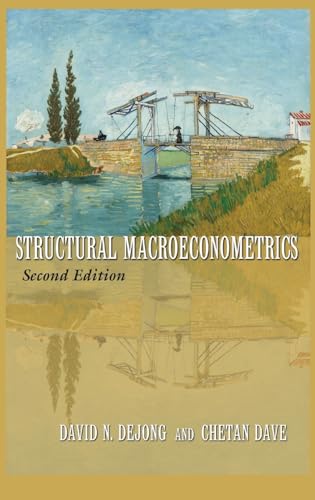
The revised edition of the essential resource on macroeconometrics Structural Macroeconometrics provides a thorough overview and in-depth exploration of methodologies, models, and techniques used to analyze forces shaping national economies. In this thoroughly revised second edition, David DeJong and Chetan Dave emphasize time series econometrics and unite theoretical and empirical research, while taking into account important new advances in the field. The authors detail strategies for solving dynamic structural models and present the full range of methods for characterizing and evaluating empirical implications, including calibration exercises, method-of-moment procedures, and likelihood-based procedures, both classical and Bayesian. The authors look at recent strides that have been made to enhance numerical efficiency, consider the expanded applicability of dynamic factor models, and examine the use of alternative assumptions involving learning and rational inattention on the part of decision makers. The treatment of methodologies for obtaining nonlinear model representations has been expanded, and linear and nonlinear model representations are integrated throughout the text. The book offers a rich array of implementation algorithms, sample empirical applications, and supporting computer code. Structural Macroeconometrics is the ideal textbook for graduate students seeking an introduction to macroeconomics and econometrics, and for advanced students pursuing applied research in macroeconomics. The book's historical perspective, along with its broad presentation of alternative methodologies, makes it an indispensable resource for academics and professionals.
Die Inhaltsangabe kann sich auf eine andere Ausgabe dieses Titels beziehen.
Über die Autorin bzw. den Autor
David N. DeJong & Chetan Dave
Von der hinteren Coverseite
"Structural Macroeconometrics is one of those essential books that every economist should read. It gives comprehensive yet detailed knowledge of the empirical arsenal now in use in cutting-edge macroeconomics. And its exercises prepare users to employ that arsenal to attack new real-world challenges. This edition expands on recent developments in nonlinear techniques and revamps the exposition on linear tools. The result is a beautiful, lively, and extremely useful work."--Roberto Chang, Rutgers University
"The first edition of this book was a gold mine of tools for formulating and estimating modern dynamic stochastic economic models suitable to macroeconomics, finance, and applied microeconomics. This edition is even better and describes how to use exciting new developments in dynamic estimation."--Thomas J. Sargent, New York University
"In the second edition of Structural Macroeconometrics, DeJong and Dave expand their excellent coverage of the tools macroeconomists use to solve, evaluate, and estimate models. Linear and nonlinear solution methods are carefully described and help the reader easily understand alternative approaches, and advanced empirical tools are clearly presented. The coverage of econometric techniques is up to date, extensive, and designed to lead seamlessly from the specification of structural models to their empirical evaluation."--Carl Walsh, University of California, Santa Cruz
Praise for the previous edition: "This book provides excellent guidance for bringing theoretical models to the forefront of macroeconometric analysis. It brings together in one place a collection of tools, methods, and procedures that are at the cutting edge of empirical macroeconomic research. It does this in a style that is accessible to first-year graduate students while providing sufficient detail that it will be a valuable reference for macroeconomists actively engaged in research. There is no other comparable existing work."--Charles Whiteman, University of Iowa
Praise for the previous edition: "Structural Macroeconometrics is a remarkably useful book for a wide variety of research economists at different stages of their careers. In addition to serving well the students and instructors, it is a convenient resource for researchers who want to refresh their skills or who have been exposed to only a subset of these techniques. The sheer breadth of material that this book covers guarantees that a large segment of its readership will fall into this category. The methods that DeJong and Dave present here will continue to be relevant for many years."--Charles Evans, Federal Reserve Bank of Chicago
Auszug. © Genehmigter Nachdruck. Alle Rechte vorbehalten.
Structural Macroeconometrics
By David N. DeJong Chetan DavePRINCETON UNIVERSITY PRESS
Copyright © 2011 Princeton University PressAll right reserved.
ISBN: 978-0-691-15287-5
Contents
Preface........................................................................................................................xiiiPreface to the First Edition...................................................................................................xv1 Background and Overview......................................................................................................32 Casting Models in Canonical Form.............................................................................................93 DSGE Models: Three Examples..................................................................................................184 Linear Solution Techniques...................................................................................................515 Nonlinear Solution Techniques................................................................................................696 Removing Trends and Isolating Cycles.........................................................................................1137 Summarizing Time Series Behavior When All Variables Are Observable...........................................................1388 State-Space Representations..................................................................................................1669 Monte Carlo Integration: The Basics..........................................................................................19310 Likelihood Evaluation and Filtering in State-Space Representations Using Sequential Monte Carlo Methods.....................22111 Calibration.................................................................................................................25312 Matching Moments............................................................................................................28513 Maximum Likelihood..........................................................................................................31414 Bayesian Methods............................................................................................................351References.....................................................................................................................387Index..........................................................................................................................401
Chapter One
Background and Overview
Science is facts; just as houses are made of stones, so is science made of facts; but a pile of stones is not a house and a collection of facts is not necessarily science. —Henri Poincaré
1.1 Background
The seminal contribution of Kydland and Prescott (1982) marked a sea change in the way macroeconomists conduct empirical research. Under the empirical paradigm that remained predominant at the time, the focus was either on purely statistical (or reduced-form) characterizations of macroeconomic behavior, or on systems-of-equations models that ignored both general-equilibrium considerations and forward-looking behavior on the part of purposeful decision makers. But the powerful criticism of this approach set forth by Lucas (1976), and the methodological contributions of, for example, Sims (1972) and Hansen and Sargent (1980), sparked a transition to a new empirical paradigm. In this transitional stage, the formal imposition of theoretical discipline on reduced-form characterizations became established. The source of this discipline was a class of models that have come to be known as dynamic stochastic general equilibrium (DSGE) models. The imposition of discipline most typically took the form of "cross-equation restrictions," under which the stochastic behavior of a set of exogenous variables, coupled with forward-looking behavior on the part of economic decision makers, yield implications for the endogenous stochastic behavior of variables determined by the decision makers. Nevertheless, the imposition of such restrictions was indirect, and reduced-form specifications continued to serve as the focal point of empirical research.
Kydland and Prescott turned this emphasis on its head. As a legacy of their work, DSGE models no longer serve as indirect sources of theoretical discipline to be imposed upon statistical specifications. Instead, they serve directly as the foundation upon which empirical work may be conducted. The methodologies used to implement DSGE models as foundational empirical models have evolved over time and vary considerably. The same is true of the statistical formality with which this work is conducted. But despite the characteristic heterogeneity of methods used in pursuing contemporary empirical macroeconomic research, the influence of Kydland and Prescott remains evident today.
This book details the use of DSGE models as foundations upon which empirical work may be conducted. It is intended primarily as an instructional guide for graduate students and practitioners, and so contains a distinct how-to perspective throughout. The methodologies it presents are organized roughly following the chronological evolution of the empirical literature in macroeconomics that has emerged following the work of Kydland and Prescott; thus it also serves as a reference guide. Throughout, the methodologies are demonstrated using applications to three benchmark models: a real-business-cycle model (fashioned after King, Plosser, and Rebelo, 1988); a monetary model featuring monopolistically competitive firms (fashioned after Ireland, 2004a); and an asset-pricing model (fashioned after Lucas, 1978).
1.2 Overview
The empirical tools outlined in the text share a common foundation: a system of nonlinear expectational difference equations representing a DSGE model. The solution to a given system takes the form of a collection of policy functions that map a subset of the variables featured in the model—state variables—into choices for the remaining subset of variables—control variables; the choices represent optimal behavior on the part of the decision makers featured in the model, subject to constraints implied by the state variables. Policy functions, coupled with laws of motion for the state variables, collectively represent the solution to a given DSGE model; the solution is in the form of a state-space representation.
Policy functions can be calculated analytically for only a narrow set of models, and thus must typically be approximated numerically. The text presents several alternative methodologies for achieving both model approximation and the subsequent empirical implementation of the corresponding state-space representation. Empirical implementation is demonstrated in applications involving parameter estimation, assessments of fit and model comparison, forecasting, policy analysis, and measurement of unobservable facets of aggregate economic activity (e.g., measurement of productivity shocks).
This book is divided into five parts. Part I contains three chapters. Following this brief introduction, chapter 2 establishes the consistent set of notation used throughout the text, and presents an important preliminary step—linearization—of the model solution stage. Chapter 3 then introduces the three benchmark models that serve as examples throughout the text.
Part II contains two chapters devoted to model-solution techniques. Chapter 4 describes solution techniques applicable to linear approximations of systems of...
„Über diesen Titel“ kann sich auf eine andere Ausgabe dieses Titels beziehen.
Suchergebnisse für Structural Macroeconometrics: Second Edition

Beispielbild für diese ISBN
Structural Macroeconometrics: Second Edition
Verlag:
Princeton University Press, 2011
ISBN 10: 069115287X
ISBN 13: 9780691152875
Gebraucht
Hardcover
Anbieter: HPB-Red, Dallas, TX, USA
Verkäuferbewertung 5 von 5 Sternen

Hardcover. Zustand: Good. Connecting readers with great books since 1972! Used textbooks may not include companion materials such as access codes, etc. May have some wear or writing/highlighting. We ship orders daily and Customer Service is our top priority! Bestandsnummer des Verkäufers S_473582645
Gebraucht kaufen
EUR 65,09
EUR 3,28 Versand
Versand innerhalb von USA
Versand innerhalb von USA
Anzahl: 1 verfügbar
Beispielbild für diese ISBN
Structural Macroeconometrics: Second Edition
Verlag:
Princeton University Press, 2011
ISBN 10: 069115287X
ISBN 13: 9780691152875
Gebraucht
Hardcover
Anbieter: Project HOME Books, Philadelphia, PA, USA
Verkäuferbewertung 5 von 5 Sternen
Zustand: Good. shelf wear, hardcover Used - Good 2011 Second All purchases support Project HOME - ending homelessness in Philadelphia. Bestandsnummer des Verkäufers FS05-000068
Gebraucht kaufen
EUR 69,38
EUR 4,36 Versand
Versand innerhalb von USA
Versand innerhalb von USA
Anzahl: 1 verfügbar
Beispielbild für diese ISBN
Structural Macroeconometrics
Anbieter: GreatBookPrices, Columbia, MD, USA
Verkäuferbewertung 5 von 5 Sternen
Zustand: New. Bestandsnummer des Verkäufers 12335505-n
Neu kaufen
EUR 77,81
EUR 2,31 Versand
Versand innerhalb von USA
Versand innerhalb von USA
Anzahl: Mehr als 20 verfügbar
Beispielbild für diese ISBN
Structural Macroeconometrics
Anbieter: PBShop.store US, Wood Dale, IL, USA
Verkäuferbewertung 5 von 5 Sternen
HRD. Zustand: New. New Book. Shipped from UK. Established seller since 2000. Bestandsnummer des Verkäufers WP-9780691152875
Beispielbild für diese ISBN
Structural Macroeconometrics
Anbieter: PBShop.store UK, Fairford, GLOS, Vereinigtes Königreich
Verkäuferbewertung 5 von 5 Sternen
HRD. Zustand: New. New Book. Shipped from UK. Established seller since 2000. Bestandsnummer des Verkäufers WP-9780691152875
Neu kaufen
EUR 81,48
EUR 6,84 Versand
Versand von Vereinigtes Königreich nach USA
Versand von Vereinigtes Königreich nach USA
Anzahl: 12 verfügbar
Beispielbild für diese ISBN
Structural Macroeconometrics: Second Edition
Anbieter: Kennys Bookshop and Art Galleries Ltd., Galway, GY, Irland
Verkäuferbewertung 5 von 5 Sternen
Zustand: New. 2011. Second. Hardcover. Provides an overview and exploration of methodologies, models, and techniques used to analyze forces shaping national economies. This title presents a range of methods for characterizing and evaluating empirical implications, including calibration exercises, method-of-moment procedures, and likelihood-based procedures, both classical and Bayesian. Num Pages: 440 pages, 57 line illus. 21 tables. BIC Classification: KCB; KCH. Category: (P) Professional & Vocational; (U) Tertiary Education (US: College). Dimension: 241 x 156 x 31. Weight in Grams: 754. . . . . . Bestandsnummer des Verkäufers V9780691152875
Neu kaufen
EUR 79,76
EUR 9,50 Versand
Versand von Irland nach USA
Versand von Irland nach USA
Anzahl: 12 verfügbar
Foto des Verkäufers
Structural Macroeconometrics
Verlag:
Princeton University Press, 2011
ISBN 10: 069115287X
ISBN 13: 9780691152875
Gebraucht
Hardcover
Anbieter: GreatBookPrices, Columbia, MD, USA
Verkäuferbewertung 5 von 5 Sternen
Zustand: As New. Unread book in perfect condition. Bestandsnummer des Verkäufers 12335505
Gebraucht kaufen
EUR 88,10
EUR 2,31 Versand
Versand innerhalb von USA
Versand innerhalb von USA
Anzahl: 3 verfügbar
Beispielbild für diese ISBN
Structural Macroeconometrics - Second Edition (eng)
Anbieter: Brook Bookstore On Demand, Napoli, NA, Italien
Verkäuferbewertung 5 von 5 Sternen
Zustand: new. Bestandsnummer des Verkäufers 535e375ad5ae341801288983fdaa2f60
Neu kaufen
EUR 84,51
EUR 8,00 Versand
Versand von Italien nach USA
Versand von Italien nach USA
Anzahl: 12 verfügbar
Foto des Verkäufers
Structural Macroeconometrics
Anbieter: GreatBookPricesUK, Woodford Green, Vereinigtes Königreich
Verkäuferbewertung 5 von 5 Sternen
Zustand: New. Bestandsnummer des Verkäufers 12335505-n
Neu kaufen
EUR 81,46
EUR 17,48 Versand
Versand von Vereinigtes Königreich nach USA
Versand von Vereinigtes Königreich nach USA
Anzahl: 3 verfügbar
Foto des Verkäufers
Structural Macroeconometrics
Verlag:
Princeton University Press, US, 2011
ISBN 10: 069115287X
ISBN 13: 9780691152875
Neu
Hardcover
Anbieter: Rarewaves USA, HEBRON, KY, USA
Verkäuferbewertung 5 von 5 Sternen
Hardback. Zustand: New. Second Edition. Structural Macroeconometrics provides a thorough overview and in-depth exploration of methodologies, models, and techniques used to analyze forces shaping national economies. In this thoroughly revised second edition, David DeJong and Chetan Dave emphasize time series econometrics and unite theoretical and empirical research, while taking into account important new advances in the field. The authors detail strategies for solving dynamic structural models and present the full range of methods for characterizing and evaluating empirical implications, including calibration exercises, method-of-moment procedures, and likelihood-based procedures, both classical and Bayesian. The authors look at recent strides that have been made to enhance numerical efficiency, consider the expanded applicability of dynamic factor models, and examine the use of alternative assumptions involving learning and rational inattention on the part of decision makers. The treatment of methodologies for obtaining nonlinear model representations has been expanded, and linear and nonlinear model representations are integrated throughout the text.The book offers a rich array of implementation algorithms, sample empirical applications, and supporting computer code. Structural Macroeconometrics is the ideal textbook for graduate students seeking an introduction to macroeconomics and econometrics, and for advanced students pursuing applied research in macroeconomics. The book's historical perspective, along with its broad presentation of alternative methodologies, makes it an indispensable resource for academics and professionals. Bestandsnummer des Verkäufers LU-9780691152875
Neu kaufen
EUR 102,15
Versand gratis
Versand innerhalb von USA
Versand innerhalb von USA
Anzahl: Mehr als 20 verfügbar