
Verwandte Artikel zu Some Problems of Unlikely Intersections in Arithmetic...
Some Problems of Unlikely Intersections in Arithmetic and Geometry (Annals of Mathematics Studies) - Softcover
Buch 35 von 202: Annals of Mathematics Studies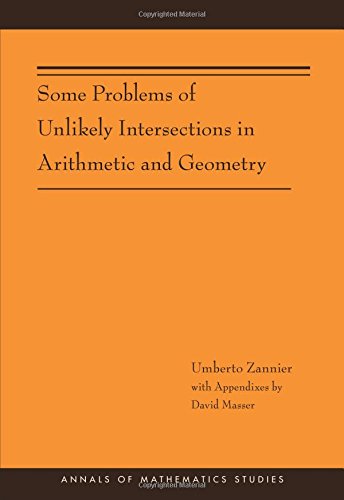
Inhaltsangabe
This book considers the so-called Unlikely Intersections, a topic that embraces well-known issues, such as Lang's and Manin-Mumford's, concerning torsion points in subvarieties of tori or abelian varieties. More generally, the book considers algebraic subgroups that meet a given subvariety in a set of unlikely dimension. The book is an expansion of the Hermann Weyl Lectures delivered by Umberto Zannier at the Institute for Advanced Study in Princeton in May 2010. The book consists of four chapters and seven brief appendixes, the last six by David Masser. The first chapter considers multiplicative algebraic groups, presenting proofs of several developments, ranging from the origins to recent results, and discussing many applications and relations with other contexts. The second chapter considers an analogue in arithmetic and several applications of this. The third chapter introduces a new method for approaching some of these questions, and presents a detailed application of this (by Masser and the author) to a relative case of the Manin-Mumford issue. The fourth chapter focuses on the André-Oort conjecture (outlining work by Pila).
Die Inhaltsangabe kann sich auf eine andere Ausgabe dieses Titels beziehen.
Über die Autorin bzw. den Autor
Umberto Zannier is professor of mathematics at the Scuola Normale Superiore di Pisa in Pisa, Italy. He is the author of Lecture Notes on Diophantine Analysis and the editor of Diophantine Geometry.
Auszug. © Genehmigter Nachdruck. Alle Rechte vorbehalten.
Some Problems of Unlikely Intersections in Arithmetic and Geometry
By Umberto ZannierPRINCETON UNIVERSITY PRESS
Copyright © 2012 Princeton University PressAll right reserved.
ISBN: 978-0-691-15371-1
Contents
Preface.......................................................................................................................ixNotation and Conventions......................................................................................................xiIntroduction: An Overview of Some Problems of Unlikely Intersections..........................................................11 Unlikely Intersections in Multiplicative Groups and the Zilber Conjecture...................................................152 An Arithmetical Analogue....................................................................................................433 Unlikely Intersections in Elliptic Surfaces and Problems of Masser..........................................................624 About the André-Oort Conjecture........................................................................................96Appendix A Distribution of Rational Points on Subanalytic Surfaces by Umberto Zannier.........................................128Appendix B Uniformity in Unlikely Intersections: An Example for Lines in Three Dimensions by David Masser.....................136Appendix C Silverman's Bounded Height Theorem for Elliptic Curves: A Direct Proof by David Masser.............................138Appendix D Lower Bounds for Degrees of Torsion Points: The Transcendence Approach by David Masser.............................140Appendix E A Transcendence Measure for a Quotient of Periods by David Masser..................................................143Appendix F Counting Rational Points on Analytic Curves: A Transcendence Approach by David Masser..............................145Appendix G Mixed Problems: Another Approach by David Masser...................................................................147Bibliography..................................................................................................................149Index.........................................................................................................................159
Chapter One
Unlikely Intersections in Multiplicative Groups and the Zilber Conjecture
As anticipated in the introduction, in this first chapter we shall describe some results of unlikely intersections in the case of multiplicative algebraic groups (also called "tori") [??]nm, together with a sketch of some of the proofs. (The important analogue for abelian varieties shall be discussed later in Chapter 3 with other methods.)
Remark 1.0.1 Algebraic subgroups and cosets. Before going on, it shall be convenient to recall briefly the simple theory giving the structure of algebraic subgroups and cosets of [??]nm. (Simple proofs may be found, e.g., in [BG06], Ch. 3.)
Every algebraic subgroup G of [??]nm may be defined by equations xa = 1 (on denoting [MATHEMATICAL EXPRESSION NOT REPRODUCIBLE IN ASCII]), where the vector a = (a1; ...; an) runs through a lattice Λ = ΛG [subset] Zn; of course it suffices to choose equations corresponding to a basis of Λ. The correspondence G ↔ ΛG is one-to-one. If ΛG has rank r then G has dimension n - r, and is irreducible if and only if ΛG is primitive (i.e., is a factor of Zn). We say that G is proper if G [not equal to]] [??]nm.
Any irreducible algebraic subgroup G is also called a "subtorus" and, setting d := dim G, it becomes isomorphic (as an algebraic group) to Gdm, the isomorphism being induced by a suitable monomial change of coordinates xi → xai on [??]nm. Such a G may be also parametrized by [MATHEMATICAL EXPRESSION NOT REPRODUCIBLE IN ASCII].
The torsion points in [??]nm are those whose coordinates are roots of unity; they are Zariski-dense in any algebraic subgroup G. Further, any coset of G in [??]nm may be defined by equations xa = ca, a [member of] ΛG, for suitable nonzero constants ca; this coset is a torsion coset (i.e., t a translate of G by a torsion point) if and only if the ca are roots of unity (which amounts to the fact that it contains a torsion point). Any torsion coset of an irreducible G is a component of an algebraic subgroup of the same dimension.
As usual, we shall denote by [l] the multiplication-by-l map on [MATHEMATICAL EXPRESSION NOT REPRODUCIBLE IN ASCII]. It is not too di_cult to prove that if X is a nonempty irreducible subvariety of [??]nm such that [l]X [subset] X for an integer l > 1, then X is a torsion coset (and conversely). (See, for instance, [Zan09], Theorem 4.6. A proof may be also obtained by projection, from the simpler case of hypersurfaces, for instance similarly to the argument in [BZ95]; see further Remark 1.1.1 in the next section for some details.)
1.1 Torsion points on subvarieties of [??]nm
Let us start with Lang's original problem of torsion points on plane curves in [??]2m and its generalization to higher dimensions, i.e., describing the torsion points on a subvariety X [subset] [??]nm. Before offering a general statement in this direction, let us recall that equations in roots of unity go back to long ago; for example, P. Gordan studied in [Gor77] the equation cos 2πx + cos 2πy + cos 2πz = -1, in rationals x; y; z, with the purpose of classifying finite subgroups of PGL2(C). Other equations of similar shape arise in the enumeration of polytopes satisfying suitable conditions. See [CJ76] for a brief description of this, and also for a general theory of trigonometric diophantine equations (in the authors' terminology), aimed to reduce every mixed diophantine equation (in angle-variables and usual variables) to a usual one. Such paper was also partly inspired by H.B. Mann's [Man65], classifying solutions in roots of unity to linear equations with rational coe_cients. (We shall see later that these results are relevant also for Lang's issue, and represent one of the possible tools to achieve a complete solution of it.)
Coming back to Lang's formulation, as mentioned in the introduction, work of M. Laurent [Lau84] and independently of Sarnak-Adams [SA94] led to the following general result:
Theorem 1.1. Torsion points theorem. Let Σ be any set of torsion points in [??]nm([bar.Q]). The Zariski closure of Σ is a finite union of torsion cosets.
This may be reformulated by saying that
The torsion points in a subvariety X [subset] [??]nm all lie and are Zariski-dense in a finite number of torsion cosets contained in X. In particular, if X is...
„Über diesen Titel“ kann sich auf eine andere Ausgabe dieses Titels beziehen.
Suchergebnisse für Some Problems of Unlikely Intersections in Arithmetic...

Beispielbild für diese ISBN
Some Problems of Unlikely Intersections in Arithmetic and Geometry (AM-181) (Annals of Mathematics Studies (181))
Anbieter: Labyrinth Books, Princeton, NJ, USA
Verkäuferbewertung 5 von 5 Sternen

Zustand: New. Bestandsnummer des Verkäufers 141128
Neu kaufen
EUR 50,62
EUR 3,95 Versand
Versand innerhalb von USA
Versand innerhalb von USA
Anzahl: 5 verfügbar
Beispielbild für diese ISBN
Some Problems of Unlikely Intersections in Arithmetic and Geometry. (Annals of Mathematics Studies, 181)
Verlag:
Publisher: Princeton University Press . 2012., 2012
ISBN 10: 069115371X
ISBN 13: 9780691153711
Gebraucht
Softcover
Anbieter: Antiquariaat Ovidius, Bredevoort, Niederlande
Verkäuferbewertung 4 von 5 Sternen

Zustand: Gebraucht / Used. Paperback. Very good. Xi,160pp. Bestandsnummer des Verkäufers 112838
Gebraucht kaufen
EUR 60,00
EUR 22,00 Versand
Versand von Niederlande nach USA
Versand von Niederlande nach USA
Anzahl: 1 verfügbar
Foto des Verkäufers
Some Problems of Unlikely Intersections in Arithmetic and Geometry
Verlag:
Princeton University Press, 2012
ISBN 10: 069115371X
ISBN 13: 9780691153711
Gebraucht
Softcover
Anbieter: GreatBookPrices, Columbia, MD, USA
Verkäuferbewertung 5 von 5 Sternen
Zustand: As New. Unread book in perfect condition. Bestandsnummer des Verkäufers 12629549
Gebraucht kaufen
EUR 96,34
EUR 2,32 Versand
Versand innerhalb von USA
Versand innerhalb von USA
Anzahl: 1 verfügbar
Foto des Verkäufers
Some Problems of Unlikely Intersections in Arithmetic and Geometry
Anbieter: GreatBookPrices, Columbia, MD, USA
Verkäuferbewertung 5 von 5 Sternen
Zustand: New. Bestandsnummer des Verkäufers 12629549-n
Neu kaufen
EUR 110,60
EUR 2,32 Versand
Versand innerhalb von USA
Versand innerhalb von USA
Anzahl: 1 verfügbar
Foto des Verkäufers
Some Problems of Unlikely Intersections in Arithmetic and Geometry
Verlag:
Princeton University Press, US, 2012
ISBN 10: 069115371X
ISBN 13: 9780691153711
Neu
Paperback
Anbieter: Rarewaves USA, HEBRON, KY, USA
Verkäuferbewertung 5 von 5 Sternen
Paperback. Zustand: New. This book considers the so-called Unlikely Intersections, a topic that embraces well-known issues, such as Lang's and Manin-Mumford's, concerning torsion points in subvarieties of tori or abelian varieties. More generally, the book considers algebraic subgroups that meet a given subvariety in a set of unlikely dimension. The book is an expansion of the Hermann Weyl Lectures delivered by Umberto Zannier at the Institute for Advanced Study in Princeton in May 2010. The book consists of four chapters and seven brief appendixes, the last six by David Masser. The first chapter considers multiplicative algebraic groups, presenting proofs of several developments, ranging from the origins to recent results, and discussing many applications and relations with other contexts. The second chapter considers an analogue in arithmetic and several applications of this. The third chapter introduces a new method for approaching some of these questions, and presents a detailed application of this (by Masser and the author) to a relative case of the Manin-Mumford issue. The fourth chapter focuses on the Andre-Oort conjecture (outlining work by Pila). Bestandsnummer des Verkäufers LU-9780691153711
Neu kaufen
EUR 113,00
Versand gratis
Versand innerhalb von USA
Versand innerhalb von USA
Anzahl: Mehr als 20 verfügbar
Foto des Verkäufers
Some Problems of Unlikely Intersections in Arithmetic and Geometry
Verlag:
Princeton University Press, 2012
ISBN 10: 069115371X
ISBN 13: 9780691153711
Gebraucht
Softcover
Anbieter: GreatBookPricesUK, Woodford Green, Vereinigtes Königreich
Verkäuferbewertung 5 von 5 Sternen
Zustand: As New. Unread book in perfect condition. Bestandsnummer des Verkäufers 12629549
Gebraucht kaufen
EUR 98,79
EUR 17,44 Versand
Versand von Vereinigtes Königreich nach USA
Versand von Vereinigtes Königreich nach USA
Anzahl: 1 verfügbar
Beispielbild für diese ISBN
Some Problems of Unlikely Intersections in Arithmetic and Geometry (Annals of Mathematics Studies, 181)
Anbieter: Ria Christie Collections, Uxbridge, Vereinigtes Königreich
Verkäuferbewertung 5 von 5 Sternen
Zustand: New. In English. Bestandsnummer des Verkäufers ria9780691153711_new
Neu kaufen
EUR 118,52
EUR 10,90 Versand
Versand von Vereinigtes Königreich nach USA
Versand von Vereinigtes Königreich nach USA
Anzahl: 1 verfügbar
Foto des Verkäufers
Some Problems of Unlikely Intersections in Arithmetic and Geometry
Anbieter: GreatBookPricesUK, Woodford Green, Vereinigtes Königreich
Verkäuferbewertung 5 von 5 Sternen
Zustand: New. Bestandsnummer des Verkäufers 12629549-n
Neu kaufen
EUR 116,03
EUR 17,44 Versand
Versand von Vereinigtes Königreich nach USA
Versand von Vereinigtes Königreich nach USA
Anzahl: 1 verfügbar
Beispielbild für diese ISBN
Some Problems of Unlikely Intersections in Arithmetic and Geometry (AM181)
Print-on-DemandAnbieter: Revaluation Books, Exeter, Vereinigtes Königreich
Verkäuferbewertung 5 von 5 Sternen
Paperback. Zustand: Brand New. 160 pages. 9.75x6.50x0.50 inches. In Stock. This item is printed on demand. Bestandsnummer des Verkäufers __069115371X
Neu kaufen
EUR 124,26
EUR 11,63 Versand
Versand von Vereinigtes Königreich nach USA
Versand von Vereinigtes Königreich nach USA
Anzahl: 1 verfügbar
Beispielbild für diese ISBN
Some Problems of Unlikely Intersections in Arithmetic and Geometry (AM-181)
Verlag:
Princeton University Press, 2012
ISBN 10: 069115371X
ISBN 13: 9780691153711
Neu
Paperback / softback
Anbieter: THE SAINT BOOKSTORE, Southport, Vereinigtes Königreich
Verkäuferbewertung 5 von 5 Sternen
Paperback / softback. Zustand: New. New copy - Usually dispatched within 4 working days. Bestandsnummer des Verkäufers B9780691153711
Neu kaufen
EUR 123,62
EUR 16,50 Versand
Versand von Vereinigtes Königreich nach USA
Versand von Vereinigtes Königreich nach USA
Anzahl: 1 verfügbar