
Verwandte Artikel zu Would you Kill the Fat Man?: The Trolley Problem and...
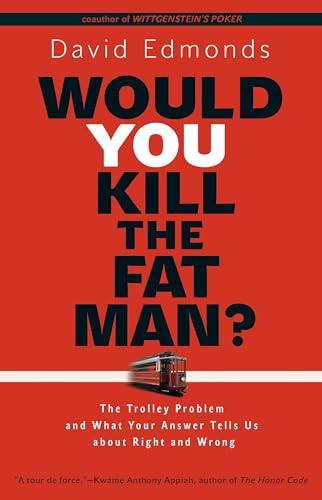
Would you Kill the Fat Man?: The Trolley Problem and What Your Answer Tells Us about Right and Wrong - Hardcover
Inhaltsangabe
The question may seem bizarre. But it's one variation of a puzzle that has baffled moral philosophers for almost half a century and that more recently has come to preoccupy neuroscientists, psychologists, and other thinkers as well. In this book, David Edmonds, coauthor of the best-selling Wittgenstein's Poker, tells the riveting story of why and how philosophers have struggled with this ethical dilemma, sometimes called the trolley problem. In the process, he provides an entertaining and informative tour through the history of moral philosophy. Most people feel it's wrong to kill the fat man. But why? After all, in taking one life you could save five. As Edmonds shows, answering the question is far more complex--and important--than it first appears. In fact, how we answer it tells us a great deal about right and wrong.
Die Inhaltsangabe kann sich auf eine andere Ausgabe dieses Titels beziehen.
Über die Autorin bzw. den Autor
David Edmonds is the author, with John Eidinow, of the best-selling Wittgenstein's Poker, as well as Rousseau's Dog and Bobby Fischer Goes to War. The cofounder of the popular Philosophy Bites podcast series, Edmonds is a senior research associate at the University of Oxford's Uehiro Centre for Practical Ethics and a multi-award-winning radio feature maker at the BBC. He holds a PhD in philosophy.
Von der hinteren Coverseite
"Lucid, witty, and beautifully written, this book is a pleasure to read. While providing an introduction to moral philosophy, it also presents engaging portraits of some of the greatest moral philosophers from Thomas Aquinas to the present day, and it makes the case for the relevance to ethics of the new experimental moral psychology. It is a tour de force."--Kwame Anthony Appiah, author ofThe Honor Code: How Moral Revolutions Happen
"This is a splendid work. You shouldn't expect it to resolve all your trolley problems but you can look forward to a romping mix of fine humor, intriguing anecdote, and solid argument. It's a sheer joy to read."--Philip Pettit, Princeton University and Australian National University
"David Edmonds has a remarkable knack for weaving the threads of philosophical debates into an engaging story.Would You Kill the Fat Man? is a stimulating introduction to some key ethical issues and philosophers."--Peter Singer, author ofThe Life You Can Save: How to Do Your Part to End World Poverty
"David Edmonds's new book, Would You Kill the Fat Man?, is both highly informative and a delight to read. Written in a clear, engaging, and witty style, it succeeds admirably in making various fascinating and important debates in philosophy and psychology accessible to a broad readership."--Jeff McMahan, Rutgers University
"This is a highly engaging book. David Edmonds's reflections are full of insight and he provides fascinating biographical background about the main players in the history of the trolley problem, in a style reminiscent of his very successfulWittgenstein's Poker."--Roger Crisp, University of Oxford
Auszug. © Genehmigter Nachdruck. Alle Rechte vorbehalten.
Would You Kill the Fat Man?
The Trolley Problem and What Your Answer Tells Us about Right and Wrong
By David EdmondsPRINCETON UNIVERSITY PRESS
Copyright © 2014 David Edmonds
All rights reserved.
ISBN: 978-0-691-15402-2All rights reserved.
Contents
| List of Figures............................................................ | xi |
| Prologue................................................................... | xiii |
| Acknowledgments............................................................ | xv |
| PART 1 Philosophy and the Trolley.......................................... | |
| CHAPTER 1 Churchill's Dilemma.............................................. | 3 |
| CHAPTER 2 Spur of the Moment............................................... | 8 |
| CHAPTER 3 The Founding Mothers............................................. | 13 |
| CHAPTER 4 The Seventh Son of Count Landulf................................. | 26 |
| CHAPTER 5 Fat Man, Loop, and Lazy Susan.................................... | 35 |
| CHAPTER 6 Ticking Clocks and the Sage of Königsberg........................ | 44 |
| CHAPTER 7 Paving the Road to Hell.......................................... | 57 |
| CHAPTER 8 Morals by Numbers................................................ | 69 |
| PART 2 Experiments and the Trolley......................................... | |
| CHAPTER 9 Out of the Armchair.............................................. | 87 |
| CHAPTER 10 It Just Feels Wrong............................................. | 94 |
| CHAPTER 11 Dudley's Choice and the Moral Instinct.......................... | 108 |
| PART 3 Mind and Brain and the Trolley...................................... | |
| CHAPTER 12 The Irrational Animal........................................... | 127 |
| CHAPTER 13 Wrestling with Neurons.......................................... | 135 |
| CHAPTER 14 Bionic Trolley.................................................. | 153 |
| PART 4 The Trolley and Its Critics......................................... | |
| CHAPTER 15 A Streetcar Named Backfire...................................... | 169 |
| CHAPTER 16 The Terminal.................................................... | 175 |
| Appendix Ten Trolleys: A Rerun............................................. | 183 |
| Notes...................................................................... | 193 |
| Bibliography............................................................... | 205 |
| Index...................................................................... | 213 |
CHAPTER 1
Churchill's Dilemma
At 4:13 a.m. on June 13, 1944, there was an explosion in a lettucepatch twenty-five miles south-east of London.
Britain had been at war for five years, but this marked thebeginning of a new torment for the inhabitants of the capital,one that would last several months and cost thousands of lives.The Germans called their flying bomb Vergeltungswaffe—retaliationweapon. The first V1 merely destroyed edible plants,but there were nine other missiles of vengeance that night, andthey had more deadly effect.
Londoners prided themselves on—and had to some extentmythologized—their fortitude during the Blitz. Yet, by thesummer of '44, reservoirs of optimism and morale were runningdry,—even though D-day had occurred on June 6 and theNazis were already on the retreat on the Eastern front.
The V1s were a terrifying sight. The two tons of steel hurtledthrough the sky, with a flaming orange-red tail. But it was thesound that most deeply imprinted itself on witnesses. The rocketswould buzz like a deranged bee and then go eerily quiet.Silence signaled that they had run out of fuel and were falling.On contact with the ground they would cause a deafening explosionthat could flatten several buildings. Londoners temperedtheir fear by giving the bombs a name of childlike innocence:doodlebugs. (The Germans called them "hell hounds"or "fire dragons.") Only an exceptional few citizens could be asphlegmatic as the poet Edith Sitwell, who was in the middle ofa reading when a doodlebug was heard above. She "merelylifted her eyes to the ceiling for a moment and, giving her voicea little more volume to counter the racket in the sky, read on."
Because the missiles were not piloted, they could be dispatchedacross the Channel day or night, rain or shine. Thatthey were unmanned made them more, not less, menacing."No enemy was risking his life up there," wrote Evelyn Waugh,"it was as impersonal as a plague, as though the city was infestedwith enormous, venomous insects."
The doodlebugs were aimed at the heart of the capital,which was both densely populated and contained the institutionsof government and power. Some doodlebugs reached thetargeted zone. One smashed windows in Buckingham Palaceand damaged George VI's tennis court. More seriously, onJune 18, 1944, a V1 landed on the Guards Chapel, near thePalace, in the midst of a morning service attended by both civiliansand soldiers: 121 people were killed.
The skylight of nearby Number 5, Seaforth Place, wouldhave been shaken by this explosion too. Number 5 was an atticflat overrun by mice and volumes of poetry: there were so manybooks that additional shelves had had to be installed in whathad originally been a bread oven, set into the wall. There wasa crack in the roof, through which could be heard the intermittentgrowl of planes, and there were cracks in the floor as well,through which could be heard the near constant roar of theunderground. The flat was home to two young women, whoshared shoes (they had three pairs between them) and a lover.Iris was working in the Treasury, and secretly feeding informationback to the Communist Party; Philippa was researchinghow American money could revitalize European economiesonce the war was over. Both Iris Murdoch and Philippa Bonsanquetwould go on to become outstanding philosophers,though Iris would always be better known as a novelist.
Iris's biographer, Peter Conradi, says the women becameused to walking to work in the morning to discover variousbuildings had disappeared during the night. Back at the flat,during intense bombing raids, they would climb into the bathtubunder the stairs for comfort and protection.
They weren't aware of it at the time, but matters could havebeen worse. The Nazis faced two problems. First, despite thenear miss to Buckingham Palace, and the terrible toll at theGuards Chapel, most of the V1 bombs actually fell a few milessouth of the center. Second, this was a fact of which the Naziswere ignorant.
An ingenious plan presented itself in Whitehall. If the Germanscould be deceived into believing that the doodlebugswere hitting their mark—or, better still, missing their mark byfalling north—then they would not readjust the trajectory ofthe bombs, and perhaps even alter it so that they fell still farthersouth. That could save lives.
The details of this deception were intricately plotted by thesecret service and involved several double agents, includingtwo of the most colorful, ZigZag and Garbo. Both ZigZagand Garbo were on the...
„Über diesen Titel“ kann sich auf eine andere Ausgabe dieses Titels beziehen.
Suchergebnisse für Would you Kill the Fat Man?: The Trolley Problem and...

Beispielbild für diese ISBN
Would You Kill the Fat Man?: The Trolley Problem and What Your Answer Tells Us about Right and Wrong
Verlag:
Princeton University Press, 2013
ISBN 10: 0691154023
ISBN 13: 9780691154022
Gebraucht
Hardcover
Anbieter: World of Books (was SecondSale), Montgomery, IL, USA
Verkäuferbewertung 5 von 5 Sternen

Hardback. Zustand: Good. A runaway train is racing toward five men who are tied to the track. Unless the train is stopped, it will inevitably kill all five men. You are standing on a footbridge looking down on the unfolding disaster. Would you kill the fat man? The question may seem bizarre. Bestandsnummer des Verkäufers 00106178568
Gebraucht kaufen
EUR 3,47
Versand gratis
Versand innerhalb von USA
Versand innerhalb von USA
Anzahl: 1 verfügbar
Foto des Verkäufers
Would You Kill the Fat Man?: The Trolley Problem and What Your Answer Tells Us about Right and Wrong
Verlag:
Princeton University Press, 2013
ISBN 10: 0691154023
ISBN 13: 9780691154022
Gebraucht
Hardcover
Anbieter: Zoom Books Company, Lynden, WA, USA
Verkäuferbewertung 5 von 5 Sternen
Zustand: very_good. Book is in very good condition and may include minimal underlining highlighting. The book can also include "From the library of" labels. May not contain miscellaneous items toys, dvds, etc. . We offer 100% money back guarantee and 24 7 customer service. Bestandsnummer des Verkäufers ZBV.0691154023.VG
Gebraucht kaufen
EUR 4,06
Versand gratis
Versand innerhalb von USA
Versand innerhalb von USA
Anzahl: 2 verfügbar
Foto des Verkäufers
Would You Kill the Fat Man?: The Trolley Problem and What Your Answer Tells Us about Right and Wrong
Verlag:
Princeton University Press, 2013
ISBN 10: 0691154023
ISBN 13: 9780691154022
Gebraucht
Hardcover
Anbieter: Greenworld Books, Arlington, TX, USA
Verkäuferbewertung 5 von 5 Sternen
Zustand: very_good. Fast Free Shipping â" Very Good condition book with a firm cover and clean pages. Shows normal use and some light wear or limited notes markings. A solid, nice copy to enjoy. Bestandsnummer des Verkäufers GWV.0691154023.VG
Gebraucht kaufen
EUR 5,28
Versand gratis
Versand innerhalb von USA
Versand innerhalb von USA
Anzahl: 1 verfügbar
Beispielbild für diese ISBN
Would You Kill the Fat Man?: The Trolley Problem and What Your Answer Tells Us about Right and Wrong
Verlag:
Princeton University Press, 2013
ISBN 10: 0691154023
ISBN 13: 9780691154022
Gebraucht
Hardcover
Anbieter: ThriftBooks-Atlanta, AUSTELL, GA, USA
Verkäuferbewertung 5 von 5 Sternen
Hardcover. Zustand: Very Good. No Jacket. Missing dust jacket; May have limited writing in cover pages. Pages are unmarked. ~ ThriftBooks: Read More, Spend Less. Bestandsnummer des Verkäufers G0691154023I4N01
Gebraucht kaufen
EUR 5,96
Versand gratis
Versand innerhalb von USA
Versand innerhalb von USA
Anzahl: 1 verfügbar
Beispielbild für diese ISBN
Would You Kill the Fat Man?: The Trolley Problem and What Your Answer Tells Us about Right and Wrong
Verlag:
Princeton University Press, 2013
ISBN 10: 0691154023
ISBN 13: 9780691154022
Gebraucht
Hardcover
Anbieter: ThriftBooks-Phoenix, Phoenix, AZ, USA
Verkäuferbewertung 5 von 5 Sternen
Hardcover. Zustand: Very Good. No Jacket. May have limited writing in cover pages. Pages are unmarked. ~ ThriftBooks: Read More, Spend Less. Bestandsnummer des Verkäufers G0691154023I4N00
Gebraucht kaufen
EUR 5,96
Versand gratis
Versand innerhalb von USA
Versand innerhalb von USA
Anzahl: 1 verfügbar
Beispielbild für diese ISBN
Would You Kill the Fat Man?: The Trolley Problem and What Your Answer Tells Us about Right and Wrong
Verlag:
Princeton University Press, 2013
ISBN 10: 0691154023
ISBN 13: 9780691154022
Gebraucht
Hardcover
Anbieter: ThriftBooks-Atlanta, AUSTELL, GA, USA
Verkäuferbewertung 5 von 5 Sternen
Hardcover. Zustand: Very Good. No Jacket. May have limited writing in cover pages. Pages are unmarked. ~ ThriftBooks: Read More, Spend Less. Bestandsnummer des Verkäufers G0691154023I4N00
Gebraucht kaufen
EUR 5,96
Versand gratis
Versand innerhalb von USA
Versand innerhalb von USA
Anzahl: 1 verfügbar
Beispielbild für diese ISBN
Would You Kill the Fat Man?: The Trolley Problem and What Your Answer Tells Us about Right and Wrong
Verlag:
Princeton University Press, 2013
ISBN 10: 0691154023
ISBN 13: 9780691154022
Gebraucht
Hardcover
Anbieter: ThriftBooks-Atlanta, AUSTELL, GA, USA
Verkäuferbewertung 5 von 5 Sternen
Hardcover. Zustand: Good. No Jacket. Pages can have notes/highlighting. Spine may show signs of wear. ~ ThriftBooks: Read More, Spend Less. Bestandsnummer des Verkäufers G0691154023I3N00
Gebraucht kaufen
EUR 5,96
Versand gratis
Versand innerhalb von USA
Versand innerhalb von USA
Anzahl: 1 verfügbar
Beispielbild für diese ISBN
Would You Kill the Fat Man? : The Trolley Problem and What Your Answer Tells Us about Right and Wrong
Verlag:
Princeton University Press, 2013
ISBN 10: 0691154023
ISBN 13: 9780691154022
Gebraucht
Hardcover
Anbieter: Better World Books, Mishawaka, IN, USA
Verkäuferbewertung 5 von 5 Sternen
Zustand: Very Good. Former library copy. Pages intact with possible writing/highlighting. Binding strong with minor wear. Dust jackets/supplements may not be included. Includes library markings. Stock photo provided. Product includes identifying sticker. Better World Books: Buy Books. Do Good. Bestandsnummer des Verkäufers GRP91561290
Gebraucht kaufen
EUR 6,19
Versand gratis
Versand innerhalb von USA
Versand innerhalb von USA
Anzahl: 2 verfügbar
Beispielbild für diese ISBN
Would You Kill the Fat Man? : The Trolley Problem and What Your Answer Tells Us about Right and Wrong
Verlag:
Princeton University Press, 2013
ISBN 10: 0691154023
ISBN 13: 9780691154022
Gebraucht
Hardcover
Anbieter: Better World Books, Mishawaka, IN, USA
Verkäuferbewertung 5 von 5 Sternen
Zustand: Good. Former library copy. Pages intact with minimal writing/highlighting. The binding may be loose and creased. Dust jackets/supplements are not included. Includes library markings. Stock photo provided. Product includes identifying sticker. Better World Books: Buy Books. Do Good. Bestandsnummer des Verkäufers 5425172-6
Gebraucht kaufen
EUR 6,19
Versand gratis
Versand innerhalb von USA
Versand innerhalb von USA
Anzahl: 1 verfügbar
Beispielbild für diese ISBN
Would You Kill the Fat Man?: The Trolley Problem and What Your Answer Tells Us about Right and Wrong
Verlag:
Princeton University Press, 2013
ISBN 10: 0691154023
ISBN 13: 9780691154022
Gebraucht
Hardcover
Anbieter: PaceSetter Books, St. Charles, IL, USA
Verkäuferbewertung 4 von 5 Sternen

hardcover. Zustand: Good. Note:Extensive underlining. Dustcover is clean. Edges are sharp. Bestandsnummer des Verkäufers 204594
Gebraucht kaufen
EUR 2,71
EUR 3,56 Versand
Versand innerhalb von USA
Versand innerhalb von USA
Anzahl: 1 verfügbar