
Verwandte Artikel zu Slicing Pizzas, Racing Turtles, and Further Adventures...
Slicing Pizzas, Racing Turtles, and Further Adventures in Applied Mathematics (Princeton Puzzlers) - Softcover
Buch 2 von 7: Princeton Puzzlers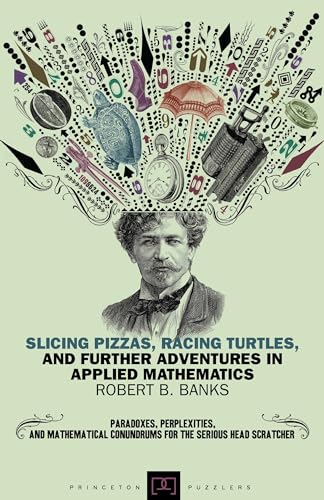
Inhaltsangabe
Have you ever daydreamed about digging a hole to the other side of the world? Robert Banks not only entertains such ideas but, better yet, he supplies the mathematical know-how to turn fantasies into problem-solving adventures. In this sequel to the popular Towing Icebergs, Falling Dominoes (Princeton, 1998), Banks presents another collection of puzzles for readers interested in sharpening their thinking and mathematical skills. The problems range from the wondrous to the eminently practical. In one chapter, the author helps us determine the total number of people who have lived on earth; in another, he shows how an understanding of mathematical curves can help a thrifty lover, armed with construction paper and scissors, keep expenses down on Valentine's Day. In twenty-six chapters, Banks chooses topics that are fairly easy to analyze using relatively simple mathematics. The phenomena he describes are ones that we encounter in our daily lives or can visualize without much trouble. For example, how do you get the most pizza slices with the least number of cuts? To go from point A to point B in a downpour of rain, should you walk slowly, jog moderately, or run as fast as possible to get least wet? What is the length of the seam on a baseball? If all the ice in the world melted, what would happen to Florida, the Mississippi River, and Niagara Falls? Why do snowflakes have six sides? Covering a broad range of fields, from geography and environmental studies to map- and flag-making, Banks uses basic algebra and geometry to solve problems. If famous scientists have also pondered these questions, the author shares the historical details with the reader. Designed to entertain and to stimulate thinking, this book can be read for sheer personal enjoyment.
Die Inhaltsangabe kann sich auf eine andere Ausgabe dieses Titels beziehen.
Über die Autorin bzw. den Autor
Robert B. Banks (1922-2002) was the author of Towing Icebergs, Falling Dominoes, and Other Adventures in Applied Mathematics (Princeton). He was professor of engineering at Northwestern University and dean of engineering at the University of Illinois at Chicago.
Auszug. © Genehmigter Nachdruck. Alle Rechte vorbehalten.
Slicing Pizzas, Racing Turtles, and Further Adventures in Applied Mathematics
By ROBERT B. BANKSPrinceton University Press
Copyright © 1999 Princeton University PressAll right reserved.
ISBN: 978-0-691-15499-2
Contents
Preface...............................................................................ixAcknowledgments.......................................................................xiiiChapter 1 Broad Stripes and Bright Stars..............................................3Chapter 2 More Stars, Honeycombs, and Snowflakes......................................13Chapter 3 Slicing Things Like Pizzas and Watermelons..................................23Chapter 4 Raindrops Keep Falling on My Head and Other Goodies.........................34Chapter 5 Raindrops and Other Goodies Revisited.......................................44Chapter 6 Which Major Rivers Flow Uphill?.............................................49Chapter 7 A Brief Look at π, e, and Some Other Famous Numbers......................57Chapter 8 Another Look at Some Famous Numbers.........................................69Chapter 9 Great Number Sequences: Prime, Fibonacci, and Hailstone.....................78Chapter 10 A Fast Way to Escape.......................................................97Chapter 11 How to Get Anywhere in About Forty-Two Minutes.............................105Chapter 12 How Fast Should You Run in the Rain?.......................................114Chapter 13 Great Turtle Races: Pursuit Curves.........................................123Chapter 14 More Great Turtle Races: Logarithmic Spirals...............................131Chapter 15 How Many People Have Ever Lived?...........................................138Chapter 16 The Great Explosion of 2023................................................146Chapter 17 How to Make Fairly Nice Valentines.........................................153Chapter 18 Somewhere Over the Rainbow.................................................163Chapter 19 Making Mathematical Mountains..............................................177Chapter 20 How to Make Mountains out of Molehills.....................................184Chapter 21 Moving Continents from Here to There.......................................196Chapter 22 Cartography: How to Flatten Spheres........................................204Chapter 23 Growth and Spreading and Mathematical Analogies............................219Chapter 24 How Long Is the Seam on a Baseball?........................................232Chapter 25 Baseball Seams, Pipe Connections, and World Travels........................247Chapter 26 Lengths, Areas, and Volumes of All Kinds of Shapes.........................256References............................................................................279Index.................................................................................285
Chapter One
Broad Stripes and Bright Stars
These days we see much more of the flag of the United States than we ever did in the past. Old Glory flies over many more office buildings and business establishments than it did before. It is now seen far more extensively in parks and along streets and indeed in a great many programs and commercials on television.
With this greatly increased presence and awareness of the flag, there is understandable growing interest in learning more about numerous aspects of the U.S. flag, including its history and physical features and the customs and protocol associated with it.
There are a number of books that examine various topics concerning the flag of the United States. Representative are the publications of Smith (1975a) and Furlong and McCandless (1981). On the world scene, many references are available dealing with the flags of all nations. For example, the books by Smith (1975b) and Crampton 1990 cover many subjects relating to flags of the world and to various other topics of vexillology: the art and science of flag study.
The Geometry of the Flag of the United States
With that brief introduction, we come directly to the point. The colors of the U.S. flag are red, white, and blue. Now, are you ready for the big question? What are the area percentages of red, white, and blue? That is, which of the three colors occupies the largest area of the flag and which color the smallest? It's a good question. Do you want to guess before we compute the answer?
The flag is shown in figure 1.1 and its more important proportions and features are listed in table 1.1. Arbitrarily selecting the foot as the unit of linear measurement, here are some preliminary observations:
The total area of the flag is 1.0 × 1.9s1.9 ft2 The area of the union is 7 13 × 0.76 0.4092 ft2 The length of the seven upper stripes is 1.14 ft The length of the six lower stripes is 1.9 ft
The width of a stripe is 1 13 0.07692 ft
The problem of computing the red area is easy
The problem of computing the white and blue areas is not so easy because of the 50 white stars in an otherwise blue union
So, before we can obtain the final answer we have to look at stars
The Geometry of a Five-Pointed Star
A five-pointed star, commonly called a pentagram, is shown in figure 1.2(a). Its radius, R, is the radius of the circumscribing circle. The five-sided polygon within the star is called a pentagon; the radius of its circumscribing circle is r.
The section ABOC is removed from the pentagram of figure 1.2(a) and displayed as the pentagram kite of figure 1.2(b). Some geometry establishes that α 36°, ß 72°, and γ 126°. Without much difficulty we obtain the expression
[MATHEMATICAL EXPRESSION NOT REPRODUCIBLE IN ASCII], (1.1)
where A is the area of the pentagram. Substituting the values of a and ß into this expression gives
A 1.12257R2. (1.2)
For comparison, remember that the area of the circumscribing circle is πR2 where, of course, π 3.14159. Equation 1.2 provides us with a simple formula to compute the area of a five-pointed star.
In elementary mathematical analysis we frequently run across the numerical quantity φ (1 2)(1 [square root of 5]) 1.61803. It is a very famous number in mathematics. It is called the golden number or divine proportion. Our pentagram is full of golden numbers. According to Huntley (1970), the following φ relationships prevail in figure 1.2 based on unit length BC i.e., one side of the pentagon:
[MATHEMATICAL EXPRESSION NOT REPRODUCIBLE IN ASCII]. (1.3)
Utilizing these relationships, it can be established that the area of the regular pentagram can be expressed in terms of φ:
[MATHEMATICAL EXPRESSION NOT REPRODUCIBLE IN ASCII]. (1.4)
As we would expect from observing equation (1.2), the quantity in the brackets of equation (1.4) is 1.12257.
The perimeter of a pentagram is not difficult to determine. Using some geometry and trigonometry we obtain
[MATHEMATICAL EXPRESSION NOT REPRODUCIBLE IN ASCII]. (1.5)
The bracketed quantity has the numerical value 7.2654. The length of the circumscribing circle is, of course, 2 πR.
Numerous other relationships could be established. For example, can you demonstrate that the ratio of the area of the five points of the pentagram to the area of the base pentagon is [square root of 5]?
How Much Red, How Much White, How Much Blue?
We now have the information we need to answer the big question. From table 1.1 we note that...
„Über diesen Titel“ kann sich auf eine andere Ausgabe dieses Titels beziehen.
Suchergebnisse für Slicing Pizzas, Racing Turtles, and Further Adventures...

Beispielbild für diese ISBN
Slicing Pizzas, Racing Turtles, and Further Adventures in Applied Mathematics
Verlag:
Princeton University Press, 2012
ISBN 10: 0691154996
ISBN 13: 9780691154992
Gebraucht
Paperback
Anbieter: World of Books (was SecondSale), Montgomery, IL, USA
Verkäuferbewertung 5 von 5 Sternen

Paperback. Zustand: Good. A collection of puzzles. Covering a range of fields, from geography and environmental studies to map- and flag-making, it uses basic algebra and geometry to solve problems. It is suitable for readers interested in sharpening their thinking and mathematical skills. Bestandsnummer des Verkäufers CIN0691154996G
Gebraucht kaufen
EUR 5,51
Versand gratis
Versand innerhalb von USA
Versand innerhalb von USA
Anzahl: 1 verfügbar
Beispielbild für diese ISBN
Slicing Pizzas, Racing Turtles, and Further Adventures in Applied Mathematics
Verlag:
Princeton University Press, 2012
ISBN 10: 0691154996
ISBN 13: 9780691154992
Gebraucht
Paperback
Anbieter: World of Books Inc, Montgomery, IL, USA
Verkäuferbewertung 4 von 5 Sternen

Paperback. Zustand: Good. A collection of puzzles. Covering a range of fields, from geography and environmental studies to map- and flag-making, it uses basic algebra and geometry to solve problems. It is suitable for readers interested in sharpening their thinking and mathematical skills. Bestandsnummer des Verkäufers CIN0691154996G
Gebraucht kaufen
EUR 7,35
Versand gratis
Versand innerhalb von USA
Versand innerhalb von USA
Anzahl: 1 verfügbar
Beispielbild für diese ISBN
Slicing Pizzas, Racing Turtles, and Further Adventures in Applied Mathematics
Verlag:
Princeton University Press, 2012
ISBN 10: 0691154996
ISBN 13: 9780691154992
Gebraucht
Paperback
Anbieter: ThriftBooks-Dallas, Dallas, TX, USA
Verkäuferbewertung 5 von 5 Sternen
Paperback. Zustand: As New. No Jacket. Pages are clean and are not marred by notes or folds of any kind. ~ ThriftBooks: Read More, Spend Less. Bestandsnummer des Verkäufers G0691154996I2N00
Gebraucht kaufen
EUR 12,83
Versand gratis
Versand innerhalb von USA
Versand innerhalb von USA
Anzahl: 1 verfügbar
Beispielbild für diese ISBN
Slicing Pizzas, Racing Turtles, and Further Adventures in Applied Mathematics (Princeton Puzzlers)
Verlag:
Princeton University Press, 2012
ISBN 10: 0691154996
ISBN 13: 9780691154992
Gebraucht
paperback
Anbieter: Half Price Books Inc., Dallas, TX, USA
Verkäuferbewertung 5 von 5 Sternen
paperback. Zustand: Very Good. Connecting readers with great books since 1972! Used books may not include companion materials, and may have some shelf wear or limited writing. We ship orders daily and Customer Service is our top priority! Bestandsnummer des Verkäufers S_462186977
Gebraucht kaufen
EUR 10,02
EUR 3,35 Versand
Versand innerhalb von USA
Versand innerhalb von USA
Anzahl: 1 verfügbar
Beispielbild für diese ISBN
Slicing Pizzas, Racing Turtles, and Further Adventures in Applied Mathematics (Princeton Puzzlers)
Verlag:
Princeton University Press, 2012
ISBN 10: 0691154996
ISBN 13: 9780691154992
Gebraucht
paperback
Anbieter: Roundabout Books, Greenfield, MA, USA
Verkäuferbewertung 4 von 5 Sternen
paperback. Zustand: Near Fine. Condition Notes: Excellent, unmarked copy with little wear and tight binding. We ship in recyclable American-made mailers. 100% money-back guarantee on all orders. Bestandsnummer des Verkäufers 1785341
Gebraucht kaufen
EUR 13,82
Versand gratis
Versand innerhalb von USA
Versand innerhalb von USA
Anzahl: 1 verfügbar
Beispielbild für diese ISBN
Slicing Pizzas, Racing Turtles, and Further Adventures in Applied Mathematics
Anbieter: GreatBookPrices, Columbia, MD, USA
Verkäuferbewertung 5 von 5 Sternen
Zustand: New. Bestandsnummer des Verkäufers 13878424-n
Neu kaufen
EUR 18,03
EUR 2,36 Versand
Versand innerhalb von USA
Versand innerhalb von USA
Anzahl: 6 verfügbar
Beispielbild für diese ISBN
Slicing Pizzas, Racing Turtles, and Further Adventures in Applied Mathematics
Anbieter: PBShop.store US, Wood Dale, IL, USA
Verkäuferbewertung 5 von 5 Sternen
PAP. Zustand: New. New Book. Shipped from UK. Established seller since 2000. Bestandsnummer des Verkäufers WP-9780691154992
Foto des Verkäufers
Slicing Pizzas, Racing Turtles, and Further Adventures in Applied Mathematics
Verlag:
Princeton University Press, US, 2012
ISBN 10: 0691154996
ISBN 13: 9780691154992
Neu
Paperback
Anbieter: Rarewaves USA, HEBRON, KY, USA
Verkäuferbewertung 5 von 5 Sternen
Paperback. Zustand: New. Have you ever daydreamed about digging a hole to the other side of the world? Robert Banks not only entertains such ideas but, better yet, he supplies the mathematical know-how to turn fantasies into problem-solving adventures. In this sequel to the popular Towing Icebergs, Falling Dominoes (Princeton, 1998), Banks presents another collection of puzzles for readers interested in sharpening their thinking and mathematical skills. The problems range from the wondrous to the eminently practical. In one chapter, the author helps us determine the total number of people who have lived on earth; in another, he shows how an understanding of mathematical curves can help a thrifty lover, armed with construction paper and scissors, keep expenses down on Valentine's Day. In twenty-six chapters, Banks chooses topics that are fairly easy to analyze using relatively simple mathematics. The phenomena he describes are ones that we encounter in our daily lives or can visualize without much trouble. For example, how do you get the most pizza slices with the least number of cuts?To go from point A to point B in a downpour of rain, should you walk slowly, jog moderately, or run as fast as possible to get least wet? What is the length of the seam on a baseball? If all the ice in the world melted, what would happen to Florida, the Mississippi River, and Niagara Falls? Why do snowflakes have six sides? Covering a broad range of fields, from geography and environmental studies to map- and flag-making, Banks uses basic algebra and geometry to solve problems. If famous scientists have also pondered these questions, the author shares the historical details with the reader. Designed to entertain and to stimulate thinking, this book can be read for sheer personal enjoyment. Bestandsnummer des Verkäufers LU-9780691154992
Neu kaufen
EUR 20,60
Versand gratis
Versand innerhalb von USA
Versand innerhalb von USA
Anzahl: Mehr als 20 verfügbar
Foto des Verkäufers
Slicing Pizzas, Racing Turtles, and Further Adventures in Applied Mathematics
Verlag:
Princeton University Press, 2012
ISBN 10: 0691154996
ISBN 13: 9780691154992
Gebraucht
Softcover
Anbieter: GreatBookPrices, Columbia, MD, USA
Verkäuferbewertung 5 von 5 Sternen
Zustand: As New. Unread book in perfect condition. Bestandsnummer des Verkäufers 13878424
Gebraucht kaufen
EUR 18,26
EUR 2,36 Versand
Versand innerhalb von USA
Versand innerhalb von USA
Anzahl: 6 verfügbar
Foto des Verkäufers
Slicing Pizzas, Racing Turtles, and Further Adventures in Applied Mathematics (Paperback or Softback)
Verlag:
Princeton University Press 7/22/2012, 2012
ISBN 10: 0691154996
ISBN 13: 9780691154992
Neu
Paperback or Softback
Anbieter: BargainBookStores, Grand Rapids, MI, USA
Verkäuferbewertung 5 von 5 Sternen
Paperback or Softback. Zustand: New. Slicing Pizzas, Racing Turtles, and Further Adventures in Applied Mathematics. Book. Bestandsnummer des Verkäufers BBS-9780691154992