
Verwandte Artikel zu Bayesian Models: A Statistical Primer for Ecologists
Inhaltsangabe
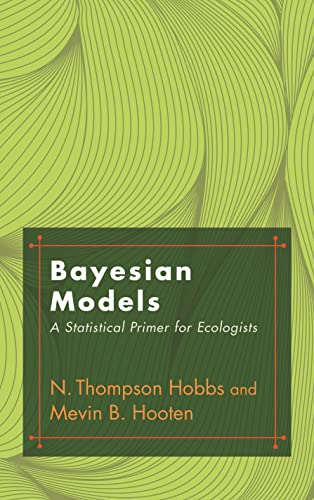
Bayesian modeling has become an indispensable tool for ecological research because it is uniquely suited to deal with complexity in a statistically coherent way. This textbook provides a comprehensive and accessible introduction to the latest Bayesian methods—in language ecologists can understand. Unlike other books on the subject, this one emphasizes the principles behind the computations, giving ecologists a big-picture understanding of how to implement this powerful statistical approach.
Bayesian Models is an essential primer for non-statisticians. It begins with a definition of probability and develops a step-by-step sequence of connected ideas, including basic distribution theory, network diagrams, hierarchical models, Markov chain Monte Carlo, and inference from single and multiple models. This unique book places less emphasis on computer coding, favoring instead a concise presentation of the mathematical statistics needed to understand how and why Bayesian analysis works. It also explains how to write out properly formulated hierarchical Bayesian models and use them in computing, research papers, and proposals.
This primer enables ecologists to understand the statistical principles behind Bayesian modeling and apply them to research, teaching, policy, and management.
- Presents the mathematical and statistical foundations of Bayesian modeling in language accessible to non-statisticians
- Covers basic distribution theory, network diagrams, hierarchical models, Markov chain Monte Carlo, and more
- Deemphasizes computer coding in favor of basic principles
- Explains how to write out properly factored statistical expressions representing Bayesian models
Die Inhaltsangabe kann sich auf eine andere Ausgabe dieses Titels beziehen.
Über die Autorin bzw. den Autor
N. Thompson Hobbs is senior research scientist at the Natural Resource Ecology Laboratory and professor in the Department of Ecosystem Science and Sustainability at Colorado State University. Mevin B. Hooten is associate professor in the Department of Fish, Wildlife, and Conservation Biology and the Department of Statistics at Colorado State University, and assistant unit leader in the US Geological Survey's Colorado Cooperative Fish and Wildlife Research Unit.
Von der hinteren Coverseite
"Hobbs and Hooten provide an important bridge between standard statistical texts and more advanced Bayesian books, even those aimed at ecologists. Ecological models are complex. Building from likelihood to simple and hierarchical Bayesian models, the authors do a superb job of focusing on concepts, from philosophy to the necessary mathematical and statistical tools. This practical and understandable book belongs on the shelves of all scientists and statisticians interested in ecology."--Jay M. Ver Hoef, Statistician, NOAA-NMFS Alaska Fisheries Science Center
"Tackling an important and challenging topic, Hobbs and Hooten provide non-statistically-trained ecologists with the skills they need to use hierarchical Bayesian models accurately and comfortably. The combination of technical explanations and practical examples is great. This book is a valuable contribution that will be widely used."--Benjamin Bolker, McMaster University
"This excellent book is one of the best-written and most complete primers on Bayesian hierarchical modeling I have seen. Hobbs and Hooten anticipate many of the common pitfalls and concerns that arise when non-statisticians are introduced to this material. Researchers across a wide range of disciplines will find this book valuable."--Christopher Wikle, University of Missouri
Auszug. © Genehmigter Nachdruck. Alle Rechte vorbehalten.
Bayesian Models
A Statistical Primer for Ecologists
By N. Thompson Hobbs, Mevin B. HootenPRINCETON UNIVERSITY PRESS
Copyright © 2015 Princeton University Press
All rights reserved.
ISBN: 978-0-691-15928-7All rights reserved.
Contents
Preface, ix,
I Fundamentals, 1,
1 PREVIEW, 3,
2 DETERMINISTIC MODELS, 17,
3 PRINCIPLES OF PROBABILITY, 29,
4 LIKELIHOOD, 71,
5 SIMPLE BAYESIAN MODELS, 79,
6 HIERARCHICAL BAYESIAN MODELS, 107,
II Implementation, 143,
7 MARKOV CHAIN MONTE CARLO, 145,
8 INFERENCE FROM A SINGLE MODEL, 181,
9 INFERENCE FROM MULTIPLE MODELS, 209,
III Practice in Model Building, 231,
10 WRITING BAYESIAN MODELS, 233,
11 PROBLEMS, 243,
12 SOLUTIONS, 251,
Afterword, 273,
Acknowledgments, 277,
A Probability Distributions and Conjugate Priors, 279,
Bibliography, 283,
Index, 293,
CHAPTER 1
Preview
Art is the lie that tells us the truth. — Pablo Picasso
All models are wrong but some are useful. — George E. P. Box
Pablo Picasso was a contemporary of George Box's, a statistician who had an enormous impact on his field, writing influential papers well into his 90s. Both men sought to express truth about nature, but they used tools that were dramatically different — Picasso brushing strokes on canvas, and Box writing equations on paper. Given the different ways they worked, it is remarkable that Box and Picasso made such similar statements about the central importance of abstraction to insight. Abstraction plays a role in all creative human enterprise — in art, music, literature, engineering, and science. We create abstractions because they allow us to focus on the most important elements of a problem, those relevant to the objectives of our work, without being distracted by elements that are not relevant.
Scientific models are, above all else, abstractions. They are statements about the operation of nature that purposefully omit many details and thus achieve insight that would otherwise be discursively obscured. They provide unambiguous statements of what we believe is important. A key principle in modeling and statistics — in science for that matter — is the need to reduce the dimensions of a problem. A data set may contain a thousand observations. By reducing its dimensions to a model with a few parameters, we are able to gain understanding.
However, because models are abstractions and reduce the dimensions of a problem, we must deal with the elements we choose to omit. These elements create uncertainty in the predictions of models, so it follows that assessing uncertainty is fundamental to science. Scientists, journalists, logicians, and attorneys alike can rightly claim to make statements based on evidence, but only scientific statements include evidence tempered by uncertainty quantified. We know what is certain only to the extent that we can say, with confidence, what is uncertain. Sharpening our thinking about uncertainty and learning how to estimate it properly is a main theme of this book.
Your science will have impact to the extent that you are able to ask important questions and provide compelling answers to them. Doing so depends on establishing a line of inference that extends from current thinking, theory, and questions to new insight qualified by uncertainty (fig. 1.1.1). This book offers a highly general, flexible approach to establishing this line of inference. We cannot help you pose novel, interesting questions, but we can teach an approach to inference applicable to an enormous range of research problems, an approach that can be understood from first principles and that can be unambiguously communicated to other scientists, managers, and policy makers. We emphasize that understanding the principles of this framework allows you to customize your analyses to accommodate the inevitable idiosyncrasies of specific problems in research.
We sketch that framework in this chapter to give a general sense of where this book is headed, a preview we use to motivate the development of concepts and principles in the chapters that follow. There should be details of our approach that are unfamiliar, otherwise you probably don't need this book. Soon enough, we will explain those details fully. For now, we offer a somewhat abstract overview followed by a concrete example as an enticement to read on. It will be rewarding to return to this section after you have worked through the book. We hope you will be pleasantly surprised by your increased understanding of our small preview. The only part of this chapter that is essential for the remainder of the book is understanding our notation, which we describe in section 1.1.1.
1.1 A Line of Inference for Ecology
Virtually all research problems in ecology share a set of features. We want to understand how the state of an ecological system changes over time, across space, or among individuals. We seek to understand why those changes occur. Our understanding usually depends on a sample drawn from all possible instances of the state because we want to make statements about a system that is too large to observe fully. The observations in that sample are often related imperfectly to the true state. In the subsections that follow, we lay out an approach first described by Berliner (1996) for modeling the imperfect observations that arise from a process we want to understand. It does not apply to all research problems, but it is sufficiently general and flexible that it applies to most.
1.1.1 Some Notation
Before we proceed, we must introduce some notation. Boldface lowercase letters will indicate vectors (e.g., θ, a), and lightface lowercase letters, scalars (θ, a). Bold capital letters will be used for matrices (e.g., A). The symbol θ will indicate a vector of parameters, and, of course, θ will indicate a single parameter. The letter y will indicate a vector of data, Y a matrix, and y or yi a single observation. Corresponding notation using x, x , and xi will be used for predictor variables, also called covariates. The notation [a|b, c] will be used for the probability distribution of the random variable a conditional on the parameters b and c. Deterministic models will be denoted by g() with arguments necessary for the model within the parentheses. Notation will be added as needed, in context.
1.1.2 Process Models
Process models include a mathematical statement that depicts a process and a way to account for uncertainty about the process. To compose a process model we start by thinking about the true state (z) of an ecological system. That state could be the size of a population, the flux of nitrogen from the soils of a grassland, the number of invasive plants in a community, or the area of landscape annually disturbed by fire. We seek to understand influences on that state, the things that cause it to change. We write an equation, a deterministic model that represents our ideas about the behavior of the state of interest and the quantities that influence it. When we say the model is deterministic, we mean that for a given set of parameters and inputs, it will make precisely the same predictions. We use the notation g(θp, x) to represent the deterministic part of a process model, where g() is any mathematical function, θp is a vector of parameters in the model, and x is one or more explanatory variables that we...
„Über diesen Titel“ kann sich auf eine andere Ausgabe dieses Titels beziehen.
Suchergebnisse für Bayesian Models: A Statistical Primer for Ecologists

Foto des Verkäufers
Bayesian Models: A Statistical Primer for Ecologists
Verlag:
Princeton University Press, 2015
ISBN 10: 0691159289
ISBN 13: 9780691159287
Gebraucht
Hardcover
Anbieter: Goodbooks Company, Springdale, AR, USA
Verkäuferbewertung 5 von 5 Sternen

Zustand: good. Has a sturdy binding with some shelf wear. May have some markings or highlighting. Used copies may not include access codes or Cd's. Slight bending may be present. Bestandsnummer des Verkäufers GBV.0691159289.G
Gebraucht kaufen
EUR 21,39
EUR 4,45 Versand
Versand innerhalb von USA
Versand innerhalb von USA
Anzahl: 1 verfügbar
Beispielbild für diese ISBN
Bayesian Models: A Statistical Primer for Ecologists
Verlag:
Princeton University Press, 2015
ISBN 10: 0691159289
ISBN 13: 9780691159287
Gebraucht
Hardcover
Anbieter: HPB-Red, Dallas, TX, USA
Verkäuferbewertung 5 von 5 Sternen
Hardcover. Zustand: Good. Connecting readers with great books since 1972! Used textbooks may not include companion materials such as access codes, etc. May have some wear or writing/highlighting. We ship orders daily and Customer Service is our top priority! Bestandsnummer des Verkäufers S_480638724
Gebraucht kaufen
EUR 31,97
EUR 3,35 Versand
Versand innerhalb von USA
Versand innerhalb von USA
Anzahl: 1 verfügbar
Beispielbild für diese ISBN
Bayesian Models: A Statistical Primer for Ecologists
Verlag:
Princeton University Press, 2015
ISBN 10: 0691159289
ISBN 13: 9780691159287
Gebraucht
Hardcover
Anbieter: Wonder Book, Frederick, MD, USA
Verkäuferbewertung 5 von 5 Sternen
Zustand: As New. Like New condition. A near perfect copy that may have very minor cosmetic defects. Bestandsnummer des Verkäufers Q09U-01056
Gebraucht kaufen
EUR 40,70
Versand gratis
Versand innerhalb von USA
Versand innerhalb von USA
Anzahl: 1 verfügbar
Beispielbild für diese ISBN
Bayesian Models
Anbieter: PBShop.store UK, Fairford, GLOS, Vereinigtes Königreich
Verkäuferbewertung 5 von 5 Sternen
HRD. Zustand: New. New Book. Shipped from UK. Established seller since 2000. Bestandsnummer des Verkäufers WP-9780691159287
Neu kaufen
EUR 49,19
EUR 5,99 Versand
Versand von Vereinigtes Königreich nach USA
Versand von Vereinigtes Königreich nach USA
Anzahl: 14 verfügbar
Foto des Verkäufers
Bayesian Models : A Statistical Primer for Ecologists
Anbieter: GreatBookPrices, Columbia, MD, USA
Verkäuferbewertung 5 von 5 Sternen
Zustand: New. Bestandsnummer des Verkäufers 22091715-n
Neu kaufen
EUR 54,10
EUR 2,36 Versand
Versand innerhalb von USA
Versand innerhalb von USA
Anzahl: 15 verfügbar
Foto des Verkäufers
Bayesian Models
Verlag:
Princeton University Press, US, 2015
ISBN 10: 0691159289
ISBN 13: 9780691159287
Neu
Hardcover
Anbieter: Rarewaves USA, HEBRON, KY, USA
Verkäuferbewertung 5 von 5 Sternen
Hardback. Zustand: New. Bayesian modeling has become an indispensable tool for ecological research because it is uniquely suited to deal with complexity in a statistically coherent way. This textbook provides a comprehensive and accessible introduction to the latest Bayesian methods--in language ecologists can understand. Unlike other books on the subject, this one emphasizes the principles behind the computations, giving ecologists a big-picture understanding of how to implement this powerful statistical approach. Bayesian Models is an essential primer for non-statisticians. It begins with a definition of probability and develops a step-by-step sequence of connected ideas, including basic distribution theory, network diagrams, hierarchical models, Markov chain Monte Carlo, and inference from single and multiple models. This unique book places less emphasis on computer coding, favoring instead a concise presentation of the mathematical statistics needed to understand how and why Bayesian analysis works. It also explains how to write out properly formulated hierarchical Bayesian models and use them in computing, research papers, and proposals.This primer enables ecologists to understand the statistical principles behind Bayesian modeling and apply them to research, teaching, policy, and management. * Presents the mathematical and statistical foundations of Bayesian modeling in language accessible to non-statisticians* Covers basic distribution theory, network diagrams, hierarchical models, Markov chain Monte Carlo, and more* Deemphasizes computer coding in favor of basic principles* Explains how to write out properly factored statistical expressions representing Bayesian models. Bestandsnummer des Verkäufers LU-9780691159287
Foto des Verkäufers
Bayesian Models : A Statistical Primer for Ecologists
Verlag:
Princeton University Press, 2015
ISBN 10: 0691159289
ISBN 13: 9780691159287
Gebraucht
Hardcover
Anbieter: GreatBookPrices, Columbia, MD, USA
Verkäuferbewertung 5 von 5 Sternen
Zustand: As New. Unread book in perfect condition. Bestandsnummer des Verkäufers 22091715
Gebraucht kaufen
EUR 55,17
EUR 2,36 Versand
Versand innerhalb von USA
Versand innerhalb von USA
Anzahl: 15 verfügbar
Beispielbild für diese ISBN
Bayesian Models
Anbieter: PBShop.store US, Wood Dale, IL, USA
Verkäuferbewertung 5 von 5 Sternen
HRD. Zustand: New. New Book. Shipped from UK. Established seller since 2000. Bestandsnummer des Verkäufers WP-9780691159287
Foto des Verkäufers
Bayesian Models
Verlag:
Princeton University Press, US, 2015
ISBN 10: 0691159289
ISBN 13: 9780691159287
Neu
Hardcover
Anbieter: Rarewaves.com USA, London, LONDO, Vereinigtes Königreich
Verkäuferbewertung 5 von 5 Sternen
Hardback. Zustand: New. Bayesian modeling has become an indispensable tool for ecological research because it is uniquely suited to deal with complexity in a statistically coherent way. This textbook provides a comprehensive and accessible introduction to the latest Bayesian methods--in language ecologists can understand. Unlike other books on the subject, this one emphasizes the principles behind the computations, giving ecologists a big-picture understanding of how to implement this powerful statistical approach. Bayesian Models is an essential primer for non-statisticians. It begins with a definition of probability and develops a step-by-step sequence of connected ideas, including basic distribution theory, network diagrams, hierarchical models, Markov chain Monte Carlo, and inference from single and multiple models. This unique book places less emphasis on computer coding, favoring instead a concise presentation of the mathematical statistics needed to understand how and why Bayesian analysis works. It also explains how to write out properly formulated hierarchical Bayesian models and use them in computing, research papers, and proposals.This primer enables ecologists to understand the statistical principles behind Bayesian modeling and apply them to research, teaching, policy, and management. * Presents the mathematical and statistical foundations of Bayesian modeling in language accessible to non-statisticians* Covers basic distribution theory, network diagrams, hierarchical models, Markov chain Monte Carlo, and more* Deemphasizes computer coding in favor of basic principles* Explains how to write out properly factored statistical expressions representing Bayesian models. Bestandsnummer des Verkäufers LU-9780691159287
Neu kaufen
EUR 60,30
Versand gratis
Versand von Vereinigtes Königreich nach USA
Versand von Vereinigtes Königreich nach USA
Anzahl: 7 verfügbar
Beispielbild für diese ISBN
Bayesian Models: A Statistical Primer for Ecologists (eng)
Anbieter: Brook Bookstore On Demand, Napoli, NA, Italien
Verkäuferbewertung 5 von 5 Sternen
Zustand: new. Bestandsnummer des Verkäufers 4da0de88e9b539a84da71ac7e2b37c4f
Neu kaufen
EUR 53,61
EUR 6,80 Versand
Versand von Italien nach USA
Versand von Italien nach USA
Anzahl: 9 verfügbar