
Verwandte Artikel zu Confronting Political Islam - Six Lessons from the...
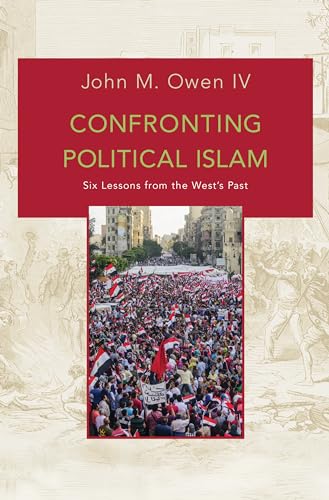
Confronting Political Islam - Six Lessons from the West's Past: Six Lessons from the West's Past - Hardcover
Inhaltsangabe
How should the Western world today respond to the challenges of political Islam? Taking an original approach to answer this question, Confronting Political Islam compares Islamism's struggle with secularism to other prolonged ideological clashes in Western history. By examining the past conflicts that have torn Europe and the Americas--and been supported by underground networks, fomented radicalism and revolution, and triggered foreign interventions and international conflicts--John Owen draws six major lessons to demonstrate that much of what we think about political Islam is wrong. Looking at the history of the Western world itself and the fraught questions over how societies should be ordered, Confronting Political Islam upends some of the conventional wisdom about the current upheavals in the Muslim world.
Die Inhaltsangabe kann sich auf eine andere Ausgabe dieses Titels beziehen.
Über die Autorin bzw. den Autor
John M. Owen IV is professor of politics and a faculty fellow at the Institute for Advanced Studies in Culture at the University of Virginia. His books include The Clash of Ideas in World Politics (Princeton) and Liberal Peace, Liberal War.
Von der hinteren Coverseite
"Through a systematic, rigorous comparison of the trajectory of historical ideological conflicts in Europe during the last five centuries and today's struggles over Islamism in the Middle East, Owen draws insightful conclusions about the future of political Islam and U.S. policy responses. His book is sure to advance understanding of the defining ideological debate of our time--that of Islam's role in political transitions throughout the Muslim world."--Lisa Curtis, Heritage Foundation
"Many people talk about the 'lessons of history,' but Owen actually delivers them. With erudition, balance, and good judgment, he uses the history of ideological conflict in the West to discern guidelines for how to deal with the challenge to American interests presented by contemporary Islamist politics in all its forms. This is a wise and well-reasoned book."--F. Gregory Gause III, Texas A&M University
"Critiques of Islamic fundamentalism rarely seek parallels in Western history. Owen assesses Islamism and offers perceptive, provocative comparisons to the historical conflicts among Protestants and Catholics, and liberals, socialists, and communists. Showing that the duel between Islamists and Muslim secularists is far from over, he explores how it has challenged and changed the West. Scholars, officials, soldiers, and students would do well to read this book."--Reuel M. Gerecht, Foundation for Defense of Democracies
"With an innovative approach, Owen provocatively argues that previous episodes and ideological battles in Western history can shed light on the questions and likely political developments in the Muslim world today. The topic is very important and will spark many reactions and discussions."--Jeremy Pressman, University of Connecticut
"Combining scholarship with important policy proposals, Confronting Political Islam successfully puts forth a set of recommendations for U.S. grand strategy toward Islamism. This engaging and accessible book does a good job relating past ideological struggles to the current ‘long war’ against religiously oriented terrorism."--Daniel Nexon, Georgetown University
Aus dem Klappentext
"Through a systematic, rigorous comparison of the trajectory of historical ideological conflicts in Europe during the last five centuries and today's struggles over Islamism in the Middle East, Owen draws insightful conclusions about the future of political Islam and U.S. policy responses. His book is sure to advance understanding of the defining ideological debate of our time--that of Islam's role in political transitions throughout the Muslim world."--Lisa Curtis, Heritage Foundation
"Many people talk about the 'lessons of history,' but Owen actually delivers them. With erudition, balance, and good judgment, he uses the history of ideological conflict in the West to discern guidelines for how to deal with the challenge to American interests presented by contemporary Islamist politics in all its forms. This is a wise and well-reasoned book."--F. Gregory Gause III, Texas A&M University
"Critiques of Islamic fundamentalism rarely seek parallels in Western history. Owen assesses Islamism and offers perceptive, provocative comparisons to the historical conflicts among Protestants and Catholics, and liberals, socialists, and communists. Showing that the duel between Islamists and Muslim secularists is far from over, he explores how it has challenged and changed the West. Scholars, officials, soldiers, and students would do well to read this book."--Reuel M. Gerecht, Foundation for Defense of Democracies
"With an innovative approach, Owen provocatively argues that previous episodes and ideological battles in Western history can shed light on the questions and likely political developments in the Muslim world today. The topic is very important and will spark many reactions and discussions."--Jeremy Pressman, University of Connecticut
"Combining scholarship with important policy proposals, Confronting Political Islam successfully puts forth a set of recommendations for U.S. grand strategy toward Islamism. This engaging and accessible book does a good job relating past ideological struggles to the current long war against religiously oriented terrorism."--Daniel Nexon, Georgetown University
Auszug. © Genehmigter Nachdruck. Alle Rechte vorbehalten.
Confronting Political Islam
Six Lessons from the West's Past
By John M. Owen IVPRINCETON UNIVERSITY PRESS
Copyright © 2015 Princeton University Press
All rights reserved.
ISBN: 978-0-691-16314-7All rights reserved.
Contents
List of Illustrations, ix,
List of Tables, ix,
Preface, xi,
Introduction It Did Happen Here, 1,
Lesson 1 Don't Sell Islamism Short, 26,
Lesson 2 Ideologies Are (Usually) Not Monolithic, 46,
Lesson 3 Foreign Interventions Are Normal, 67,
Lesson 4 A State May Be Rational and Ideological at the Same Time, 86,
Lesson 5 The Winner May Be "None of the Above", 110,
Lesson 6 Watch Turkey and Iran, 130,
Conclusion What to Do and What Not to Do, 156,
Notes, 165,
Bibliography, 193,
Index, 211,
CHAPTER 1
Don't Sell Islamism Short
I know I am leaving the winning side for the losing side.
—Whittaker Chambers, explaining to his wife his decision to quit the American Communist Party, 1938
"The Islamists Are Not Coming." This reassuring title headed an article in early 2010 in the influential U.S. magazine Foreign Policy. The authors, experts on Islamist movements, reported that religious parties usually do not perform very well in elections in Muslim countries: in campaigns over the past forty years, 80 percent of these parties received less than 20 percent support, and most receive less then 10 percent. And when Islamist parties do manage to get elected, they soften their policies, sometimes dropping their core program of imposing Sharia on society.
"Islamism seems to be fading as a revolutionary force," pronounced the Economist at roughly the same time. Yes, young Egyptians are more pious or observant of the religion than was the case a generation previous. But, the magazine reassured readers, "[t]he symbols of commitment among today's radical youth are no longer guns and beards but pious conduct and knowledge of scripture. The religious wave has certainly not passed and may still carry a lot in its wake. But in Egypt, at least, it no longer looks like a revolutionary force."
Just over a year later, as the first buds of the Arab Spring were appearing, pundits calmly predicted that the incipient revolutions would usher in secular democratic governments. "Look at those involved in the uprisings, and it is clear we are dealing with a post-Islamist generation," wrote Olivier Roy. "Egyptians have seen Mubarak and the mullahs and want neither," wrote Fareed Zakaria.
By the end of 2011, however, a sober Economist was openly acknowledging that the real winner of the Arab Spring might be the Islamists—and that their victory might come at the ballot box. Islamist parties were winning post-revolution elections. Islamism, or at least politicians espousing it, was popular. "Indeed," ventured the magazine, "political Islam now has more clout in the region than at any time since the Ottoman empire collapsed almost a century ago, and perhaps since Napoleon brought a modernising message to the Arab world when he invaded Egypt in 1798."
Since those days Islamists have had setbacks across the Arab world, most pointedly in Egypt, where the government of Mohamed Morsi was ousted by the secularist Egyptian Army in July 2013. The point is not that Islamists have won or are going to win in the end. It is rather that Westerners, time and time again, have underestimated their popularity and power. As Middle East expert Shadi Hamid notes, "Analysts always seem to be finding signs of Islamist decline," yet real decline is not evident. Take the March 2010 parliamentary elections in Iraq, well before the Arab Spring began. A coalition of parties headed by Ayad Allawi won, and Western pundits hailed this victory for secularism in the new Iraq. But in fact, Allawi's coalition included an overtly Islamist party. Adding all the seats that other Islamist parties won yields 159, just shy of the 163 needed to form a government.
Underreporting of this kind often happens when a Muslim country holds elections: analysts note that Islamists are divided, ignoring the overall strength of Muslim sentiment that "Islam is the solution." "In short," concludes Hamid, "it would be a mistake to assume that when Islamist parties lose, that this reflects a broader shift away from religious politics or from religion, and towards 'secularism'—the kind of thing we like to believe is happening in the Middle East but, for both better and worse, rarely does and most likely won't."
Analyses and predictions that short- sell Islamism disclose a deep conviction, prominent among many Western observers, that political Islam cannot last, that it is simply an unsustainable, impractical set of ideas in the modern world. We Westerners come by this conviction honestly. For at least two hundred years, we have tended to believe in historical progress. Much of our discourse and the way we think about social and technical problems suggest that we believe that the human race is moving in the direction of rationality and morality (as we define those things). History, we believe, is a story not of decline, nor of stagnation, nor of cycles of progress and regress; it is a story of forward or upward movement. Indeed, it seems self- evident to us that society has steadily improved over the past several centuries.
Our unprecedented and growing power over nature, owing to the spectacular successes of modern science, is probably the most important source of that belief. But we also are less violent and superstitious, and more tolerant, fair, and productive, than the forebears we read about on Wikipedia or see in movies. Even our parents and grandparents, who likewise believed in progress, were backward, we agree—greedy, violent, sexually repressed, lacking environmental consciousness—and we congratulate ourselves for being more enlightened. Thus the critically acclaimed television show Mad Men depicts America in the early 1960s as experiencing a kind of collective mental illness. Perhaps people back then dressed better than we do, but they smoked, drank too much, littered, repressed their feelings, and were sexist.
We do not know what America will be like in 2060, but we can be fairly certain that Americans will consider us backward, exotic, morally suspect, and embarrassing. This Western narrative of progress is old and probably invincible. The Enlightenment philosopher Immanuel Kant famously proposed that human history was a story of unsteady but real progress. A generation later G. W. F. Hegel wrote a philosophy of history depicting the emergence of universal rationality that influenced thinkers as diverse as Karl Marx and John Stuart Mill. Progressive or teleological histories have long had their severe critics. In the 1930s the British historian Herbert Butterfield chastised the members of his guild for assuming that developments in Britain's past had led ineluctably to the best of all possible worlds, parliamentary democracy.
Butterfield's complaint was that this "Whig interpretation of history" distorted our understanding of the past. But there are other objections to it. What would constitute progress, anyway? More consumer goods? Less suffering? Better art (whatever that might mean)? More individual autonomy? More social solidarity? More mastery of nature? Or perhaps more deference to nature? If we cannot agree on what progress looks like, then we cannot know whether it is happening.
Lesson 1 from the West's own past is about caution: simply because we find Islamism irrational and...
„Über diesen Titel“ kann sich auf eine andere Ausgabe dieses Titels beziehen.
Suchergebnisse für Confronting Political Islam - Six Lessons from the...

Beispielbild für diese ISBN
Confronting Political Islam: Six Lessons from the West's Past
Verlag:
Princeton University Press, 2014
ISBN 10: 0691163146
ISBN 13: 9780691163147
Gebraucht
Hardcover
Anbieter: Academybookshop, Long Island City, NY, USA
Verkäuferbewertung 4 von 5 Sternen

Hardcover. Zustand: As New. In fine condition, with some shelf-wear on the cover, clean pages. Bestandsnummer des Verkäufers N-gj24-09689
Gebraucht kaufen
EUR 4,68
EUR 3,48 Versand
Versand innerhalb von USA
Versand innerhalb von USA
Anzahl: 1 verfügbar
Beispielbild für diese ISBN
Confronting Political Islam: Six Lessons from the West's Past
Verlag:
Princeton University Press, 2014
ISBN 10: 0691163146
ISBN 13: 9780691163147
Gebraucht
Hardcover
Anbieter: Academybookshop, Long Island City, NY, USA
Verkäuferbewertung 4 von 5 Sternen
Hardcover. Zustand: Very Good. In fine, clean condition, with a tear on the dust-cover, clean pages. Bestandsnummer des Verkäufers A-26525
Gebraucht kaufen
EUR 4,68
EUR 3,48 Versand
Versand innerhalb von USA
Versand innerhalb von USA
Anzahl: 1 verfügbar
Beispielbild für diese ISBN
Confronting Political Islam: Six Lessons from the West's Past
Verlag:
Princeton University Press, 2014
ISBN 10: 0691163146
ISBN 13: 9780691163147
Gebraucht
Hardcover
Anbieter: ThriftBooks-Dallas, Dallas, TX, USA
Verkäuferbewertung 5 von 5 Sternen

Hardcover. Zustand: As New. No Jacket. Pages are clean and are not marred by notes or folds of any kind. ~ ThriftBooks: Read More, Spend Less. Bestandsnummer des Verkäufers G0691163146I2N00
Gebraucht kaufen
EUR 8,25
Versand gratis
Versand innerhalb von USA
Versand innerhalb von USA
Anzahl: 1 verfügbar
Beispielbild für diese ISBN
Confronting Political Islam: Six Lessons from the West's Past
Verlag:
Princeton University Press, 2014
ISBN 10: 0691163146
ISBN 13: 9780691163147
Gebraucht
Hardcover
Anbieter: Academybookshop, Long Island City, NY, USA
Verkäuferbewertung 4 von 5 Sternen
Hardcover. Zustand: Very Good. In fine, clean condition, with a TEAR on the dust cover, clean pages. Bestandsnummer des Verkäufers F-gj7-05320
Gebraucht kaufen
EUR 5,57
EUR 3,48 Versand
Versand innerhalb von USA
Versand innerhalb von USA
Anzahl: 1 verfügbar
Beispielbild für diese ISBN
Confronting Political Islam: Six Lessons from the West's Past
Anbieter: The Book Corner, Beaverton, OR, USA
Verkäuferbewertung 5 von 5 Sternen
hardcover. Zustand: New. Brand new. Hardback with dust jacket. Ships from Friends bookstore to benefit Beaverton (Oregon) library. Bestandsnummer des Verkäufers mon0000029848
Neu kaufen
EUR 23,10
EUR 4,36 Versand
Versand innerhalb von USA
Versand innerhalb von USA
Anzahl: 1 verfügbar
Beispielbild für diese ISBN
Confronting Political Islam : Six Lessons from the West's Past
Anbieter: GreatBookPrices, Columbia, MD, USA
Verkäuferbewertung 5 von 5 Sternen
Zustand: New. Bestandsnummer des Verkäufers 21396211-n
Neu kaufen
EUR 36,62
EUR 2,30 Versand
Versand innerhalb von USA
Versand innerhalb von USA
Anzahl: 7 verfügbar
Foto des Verkäufers
Confronting Political Islam
Verlag:
Princeton University Press, US, 2014
ISBN 10: 0691163146
ISBN 13: 9780691163147
Neu
Hardcover
Anbieter: Rarewaves USA, HEBRON, KY, USA
Verkäuferbewertung 5 von 5 Sternen
Hardback. Zustand: New. Political Islam has often been compared to ideological movements of the past such as fascism or Christian theocracy. But are such analogies valid? How should the Western world today respond to the challenges of political Islam? Taking an original approach to answer this question, Confronting Political Islam compares Islamism's struggle with secularism to other prolonged ideological clashes in Western history. By examining the past conflicts that have torn Europe and the Americas--and how they have been supported by underground networks, fomented radicalism and revolution, and triggered foreign interventions and international conflicts--John Owen draws six major lessons to demonstrate that much of what we think about political Islam is wrong. Owen focuses on the origins and dynamics of twentieth-century struggles among Communism, Fascism, and liberal democracy; the late eighteenth- and nineteenth-century contests between monarchism and republicanism; and the sixteenth- and seventeenth-century wars of religion between Catholics, Lutherans, Calvinists, and others.Owen then applies principles learned from the successes and mistakes of governments during these conflicts to the contemporary debates embroiling the Middle East. He concludes that ideological struggles last longer than most people presume; ideologies are not monolithic; foreign interventions are the norm; a state may be both rational and ideological; an ideology wins when states that exemplify it outperform other states across a range of measures; and the ideology that wins may be a surprise. Looking at the history of the Western world itself and the fraught questions over how societies should be ordered, Confronting Political Islam upends some of the conventional wisdom about the current upheavals in the Muslim world. Bestandsnummer des Verkäufers LU-9780691163147
Beispielbild für diese ISBN
Confronting Political Islam
Anbieter: PBShop.store US, Wood Dale, IL, USA
Verkäuferbewertung 5 von 5 Sternen
HRD. Zustand: New. New Book. Shipped from UK. Established seller since 2000. Bestandsnummer des Verkäufers WP-9780691163147
Foto des Verkäufers
Confronting Political Islam : Six Lessons from the West's Past
Verlag:
Princeton University Press, 2014
ISBN 10: 0691163146
ISBN 13: 9780691163147
Gebraucht
Hardcover
Anbieter: GreatBookPrices, Columbia, MD, USA
Verkäuferbewertung 5 von 5 Sternen
Zustand: As New. Unread book in perfect condition. Bestandsnummer des Verkäufers 21396211
Gebraucht kaufen
EUR 40,71
EUR 2,30 Versand
Versand innerhalb von USA
Versand innerhalb von USA
Anzahl: 7 verfügbar
Beispielbild für diese ISBN
Confronting Political Islam
Anbieter: PBShop.store UK, Fairford, GLOS, Vereinigtes Königreich
Verkäuferbewertung 5 von 5 Sternen
HRD. Zustand: New. New Book. Shipped from UK. Established seller since 2000. Bestandsnummer des Verkäufers WP-9780691163147
Neu kaufen
EUR 38,45
EUR 5,85 Versand
Versand von Vereinigtes Königreich nach USA
Versand von Vereinigtes Königreich nach USA
Anzahl: 7 verfügbar