
Verwandte Artikel zu Profane Culture: Updated Edition
Inhaltsangabe
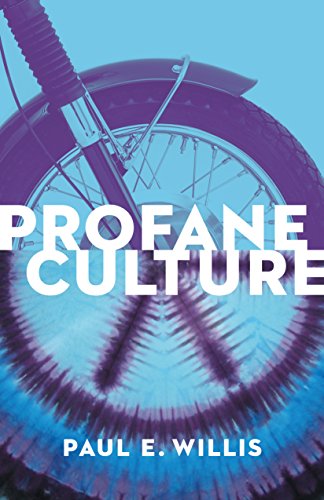
A classic of British cultural studies, Profane Culture takes the reader into the worlds of two important 1960s youth cultures—the motor-bike boys and the hippies. The motor-bike boys were working-class motorcyclists who listened to the early rock 'n' roll of the late 1950s. In contrast, the hippies were middle-class drug users with long hair and a love of progressive music. Both groups were involved in an unequal but heroic fight to produce meaning and their own cultural forms in the face of a larger society dominated by the capitalist media and commercialism. They were pioneers of cultural experimentation, the self-construction of identity, and the curating of the self, which, in different ways, have become so widespread today.
In Profane Culture, Paul Willis develops an important and still very contemporary theory and methodology for understanding the constructions of lived and popular culture. His new preface discusses the ties between the cultural moment explored in the book and today.
Die Inhaltsangabe kann sich auf eine andere Ausgabe dieses Titels beziehen.
Über die Autorin bzw. den Autor
Paul E. Willis, an ethnographer and cultural theorist, is a lecturer with the rank of professor in the Department of Sociology at Princeton University. He is a founding editor and current joint editor of the journal Ethnography and the author of Learning to Labor: How Working Class Kids Get Working Class Jobs, among other books.
Von der hinteren Coverseite
"Long out of print, this new edition of Paul Willis's classic study of the motor-bike boys and hippies is a must read for anyone interested in cultural outsiders, past and present."--Mitch Duneier, author of Sidewalk
"Profane Culture remains a powerful emblem of both ethnographic and cultural-sociological research that continues to be cited today. It has gained even greater relevance from the passing of time--its coupled studies can now be viewed as quintessential reconstructions of mid-twentieth-century subcultures that are now long past. They did indeed capture the spirit of their age, and we can recover the sense of that spirit by rereading this book. But the principal contribution of Profane Culture is contemporary, not historical. The two studies show how ethnography can contribute to the exploration of macro-level cultural structures."--Jeffrey C. Alexander, Yale University
Auszug. © Genehmigter Nachdruck. Alle Rechte vorbehalten.
Profane Culture
By Paul E. WillisPRINCETON UNIVERSITY PRESS
Copyright © 2014 Princeton University Press
All rights reserved.
ISBN: 978-0-691-16369-7All rights reserved.
Contents
MOMENTS PREFACE TO THE 2014 EDITION, XI,
1 Introduction: Profanity and Creativity, 1,
PART ONE, 13,
2 The Motor-Bike Boys, 15,
3 The Motor-Bike, 69,
4 The Golden Age, 82,
PART TWO, 105,
5 The Hippies, 107,
6 The Experience of Drugs, 177,
7 The Creative Age, 201,
8 Conclusions: Cultural Politics, 223,
EPILOGUE, 239,
THEORETICAL APPENDIX, 247,
NOTES, 267,
INDEX, 273,
CHAPTER 1
INTRODUCTION
PROFANITY AND CREATIVITY
The sheer surprise of a living culture is a slap to reverie. Real, bustling, startling cultures move. They exist. They are something in the world. They suddenly leave behind—empty, exposed, ugly—ideas of poverty, deprivation, existence and culture. Real events can save us much philosophy.
This book presents two important cultures generated during the 1960s and still widely influential today—the motor-bike boys, sometimes known as rockers, and the hippies, sometimes known as heads or freaks. The form of the book is of two ethnographic accounts of the inner meanings, style and movement of these cultures, but the essential theme of the book is that oppressed, subordinate or minority groups can have a hand in the construction of their own vibrant cultures and are not merely dupes: the fall guys in a social system stacked overwhelmingly against them and dominated by capitalist media and commercial provision. Not only this, but their profane creativity shows us the only route for radical cultural change. In particular they mark out the aridity of abstract or purely theoretical solutions. It is only real people at work on real objects in an uncertain world who actually produce new movements in style, consciousness and feeling—new arts in life.
The oppression of working-class youth, the alienation of middle-class youth, can be analysed. The social sciences show the oppression and share the alienation. They outline 'the problem'. They say something must give, something must happen. But it is only in the factories, on the streets, in the bars, in the dance halls, in the tower flats, in the two-up-and-two-downs that contradictions and problems are lived through to particular outcomes. It is in these places where direct experience, ways of living, creative acts and penetrations—cultures—redefine problems, break the stasis of meaning, and reset the possibilities somewhat for all of us. And this material experience has not had the benefit of prior validation, of collective discussion, of the security of the common line. It is embedded in the real engagement of experience with the world: in the dialectic of cultural life. This is not to say that living cultures do not 'know' the nature of the conditions which produced them. They 'know' them, however, not in words, but in their structures, form and style. They 'know' them as the unsaid precondition for certain kinds of behaviour, as the only possible if silent context which make particular repertoires of action and interest mean anything at all. Not only this, but they 'know' what surrounds them sufficiently to seize and creatively exploit aspects of it to express their own zest and identity—so partially changing their conditions of existence. This is, precisely the dialectic of cultural life.
The social sciences could never produce a bedizened, solid motor-bike, an embroidered sheepskin coat, an outrageous rock 'n' roll record. Yet these things speak most profoundly to an age, as vulgar theories damage it. They are the astonishing products of one real outcome when many were contesting, when there were a thousand possibilities. They show us the real movement of experience in the concrete world. Life is the laboratory. Life is the thing. Ethnography is not simply description, it's about capturing that.
Culture, then, is not simply about a relationship with what is called 'art' , or with 'the best which has been thought and said', or with the restricted or the refined. I see cultural experience essentially as shared material experience. It does not proceed either from individual variation and proclivity, or from the specifications downwards of a gigantic social order. It comes from direct involvement with the everyday world. It is in relation to the commonplace, to trivia and the slow accumulation of concrete lessons that individuals in groups, come to recognize their subjectivity. The determinations of the wider social system are borne in upon the social individual in a thousand different and variable ways. Tastes, feelings, likes and dislikes are developed in minute articulation with the concrete world.
The essential and primitive distinction I wish to make is not an idealist one between 'art' and 'non-art', but between two types of human involvement with this world: between a random or arbitrary relationship, and a reciprocal, or, as I have called it, dialectical relationship. All material experience is a complex combination of both, but we need to separate them in thought in order to take a grip on what is distinctive in new cultural forms.
Random relationships, though a 'fact of nature' and necessary for survival perhaps, are not only unintended from the point of view of the group experiencing them, but do not express anything of particular internal importance or relevance. There is no creative articulation of meaning through a responsive field of external items. Commodity production continuously expands the field of items for such relationships. It provides toothpaste, spanners, cans of beans, roads, tower blocks and all the glitter of the new consciousness/cultural industry.
In the long term such random relations act to condition subjectivity in a way which is beyond the control of the individual or group. This is one of the profoundest meanings of domination. The deadliest domination comes through the domination of trivia. This book, however, considers this level in another light. It examines how people—uncertainly, through unforeseen consequence and often without consciousness or purpose—take at least a hand in their own day-today making. We will look at two minority and excluded cultures whose forms look random and arbitrary from the outside and incapable of expressing any significant internal cultural meanings, to judge how far their central relationships are actually reciprocal, expressive and developmental. These cultures are important and full of lessons for us because the things of the world which surround them, and through which they are developed and expressed, are without conventional 'cultural' or 'artistic' significance. These cultures work through profane materials: simple functional commodities, drugs, chemicals and cultural commodities exploitatively produced by the new 'consciousness industry'. And yet from the rubbish available within a preconstituted market these groups do generate viable cultures, and through their work on received commodities and categories, actually formulate a living, lived out and concretized critique of the society which produces these distorted, insulting, often meaningless things. After the main ethnographic accounts, further chapters explore the particular relationship of both cultures to their most important constitutive material items: the motor-bike and rock 'n' roll for the motor-bike boys, drugs and progressive music for the hippies.
The essence of the...
„Über diesen Titel“ kann sich auf eine andere Ausgabe dieses Titels beziehen.
Weitere beliebte Ausgaben desselben Titels

Suchergebnisse für Profane Culture: Updated Edition

Foto des Verkäufers
Profane Culture
Anbieter: GreatBookPrices, Columbia, MD, USA
Verkäuferbewertung 5 von 5 Sternen

Zustand: New. Bestandsnummer des Verkäufers 21433127-n
Neu kaufen
EUR 28,40
EUR 2,28 Versand
Versand innerhalb von USA
Versand innerhalb von USA
Anzahl: 2 verfügbar
Beispielbild für diese ISBN
Profane Culture
Anbieter: PBShop.store US, Wood Dale, IL, USA
Verkäuferbewertung 5 von 5 Sternen
PAP. Zustand: New. New Book. Shipped from UK. Established seller since 2000. Bestandsnummer des Verkäufers WP-9780691163697
Beispielbild für diese ISBN
Profane Culture
Verlag:
Princeton University Press, 2014
ISBN 10: 0691163693
ISBN 13: 9780691163697
Gebraucht
Softcover
Anbieter: GreatBookPrices, Columbia, MD, USA
Verkäuferbewertung 5 von 5 Sternen
Zustand: As New. Unread book in perfect condition. Bestandsnummer des Verkäufers 21433127
Gebraucht kaufen
EUR 29,92
EUR 2,28 Versand
Versand innerhalb von USA
Versand innerhalb von USA
Anzahl: 2 verfügbar
Beispielbild für diese ISBN
Profane Culture Format: Paperback
Verlag:
Princeton University Press, 2014
ISBN 10: 0691163693
ISBN 13: 9780691163697
Gebraucht
Softcover
Anbieter: INDOO, Avenel, NJ, USA
Verkäuferbewertung 5 von 5 Sternen
Zustand: As New. Unread copy in mint condition. Bestandsnummer des Verkäufers PG9780691163697
Gebraucht kaufen
EUR 32,28
Versand gratis
Versand innerhalb von USA
Versand innerhalb von USA
Anzahl: Mehr als 20 verfügbar
Beispielbild für diese ISBN
Profane Culture Format: Paperback
Anbieter: INDOO, Avenel, NJ, USA
Verkäuferbewertung 5 von 5 Sternen
Zustand: New. Brand New. Bestandsnummer des Verkäufers 9780691163697
Neu kaufen
EUR 32,37
Versand gratis
Versand innerhalb von USA
Versand innerhalb von USA
Anzahl: Mehr als 20 verfügbar
Foto des Verkäufers
Profane Culture
Verlag:
Princeton University Press, US, 2014
ISBN 10: 0691163693
ISBN 13: 9780691163697
Neu
Paperback
Anbieter: Rarewaves.com USA, London, LONDO, Vereinigtes Königreich
Verkäuferbewertung 5 von 5 Sternen
Paperback. Zustand: New. Updated Edition. A classic of British cultural studies, Profane Culture takes the reader into the worlds of two important 1960s youth cultures--the motor-bike boys and the hippies. The motor-bike boys were working-class motorcyclists who listened to the early rock 'n' roll of the late 1950s. In contrast, the hippies were middle-class drug users with long hair and a love of progressive music. Both groups were involved in an unequal but heroic fight to produce meaning and their own cultural forms in the face of a larger society dominated by the capitalist media and commercialism. They were pioneers of cultural experimentation, the self-construction of identity, and the curating of the self, which, in different ways, have become so widespread today. In Profane Culture, Paul Willis develops an important and still very contemporary theory and methodology for understanding the constructions of lived and popular culture. His new preface discusses the ties between the cultural moment explored in the book and today. Bestandsnummer des Verkäufers LU-9780691163697
Neu kaufen
EUR 33,36
Versand gratis
Versand von Vereinigtes Königreich nach USA
Versand von Vereinigtes Königreich nach USA
Anzahl: 1 verfügbar
Beispielbild für diese ISBN
Profane Culture
Anbieter: PBShop.store UK, Fairford, GLOS, Vereinigtes Königreich
Verkäuferbewertung 5 von 5 Sternen
PAP. Zustand: New. New Book. Shipped from UK. Established seller since 2000. Bestandsnummer des Verkäufers WP-9780691163697
Neu kaufen
EUR 29,17
EUR 4,87 Versand
Versand von Vereinigtes Königreich nach USA
Versand von Vereinigtes Königreich nach USA
Anzahl: 2 verfügbar
Foto des Verkäufers
Profane Culture
Verlag:
Princeton University Press, US, 2014
ISBN 10: 0691163693
ISBN 13: 9780691163697
Neu
Paperback
Anbieter: Rarewaves USA, OSWEGO, IL, USA
Verkäuferbewertung 5 von 5 Sternen
Paperback. Zustand: New. Updated Edition. A classic of British cultural studies, Profane Culture takes the reader into the worlds of two important 1960s youth cultures--the motor-bike boys and the hippies. The motor-bike boys were working-class motorcyclists who listened to the early rock 'n' roll of the late 1950s. In contrast, the hippies were middle-class drug users with long hair and a love of progressive music. Both groups were involved in an unequal but heroic fight to produce meaning and their own cultural forms in the face of a larger society dominated by the capitalist media and commercialism. They were pioneers of cultural experimentation, the self-construction of identity, and the curating of the self, which, in different ways, have become so widespread today. In Profane Culture, Paul Willis develops an important and still very contemporary theory and methodology for understanding the constructions of lived and popular culture. His new preface discusses the ties between the cultural moment explored in the book and today. Bestandsnummer des Verkäufers LU-9780691163697
Beispielbild für diese ISBN
Profane Culture: Updated Edition
Anbieter: Kennys Bookshop and Art Galleries Ltd., Galway, GY, Irland
Verkäuferbewertung 5 von 5 Sternen
Zustand: New. Num Pages: 304 pages. BIC Classification: JFCA; JHB. Category: (P) Professional & Vocational; (U) Tertiary Education (US: College). Dimension: 144 x 217 x 19. Weight in Grams: 360. . 2014. Updated edition with a New Preface. Paperback. . . . . Bestandsnummer des Verkäufers V9780691163697
Neu kaufen
EUR 28,40
EUR 9,50 Versand
Versand von Irland nach USA
Versand von Irland nach USA
Anzahl: 1 verfügbar
Beispielbild für diese ISBN
Profane Culture: Updated Edition
Anbieter: Kennys Bookstore, Olney, MD, USA
Verkäuferbewertung 5 von 5 Sternen
Zustand: New. Num Pages: 304 pages. BIC Classification: JFCA; JHB. Category: (P) Professional & Vocational; (U) Tertiary Education (US: College). Dimension: 144 x 217 x 19. Weight in Grams: 360. . 2014. Updated edition with a New Preface. Paperback. . . . . Books ship from the US and Ireland. Bestandsnummer des Verkäufers V9780691163697
Neu kaufen
EUR 34,58
EUR 9,07 Versand
Versand innerhalb von USA
Versand innerhalb von USA
Anzahl: 1 verfügbar