
Verwandte Artikel zu The Praise of Folly: Updated Edition (Princeton Classics)
The Praise of Folly: Updated Edition (Princeton Classics) - Softcover
Buch 15 von 49: Princeton Classics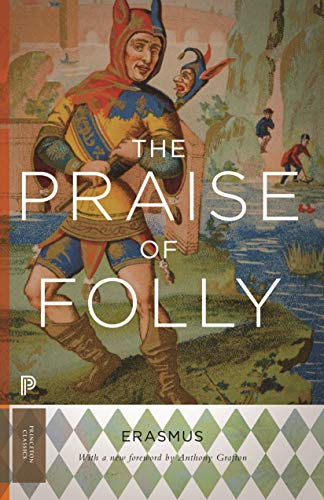
Inhaltsangabe
The Praise of Folly is perhaps Desiderius Erasmus (1466-1536) best-known work. No other book displays quite so completely the transition from the medieval to the modern world, and Erasmus's wit, wisdom, and critical spirit have lost none of their timeliness today. This Princeton Classics edition features a new foreword by Anthony Grafton that provides an essential introduction to this enduring masterpiece.
Die Inhaltsangabe kann sich auf eine andere Ausgabe dieses Titels beziehen.
Über die Autorin bzw. den Autor
Anthony Grafton is the Henry Putnam University Professor of History at Princeton University.
Auszug. © Genehmigter Nachdruck. Alle Rechte vorbehalten.
The Praise of Folly
By Desiderius Erasmus, Hoyt Hopewell HudsonPRINCETON UNIVERSITY PRESS
Copyright © 1969 Princeton University Press
All rights reserved.
ISBN: 978-0-691-16564-6All rights reserved.
Contents
A PRELUDE TO THE PRAISE OF FOLLY: FOREWORD TO THE PRINCETON CLASSICS EDITION, vii,
ACKNOWLEDGMENTS, xxiii,
THE FOLLY OF ERASMUS: AN ESSAY, xxv,
PREFACE: DESIDERIUS ERASMUS TO HIS FRIEND THOMAS MORE, 1,
MORIAE ENCOMIUM, THAT IS, THE PRAISE OF FOLLY, 7,
ANALYSIS, 129,
NOTES, 143,
INDEX OF PROPER NAMES, 155,
CHAPTER 1
Stultitia loquitur:
HOWEVER MORTAL FOLK MAY COMMONLY SPEAK of me (for I am not ignorant how ill the name of Folly sounds, even to the greatest fools), I am she—the only she, I may say —whose divine influence makes gods and men rejoice. One great and sufficient proof of this is that the instant I stepped up to speak to this crowded assembly, all faces at once brightened with a fresh and unwonted cheerfulness, all of you suddenly unbent your brows, and with frolic and affectionate smiles you applauded; so that as I look upon all present about me, you seem flushed with nectar, like gods in Homer, not without some nepenthe, also; whereas a moment ago you were sitting moody and depressed, as if you had come out of the cave of Trophonius. Just as it commonly happens, when the sun first shows his splendid golden face to the earth or when, after a bitter winter, young spring breathes mild west winds, that a new face comes over everything, new color and a sort of youthfulness appear; so at the mere sight of me, you straightway take on another aspect. And thus what great orators elsewhere can hardly bring about in a long, carefully planned speech, I have done in a moment, with nothing but my looks.
As to why I appear today in this unaccustomed garb, you shall now hear, if only you will not begrudge lending your ears to my discourse—not those ears, to be sure, which you carry to sermons, but those which you are accustomed to prick up for mountebanks in the marketplace, for clowns and jesters, the ears which, in the old days, our friend Midas inclined to the god Pan. It is my pleasure for a little while to play the rhetorician before you, yet not one of the tribe of those who nowadays cram certain pedantic trifles into the heads of schoolboys, and teach a more than womanish obstinacy in disputing; no, I emulate those ancients who, to avoid the unpopular name of philosophers, preferred to be called Sophists. Their study was to celebrate in eulogies the virtues of gods and of heroic men. Such a eulogy, therefore, you shall hear, but not of Hercules or Solon; rather of my own self—to wit, Folly.
[2] Nor do I have any use for those wiseacres who preach that it is most foolish and insolent for a person to praise himself. Yet let it be as foolish as they would have it, if only they will grant that it is proper: and what is more suitable than that Folly herself should be the trumpeter of her praises? "She is her own flute-player." Who, indeed, could portray me better than can I myself? Unless it could so happen that I am better known to some one else than I am to myself. On the whole, however, I deem that what I am doing is much more decent than what a host of our best people, and scholars even, do continually. With a certain perverse modesty they are wont to convey instructions to some sycophantic speaker or prattling poet whom they have engaged at a fee; and then they hear back from him their praises, that is to say, some pure fiction. The blushing listener, meanwhile, spreads his plumes like a peacock, and bridles, while the brazen adulator searches among the gods to find a parallel for this good-for-nothing, and proposes him as the complete exemplar of all virtues—from which the man himself knows that he is farther away than twice infinity. Thus the flatterer adorns a crow with other birds' feathers, washes the Ethiopian white, and, in sum, makes an elephant out of a gnat. Lastly, I follow the familiar proverb of the folk, to the effect that he rightly praises himself who never meets anyone else who will praise him. Here, by the way, I wonder at the ingratitude, or perhaps the negligence, of men: although all of them studiously cherish me and freely acknowledge my benefits, not a one has emerged so far in all the ages to celebrate the praises of Folly in a grateful oration. In the meantime, there has been no lack of those who at great expense of lamp-oil and of sleep have extolled, in elegant eulogies, Busiruses, Phalarises, quartan fevers, flies, baldness, and pests of that sort.
And now you shall hear from me an extemporaneous speech, unlabored, but so much the truer for all that. I should not want you to think it is made to show off my wit, as is done by the common run of orators. They, as you know so well, when they bring out a speech they have been working on for thirty whole years, and sometimes not their own at all, will swear it was written in three days, for pastime, or even that they merely dictated it. For my part, it has always been most satisfactory to speak "whatever pops into my head."
[3] And let no one expect that, after the manner of these ordinary orators, I shall expound myself by definition, much less divide myself. For it is equally unlucky to circumscribe with a limit her whose nature extends so universally or to dissect her in whose worship every order of being is at one. Anyway, what end would be served in setting forth by definition a sketch and, as it were, a shadow of me, when you, present here, with your own eyes perceive me in your presence? I am as you see me, that true disposer of good things whom the Latins call Stultitia and the Greeks [TEXT NOT REPRODUCIBLE IN ASCII].
Still, what need was there to tell you this, as if in my very face and front, so to speak, I do not sufficiently announce who I am? As if anyone who was claiming that I am Minerva or the Spirit of Wisdom could not immediately be refuted by one good look, even if I were not speaking—though speech is the least deceptive mirror of the mind. I have no use for cosmetics. I do not feign one thing in my face while I hold something else in my heart. I am in all points so like myself that even those who specially arrogate to themselves the part and name of wise men cannot conceal me, though they walk about "like apes in scarlet or asses in lion-skins." Let them carry it as cunningly as you could ask, the protruding ears will somewhere betray the Midas. An ungrateful class of men that, so help me! Although they are wholly of my party, in public they are so ashamed of my name that they toss it up at others as a great reproach! Wherefore, since in fact they are [TEXT NOT REPRODUCIBLE IN ASCII], "most foolish," and yet are eager to seem wise men and veritable Thaleses, shall we not with entire justice dub them [TEXT NOT REPRODUCIBLE IN ASCII], "foolosophers"? It has seemed well, you note, to imitate the rhetoricians of our time, who believe themselves absolutely to be gods if they can show themselves bilingual (like a horse-leech), and account it a famous feat if they can weave a few Greekish words, like inlay work, ever and anon into their Latin orations, even if at the moment there is no place for them. Then if they want exotic touches, they dig four or five obsolete words out of decaying manuscripts, by which they spread darkness over the reader; with the idea, I warrant you, that those who understand will be vastly pleased with themselves, and those who do not understand will admire the more—and all the more the less they understand. The fact is that there is a...
„Über diesen Titel“ kann sich auf eine andere Ausgabe dieses Titels beziehen.
Suchergebnisse für The Praise of Folly: Updated Edition (Princeton Classics)

Foto des Verkäufers
The Praise of Folly: Updated Edition (Princeton Classics)
Verlag:
Princeton University Press, 2015
ISBN 10: 0691165645
ISBN 13: 9780691165646
Gebraucht
Softcover
Anbieter: Dream Books Co., Denver, CO, USA
Verkäuferbewertung 5 von 5 Sternen

Zustand: good. Gently used with minimal wear on the corners and cover. A few pages may contain light highlighting or writing, but the text remains fully legible. Dust jacket may be missing, and supplemental materials like CDs or codes may not be included. May be ex-library with library markings. Ships promptly! Bestandsnummer des Verkäufers DBV.0691165645.G
Gebraucht kaufen
EUR 6,60
Versand gratis
Versand innerhalb von USA
Versand innerhalb von USA
Anzahl: 1 verfügbar
Beispielbild für diese ISBN
The Praise of Folly: Updated Edition (Princeton Classics)
Verlag:
Princeton University Press (edition Updated), 2015
ISBN 10: 0691165645
ISBN 13: 9780691165646
Gebraucht
Paperback
Anbieter: BooksRun, Philadelphia, PA, USA
Verkäuferbewertung 5 von 5 Sternen
Paperback. Zustand: Very Good. Updated. It's a well-cared-for item that has seen limited use. The item may show minor signs of wear. All the text is legible, with all pages included. It may have slight markings and/or highlighting. Bestandsnummer des Verkäufers 0691165645-8-1
Gebraucht kaufen
EUR 7,17
Versand gratis
Versand innerhalb von USA
Versand innerhalb von USA
Anzahl: 1 verfügbar
Foto des Verkäufers
The Praise of Folly: Updated Edition (Princeton Classics)
Verlag:
Princeton University Press, 2015
ISBN 10: 0691165645
ISBN 13: 9780691165646
Gebraucht
Softcover
Anbieter: clickgoodwillbooks, Indianapolis, IN, USA
Verkäuferbewertung 4 von 5 Sternen

Zustand: acceptable. Used - Acceptable: All pages and the cover are intact, but shrink wrap, dust covers, or boxed set case may be missing. Pages may include limited notes, highlighting, or minor water damage but the text is readable. Item may be missing bundled media. Bestandsnummer des Verkäufers CSIV.0691165645.A
Gebraucht kaufen
EUR 4,58
EUR 3,55 Versand
Versand innerhalb von USA
Versand innerhalb von USA
Anzahl: 1 verfügbar
Beispielbild für diese ISBN
The Praise of Folly: Updated Edition
Verlag:
Princeton University Press, 2015
ISBN 10: 0691165645
ISBN 13: 9780691165646
Gebraucht
Paperback
Anbieter: World of Books (was SecondSale), Montgomery, IL, USA
Verkäuferbewertung 5 von 5 Sternen
Paperback. Zustand: Good. Desiderius Erasmus (1466-1536) was a Dutch humanist, scholar, and social critic, and one of the most important figures of the Renaissance. The Praise of Folly is perhaps his best-known work. Originally written to amuse his friend Sir Thomas More, this satiric celebration of pleasure, youth, and intoxication irreverently pokes fun at the pieties of theologians and the foibles that make us all human, while ultimately reaffirming the value of Christian ideals. No other book displays quite so completely the transition from the medieval to the modern world, and Erasmus's wit, wisdom, and critical spirit have lost none of their timeliness today. This Princeton Classics edition of The Praise of Folly features a new foreword by Anthony Grafton that provides an essential introduction to this iridescent and enduring masterpiece. Bestandsnummer des Verkäufers 00109017024
Gebraucht kaufen
EUR 9,95
Versand gratis
Versand innerhalb von USA
Versand innerhalb von USA
Anzahl: 1 verfügbar
Beispielbild für diese ISBN
The Praise of Folly: Updated Edition (Princeton Classics)
Verlag:
Princeton University Press, 2015
ISBN 10: 0691165645
ISBN 13: 9780691165646
Gebraucht
paperback
Anbieter: HPB-Diamond, Dallas, TX, USA
Verkäuferbewertung 5 von 5 Sternen
paperback. Zustand: Very Good. Connecting readers with great books since 1972! Used books may not include companion materials, and may have some shelf wear or limited writing. We ship orders daily and Customer Service is our top priority! Bestandsnummer des Verkäufers S_486088190
Gebraucht kaufen
EUR 7,78
EUR 3,34 Versand
Versand innerhalb von USA
Versand innerhalb von USA
Anzahl: 1 verfügbar
Beispielbild für diese ISBN
The Praise of Folly: Updated Edition
Verlag:
Princeton University Press, 2015
ISBN 10: 0691165645
ISBN 13: 9780691165646
Gebraucht
Paperback
Anbieter: World of Books Inc, Montgomery, IL, USA
Verkäuferbewertung 4 von 5 Sternen
Paperback. Zustand: Good. Desiderius Erasmus (1466-1536) was a Dutch humanist, scholar, and social critic, and one of the most important figures of the Renaissance. The Praise of Folly is perhaps his best-known work. Originally written to amuse his friend Sir Thomas More, this satiric celebration of pleasure, youth, and intoxication irreverently pokes fun at the pieties of theologians and the foibles that make us all human, while ultimately reaffirming the value of Christian ideals. No other book displays quite so completely the transition from the medieval to the modern world, and Erasmus's wit, wisdom, and critical spirit have lost none of their timeliness today. This Princeton Classics edition of The Praise of Folly features a new foreword by Anthony Grafton that provides an essential introduction to this iridescent and enduring masterpiece. Bestandsnummer des Verkäufers CIN0691165645G
Gebraucht kaufen
EUR 11,79
Versand gratis
Versand innerhalb von USA
Versand innerhalb von USA
Anzahl: 1 verfügbar
Beispielbild für diese ISBN
Praise of Folly: Updated Edition (Revised)
Verlag:
Princeton University Press June 2015, 2015
ISBN 10: 0691165645
ISBN 13: 9780691165646
Gebraucht
Paper Back
Anbieter: A Cappella Books, Inc., Atlanta, GA, USA
Verkäuferbewertung 5 von 5 Sternen
Paper Back. Zustand: Very Good. Bestandsnummer des Verkäufers 371302
Gebraucht kaufen
EUR 14,66
Versand gratis
Versand innerhalb von USA
Versand innerhalb von USA
Anzahl: 1 verfügbar
Beispielbild für diese ISBN
The Praise of Folly: Updated Edition (Princeton Classics (91))
Anbieter: Lakeside Books, Benton Harbor, MI, USA
Verkäuferbewertung 5 von 5 Sternen
Zustand: New. Brand New! Not Overstocks or Low Quality Book Club Editions! Direct From the Publisher! We're not a giant, faceless warehouse organization! We're a small town bookstore that loves books and loves it's customers! Buy from Lakeside Books! Bestandsnummer des Verkäufers OTF-S-9780691165646
Neu kaufen
EUR 11,71
EUR 3,55 Versand
Versand innerhalb von USA
Versand innerhalb von USA
Anzahl: Mehr als 20 verfügbar
Beispielbild für diese ISBN
Praise of Folly
Anbieter: GreatBookPrices, Columbia, MD, USA
Verkäuferbewertung 5 von 5 Sternen
Zustand: New. Bestandsnummer des Verkäufers 22100969-n
Neu kaufen
EUR 12,94
EUR 2,35 Versand
Versand innerhalb von USA
Versand innerhalb von USA
Anzahl: Mehr als 20 verfügbar
Foto des Verkäufers
The Praise of Folly (Paperback or Softback)
Verlag:
Princeton University Press 6/9/2015, 2015
ISBN 10: 0691165645
ISBN 13: 9780691165646
Neu
Paperback or Softback
Anbieter: BargainBookStores, Grand Rapids, MI, USA
Verkäuferbewertung 5 von 5 Sternen
Paperback or Softback. Zustand: New. The Praise of Folly. Book. Bestandsnummer des Verkäufers BBS-9780691165646