
Verwandte Artikel zu Think Again: Contrarian Reflections on Life, Culture,...
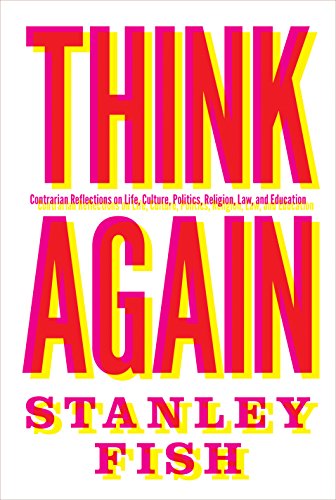
Think Again: Contrarian Reflections on Life, Culture, Politics, Religion, Law, and Education - Hardcover
Inhaltsangabe
From 1995 to 2013, Stanley Fishs provocative New York Times columns consistently generated passionate discussion and debate. In Think Again, he has assembled almost one hundred of his best columns into a thematically arranged collection with a substantial new introduction that explains his intention in writing these pieces and offers an analysis of why they provoked so much reaction. Brief and accessible yet challenging, these essays provide all the hard-edged intellectual, cultural, and political analysis one expects from Fish. At the same time, the collection includes a number of revealing and even poignant autobiographical essays in which, as Fish says, "readers will learn about my anxieties, my aspirations, my eccentricities, my foibles, my father, and my obsessions - Frank Sinatra, Ted Williams, basketball, and Jews." Reflecting the wide-ranging interests of one of Americas leading critics, this is Fishs broadest and most engaging book to date.
Die Inhaltsangabe kann sich auf eine andere Ausgabe dieses Titels beziehen.
Über die Autorin bzw. den Autor
Stanley Fish is the author of numerous books, including How to Write a Sentence, There's No Such Thing as Free Speech, and Is There a Text in This Class? His most recent book is Versions of Academic Freedom. He is the Davidson-Kahn Distinguished University Professor and Professor of Law at Florida International University and the Visiting Floersheimer Professor of Law at Cardozo Law School. He previously taught at Berkeley, Johns Hopkins, Duke, and the University of Illinois, Chicago.
Von der hinteren Coverseite
"This collection of Stanley Fish's New York Times essays amounts to an intellectual autobiography of one of America's most interesting writers. As Fish says, his purpose isn't, as in most op-eds, to tell the reader what to think; rather, it's to illuminate Fish's view of how to think--and to shake readers out of their complacent assumptions about free speech, religion, academia, and other subjects."--Linda Greenhouse, author of The U.S. Supreme Court: A Very Short Introduction
Auszug. © Genehmigter Nachdruck. Alle Rechte vorbehalten.
Think Again
Contrarian Reflections on Life, Culture, Politics, Religion, Law, and Education
By Stanley FishPRINCETON UNIVERSITY PRESS
Copyright © 2015 Princeton University Press
All rights reserved.
ISBN: 978-0-691-16771-8All rights reserved.
Contents
Introduction, XI,
PART 1 PERSONAL REFLECTIONS, 1,
1.1 My Life Report, 3,
1.2 'Tis the Season, 7,
1.3 Max the Plumber, 10,
1.4 Is It Good for the Jews?, 13,
1.5 My Life on the Court, 18,
1.6 The Kid and Old Blue Eyes, 21,
1.7 Travel Narrows, 24,
1.8 I Am, Therefore I Pollute, 26,
1.9 Why We Can't Just Get Along, 29,
1.10 Truth and Conspiracy in the Catskills, 32,
1.11 Moving On, 35,
PART 2 A ESTHETIC REFLECTIONS, 37,
2.1 Why Do Writers Write?, 39,
2.2 Two Aesthetics, 42,
2.3 Norms and Deviations: Who's to Say?, 47,
2.4 The Ten Best American Movies, 52,
2.5 Giving Kim Novak Her Due, 59,
2.6 Larger than Life: Charlton Heston, 62,
2.7 Vengeance Is Mine, 67,
2.8 Little Big Men, 70,
2.9 Narrative and the Grace of God: The New True Grit, 73,
2.10 Les Misérables and Irony, 76,
2.11 No Way Out: 12 Years a Slave, 80,
2.12 Stand Your Ground, Be a Man, 84,
2.13 Country Roads, 87,
PART 3 CULTURAL REFLECTIONS, 91,
3.1 Professor Sokal's Bad Joke, 93,
3.2 French Theory in America, 98,
3.3 Dorothy and the Tree: A Lesson in Epistemology, 105,
3.4 Does Philosophy Matter?, 109,
3.5 What Did Watson the Computer Do?, 112,
3.6 None of the Answers: Charles Van Doren Finally Speaks, or Does He?, 115,
3.7 Can I Put You on Hold?, 120,
3.8 So's Your Old Man, 123,
3.9 Two Cheers for Double Standards, 126,
3.10 Favoritism Is Good, 129,
PART 4 REFLECTIONS ON POLITICS, 133,
4.1 Condemnation without Absolutes, 135,
4.2 The All-Spin Zone, 138,
4.3 Against Independent Voters, 142,
4.4 When "Identity Politics" Is Rational, 145,
4.5 Blowin' in the Wind, 149,
4.6 Looking for Gas in All the Wrong Places, 151,
4.7 When Principles Get in the Way, 154,
4.8 Revisiting Affirmative Action, with Help from Kant, 157,
4.9 Is the NRA Un-American?, 162,
4.10 All You Need Is Hate, 167,
4.11 How the Right Hijacked the Magic Words, 170,
PART 5 REFLECTIONS ON THE LAW, 175,
5.1 Why Scalia Is Right, 177,
5.2 How Scalia Is Wrong, 180,
5.3 Intentional Neglect, 185,
5.4 What Did the Framers Have in Mind?, 189,
5.5 What Is the First Amendment For?, 192,
5.6 How the First Amendment Works, 198,
5.7 What Does the First Amendment Protect?, 203,
5.8 The First Amendment and Kittens, 207,
5.9 Sticks and Stones, 212,
5.10 The Harm in Free Speech, 215,
5.11 Hate Speech and Stolen Valor, 220,
5.12 Going in Circles with Hate Speech, 225,
5.13 Our Faith in Letting It All Hang Out, 231,
PART 6 REFLECTIONS ON RELIGION, 235,
6.1 The Three Atheists, 237,
6.2 Atheism and Evidence, 242,
6.3 Is Religion Man-Made?, 246,
6.4 God Talk, 249,
6.5 Suffering, Evil, and the Existence of God, 254,
6.6 Liberalism and Secularism: One and the Same, 260,
6.7 Are There Secular Reasons?, 266,
6.8 Serving Two Masters: Sharia Law and the Secular State, 271,
6.9 Religion and the Liberal State Once Again, 276,
6.10 Religion without Truth, 281,
6.11 Is the Establishment Clause Unconstitutional?, 283,
6.12 The Religion Clause Divided against Itself, 288,
6.13 When Is a Cross a Cross?, 291,
6.14 Being Neutral Is Oh So Hard to Do, 294,
PART 7 REFLECTIONS ON LIBERAL ARTS EDUCATION, 299,
7.1 Why We Built the Ivory Tower, 301,
7.2 There's No Business like Show Business, 304,
7.3 Tip to Professors: Just Do Your Job, 307,
7.4 Devoid of Content, 311,
7.5 What Should Colleges Teach?, 315,
7.6 Will the Humanities Save Us?, 320,
7.7 The Uses of the Humanities, 324,
7.8 The Value of Higher Education Made Literal, 331,
7.9 A Classical Education: Back to the Future, 334,
7.10 Deep in the Heart of Texas, 339,
7.11 The Digital Humanities and the Transcending of Mortality, 343,
7.12 Mind Your P's and B's: The Digital Humanities and Interpretation, 349,
PART 8 REFLECTIONS ON ACADEMIC FREEDOM, 357,
8.1 Conspiracy Theories, 101,
8.2 Always Academicize: My Response to the Responses, 363,
8.3 A Closing Argument (for Now), 368,
8.4 The Two Languages of Academic Freedom, 374,
8.5 Are Academics Different?, 378,
8.6 The Kushner Flap: Much Ado about Nothing, 384,
8.7 Sex, the Koch Brothers, and Academic Freedom, 388,
8.8 To Boycott or Not to Boycott, That Is the Question, 395,
8.9 Academic Freedom against Itself: Boycotting Israeli Universities, 402,
8.10 Boycotting Israeli Universities: Part 2, 407,
8.11 So Long, It's Been Good to Know You, 412,
Acknowledgments, 415,
Index, 417,
CHAPTER 1
My Life Report
OCTOBER 31, 2011
Last week my colleague David Brooks made a request I couldn't refuse. He asked people over seventy to "write a brief report on your life so far, an evaluation of what you did well, of what you did not do well, and what you learned along the way." Well, here I am, reporting in.
My father was an immigrant from Poland, a taciturn, massive man who began with nothing and became a major force in the plumbing and heating industry. Once when I locked myself in the bathroom because I had done something bad — I had either set a fire under the gas tank of a car parked in a vacant lot or pushed my baby sister's carriage off the porch with her in it, I can't remember which — he knocked down the door with a single blow of his fist. My mother was a volatile woman with a fierce but untutored intelligence and a need to control everything. She and I were engaged in a contest of wills until the day she died after having, willfully, refused treatment for congestive heart failure.
We were far from well off — I still remember the eight-dollar secondhand bike I got as a birthday present; I loved it — but we were, like everyone else we knew, upwardly mobile, and that meant college, even though no one in my family had ever been there. I was not bookish; I spent most of my time playing sports badly, playing cards a little better, and lusting after girls and cars. But I was lucky, and that, I believe, made all the difference.
My first and decisive bit of luck (in addition to having parents who wanted their children to succeed) was to have had Sarah Flanagan as an English teacher in high school. It was the time when adults were asking me a terrifying question: "What are you going to be?" or, in another version, "What are you going to do with your life?" The implication was that I was not yet anything and that, unless something happened quickly, my life would come to naught.
What happened was that Miss Flanagan told me, not in so many words, that writing papers about poems was something I was good at, and since I was desperate to be good at something, I took what she said to heart and began to think of myself as someone who could at least do that.
My next bit of luck was to have had Maurice Johnson as an English teacher at the University of Pennsylvania (one of only two schools that admitted me). Johnson was an urbane man of dry wit who offered me a model of what the academic life might be like, if I could only learn to dress better and develop a taste...
„Über diesen Titel“ kann sich auf eine andere Ausgabe dieses Titels beziehen.
Suchergebnisse für Think Again: Contrarian Reflections on Life, Culture,...

Beispielbild für diese ISBN
Think Again: Contrarian Reflections on Life, Culture, Politics, Religion, Law, and Education
Verlag:
Princeton University Press, 2015
ISBN 10: 0691167710
ISBN 13: 9780691167718
Gebraucht
Hardcover
Anbieter: Bookmonger.Ltd, HILLSIDE, NJ, USA
Verkäuferbewertung 5 von 5 Sternen

hardcover. Zustand: Good. Crease on cover and a few pages*. Bestandsnummer des Verkäufers mon0000698341
Gebraucht kaufen
EUR 1,34
EUR 3,47 Versand
Versand innerhalb von USA
Versand innerhalb von USA
Anzahl: 1 verfügbar
Beispielbild für diese ISBN
Think Again: Contrarian Reflections on Life, Culture, Politics, Religion, Law, and Education
Verlag:
Princeton University Press (edition ), 2015
ISBN 10: 0691167710
ISBN 13: 9780691167718
Gebraucht
Hardcover
Anbieter: BooksRun, Philadelphia, PA, USA
Verkäuferbewertung 5 von 5 Sternen
Hardcover. Zustand: Very Good. With dust jacket. It's a well-cared-for item that has seen limited use. The item may show minor signs of wear. All the text is legible, with all pages included. It may have slight markings and/or highlighting. Bestandsnummer des Verkäufers 0691167710-8-1-29
Gebraucht kaufen
EUR 6,41
Versand gratis
Versand innerhalb von USA
Versand innerhalb von USA
Anzahl: 1 verfügbar
Beispielbild für diese ISBN
Think Again : Contrarian Reflections on Life, Culture, Politics, Religion, Law, and Education
Verlag:
Princeton University Press, 2015
ISBN 10: 0691167710
ISBN 13: 9780691167718
Gebraucht
Hardcover
Anbieter: Better World Books, Mishawaka, IN, USA
Verkäuferbewertung 5 von 5 Sternen
Zustand: Good. Former library copy. Pages intact with minimal writing/highlighting. The binding may be loose and creased. Dust jackets/supplements are not included. Includes library markings. Stock photo provided. Product includes identifying sticker. Better World Books: Buy Books. Do Good. Bestandsnummer des Verkäufers 11540437-6
Gebraucht kaufen
EUR 6,73
Versand gratis
Versand innerhalb von USA
Versand innerhalb von USA
Anzahl: 2 verfügbar
Beispielbild für diese ISBN
Think Again : Contrarian Reflections on Life, Culture, Politics, Religion, Law, and Education
Verlag:
Princeton University Press, 2015
ISBN 10: 0691167710
ISBN 13: 9780691167718
Gebraucht
Hardcover
Anbieter: Better World Books: West, Reno, NV, USA
Verkäuferbewertung 5 von 5 Sternen
Zustand: Good. Pages intact with minimal writing/highlighting. The binding may be loose and creased. Dust jackets/supplements are not included. Stock photo provided. Product includes identifying sticker. Better World Books: Buy Books. Do Good. Bestandsnummer des Verkäufers 15458828-6
Gebraucht kaufen
EUR 6,73
Versand gratis
Versand innerhalb von USA
Versand innerhalb von USA
Anzahl: 1 verfügbar
Beispielbild für diese ISBN
Think Again: Contrarian Reflections on Life, Culture, Politics, Religion, Law, and Education
Verlag:
Princeton University Press, 2015
ISBN 10: 0691167710
ISBN 13: 9780691167718
Gebraucht
Hardcover
Anbieter: Wonder Book, Frederick, MD, USA
Verkäuferbewertung 5 von 5 Sternen
Zustand: Good. Good condition. Very Good dust jacket. A copy that has been read but remains intact. May contain markings such as bookplates, stamps, limited notes and highlighting, or a few light stains. Bestandsnummer des Verkäufers P03H-00344
Gebraucht kaufen
EUR 7,13
Versand gratis
Versand innerhalb von USA
Versand innerhalb von USA
Anzahl: 1 verfügbar
Beispielbild für diese ISBN
Think Again: Contrarian Reflections on Life, Culture, Politics, Religion, Law, and Education
Verlag:
Princeton University Press, 2015
ISBN 10: 0691167710
ISBN 13: 9780691167718
Gebraucht
Hardcover
Anbieter: HPB Inc., Dallas, TX, USA
Verkäuferbewertung 5 von 5 Sternen
Hardcover. Zustand: Very Good. Connecting readers with great books since 1972! Used books may not include companion materials, and may have some shelf wear or limited writing. We ship orders daily and Customer Service is our top priority! Bestandsnummer des Verkäufers S_473991444
Gebraucht kaufen
EUR 4,64
EUR 3,25 Versand
Versand innerhalb von USA
Versand innerhalb von USA
Anzahl: 1 verfügbar
Beispielbild für diese ISBN
Think Again: Contrarian Reflections on Life, Culture, Politics, Religion, Law, and Education
Verlag:
Princeton University Press, 2015
ISBN 10: 0691167710
ISBN 13: 9780691167718
Gebraucht
Hardcover
Anbieter: ThriftBooks-Dallas, Dallas, TX, USA
Verkäuferbewertung 5 von 5 Sternen
Hardcover. Zustand: Good. No Jacket. Former library book; Pages can have notes/highlighting. Spine may show signs of wear. ~ ThriftBooks: Read More, Spend Less. Bestandsnummer des Verkäufers G0691167710I3N10
Gebraucht kaufen
EUR 8,02
Versand gratis
Versand innerhalb von USA
Versand innerhalb von USA
Anzahl: 1 verfügbar
Beispielbild für diese ISBN
Think Again: Contrarian Reflections on Life, Culture, Politics, Religion, Law, and Education
Verlag:
Princeton University Press, 2015
ISBN 10: 0691167710
ISBN 13: 9780691167718
Gebraucht
Hardcover
Anbieter: ThriftBooks-Dallas, Dallas, TX, USA
Verkäuferbewertung 5 von 5 Sternen
Hardcover. Zustand: Very Good. No Jacket. May have limited writing in cover pages. Pages are unmarked. ~ ThriftBooks: Read More, Spend Less. Bestandsnummer des Verkäufers G0691167710I4N00
Gebraucht kaufen
EUR 8,02
Versand gratis
Versand innerhalb von USA
Versand innerhalb von USA
Anzahl: 1 verfügbar
Beispielbild für diese ISBN
Think Again: Contrarian Reflections on Life, Culture, Politics, Religion, Law, and Education
Verlag:
Princeton University Press, 2015
ISBN 10: 0691167710
ISBN 13: 9780691167718
Gebraucht
Hardcover
Anbieter: Academybookshop, Long Island City, NY, USA
Verkäuferbewertung 4 von 5 Sternen

Hardcover. Zustand: Very Good. This is a new book that has some minor damage, which is usually a tear, a scratch, dents or stain on the edge, pages are clean, no missing pages. Bestandsnummer des Verkäufers C-gj24-11797
Gebraucht kaufen
EUR 4,65
EUR 3,46 Versand
Versand innerhalb von USA
Versand innerhalb von USA
Anzahl: 1 verfügbar
Beispielbild für diese ISBN
Think Again: Contrarian Reflections on Life, Culture, Politics, Religion, Law, and Education
Verlag:
Princeton University Press, 2015
ISBN 10: 0691167710
ISBN 13: 9780691167718
Gebraucht
Hardcover
Anbieter: Academybookshop, Long Island City, NY, USA
Verkäuferbewertung 4 von 5 Sternen
Hardcover. Zustand: Very Good. This book is in clean condition, but has some damage, which is usually a tear, a scratch or a dent on the cover. clean pages, no missing pages. Bestandsnummer des Verkäufers C-gj24-12320
Gebraucht kaufen
EUR 4,65
EUR 3,46 Versand
Versand innerhalb von USA
Versand innerhalb von USA
Anzahl: 1 verfügbar