
Verwandte Artikel zu Montaigne: A Life
Inhaltsangabe
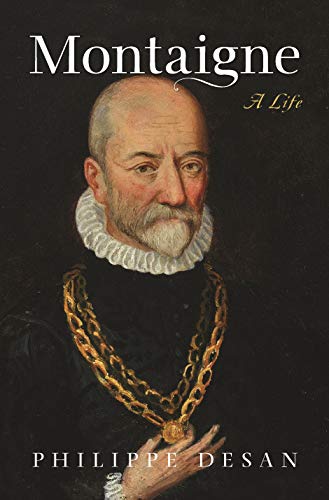
One of the most important writers and thinkers of the Renaissance, Michel de Montaigne (1533-92) helped invent a literary genre that seemed more modern than anything that had come before. But did he do it, as he suggests in his Essays, by retreating to his chateau, turning his back on the world, and stoically detaching himself from his violent times? In this definitive biography, Philippe Desan, one of the worlds leading authorities on Montaigne, overturns this longstanding myth by showing that Montaigne was constantly concerned with realizing his political ambitions - and that the literary and philosophical character of the Essays largely depends on them. The most comprehensive and authoritative biography of Montaigne yet written, this sweeping narrative offers a fascinating new picture of his life and work.
Die Inhaltsangabe kann sich auf eine andere Ausgabe dieses Titels beziehen.
Über die Autorin bzw. den Autor
Philippe Desan is the Howard L. Willett Professor in Renaissance Literature and History of Culture at the University of Chicago and the author of many books.
Von der hinteren Coverseite
"The new standard biography of Montaigne. Phillipe Desan throws new light on Montaigne's rewriting of the Essays through a study of his changing political aspirations."--Peter Mack, University of Warwick
"This biography is thoroughly illuminating and it is difficult to imagine that it could be bettered. It will surely hold the field for decades."--Michael Moriarty, University of Cambridge
"Philippe Desan's biography offers a refreshing corrective to those Lives of Montaigne that have underplayed his political activities and aspirations by presenting his literary activities as belonging to their own autonomous sphere. The book offers some intriguing new interpretations, including a compelling account of the different circumstances that surround--and intentions that may animate--the various editions of the Essays."--Richard Scholar, University of Oxford
Auszug. © Genehmigter Nachdruck. Alle Rechte vorbehalten.
Montaigne
A Life
By Philippe Desan, Steven Rendall, Lisa NealPRINCETON UNIVERSITY PRESS
Copyright © 2017 Princeton University Press
All rights reserved.
ISBN: 978-0-691-16787-9All rights reserved.
Contents
ACKNOWLEDGMENTS, ix,
PROLOGUE, xi,
INTRODUCTION, xvii,
Questions of Method and the Politics of a Book, xix,
Part One — Ambitions,
CHAPTER 1 THE EYQUEMS' SOCIAL ASCENSION, 3,
CHAPTER 2 A FIRST CAREER AS A MAGISTRATE (1556–1570), 48,
CHAPTER 3 LA BOÉTIE AND MONTAIGNE: DISCOURSE ON SERVITUDE AND ESSAY OF ALLEGIANCE, 112,
CHAPTER 4 "WITNESS MY CANNIBALS": THE ENCOUNTER WITH THE INDIANS OF THE NEW WORLD, 155,
CHAPTER 5 THE MAKING OF A GENTLEMAN (1570–1580), 183,
CHAPTER 6 THE ESSAIS OF 1580: MORAL, POLITICAL, AND MILITARY DISCOURSES, 254,
Part Two — Practices,
CHAPTER 7 THE CALL OF ROME, OR HOW MONTAIGNE NEVER BECAME AN AMBASSADOR (1580–1581), 319,
CHAPTER 8 "MESSIEURS OF BORDEAUX ELECTED ME MAYOR OF THEIR CITY" (1581–1585), 408,
CHAPTER 9 "BENIGNITY OF THE GREAT" AND "PUBLIC RUIN" (1585–1588), 482,
CHAPTER 10 THE MARGINALIZATION OF MONTAIGNE (1588–1592), 549,
Part Three — Post Mortem,
CHAPTER 11 MONTAIGNE'S POLITICAL POSTERITY, 613,
EPILOGUE, 631,
ABBREVIATIONS, 635,
NOTES, 637,
BIBLIOGRAPHY, 723,
TRANSLATIONS CITED, 765,
INDEX, 767,
CHAPTER 1
The Eyquems' Social Ascension
"And if I were to live a long time, I do not doubt that I would forget my own name." Montaigne's name constitutes the author's memory and incarnates the history of a family and its social ascension, but we still need to know what name Montaigne is talking about. Is it Michel Eyquem, his patronymic, or Michel de Montaigne, the name of his estate and his seigneury? The answer to this question differs over time, and the passage from Eyquem to Montaigne is a textbook case for the study of the social history of the class of wealthy merchants and bourgeois who became gentlemen at the end of the fifteenth and throughout the sixteenth centuries. The author of the Essais was the first member of his family to give up the name of his ancestors and retain only the name of his seigneury. In fact, the biography of "Michel, seigneur Montaigne" begins long before his birth. To understand his familial milieu, we have to study the social ascension of the house of Montaigne that started in the middle of the fourteenth century. The economic transformations of the fifteenth and sixteenth centuries favored the emergence and domination of well-off merchant families who had settled in the great European cities.
Political power slowly but surely shifted toward centers of exchange and commerce, particularly cities built on navigable waterways or at the mouths of rivers. Bordeaux was ideally situated to become a hub serving most European ports. Its access to the ocean gave a major advantage to those whose main activity consisted in warehousing merchandise and sending it on by sea to new markets. In the fifteenth century, during the decline of the English presence in the region, Bordeaux was a land of opportunity, and a significant number of merchants emigrated there from other parts of France and also from Spain and Portugal. For example, an edict of 1464 authorized emigrants to settle in Bordeaux in houses they found empty and to obtain letters of naturalization. Very early on, the wheels of commerce and the administrative control of the city were concentrated in the hands of a few families that had been able to benefit from the commercial development of Guyenne after the departure of the English.
In the fourteenth century, the name Eyquem was quite common in the Bordeaux region. It was spelled "Ayquem" and "Aiquem" as well as "Eyquem" and is found in several localities, including Mérignac, Taillan, Pessac, Camblanes, Blanquefort, and Langon. The Eyquems of Blanquefort — from whom the Montaignes descended — settled in Bordeaux in the early fourteenth century and joined the jurade as early as 1358, a sign that they had already achieved a significant economic success. Wealthy Bordeaux families formed a bourgeoisie that was little inclined to discuss its origins. Focused on the future, they practiced endogamy to increase their status in the city and to favor their access to municipal political power. Their goal was to advance their social position by means of marriages with other great bourgeois families. In the city, a political void allowed these families to take control of the administration in order to manage the regulation of their economic and commercial activities. By the middle of the fifteenth century, English power had grown considerably weaker in Guyenne, and in 1453 the battle of Castillon put an end to three centuries of English domination in Aquitaine. A parlement was established in 1462, and the city's privileges were approved and confirmed by Charles VIII in 1483. The king was generous toward the bourgeois of Bordeaux, declaring them free and exempt from having to pay subsidies and land taxes or make compulsory loans. Troops could not be billeted in the city without the consent of the mayor and the magistrates, and the city's guard as well as its police were entrusted to the citizens. However, after the English left, Guyenne's share of the land tax to be collected in Aquitaine was doubled. In this context of European expansion and political reforms, the city of Bordeaux underwent an unprecedented economic growth at the end of the fifteenth and the beginning of the sixteenth centuries.
Under Francis I the Anciennes Coutumes de Guyenne ("ancient customary laws of Guyenne") were reformed to take into account the local bourgeoisie's demands. The three estates of the sénéchaussée of Guyenne assembled in February 1520 to modify the old Coutumier. Several articles were suppressed or changed and new ones were added. The work lasted five months and the reformed Coutumier went into effect toward the end of 1527. Its territory was extended to include the former sénéchaussée of Bordeaux. The new customary law of Guyenne, which heavily favored the bourgeoisie, consisted of 117 articles written in a rather disorderly fashion and without much equity. Questions of inheritance and testamentary succession strongly recentered customary law around the transmission of property, and the goal of the great majority of the articles was to provide better protection for private property and to favor bourgeois property owners over the feudal territorial rights of noble landlords. The first article sets the tone of this rewriting of customary law. It stipulates that every son of a merchant family engaged in commerce or other business (banking, brokerage, purchasing) "can make commitments without his father's consent, in matters concerning merchandise or business." For example, children had the right to do business under their own names without depending on the authority of their fathers. In the same spirit of liberalizing mercantile law, Article V reorganized the law governing the legacy of goods to descendants by specifying that lineal transmission henceforth always had priority over feudal law. Inheritances, successions, transmissions, and donations of buildings, as well as the regulation of rents and mortgages, were subjected to new interpretations favorable to the rising bourgeoisie and represented more than sixty articles in the Coutumes générales de la ville de Bordeaux et de la sénéchaussée de...
„Über diesen Titel“ kann sich auf eine andere Ausgabe dieses Titels beziehen.
Suchergebnisse für Montaigne: A Life

Beispielbild für diese ISBN
Montaigne: A Life
Verlag:
Princeton University Press, 2017
ISBN 10: 0691167877
ISBN 13: 9780691167879
Gebraucht
Hardcover
Anbieter: Academybookshop, Long Island City, NY, USA
Verkäuferbewertung 4 von 5 Sternen

Hardcover. Zustand: As New. In fine, clean condition, but WITHOUT THE DUST-COVER, clean pages. Bestandsnummer des Verkäufers A-gj24-34065
Gebraucht kaufen
EUR 13,63
EUR 3,47 Versand
Versand innerhalb von USA
Versand innerhalb von USA
Anzahl: 1 verfügbar
Foto des Verkäufers
Montaigne: A Life
Verlag:
Princeton University Press, 2017
ISBN 10: 0691167877
ISBN 13: 9780691167879
Gebraucht
Hardcover
Anbieter: Arches Bookhouse, Portland, OR, USA
Verkäuferbewertung 5 von 5 Sternen

Hardcover with Dust Jacket. Zustand: NEAR FINE. Zustand des Schutzumschlags: NEAR FINE. xxxv, 796 pp. Tips very lightly rubbed, small splotching to tail of fore edge, sharp and clean otherwise. DJ small tear to tail of spine. Bestandsnummer des Verkäufers 6437
Gebraucht kaufen
EUR 19,73
EUR 6,09 Versand
Versand innerhalb von USA
Versand innerhalb von USA
Anzahl: 1 verfügbar
Beispielbild für diese ISBN
Montaigne: A Life
Verlag:
Princeton University Press, 2017
ISBN 10: 0691167877
ISBN 13: 9780691167879
Gebraucht
Hardcover
Anbieter: Harmonium Books, Philadelphia, PA, USA
Verkäuferbewertung 4 von 5 Sternen
Hardcover. Zustand: As New. New hardback w/ jacket; unmarked; no bent/torn pp; jacket excellent. Bestandsnummer des Verkäufers ABE-1764902585845
Gebraucht kaufen
EUR 30,49
EUR 6,09 Versand
Versand innerhalb von USA
Versand innerhalb von USA
Anzahl: 1 verfügbar
Beispielbild für diese ISBN
Montaigne : A Life
Anbieter: GreatBookPrices, Columbia, MD, USA
Verkäuferbewertung 5 von 5 Sternen
Zustand: New. Bestandsnummer des Verkäufers 26398921-n
Neu kaufen
EUR 44,98
EUR 2,30 Versand
Versand innerhalb von USA
Versand innerhalb von USA
Anzahl: 1 verfügbar
Beispielbild für diese ISBN
Montaigne
Anbieter: PBShop.store US, Wood Dale, IL, USA
Verkäuferbewertung 5 von 5 Sternen
HRD. Zustand: New. New Book. Shipped from UK. Established seller since 2000. Bestandsnummer des Verkäufers WP-9780691167879
Beispielbild für diese ISBN
Montaigne : A Life
Verlag:
Princeton University Press, 2017
ISBN 10: 0691167877
ISBN 13: 9780691167879
Gebraucht
Hardcover
Anbieter: GreatBookPrices, Columbia, MD, USA
Verkäuferbewertung 5 von 5 Sternen
Zustand: As New. Unread book in perfect condition. Bestandsnummer des Verkäufers 26398921
Gebraucht kaufen
EUR 45,77
EUR 2,30 Versand
Versand innerhalb von USA
Versand innerhalb von USA
Anzahl: 1 verfügbar
Foto des Verkäufers
Montaigne
Verlag:
Princeton University Press, US, 2017
ISBN 10: 0691167877
ISBN 13: 9780691167879
Neu
Hardcover
Anbieter: Rarewaves USA, HEBRON, KY, USA
Verkäuferbewertung 5 von 5 Sternen
Hardback. Zustand: New. One of the most important writers and thinkers of the Renaissance, Michel de Montaigne (1533-92) helped invent a literary genre that seemed more modern than anything that had come before. But did he do it, as he suggests in his Essays, by retreating to his chateau, turning his back on the world, and stoically detaching himself from his violent times? In this definitive biography, Philippe Desan, one of the world's leading authorities on Montaigne, overturns this longstanding myth by showing that Montaigne was constantly concerned with realizing his political ambitions--and that the literary and philosophical character of the Essays largely depends on them. The most comprehensive and authoritative biography of Montaigne yet written, this sweeping narrative offers a fascinating new picture of his life and work. As Desan shows, Montaigne always considered himself a political figure and he conceived of each edition of the Essays as an indispensable prerequisite to the next stage of his public career.He lived through eight civil wars, successfully lobbied to be raised to the nobility, and served as mayor of Bordeaux, special ambassador, and negotiator between Henry III and Henry of Navarre. It was only toward the very end of Montaigne's life, after his political failure, that he took refuge in literature. But, even then, it was his political experience that enabled him to find the right tone for his genre. In this essential biography, we discover a new Montaigne--caught up in the events of his time, making no separation between private and public life, and guided by strategy first in his words and silences. Neither candid nor transparent, but also not yielding to the cynicism of his age, this Montaigne lends a new depth to the Montaigne of literary legend. Bestandsnummer des Verkäufers LU-9780691167879
Beispielbild für diese ISBN
Montaigne: A Life
Anbieter: Kennys Bookshop and Art Galleries Ltd., Galway, GY, Irland
Verkäuferbewertung 5 von 5 Sternen
Zustand: New. Translator(s): Rendall, Steven; Neal, Lisa. Num Pages: 832 pages, 2 halftones. 19 line illus. BIC Classification: 1DDF; 3JB; BGL. Category: (G) General (US: Trade); (U) Tertiary Education (US: College). Dimension: 170 x 243 x 53. Weight in Grams: 1266. . 2017. Hardcover. . . . . Bestandsnummer des Verkäufers V9780691167879
Neu kaufen
EUR 44,04
EUR 9,50 Versand
Versand von Irland nach USA
Versand von Irland nach USA
Anzahl: 1 verfügbar
Beispielbild für diese ISBN
Montaigne: A Life (eng)
Anbieter: Brook Bookstore On Demand, Napoli, NA, Italien
Verkäuferbewertung 5 von 5 Sternen
Zustand: new. Bestandsnummer des Verkäufers 91a6c1e752fba61e637b78e430f2cf81
Neu kaufen
EUR 45,37
EUR 11,00 Versand
Versand von Italien nach USA
Versand von Italien nach USA
Anzahl: 3 verfügbar
Beispielbild für diese ISBN
Montaigne
Anbieter: PBShop.store UK, Fairford, GLOS, Vereinigtes Königreich
Verkäuferbewertung 5 von 5 Sternen
HRD. Zustand: New. New Book. Shipped from UK. Established seller since 2000. Bestandsnummer des Verkäufers WP-9780691167879
Neu kaufen
EUR 49,11
EUR 8,90 Versand
Versand von Vereinigtes Königreich nach USA
Versand von Vereinigtes Königreich nach USA
Anzahl: 3 verfügbar