
Verwandte Artikel zu Polarized: Making Sense of a Divided America
Inhaltsangabe
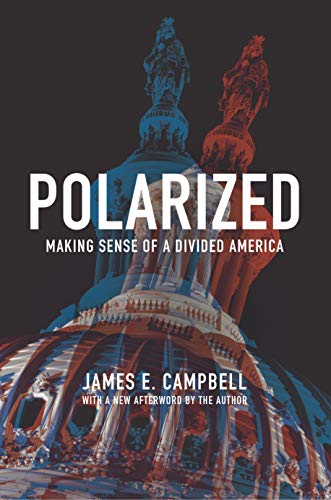
Polarized challenges the widely held belief that polarization is the product of party and media elites, revealing instead how the American public in the 1960s set in motion the increase of polarization. American politics became highly polarized from the bottom up, not the top down, and this began much earlier than often thought. The Democrats and the Republicans are now ideologically distant from each other and about equally distant from the political center. Polarized also explains why the parties are polarized at all, despite their battle for the decisive median voter. No subject is more central to understanding American politics than political polarization, and no other book offers a more in-depth and comprehensive analysis of the subject than this one.
Die Inhaltsangabe kann sich auf eine andere Ausgabe dieses Titels beziehen.
Über die Autorin bzw. den Autor
James E. Campbell is UB Distinguished Professor of Political Science at the University at Buffalo, State University of New York.
Von der hinteren Coverseite
"If recent elections have proven anything, it is how deeply polarized American voters really are. In this remarkably perceptive and probing book, Campbell explains how and why this phenomenon began and developed. You'll be surprised by some of his findings. We can't reduce paralyzing polarization until we truly understand it. Thanks to Campbell, we're much better equipped."--Larry J. Sabato, author of The Kennedy Half-Century
"Regardless of where you stand in the debate about polarization, there is no question that anyone interested in the subject must seriously engage Campbell's nuanced theoretical arguments and careful empirical analyses."--Morris P. Fiorina, Stanford University
"Rigorous, balanced, and insightful, Polarized is a major contribution to our understanding of political polarization."--George C. Edwards III, author of Predicting the Presidency: The Potential of Persuasive Leadership
"Campbell makes a forceful case for his point of view, arguing that America is no longer a pluralist polity characterized by a moderate, compromising politics. Even if one disagrees with him, one knows where he stands and why. Polarized is a learning experience, for protagonists and antagonists alike."--Michael S. Lewis-Beck, coauthor of The American Voter Revisited
"A must-read for anyone interested in the evolution and current state of American politics. Campbell flips much of the conventional wisdom about polarization on its head--rather than being a top-down or elite-driven phenomenon, polarization is driven largely by the American public and their shifting views."--James N. Druckman, coauthor of Who Governs?: Presidents, Public Opinion, and Manipulation
Auszug. © Genehmigter Nachdruck. Alle Rechte vorbehalten.
Polarized
Making Sense Of A Divided America
By James E. CampbellPRINCETON UNIVERSITY PRESS
Copyright © 2018 Princeton University Press
All rights reserved.
ISBN: 978-0-691-18086-1All rights reserved.
Contents
List of Figures and Tables, ix,
Acknowledgments, xi,
Introduction, 1,
Part One. Preparing the Foundation, 13,
Chapter 1. Knowns and Unknowns, 15,
Chapter 2. History and Theories, 39,
Part Two. The Polarized Electorate, 59,
Chapter 3. Ideology and Polarization, 61,
Chapter 4. Issues and Polarization, 91,
Chapter 5. Circumstantial Evidence, 117,
Part Three. The Polarized Parties, 143,
Chapter 6. Why Are the Parties More Polarized?, 145,
Chapter 7. One-Sided Party Polarization?, 173,
Chapter 8. Why Are the Parties Polarized at All?, 197,
Chapter 9. Polarization and Democracy, 221,
Afterword, 247,
Appendix A. Five Ideological Series, 257,
Appendix B. Regression Analyses of Ideological Orientations, 259,
Notes, 263,
References, 293,
Index, 323,
CHAPTER 1
KNOWNS AND UNKNOWNS
Let's start at the beginning. Gentlemen, this is a football.
— Vince Lombardi, legendary NFL coach
Despite an avalanche of studies in recent years, many important questions about polarization in American politics remain unsettled. Before delving into them, as Coach Lombardi ever so gently suggests in the epigraph, it is a good idea to begin with the basics, to establish what we know (or think we know) and what we do not know about the subject. This taking stock and clarifying the concepts and the questions of polarization is the principal purpose of this chapter.
It might seem unnecessary to state the case for why the subject of polarization is important, but it should be stated nevertheless. It is our football. The level of polarization is important because it affects every aspect of political life, from discussions of political issues in informal settings, to the conduct of elections, to interactions at the highest levels of government over national public policies. As noted in the Introduction, polarization is the condition of substantial and intense conflict over political perspectives arrayed along a single dimension — generally along ideological lines. Rather than political differences being aligned differently on a variety of unconnected issues on which opinions are weakly held, highly polarized conflict is aligned across different issues with strongly held and divergent views. In highly polarized politics, there are distinct sides who see the political world in diametrically opposite ways. Whether in discussions over a few beers in a pub or on roll-call votes cast in the halls of Congress, polarized conflict is not easily resolved or accommodated.
Some degree of polarization is a fact of life in politics. Politics, especially free and democratic politics, involves conflict over differing views. But the extent of polarization can vary, and this is important. The level of polarization in the public and between its political parties establishes the "degree-of-difficulty" that the nation and its political system confronts in governing. A less polarized public and party system makes the political process less contentious and its results more broadly satisfactory. Greater polarization translates into more difficult and combative politics. Considering the gravity of the stakes involved, anyone who cares about or who might be affected by American politics should have an interest in understanding its polarization. If you are not in this group, you are excused.
THE KNOWNS
To move further down the road of understanding polarization in modern American politics, we need to know where we are starting from — what do we already know about polarization? While we know a good deal about it, five observations and findings are most important. The first two are observations about the character or nature of polarization. These are relevant to understanding the magnitude of both polarization in general (first-order polarization) as well as polarization between the political parties (second-order polarization). The three remaining "knowns" are basic empirical findings about party polarization on which there seems to be general agreement.
A Matter of Degree
Polarization is not an all-or-nothing condition. It is a matter of degree. Polarization is about antagonistic political perspectives confronting one another (a single dimension of conflict). Political differences are always present to some degree, but they are never all-consuming. Although the complete absence of polarization and the complete dominance of polarization are hypothetical possibilities, they are not realistic possibilities.
The idea that polarization is a matter of degree may be best appreciated by reviewing what the extreme conditions of no polarization and complete polarization would require. There are only two conceivable ways in which the politics of a free society could be free of polarization. The first of these is unanimity. If everyone were of one mind on all important matters of public policy, politics would be entirely unpolarized. This is, of course, well beyond the realm of possibility. The only other way to avoid polarization entirely is if differences on important matters were distributed in such a random way that there were no stable alliances formed across different matters in dispute — in effect, perfect pluralism. Allies on one issue were as likely as not to be opponents on the next issue. This, too, is beyond the realm of possibility. Common strands of thinking on issues build relationships — friends and foes.
At the other hypothetical extreme, politics would be completely polarized when two sides of equal size were as far apart as possible in their perspectives. Between two homogeneous and diametrically opposed perspectives would be a vast and vacant chasm of the political center. Even civil wars might not reach this extreme.
Real world politics are considerably more messy than these hypothetical extremes of no polarization and complete polarization. Public opinion is complex, motivated in part by common interests, often not well formed and articulated, and routinely measured with error. With these characteristics, simple pictures of universal agreement or random differences, on the one hand, or neatly concentrated bimodal divisions, on the other, are not remotely realistic possibilities.
As a consequence, whether with reference to the public or to the political parties, there is no bright line over which normal political differences become polarized political differences. In statistical parlance, polarization is an interval condition, not a dichotomy. No one would seriously contend that adding one more contentious ideologue to an otherwise unpolarized society or legislature would "flip the switch" and convert it to a polarized body. The real question is not whether American politics are or are not polarized, but to what degree are American politics highly polarized or relatively unpolarized?
This observation may seem obvious, but debates about polarization are often conducted as if they were about the extremes. We are polarized or we are not. Those seeing politics as fairly moderate tend to downplay the extent of real conflict. Those seeing a polarized America tend to look past the fact that differences among ordinary citizens as well as differences between the political parties could be larger and even more intense.
The interval nature of polarization...
„Über diesen Titel“ kann sich auf eine andere Ausgabe dieses Titels beziehen.
Suchergebnisse für Polarized: Making Sense of a Divided America

Beispielbild für diese ISBN
Polarized: Making Sense of a Divided America
Verlag:
Princeton University Press, 2018
ISBN 10: 0691180865
ISBN 13: 9780691180861
Gebraucht
Softcover
Anbieter: Wonder Book, Frederick, MD, USA
Verkäuferbewertung 5 von 5 Sternen

Zustand: Good. Good condition. A copy that has been read but remains intact. May contain markings such as bookplates, stamps, limited notes and highlighting, or a few light stains. Bestandsnummer des Verkäufers U14B-06168
Gebraucht kaufen
EUR 6,40
Versand gratis
Versand innerhalb von USA
Versand innerhalb von USA
Anzahl: 1 verfügbar
Foto des Verkäufers
Polarized: Making Sense of a Divided America
Verlag:
Princeton University Press, 2018
ISBN 10: 0691180865
ISBN 13: 9780691180861
Gebraucht
Softcover
Anbieter: Blue Vase Books, Interlochen, MI, USA
Verkäuferbewertung 5 von 5 Sternen
Zustand: good. The item shows wear from consistent use, but it remains in good condition and works perfectly. All pages and cover are intact including the dust cover, if applicable . Spine may show signs of wear. Pages may include limited notes and highlighting. May NOT include discs, access code or other supplemental materials. Bestandsnummer des Verkäufers BVV.0691180865.G
Gebraucht kaufen
EUR 7,76
Versand gratis
Versand innerhalb von USA
Versand innerhalb von USA
Anzahl: 1 verfügbar
Foto des Verkäufers
Polarized: Making Sense of a Divided America
Verlag:
Princeton University Press, 2018
ISBN 10: 0691180865
ISBN 13: 9780691180861
Gebraucht
Softcover
Anbieter: Greenworld Books, Arlington, TX, USA
Verkäuferbewertung 5 von 5 Sternen
Zustand: very_good. Fast Free Shipping â" Very Good condition book with a firm cover and clean pages. Shows normal use and some light wear or limited notes markings. A solid, nice copy to enjoy. Bestandsnummer des Verkäufers GWV.0691180865.VG
Gebraucht kaufen
EUR 8,64
Versand gratis
Versand innerhalb von USA
Versand innerhalb von USA
Anzahl: 1 verfügbar
Beispielbild für diese ISBN
Polarized: Making Sense of a Divided America
Verlag:
Princeton University Press, 2018
ISBN 10: 0691180865
ISBN 13: 9780691180861
Gebraucht
Paperback
Anbieter: Academybookshop, Long Island City, NY, USA
Verkäuferbewertung 4 von 5 Sternen

Paperback. Zustand: Very Good. This is a new book that has some minor damage, which is usually a tear, a scratch, dents or stain on the edge, pages are clean, no missing pages. Bestandsnummer des Verkäufers N-gj24-11208
Gebraucht kaufen
EUR 5,68
EUR 3,55 Versand
Versand innerhalb von USA
Versand innerhalb von USA
Anzahl: 1 verfügbar
Beispielbild für diese ISBN
Polarized: Making Sense of a Divided America
Verlag:
Princeton University Press, 2018
ISBN 10: 0691180865
ISBN 13: 9780691180861
Gebraucht
Paperback
Anbieter: Academybookshop, Long Island City, NY, USA
Verkäuferbewertung 4 von 5 Sternen
Paperback. Zustand: Very Good. This is a new book that has some minor damage, which is usually a tear, a scratch, dents or stain on the edge, pages are clean, no missing pages. Bestandsnummer des Verkäufers C-gj24-10396
Gebraucht kaufen
EUR 5,68
EUR 3,55 Versand
Versand innerhalb von USA
Versand innerhalb von USA
Anzahl: 1 verfügbar
Beispielbild für diese ISBN
Polarized: Making Sense of a Divided America
Verlag:
Princeton University Press, 2018
ISBN 10: 0691180865
ISBN 13: 9780691180861
Gebraucht
Paperback
Anbieter: Academybookshop, Long Island City, NY, USA
Verkäuferbewertung 4 von 5 Sternen
Paperback. Zustand: Very Good. This is a new book that has some minor damage, which is usually a tear, a scratch, dents or stain on the edge, pages are clean, no missing pages. Bestandsnummer des Verkäufers F-gj24-06964
Gebraucht kaufen
EUR 5,68
EUR 3,55 Versand
Versand innerhalb von USA
Versand innerhalb von USA
Anzahl: 1 verfügbar
Beispielbild für diese ISBN
Polarized: Making Sense of a Divided America
Verlag:
Princeton University Press, 2018
ISBN 10: 0691180865
ISBN 13: 9780691180861
Gebraucht
Paperback
Anbieter: Last Word Books, Olympia, WA, USA
Verkäuferbewertung 5 von 5 Sternen
Paperback. Zustand: Good. A used book with minor shelf wear and imperfections. Thank you for supporting Last Word Books and independent bookstores. Bestandsnummer des Verkäufers 210448412
Gebraucht kaufen
EUR 10,06
Versand gratis
Versand innerhalb von USA
Versand innerhalb von USA
Anzahl: 1 verfügbar
Beispielbild für diese ISBN
Polarized: Making Sense of a Divided America
Verlag:
Princeton University Press, 2018
ISBN 10: 0691180865
ISBN 13: 9780691180861
Gebraucht
Paperback
Anbieter: Academybookshop, Long Island City, NY, USA
Verkäuferbewertung 4 von 5 Sternen
Paperback. Zustand: Very Good. This is a new book that has some damage, which is usually a tear, a scratch, dents or stain on the edge, pages are clean, no missing pages. Bestandsnummer des Verkäufers C-gj24-09911
Gebraucht kaufen
EUR 10,26
EUR 3,55 Versand
Versand innerhalb von USA
Versand innerhalb von USA
Anzahl: 1 verfügbar
Beispielbild für diese ISBN
Polarized : Making Sense of a Divided America
Verlag:
Princeton University Press, 2018
ISBN 10: 0691180865
ISBN 13: 9780691180861
Gebraucht
Softcover
Anbieter: GreatBookPrices, Columbia, MD, USA
Verkäuferbewertung 5 von 5 Sternen
Zustand: As New. Unread book in perfect condition. Bestandsnummer des Verkäufers 30170395
Gebraucht kaufen
EUR 19,31
EUR 2,35 Versand
Versand innerhalb von USA
Versand innerhalb von USA
Anzahl: 1 verfügbar
Foto des Verkäufers
Polarized : Making Sense of a Divided America
Anbieter: GreatBookPrices, Columbia, MD, USA
Verkäuferbewertung 5 von 5 Sternen
Zustand: New. Bestandsnummer des Verkäufers 30170395-n
Neu kaufen
EUR 22,23
EUR 2,35 Versand
Versand innerhalb von USA
Versand innerhalb von USA
Anzahl: 1 verfügbar