
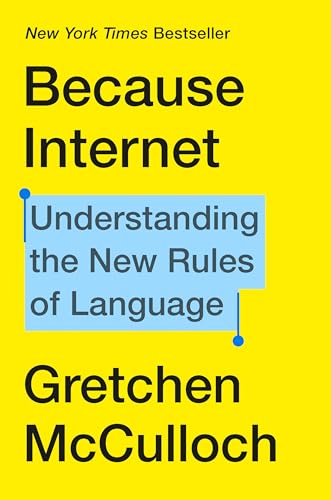
Verwandte Artikel zu Because Internet: Understanding the New Rules of Language
Inhaltsangabe
AN INSTANT NEW YORK TIMES BESTSELLER!!
Named a Best Book of 2019 by TIME, Amazon, and The Washington Post
A Wired Must-Read Book of Summer
“Gretchen McCulloch is the internet’s favorite linguist, and this book is essential reading. Reading her work is like suddenly being able to see the matrix.” —Jonny Sun, author of everyone's a aliebn when ur a aliebn too
Because Internet is for anyone who's ever puzzled over how to punctuate a text message or wondered where memes come from. It's the perfect book for understanding how the internet is changing the English language, why that's a good thing, and what our online interactions reveal about who we are.
Language is humanity's most spectacular open-source project, and the internet is making our language change faster and in more interesting ways than ever before. Internet conversations are structured by the shape of our apps and platforms, from the grammar of status updates to the protocols of comments and @replies. Linguistically inventive online communities spread new slang and jargon with dizzying speed. What's more, social media is a vast laboratory of unedited, unfiltered words where we can watch language evolve in real time.
Even the most absurd-looking slang has genuine patterns behind it. Internet linguist Gretchen McCulloch explores the deep forces that shape human language and influence the way we communicate with one another. She explains how your first social internet experience influences whether you prefer "LOL" or "lol," why ~sparkly tildes~ succeeded where centuries of proposals for irony punctuation had failed, what emoji have in common with physical gestures, and how the artfully disarrayed language of animal memes like lolcats and doggo made them more likely to spread.
Die Inhaltsangabe kann sich auf eine andere Ausgabe dieses Titels beziehen.
Über die Autorin bzw. den Autor
Gretchen McCulloch writes about linguistics for a general audience, especially internet language. She writes the Resident Linguist column at Wired (and formerly at The Toast). McCulloch has a master’s in linguistics from McGill University, runs the blog All Things Linguistic, and cohosts Lingthusiasm, a podcast that’s enthusiastic about linguistics. She lives in Montreal, but also on the internet.
Auszug. © Genehmigter Nachdruck. Alle Rechte vorbehalten.
Chapter 1
Informal Writing
Imagine learning to talk from recordings rather than people. If you learned how to have a conversation from movies, you might think that people regularly hang up the phone without saying goodbye and no one ever interrupts anyone else. If you learned to think out loud from news programs, you might believe that no one ever "ums" or waves their hands while searching for an idea, and that people swear rarely and never before ten p.m. If you learned to tell stories from audiobooks, you might think that nothing much new had happened with the English language in the past couple hundred years. If you only ever talked when you were public speaking, you'd expect that talking always involves anxious butterflies in your stomach and hours of preparation before facing an audience.
Of course, you did none of these things. You learned to speak English domestically, conversationally, and informally long before you could sit through an entire news report or deliver a speech. You might never be wholly comfortable with public speaking, but of course you can complain about the weather to a friend. Sure, they both involve moving the same body parts, but they're hardly the same task at all.
And yet this is exactly how we all learned to read and write.
When we think about writing, we think about books and newspapers, magazines and academic articles-and the school essays in which we tried (and mostly failed) to emulate them. We learned to read a formal kind of language which pretends that the past century or two of the English language hasn't really happened, which presents words and books to us cut off from the living people who created them, which downplays the alchemy of two people tossing thoughts back and forth in perfect balance. We learned to write with a paralyzing fear of red ink and were taught to worry about form before we even got to consider what we wanted to say, as if good writing was a thing of mechanistic rule-picking rather than of grace and verve. Naturally, we're as intimidated by the blank page as we are by public speaking.
That is, we were until very recently. The internet and mobile devices have brought us an explosion of writing by normal people. Writing has become a vital, conversational part of our ordinary lives. In the year 800, Charlemagne managed to get himself crowned as Holy Roman Emperor without being able to sign his own name. Sure, he had scribes to write up his charters, but illiterately running an empire? Today it's hard to imagine even organizing a birthday party without writing. One type of writing hasn't replaced the other: the "Happy Birthday" text message hasn't killed the diplomatic treaty. What's changed is that writing now comes in both formal and informal versions, just as speaking has for so long.
We write all the time now, and most of what we're writing is informal: our texts and chats and posts are quick, they're conversational, they're untouched by the hands of an editor. If you define a "published" writer as someone who's had something they've written reach over a hundred people, practically everyone who uses social media qualifies-just announce a new job or baby on Facebook. It's not that edited, formal writing has disappeared online (there are plenty of business and news sites that still write much like we did in print), it's that it's now surrounded by a vast sea of unedited, unfiltered words that once might have only been spoken.
IÕm a linguist, and I live on the internet. When I see the boundless creativity of internet language flowing past me online, I canÕt help but want to understand how it works. Why did emoji become so popular so quickly? WhatÕs the deal with how people of different ages punctuate their emails and text messages so differently? Why does the language in memes often look so wonderfully strange?
I'm not alone in wondering about these things. When I started writing about internet linguistics online, I quickly ran into more follow-up questions from readers than just another article could answer. I went to conferences and dived into research papers and ran a few of my own queries. I realized that in many cases there were answers, just not from an internet native speaker, not all together in one place, not in a form that's fun to read regardless of how much you already know about linguistics. So I wrote this book.
Linguists are interested in the subconscious patterns behind the language we produce every day. But traditionally, linguistics doesn't analyze writing very much, unless it's a question about the history of a language and written records are all we have. The problem is that writing is too premeditated, too likely to have gotten filtered through multiple hands, too hard to attribute to a single person's linguistic intuitions at a specific moment. But internet writing is different. It's unedited, it's unfiltered, and it's so beautifully mundane. And, as I've continued rediscovering with every chapter of this book, when we analyze the hidden patterns of written internet language, we can understand more about language in general.
Internet writing is also useful because speech is an absolute nightmare to analyze. First of all, speech vanishes as soon as itÕs said, and if youÕre just taking notes, you might be misremembering things or not noticing everything. So you want to record the audio, but thatÕs your second problem: now you need to physically transport people into a recording lab or travel around with a recorder. Once youÕve got recordings, youÕve got a third problem: processing. It takes about an hour of skilled human work per minute of audio recording to get speech into a transcript usable for linguistic analysis: to transcribe the overall gist, to go back and add detailed phonetic information, to extract parts and analyze their acoustic frequencies or sentence structure. Many a beleaguered linguistics grad student has spent years of their life doing precisely this, in search of the answers to just a handful of specific questions. ItÕs hard to do at a massive scale. All the while, thereÕs a fourth challenge: your participants probably wonÕt talk to an academic interviewer the same way theyÕd talk to a friend. Want to analyze a signed language instead? Instead of analyzing audio in just one dimension, now youÕre facing video in two. Want to skip a step and use preexisting recordings? Good luck: most of that is news, acting, and other formal varieties.
There were difficulties in studying informal writing before the internet, too. It existed, in forms like letters, diaries, and postcards, but by the time a collection of papers is donated to an archive, they've generally been moldering in boxes for decades, and of course they also need to be processed in order to be analyzed. Deciphering old-timey handwriting on fragile paper is only marginally easier than transcribing audio. Studies of Victorian letters and medieval manuscripts can tell us that a particular word is older than we thought, or provide evidence of changing pronunciations through idiosyncratic spelling, but we don't want to limit our studies of present-day English to a fifty-year time delay, based solely on the highly biased sample of the kinds of famous people whose papers get donated to archives. But if we wanted more recent stuff, we'd again face the logistical challenges of getting people to write, for instance, sample postcards for our study and hoping that they're not too self-conscious about researchers reading their words.
Lucky for us, internet language is both easier to work with, since the text is already digital, and less likely to get distorted because someone's observing it, since much of it is already public as tweets and blogs and videos. (Although the would-be internet researcher...
„Über diesen Titel“ kann sich auf eine andere Ausgabe dieses Titels beziehen.
Suchergebnisse für Because Internet: Understanding the New Rules of Language

Beispielbild für diese ISBN
Because Internet: Understanding the New Rules of Language
Anbieter: World of Books (was SecondSale), Montgomery, IL, USA
Verkäuferbewertung 5 von 5 Sternen

Hardback. Zustand: Good. The internet isn't the first technology to alter how we communicate, but it is making our language change faster and in more interesting ways than ever before. The programmers behind the apps and platforms we use decide how our conversations are structured, from the grammar of status updates to the protocols of comments and @replies. Linguistically inventive niche online communities spread slang and jargon exponentially faster than in the days when new dialects were constrained by physical space. What's more, social media provides a fascinating laboratory for watching language evolve in real time. Bestandsnummer des Verkäufers 00095605104
Gebraucht kaufen
EUR 3,87
Versand gratis
Versand innerhalb von USA
Versand innerhalb von USA
Anzahl: 18 verfügbar
Foto des Verkäufers
Because Internet: Understanding the New Rules of Language
Anbieter: Dream Books Co., Denver, CO, USA
Verkäuferbewertung 5 von 5 Sternen
Zustand: good. Gently used with minimal wear on the corners and cover. A few pages may contain light highlighting or writing, but the text remains fully legible. Dust jacket may be missing, and supplemental materials like CDs or codes may not be included. May be ex-library with library markings. Ships promptly! Bestandsnummer des Verkäufers DBV.0735210934.G
Gebraucht kaufen
EUR 3,87
Versand gratis
Versand innerhalb von USA
Versand innerhalb von USA
Anzahl: 1 verfügbar
Foto des Verkäufers
Because Internet: Understanding the New Rules of Language
Anbieter: Zoom Books East, Glendale Heights, IL, USA
Verkäuferbewertung 5 von 5 Sternen
Zustand: good. Book is in good condition and may include underlining highlighting and minimal wear. The book can also include "From the library of" labels. May not contain miscellaneous items toys, dvds, etc. . We offer 100% money back guarantee and 24 7 customer service. Bestandsnummer des Verkäufers ZEV.0735210934.G
Gebraucht kaufen
EUR 4,04
Versand gratis
Versand innerhalb von USA
Versand innerhalb von USA
Anzahl: 1 verfügbar
Beispielbild für diese ISBN
Because Internet: Understanding the New Rules of Language
Anbieter: More Than Words, Waltham, MA, USA
Verkäuferbewertung 5 von 5 Sternen
Zustand: Good. A sound copy with only light wear. Overall a solid copy at a great price! Bestandsnummer des Verkäufers BOS-M-08i-01657
Gebraucht kaufen
EUR 1,16
EUR 3,55 Versand
Versand innerhalb von USA
Versand innerhalb von USA
Anzahl: 1 verfügbar
Foto des Verkäufers
Because Internet: Understanding the New Rules of Language
Anbieter: Greenworld Books, Arlington, TX, USA
Verkäuferbewertung 5 von 5 Sternen
Zustand: like_new. Fast Free Shipping â" Excellent condition book with clean cover and pages. Barely handled, with minimal wear. An outstanding copy, close to enjoy! Bestandsnummer des Verkäufers GWV.0735210934.LN
Gebraucht kaufen
EUR 5,39
Versand gratis
Versand innerhalb von USA
Versand innerhalb von USA
Anzahl: 1 verfügbar
Beispielbild für diese ISBN
Because Internet: Understanding the New Rules of Language
Verlag:
Riverhead Books (edition First Edition), 2019
ISBN 10: 0735210934
ISBN 13: 9780735210936
Gebraucht
Hardcover
Erstausgabe
Anbieter: BooksRun, Philadelphia, PA, USA
Verkäuferbewertung 5 von 5 Sternen
Hardcover. Zustand: Very Good. First Edition. With dust jacket. It's a well-cared-for item that has seen limited use. The item may show minor signs of wear. All the text is legible, with all pages included. It may have slight markings and/or highlighting. Bestandsnummer des Verkäufers 0735210934-8-1-29
Gebraucht kaufen
EUR 5,58
Versand gratis
Versand innerhalb von USA
Versand innerhalb von USA
Anzahl: 1 verfügbar
Foto des Verkäufers
Because Internet: Understanding the New Rules of Language
Anbieter: The Happy Book Stack, Murfreesboro, TN, USA
Verkäuferbewertung 5 von 5 Sternen
Zustand: very_good. Book is in very good condition and has little to no writing, underlining, and or highlighting. Cover may have some cosmetic wear. Bestandsnummer des Verkäufers HBSV.0735210934.VG
Gebraucht kaufen
EUR 5,59
Versand gratis
Versand innerhalb von USA
Versand innerhalb von USA
Anzahl: 1 verfügbar
Beispielbild für diese ISBN
Because Internet: Understanding the New Rules of Language
Anbieter: World of Books Inc, Montgomery, IL, USA
Verkäuferbewertung 4 von 5 Sternen

Hardback. Zustand: Good. The internet isn't the first technology to alter how we communicate, but it is making our language change faster and in more interesting ways than ever before. The programmers behind the apps and platforms we use decide how our conversations are structured, from the grammar of status updates to the protocols of comments and @replies. Linguistically inventive niche online communities spread slang and jargon exponentially faster than in the days when new dialects were constrained by physical space. What's more, social media provides a fascinating laboratory for watching language evolve in real time. Bestandsnummer des Verkäufers CIN0735210934G
Gebraucht kaufen
EUR 5,70
Versand gratis
Versand innerhalb von USA
Versand innerhalb von USA
Anzahl: 18 verfügbar
Foto des Verkäufers
Because Internet: Understanding the New Rules of Language
Anbieter: clickgoodwillbooks, Indianapolis, IN, USA
Verkäuferbewertung 4 von 5 Sternen
Zustand: acceptable. Used - Acceptable: All pages and the cover are intact, but shrink wrap, dust covers, or boxed set case may be missing. Pages may include limited notes, highlighting, or minor water damage but the text is readable. Item may be missing bundled media. Bestandsnummer des Verkäufers 3O6QYV002F4O_ns
Gebraucht kaufen
EUR 2,29
EUR 3,55 Versand
Versand innerhalb von USA
Versand innerhalb von USA
Anzahl: 1 verfügbar
Beispielbild für diese ISBN
Because Internet: Understanding the New Rules of Language
Anbieter: Evergreen Goodwill, Seattle, WA, USA
Verkäuferbewertung 5 von 5 Sternen
hardcover. Zustand: Good. Bestandsnummer des Verkäufers mon0000047419
Gebraucht kaufen
EUR 2,29
EUR 3,55 Versand
Versand innerhalb von USA
Versand innerhalb von USA
Anzahl: 1 verfügbar