
Verwandte Artikel zu Animal Talk: Breaking the Codes of Animal Language
Inhaltsangabe
Is it possible that there is a universal language spoken and understood by all animals on earth, including humans? Is human language unique, as linguists and philosphers have taught for centuries, or could it share and combine well-developed components of other species' communications? Do you long to know what wild animals are discussing and what your dog, cat, bird, fish, or horse is really saying?
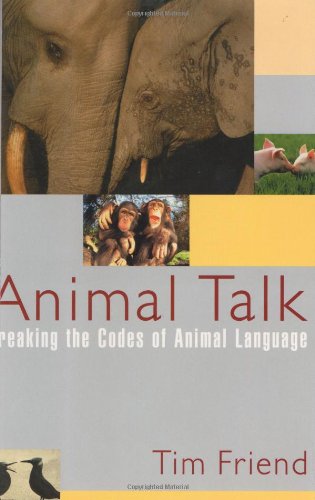
Animal Talk, the first authoritative, popular book about animal communication, answers these and other provocative questions with often astonishing news about the latest scientific discoveries. Using his ten years of field research and numerous interviews with preeminent scientists in the field and under the sea, veteran journalist and popular science write Tim Friend helps us understand what lies behind the eyes, within the sounds and scents, and beneath the flashy displays and postures of our animal neighbors.
The world has an estimated 10 million species, all chattering away with noisy and smelly abandon, using their own seemingly unique and baffling signals. Nonetheless, Friend reveals that animals and humans can easily understand each other because every creature on earth "speaks" a common nonverbal language -- an animal Esperanto that has developed through hundreds of millions of years of evolution. Through a skillful interweaving of amazing facts and compelling true animal stories, Friend demonstrates how similar human behavior and language are to other species', including the ways we attract members of the opposite sex, rear children, and compete in society.
A scientific Dr. Dolittle, author Tim Friend is your guide on a fascinating tour of the animal kingdom. Along the way, he enlists the enthusiastic translation services of the top scientists in animal communication to show a wonderful range of animals in action, to explain the intricate ways in which they use signals, and to interpret what they mean by them. From the Amazon and Central American rainforests to deep into the Ozarks, every environment Friend visits reveals a fascinating new insight and clue to the great puzzle of how animals communicate within and between species -- and how the many tongues, stripes, and resonances of the animal kingdom laid the original foundation for our own language.
Animal Talk tells the grand story of animal communication through the stories and signals of the animals themselves. Vital to our understanding of birds and bees, dogs and dolphins, and ourselves and our fellow primates, Animal Talk is also vital to the survival of our planet.
Die Inhaltsangabe kann sich auf eine andere Ausgabe dieses Titels beziehen.
Über die Autorin bzw. den Autor
Tim Friend is the senior science writer for USA Today. During his sixteen-year career at the newspaper, he has covered a broad range of topics including animal behavior, anthropology, physics, astronomy, biotechnology, and genetics. He has reported stories from Mount Everest, Antarctica, the Arctic Circle, the Amazon Rain Forest, the Middle East, Central America, and from a one-person submersible on the ocean floor. In addition to his work with USA Today, he has written for national magazines, including National Wildlife and Men's Health. He lives in Alexandria, Virginia.
Auszug. © Genehmigter Nachdruck. Alle Rechte vorbehalten.
Chapter One: A Walk in the Park: Toward a Universal Language
Just before midnight, I crawl off my hammock and slip quietly from under the blessed drapes of mosquito netting. The kerosene lanterns have been dimmed to barely a flicker across the long raised wooden platform that serves as our base camp in the tropical rain forest of northwestern Peru. The platform is in the center of a clearing next to the bank of a small tributary that feeds into the Napo River half a mile away. I arrived with four other journalists and a guide late in the afternoon after hiking through the muddy and tangled jungle since early morning. We have joined two scientists, a few camp cooks, and the drunken pilot of a Cessna seaplane, who arrived just before dinner. The pilot is supposed to give us a flyover of the region first thing after breakfast. As much Johnny Walker Red scotch as he was putting away tonight, he'll still be drunk when we take off on the river early in the morning. The bush pilot's creed is, If you can't fly drunk, you can't fly.
This is my first trip to the Amazon rain forest. The closest I have come to a jungle until now is the tangled thicket of the Ozarks, where I grew up. Surprisingly, there are a lot of similarities, especially in the number of things that bite, sting, scratch, and burn. At the moment, the others in the expedition party are snoring. But that isn't why I'm awake. There's a raucous party going on -- with lots of wild action by the strange and wondrous creatures all around our campsite. The night is teeming with sounds that seem louder and more intriguing than anything I have ever heard.
A minute ago, high in the canopy just beyond the camp's perimeter, something big crashed through the leaves. The only creature large enough around here to make such noise is a sloth. True to its name, it does not seem to be in much of a hurry. Bats have been fluttering since dusk through the rafters of the thatched roof above the platform. Earlier this evening, one swooped down and snatched a tarantula that was crawling up a colleague's mosquito netting. We could hear a soft crunch as the bat caught the spider with its teeth and darted off with its dinner into the night.
Beyond the camp, in vibrant surround sound, tree frogs and insects are laying down a soulful, energetic chorus like a choir at an old-fashioned Southern tent revival. Unfamiliar birds and nocturnal monkeys overlay the chorus with melodies and their own unique lyrics. This is one party I am not going to miss despite the rather condescending warning of the scientists not to leave camp alone at night. We could get lost or worse, they cautioned. I spend quite a bit of time in the field, but no matter where I travel, scientists tend to treat journalists like bad children who need constant supervision. Their admonishment only heightens my resolve to sneak out of camp.
The main attraction of this remote spot in the jungle is a canopy walkway constructed with ladders and suspension bridges that leads 115 feet straight up to the tops of the trees. Ordinarily, getting to the upper canopy entails climbing with harnesses and ropes. This is no simple task and usually involves close encounters of the unpleasant kind with nasty things that sting, burn, and bite. The canopy walkway, which bears a strong resemblance to the Swiss family Robinson's tree house, is a vast improvement on grappling and slapping one's way up. As far as I know, only a few of these walkways exist in the world. Tonight, this one is going to be my stairway to heaven.
I am on a mission and have a woefully short time to fulfill it: to learn how animals communicate with each other and what they spend so much time chattering to each other about. At this point, my quest seems absolutely overwhelming. Real experts devote entire careers to studying a single species of animal and are still left with many more questions than answers at the end of the day. My head is full of questions, too, which I plan to explore and explain in this book: If animal behavior is mostly instinctual, as scientists generally thought for more than a hundred years, why do animals need to communicate? If animals are thinking creatures and capable of emotions, as a growing number of scientists now believe, do their signals convey information (similar to our words)? Or are animals merely snarling or cooing to manipulate each other's behavior to get something they want (as we also often do)? How did the colorful, noisy, and smelly signals of the animal kingdom arise in the first place? Is any animal system of communication similar to human language? Do animals ever lie or attempt to deceive each other when communicating? Do the chirps, barks, and roars of different species have anything in common or follow predictable rules or patterns? Can a bird understand a monkey? Do species learn to communicate or is it all programmed by genes? To what extent is human communication, both verbal and nonverbal, programmed into our genes?
Scientists have been asking questions like these and working hard at finding the answers for more than a century, but there have been an enormous number of recent discoveries about animal communication. Studies on communication among tree frogs alone could fill a book. The eminent sociobiologist E. O. Wilson and the entomologist Bert Hölldobler produced a 732-page tome devoted to ants. I have three books in my home library on cichlid fishes, seven devoted to primates, five on dogs, more than a dozen on various species of birds. Most books focus on a single behavior, such as courtship rituals among birds, or the social behavior of primates, or the chemical signals of insects.
Yet surprisingly few books written for the general public have focused on the great range of animal communication. Usually, these books devote only a chapter or two to songs, dances, and scents. So my challenge here is to draw from the wealth of research conducted by hundreds of scientists and present the bigger picture of animal talk in the wild. The Amazon rain forest seemed like the best place to get a full immersion in nature and to begin eavesdropping on some animal conversations.
The few remaining unspoiled rain forests of the world are nature's Manhattan, London, and Tokyo -- bustling organic metropolises with their own laws that govern every creature equally from conception through life and into death. The laws of nature demand procreation and a fight for survival, but the means developed to achieve those ends are tremendously varied. Mother Nature has fostered all manner of societies, cultures, learning, gaming, altruism, deception, cooperation, competition, industries, arms races, and intelligence. Look closely at any habitat and you can find daily dramas involving struggles between predators and prey, elaborate courtships, covert copulations, sibling rivalries, struggles for dominance, defense of territories, and many, many opportunities to arrive at a premature death. The same dramas are played out all over the world in every environment, from the deep ocean vents where microscopic life may have begun to the lawns and shrubs only a few steps away in the backyard.
Communication between all of the earth's creatures makes these dramas possible. Indeed, communication is the glue of animal societies. Without a means of communicating, no life, including the simplest single-celled organisms, could exist. Communication, like the tango, takes two. And it requires a signal, which can be anything from the release of chemicals between colonizing bacteria, to the come-hither flashes between male and female fireflies in the backyard, to the "let's go" rumble of African elephants, to the "signature" whistles of dolphins, to a dog barking simply to be let outside.
Over the course of our journey we will explore the origins of communication and how all of the marvelous signals...
„Über diesen Titel“ kann sich auf eine andere Ausgabe dieses Titels beziehen.
Suchergebnisse für Animal Talk: Breaking the Codes of Animal Language

Beispielbild für diese ISBN
Animal Talk: Breaking the Codes of Animal Language
Anbieter: Once Upon A Time Books, Siloam Springs, AR, USA
Verkäuferbewertung 4 von 5 Sternen

Hardcover. Zustand: Acceptable. This is a used book. It may contain highlighting/underlining and/or the book may show heavier signs of wear . It may also be ex-library or without dustjacket. This is a used book. It may contain highlighting/underlining and/or the book may show heavier signs of wear . It may also be ex-library or without dustjacket. Bestandsnummer des Verkäufers mon0000925114
Gebraucht kaufen
EUR 2,06
EUR 3,51 Versand
Versand innerhalb von USA
Versand innerhalb von USA
Anzahl: 1 verfügbar
Beispielbild für diese ISBN
Animal Talk: Breaking the Codes of Animal Language
Anbieter: World of Books (was SecondSale), Montgomery, IL, USA
Verkäuferbewertung 5 von 5 Sternen

Zustand: Good. Item in good condition. Textbooks may not include supplemental items i.e. CDs, access codes etc. Bestandsnummer des Verkäufers 00104736752
Gebraucht kaufen
EUR 5,67
Versand gratis
Versand innerhalb von USA
Versand innerhalb von USA
Anzahl: 2 verfügbar
Beispielbild für diese ISBN
Animal Talk: Breaking the Codes of Animal Language
Anbieter: ThriftBooks-Dallas, Dallas, TX, USA
Verkäuferbewertung 5 von 5 Sternen
Hardcover. Zustand: Very Good. No Jacket. May have limited writing in cover pages. Pages are unmarked. ~ ThriftBooks: Read More, Spend Less. Bestandsnummer des Verkäufers G0743201574I4N00
Gebraucht kaufen
EUR 6,01
Versand gratis
Versand innerhalb von USA
Versand innerhalb von USA
Anzahl: 1 verfügbar
Beispielbild für diese ISBN
Animal Talk: Breaking the Codes of Animal Language
Anbieter: ThriftBooks-Dallas, Dallas, TX, USA
Verkäuferbewertung 5 von 5 Sternen
Hardcover. Zustand: Very Good. No Jacket. Former library book; Missing dust jacket; May have limited writing in cover pages. Pages are unmarked. ~ ThriftBooks: Read More, Spend Less. Bestandsnummer des Verkäufers G0743201574I4N11
Gebraucht kaufen
EUR 6,01
Versand gratis
Versand innerhalb von USA
Versand innerhalb von USA
Anzahl: 1 verfügbar
Beispielbild für diese ISBN
Animal Talk: Breaking the Codes of Animal Language
Anbieter: HPB Inc., Dallas, TX, USA
Verkäuferbewertung 5 von 5 Sternen
hardcover. Zustand: Very Good. Connecting readers with great books since 1972! Used books may not include companion materials, and may have some shelf wear or limited writing. We ship orders daily and Customer Service is our top priority! Bestandsnummer des Verkäufers S_431442450
Gebraucht kaufen
EUR 2,75
EUR 3,33 Versand
Versand innerhalb von USA
Versand innerhalb von USA
Anzahl: 1 verfügbar
Beispielbild für diese ISBN
Animal Talk: Breaking the Codes of Animal Language
Anbieter: HPB-Ruby, Dallas, TX, USA
Verkäuferbewertung 5 von 5 Sternen
hardcover. Zustand: Very Good. Connecting readers with great books since 1972! Used books may not include companion materials, and may have some shelf wear or limited writing. We ship orders daily and Customer Service is our top priority! Bestandsnummer des Verkäufers S_464428106
Gebraucht kaufen
EUR 2,75
EUR 3,33 Versand
Versand innerhalb von USA
Versand innerhalb von USA
Anzahl: 1 verfügbar
Foto des Verkäufers
Animal Talk: Breaking the Codes of Animal Language
Anbieter: -OnTimeBooks-, Phoenix, AZ, USA
Verkäuferbewertung 5 von 5 Sternen
Zustand: good. A copy that has been read, remains in good condition. All pages are intact, and the cover is intact. The spine and cover show signs of wear. Pages can include notes and highlighting and show signs of wear, and the copy can include "From the library of" labels or previous owner inscriptions. 100% GUARANTEE! Shipped with delivery confirmation, if you're not satisfied with purchase please return item! Ships via media mail. Bestandsnummer des Verkäufers OTV.0743201574.G
Gebraucht kaufen
EUR 6,27
Versand gratis
Versand innerhalb von USA
Versand innerhalb von USA
Anzahl: 1 verfügbar
Foto des Verkäufers
Animal Talk: Breaking the Codes of Animal Language
Anbieter: -OnTimeBooks-, Phoenix, AZ, USA
Verkäuferbewertung 5 von 5 Sternen
Zustand: very_good. Gently read. May have name of previous ownership, or ex-library edition. Binding tight; spine straight and smooth, with no creasing; covers clean and crisp. Minimal signs of handling or shelving. 100% GUARANTEE! Shipped with delivery confirmation, if you're not satisfied with purchase please return item! Ships USPS Media Mail. Bestandsnummer des Verkäufers OTV.0743201574.VG
Gebraucht kaufen
EUR 6,27
Versand gratis
Versand innerhalb von USA
Versand innerhalb von USA
Anzahl: 1 verfügbar
Beispielbild für diese ISBN
Animal Talk : Breaking the Codes of Animal Language
Anbieter: Better World Books, Mishawaka, IN, USA
Verkäuferbewertung 5 von 5 Sternen
Zustand: Very Good. Former library copy. Pages intact with possible writing/highlighting. Binding strong with minor wear. Dust jackets/supplements may not be included. Includes library markings. Stock photo provided. Product includes identifying sticker. Better World Books: Buy Books. Do Good. Bestandsnummer des Verkäufers 9849702-6
Gebraucht kaufen
EUR 6,54
Versand gratis
Versand innerhalb von USA
Versand innerhalb von USA
Anzahl: 1 verfügbar
Beispielbild für diese ISBN
Animal Talk : Breaking the Codes of Animal Language
Anbieter: Better World Books, Mishawaka, IN, USA
Verkäuferbewertung 5 von 5 Sternen
Zustand: Good. Pages intact with minimal writing/highlighting. The binding may be loose and creased. Dust jackets/supplements are not included. Stock photo provided. Product includes identifying sticker. Better World Books: Buy Books. Do Good. Bestandsnummer des Verkäufers 15287264-6
Gebraucht kaufen
EUR 6,54
Versand gratis
Versand innerhalb von USA
Versand innerhalb von USA
Anzahl: 1 verfügbar