
Verwandte Artikel zu Battle of Wits: The Complete Story of Codebreaking...
Inhaltsangabe
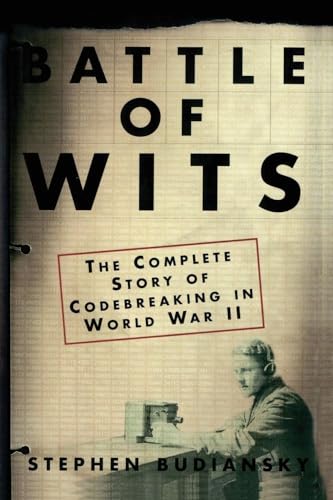
A million pages of new World War II codebreaking records have been released by the U.S. Army and Navy and the British government over the last five years. Now, Battle of Wits presents the history of the war that these documents reveal. From the battle of Midway until the last German code was broken in January 1945, this is an astonishing epic of a war that was won not simply by brute strength but also by reading the enemy's intentions.
The revelations of Stephen Budiansky's dramatic history include how Britain tried to manipulate the American codebreakers and monopolize German Enigma code communications; the first detailed published explanations of how the Japanese codes were broken; and how the American codebreaking machines worked to crack the Japanese, the German, and even the Russian diplomatic codes. The compelling narrative shows the crucial effect codebreaking had on the battlefields by explaining the urgency of stopping the wolf pack U-boat attacks in the North Atlantic, the importance of halting Rommel's tanks in North Africa, and the necessity of ensuring that the Germans believed the Allies' audacious deception and cover plans for D-Day. Unveiled for the first time, the complete story of codebreaking in World War II has now been told.
Die Inhaltsangabe kann sich auf eine andere Ausgabe dieses Titels beziehen.
Über die Autorin bzw. den Autor
Stephen Budiansky is a historian, biographer, and journalist, the author of 18 books exploring intellectual and creative lives, military and intelligence history, and science and the natural world. He is the former Washington Editor of the scientific journal Nature and a regular book reviewer for the Wall Street Journal. He lives on a small farm in northern Virginia.
Von der hinteren Coverseite
A million pages of new World War II codebreaking records have been released by the U.S. Army and Navy and the British government over the last five years. Now, Battle of Wits presents the history of the war that these documents reveal. From the battle of Midway until the last German code was broken in January 1945, this is an astonishing epic of a war that was won not simply by brute strength but also by reading the enemy's intentions. The revelations of Stephen Budiansky's dramatic history include how Britain tried to manipulate the American codebreakers and monopolize German Enigma code communications; the first detailed published explanations of how the Japanese codes were broken; and how the American codebreaking machines worked to crack the Japanese, the German, and even the Russian diplomatic codes. The compelling narrative shows the crucial effect codebreaking had on the battlefields by explaining the urgency of stopping the wolf pack U-boat attacks in the North Atlantic, the importance of halting Rommel's tanks in North Africa, and the necessity of ensuring that the Germans believed the Allies' audacious deception and cover plans for D-Day. Unveiled for the first time, the complete story of codebreaking in World War II has now been told.
Auszug. © Genehmigter Nachdruck. Alle Rechte vorbehalten.
Prologue
Midway
Green water breaking across her flat topside, the U.S. carrier Hornet plunged through a heavy sea and strong wind. A few hours earlier, as dawn broke on April 18, 1942, lookouts aboard the American ship had spotted a Japanese patrol boat. The Hornet's planes were intending to carry out their raid under cover of darkness, but Admiral William Halsey, whose nickname "Bull" had not been bestowed lightly, gave the order to launch at once -- wind, wave, and daylight be damned. The ship swung into the wind, and at 7:25 A.M. the first of the twin-engine bombers groaned off the flight deck.
The Army pilots at the controls of the B-25s had practiced short takeoffs from the comfortably dry land of a Florida airstrip but had never once tried it at sea. No one else ever had, either. Landing a B-25 on a carrier was impossible. Flying a B-25 off a carrier was, by comparison, merely insane. But the medium-weight bombers were the only aircraft in the American arsenal with a prayer of completing the daredevil mission. If all went according to plan, they would fly five hundred miles to Japan, drop their load, then continue another eleven hundred miles to a safe landing in unoccupied China.
Leading the attack was an unflappable test pilot, Lieutenant Colonel James H. Doolittle; his was the first of the lumbering bombers to catapult down the heaving deck. Over the next hour fifteen others followed. One pilot hung on the verge of a stall for so long as he struggled to get airborne that, Halsey later recalled, "we nearly catalogued his effects." Thirteen of the planes headed for Tokyo, roared in over the rooftops from different directions, and dropped their four bombs apiece. The three others hit Nagoya and Osaka. Ever since the attack on Pearl Harbor four months earlier, President Franklin D. Roosevelt had been pressing for just such a morale-boosting coup to bolster some of America's wounded pride. The Doolittle raid had been his pet project, and he was exultant with the news. Asked by reporters where the planes had come from, FDR grinned and said, "Shangri-La."
Doolittle's raiders did essentially no damage -- except to the Japanese psyche. On that they scored a direct hit. The Japanese Army claimed it shot down nine of the marauders; the true figure was zero. But the premature launch of the planes had added almost two hundred miles to their planned mission, strong head winds burned up still more fuel as they made their way toward China, and most of the crews ditched or bailed out. Eight who landed in Japanese-occupied territory were taken prisoner and three of them were executed, ostensibly for the crime of bombing civilian targets but in reality in an access of Japanese fury and mortification.
In the months since his lightning strike against the American fleet on December 7, 1941, Admiral Isoroku Yamamoto, Commander in Chief of Japan's Combined Fleet, had grown accustomed to the adulation of a grateful public; each day brought sacks of adoring letters. After the bombs fell on Tokyo he was rattled to find he had become the target of hate mail. He was wracked, too, with anxiety over the Emperor's personal safety.
Where had the bombers come from? Yamamoto pointed to Midway Island, America's westernmost outpost in the Pacific since the Philippines, Guam, and Wake Island had been overrun in Japan's seaborne blitzkrieg. It was a plausible conclusion, even if Shangri-La was actually closer to the mark. Midway was twenty-five hundred miles from Japan and thirteen hundred miles from Honolulu. Thus, Yamamoto argued, as long as it remained in American hands, bombers could fly from Hawaii to Midway, and from Midway to strike Dai Nippon. Japan's defensive perimeter would have to be pushed back farther still.
Two days later, Yamamoto's fleet air officer, Captain Yoshitake Miwa, noted in his diary that if further raids on the mainland were to be prevented, "there would be no other way but to make a landing on Hawaii. This makes landing on Midway a prerequisite. This is the very reason why the Combined Fleet urges a Midway operation." But, truth be told, Yamamoto had had his eyes on Midway for months. Untouched by the "victory fever" that swept through Japan's high command, Yamamoto insisted that unless America could be forced swiftly to accept a negotiated settlement, Japan was ultimately doomed. The grand admiral was a gambler and something of a playboy; he had been to Harvard to learn English, served in Washington as a naval attachÉ, and his knowledge of America's industrial power made him view war with the United States as folly. But if war was inevitable, he had consistently argued, Japan's only hope was to risk all on a knockout blow. America's industrial might would take months or even years to fully mobilize: thus Yamamoto's bold stroke on December 7. Unfortunately, that had left the job only half done. America's battleships had been caught at anchor at Pearl Harbor, but her aircraft carriers, at sea on the morning of the Japanese attack, had escaped.
Throughout March and early April a bitter fight roiled Japan's high command. Yamamoto pressed his case with mounting impatience: To draw the American carriers into the decisive battle, Japan must seize an objective that the United States would have to defend. If his plan to attack Midway was not approved, he would resign. The Naval General Staff sputtered. Midway might be of strategic value to an America on the defensive, the staff insisted, but it was worthless to Japan. Midway was a rocky atoll hardly larger than the small airstrip that stretched from one end of the island to the other; it could hold no more aircraft than a single carrier. The naval staff preferred a thrust to the south to cut off Australia, or, even more ambitiously, to seize Ceylon and India and link up with the German forces in the Near East. The Japanese Army, its eyes on China and on the threat Russia would pose if it entered the Pacific war, declared it would have nothing to do with Yamamoto's scheme, either.
But as the dust from Doolittle's bombs settled, the Army staff came forward with a new demand: It now insisted that the Army must be included in Yamamoto's forthcoming assault on Midway.
Four thousand miles to the east, Midway had become an obsession to another man during that winter and spring of 1942, a man as anonymous as Yamamoto was famous. Commander Joseph J. Rochefort came by his anonymity as much by the nature of his personality as by the necessity of his vocation. Above his desk hung a notice that read: "We can accomplish anything provided no one cares who gets the credit." He would later have reason to question the wisdom of that principle. But putting in twenty-hour shifts in a windowless basement was not a calling that appealed to the glory seekers in the United States Navy anyway. "The Dungeon," they called their cheerless command post in the basement of the administration building at Fourteenth Naval District Headquarters at Pearl Harbor; its more formal name was Station Hypo.
Rochefort had enlisted in the Navy in 1918 with vague dreams of becoming a naval aviator. Nothing but the oddest of chances determined that 1942 would find him in charge of breaking JN-25, the Japanese Fleet General Purpose Code -- the code that carried the operational orders of the Combined Fleet, the code that would, in short, tell where Japan was going to strike next.
Rochefort was driven but unflamboyant, a conventional career sailor who had pursued a conventional career path: sea duty, engineering school, ensign's commission, more sea duty. Rising from the enlisted ranks, he was an outsider to the elite fraternity of officers who had graduated from the Naval Academy. The coincidence that deflected him out of the ordinary course of duty occurred while he was serving aboard the battleship Arizona in 1925. The...
„Über diesen Titel“ kann sich auf eine andere Ausgabe dieses Titels beziehen.
Suchergebnisse für Battle of Wits: The Complete Story of Codebreaking...

Beispielbild für diese ISBN
Battle of Wits
Anbieter: World of Books (was SecondSale), Montgomery, IL, USA
Verkäuferbewertung 5 von 5 Sternen

Paperback. Zustand: Good. A million pages of new World War II codebreaking records have been released by the U.S. Army and Navy and the British government over the last five years. Now, Battle of Wits presents the history of the war that these documents reveal. From the battle of Midway until the last German code was broken in January 1945, this is an astonishing epic of a war that was won not simply by brute strength but also by reading the enemy's intentions. The revelations of Stephen Budiansky's dramatic history include how Britain tried to manipulate the American codebreakers and monopolize German Enigma code communications; the first detailed published explanations of how the Japanese codes were broken; and how the American codebreaking machines worked to crack the Japanese, the German, and even the Russian diplomatic codes. The compelling narrative shows the crucial effect codebreaking had on the battlefields by explaining the urgency of stopping the wolf pack U-boat attacks in the North Atlantic, the importance of halting Rommel's tanks in North Africa, and the necessity of ensuring that the Germans believed the Allies' audacious deception and cover plans for D-Day. Unveiled for the first time, the complete story of codebreaking in World War II has now been told. Bestandsnummer des Verkäufers 00094366519
Gebraucht kaufen
EUR 3,91
Versand gratis
Versand innerhalb von USA
Versand innerhalb von USA
Anzahl: 5 verfügbar
Beispielbild für diese ISBN
Battle of Wits: The Complete Story of Codebreaking in World War II
Anbieter: Your Online Bookstore, Houston, TX, USA
Verkäuferbewertung 5 von 5 Sternen
Paperback. Zustand: Very Good. Bestandsnummer des Verkäufers 0743217349-2-18416740
Gebraucht kaufen
EUR 4,15
Versand gratis
Versand innerhalb von USA
Versand innerhalb von USA
Anzahl: 1 verfügbar
Beispielbild für diese ISBN
Battle of Wits: The Complete Story of Codebreaking in World War II
Verlag:
Free Press (edition Reprint), 2002
ISBN 10: 0743217349
ISBN 13: 9780743217347
Gebraucht
Paperback
Anbieter: BooksRun, Philadelphia, PA, USA
Verkäuferbewertung 5 von 5 Sternen
Paperback. Zustand: Very Good. Reprint. It's a well-cared-for item that has seen limited use. The item may show minor signs of wear. All the text is legible, with all pages included. It may have slight markings and/or highlighting. Bestandsnummer des Verkäufers 0743217349-8-1
Gebraucht kaufen
EUR 4,96
Versand gratis
Versand innerhalb von USA
Versand innerhalb von USA
Anzahl: 1 verfügbar
Beispielbild für diese ISBN
Battle of Wits: The Complete Story of Codebreaking in World War II
Verlag:
Free Press (edition Reprint), 2002
ISBN 10: 0743217349
ISBN 13: 9780743217347
Gebraucht
Paperback
Anbieter: BooksRun, Philadelphia, PA, USA
Verkäuferbewertung 5 von 5 Sternen
Paperback. Zustand: Fair. Reprint. The item might be beaten up but readable. May contain markings or highlighting, as well as stains, bent corners, or any other major defect, but the text is not obscured in any way. Bestandsnummer des Verkäufers 0743217349-7-1
Gebraucht kaufen
EUR 5,19
Versand gratis
Versand innerhalb von USA
Versand innerhalb von USA
Anzahl: 1 verfügbar
Beispielbild für diese ISBN
Battle of Wits
Anbieter: World of Books Inc, Montgomery, IL, USA
Verkäuferbewertung 4 von 5 Sternen

Paperback. Zustand: Good. A million pages of new World War II codebreaking records have been released by the U.S. Army and Navy and the British government over the last five years. Now, Battle of Wits presents the history of the war that these documents reveal. From the battle of Midway until the last German code was broken in January 1945, this is an astonishing epic of a war that was won not simply by brute strength but also by reading the enemy's intentions. The revelations of Stephen Budiansky's dramatic history include how Britain tried to manipulate the American codebreakers and monopolize German Enigma code communications; the first detailed published explanations of how the Japanese codes were broken; and how the American codebreaking machines worked to crack the Japanese, the German, and even the Russian diplomatic codes. The compelling narrative shows the crucial effect codebreaking had on the battlefields by explaining the urgency of stopping the wolf pack U-boat attacks in the North Atlantic, the importance of halting Rommel's tanks in North Africa, and the necessity of ensuring that the Germans believed the Allies' audacious deception and cover plans for D-Day. Unveiled for the first time, the complete story of codebreaking in World War II has now been told. Bestandsnummer des Verkäufers CIN0743217349G
Gebraucht kaufen
EUR 5,75
Versand gratis
Versand innerhalb von USA
Versand innerhalb von USA
Anzahl: 5 verfügbar
Beispielbild für diese ISBN
Battle of Wits: The Complete Story of Codebreaking in World War II
Anbieter: Idaho Youth Ranch Books, Boise, ID, USA
Verkäuferbewertung 5 von 5 Sternen
Zustand: Good. A copy that has been read, but remains in clean condition. All pages are intact, and the cover is intact (including dust cover, if applicable). The spine may show signs of wear. Pages can include limited notes and highlighting, and the copy can include "From the library of" labels or limited small stickers. Book may have a remainder mark or be a price cutter. Bestandsnummer des Verkäufers BU-02-07-09-0225
Gebraucht kaufen
EUR 2,60
EUR 3,57 Versand
Versand innerhalb von USA
Versand innerhalb von USA
Anzahl: 1 verfügbar
Beispielbild für diese ISBN
Battle of Wits: The Complete Story of Codebreaking in World War II
Anbieter: ThriftBooks-Phoenix, Phoenix, AZ, USA
Verkäuferbewertung 5 von 5 Sternen
Paperback. Zustand: Very Good. No Jacket. May have limited writing in cover pages. Pages are unmarked. ~ ThriftBooks: Read More, Spend Less. Bestandsnummer des Verkäufers G0743217349I4N00
Gebraucht kaufen
EUR 6,26
Versand gratis
Versand innerhalb von USA
Versand innerhalb von USA
Anzahl: 1 verfügbar
Beispielbild für diese ISBN
Battle of Wits: The Complete Story of Codebreaking in World War II
Anbieter: ThriftBooks-Dallas, Dallas, TX, USA
Verkäuferbewertung 5 von 5 Sternen
Paperback. Zustand: Very Good. No Jacket. May have limited writing in cover pages. Pages are unmarked. ~ ThriftBooks: Read More, Spend Less. Bestandsnummer des Verkäufers G0743217349I4N00
Gebraucht kaufen
EUR 6,27
Versand gratis
Versand innerhalb von USA
Versand innerhalb von USA
Anzahl: 1 verfügbar
Beispielbild für diese ISBN
Battle of Wits: The Complete Story of Codebreaking in World War II
Anbieter: ThriftBooks-Atlanta, AUSTELL, GA, USA
Verkäuferbewertung 5 von 5 Sternen
Paperback. Zustand: Good. No Jacket. Pages can have notes/highlighting. Spine may show signs of wear. ~ ThriftBooks: Read More, Spend Less. Bestandsnummer des Verkäufers G0743217349I3N00
Gebraucht kaufen
EUR 6,27
Versand gratis
Versand innerhalb von USA
Versand innerhalb von USA
Anzahl: 1 verfügbar
Beispielbild für diese ISBN
Battle of Wits: The Complete Story of Codebreaking in World War II
Anbieter: ThriftBooks-Atlanta, AUSTELL, GA, USA
Verkäuferbewertung 5 von 5 Sternen
Paperback. Zustand: Very Good. No Jacket. Former library book; May have limited writing in cover pages. Pages are unmarked. ~ ThriftBooks: Read More, Spend Less. Bestandsnummer des Verkäufers G0743217349I4N10
Gebraucht kaufen
EUR 6,27
Versand gratis
Versand innerhalb von USA
Versand innerhalb von USA
Anzahl: 1 verfügbar