
Verwandte Artikel zu Diffusion of Innovations, 5th Edition
Inhaltsangabe
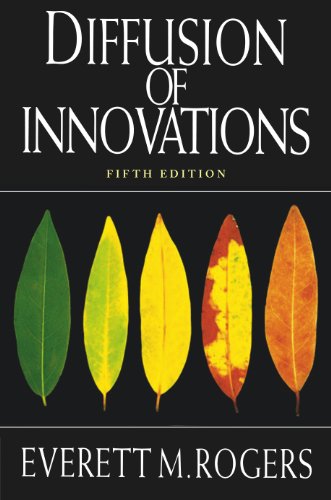
Now in its fifth edition, Diffusion of Innovations is a classic work on the spread of new ideas.
In this renowned book, Everett M. Rogers, professor and chair of the Department of Communication & Journalism at the University of New Mexico, explains how new ideas spread via communication channels over time. Such innovations are initially perceived as uncertain and even risky. To overcome this uncertainty, most people seek out others like themselves who have already adopted the new idea. Thus the diffusion process consists of a few individuals who first adopt an innovation, then spread the word among their circle of acquaintances—a process which typically takes months or years. But there are exceptions: use of the Internet in the 1990s, for example, may have spread more rapidly than any other innovation in the history of humankind. Furthermore, the Internet is changing the very nature of diffusion by decreasing the importance of physical distance between people. The fifth edition addresses the spread of the Internet, and how it has transformed the way human beings communicate and adopt new ideas.
Die Inhaltsangabe kann sich auf eine andere Ausgabe dieses Titels beziehen.
Über die Autorin bzw. den Autor
Dr. Everett M. Rogers is Distinguished Professor in the Department of Communication and Journalism at the University of New Mexico (UNM), where he teaches and conducts research on the diffusion of innovations.
Auszug. © Genehmigter Nachdruck. Alle Rechte vorbehalten.
Chapter 1
ELEMENTS OF DIFFUSION
There is nothing more difficult to plan, more doubtful of success, nor more dangerous to manage than the creation of a new order of things....Whenever his enemies have the ability to attack the innovator, they do so with the passion of partisans, while the others defend him sluggishly, so that the innovator and his party alike are vulnerable.
Niccolò Machiavelli, The Prince (1513)
Getting a new idea adopted, even when it has obvious advantages, is difficult. Many innovations require a lengthy period of many years from the time when they become available to the time when they are widely adopted. Therefore, a common problem for many individuals and organizations is how to speed up the rate of diffusion of an innovation. The following case illustration provides insight into some common difficulties facing diffusion campaigns.
Water Boiling in a Peruvian Village:
Diffusion That Failed
The public health service in Peru attempts to introduce innovations to villagers to improve their health and lengthen their lives. This change agency encourages people to install latrines, burn garbage daily, control house flies, report cases of infectious diseases, and boil drinking water. These innovations involve major changes in thinking and behavior for Peruvian villagers, who do not understand the relationship of sanitation to illness. Water boiling is an especially important health practice for Peruvian villagers. Unless they boil their drinking water, patients who are cured of an infectious disease in a medical clinic often return within a short time to be treated again for the same disease.
A two-year water-boiling campaign conducted in Los Molinas, a peasant village of two hundred families in the coastal region of Peru, persuaded only eleven housewives to boil water. From the viewpoint of the public health agency, the local health worker, Nelida, had a simple task: to persuade the housewives of Los Molinas to add water boiling to their pattern of daily behavior. Even with the aid of a medical doctor, who gave public talks on water boiling, and fifteen village housewives who were already boiling water, Nelida's diffusion campaign failed. To understand why, we need to take a closer look at the culture, the local environment, and the individuals in Los Molinas.
Most residents of Los Molinas are peasants who work as field hands on local plantations. Water is carried by can, pail, gourd, or cask. The three sources of water in Los Molinas include a seasonal irrigation ditch close to the village, a spring more than a mile away from the village, and a public well whose water most villagers dislike. All three sources are subject to pollution at all times and show contamination whenever tested. Of the three sources, the irrigation ditch is the most commonly used. It is closer to most homes, and the villagers like the taste of its water.
Although it is not feasible for the village to install a sanitary water system, the incidence of typhoid and other waterborne diseases could be greatly reduced by boiling water before it is consumed. During her two-year campaign in Los Molinas, Nelida made several visits to every home in the village and devoted especially intensive efforts to twenty-one families. She visited each of the selected families between fifteen and twenty-five times; eleven of these families now boil their water regularly.
What kinds of people do these numbers represent? We describe three village housewives: one who boils water to obey custom, one who was persuaded to boil water by the health worker, and one of the many who rejected the innovation.
Mrs. A: Custom-Oriented Adopter
Mrs. A is about forty and suffers from a sinus infection. The Los Molinas villagers call her the "sickly one." Each morning, Mrs. A boils a potful of water, which she uses throughout the day. She has no understanding of germ theory, as explained by Nelida. Her motivation for boiling water is a complex local custom of "hot" and "cold" distinctions. The basic principle of this belief system is that all foods, liquids, medicines, and other objects are inherently hot or cold, quite apart from their actual temperature. In essence, the hot-cold distinction serves as a series of avoidances and approaches in such behavior as pregnancy, child rearing, and the health-illness system.
Boiled water and illness are closely linked in the norms of Los Molinas. By custom, only the ill use cooked, or "hot" water. If an individual becomes ill, it is unthinkable to eat pork (very cold) or drink brandy (very hot). Extremes of hot and cold must be avoided by the sick; therefore, raw water, which is perceived to be very cold, must be boiled to make it appropriate.
Villagers learn from early childhood to dislike boiled water. Most can tolerate cooked water only if a flavoring, such as sugar, lemon, or herbs, is added. Mrs. A likes a dash of cinnamon in her drinking water. The village belief system does not involve the notion of bacteriological contamination of water. By tradition, boiling is aimed at eliminating the "cold" quality of unboiled water, not the harmful bacteria. Mrs. A drinks boiled water in obedience to local norms, because she perceives herself as ill. She adopted the innovation, but for the wrong reason.
Mrs. B: Persuaded Adopter
The B family came to Los Molinas a generation ago, but they are still strongly oriented toward their birthplace in the high Andes. Mrs. B worries about lowland diseases that she feels infest the village. It is partly because of this anxiety that the public health worker, Nelida, was able to convince Mrs. B to boil water. To Mrs. B, Nelida is a friendly authority (rather than a "dirt inspector," as she is seen by other housewives) who imparts useful knowledge and brings protection from uncertain threats. Mrs. B not only boils water but has also installed a latrine and sent her youngest child to the health center for a checkup.
Mrs. B is marked as an outsider in the community by her highland hairdo and stumbling Spanish. She will never achieve more than marginal social acceptance in the village. Because the community is not an important reference group to her, Mrs. B can deviate from the village norms on health innovations. With nothing to lose socially, Mrs. B gains in personal security by heeding Nelida's advice. Mrs. B's practice of boiling water has no effect in improving or damaging her marginal status. She is grateful to Nelida for teaching her how to neutralize the danger of contaminated water, which she perceives as a lowland peril.
Mrs. C: Rejector
This housewife represents the majority of Los Molinas families who were not persuaded by the efforts of the change agent during the two-year water-boiling campaign. In spite of Nelida's repeated explanations, Mrs. C does not understand germ theory. How, she argues, can microbes survive in water that would drown people? Are they fish? If germs are so small that they cannot be seen or felt, how can they hurt a grown person? There are enough real threats in the world to worry about -- poverty and hunger -- without bothering about tiny animals that one cannot see, hear, touch, or smell. Mrs. C's allegiance to traditional village norms is at odds with the boiling of water. A firm believer in the hot-cold superstition, she feels that only the sick should drink boiled water.
Why Did the Diffusion of Water Boiling Fail?
This intensive two-year campaign by a public health worker in a Peruvian village of two hundred families, aimed at persuading housewives to boil drinking water, was largely unsuccessful. Nelida was able to encourage only about 5 percent of the population, eleven families, to adopt the innovation. The diffusion campaign in Los Molinas failed because the...
„Über diesen Titel“ kann sich auf eine andere Ausgabe dieses Titels beziehen.
Suchergebnisse für Diffusion of Innovations, 5th Edition

Beispielbild für diese ISBN
Diffusion of Innovations, 5th Edition
Anbieter: World of Books (was SecondSale), Montgomery, IL, USA
Verkäuferbewertung 5 von 5 Sternen

Paperback. Zustand: Very Good. A classic since its first appearance in the 1980s, this comprehensive reference continues to be THE history of the spread of new ideas, for academics and professionals alike. Bestandsnummer des Verkäufers 00110793756
Gebraucht kaufen
EUR 4,79
Versand gratis
Versand innerhalb von USA
Versand innerhalb von USA
Anzahl: 1 verfügbar
Beispielbild für diese ISBN
Diffusion of Innovations 5th E
Anbieter: World of Books (was SecondSale), Montgomery, IL, USA
Verkäuferbewertung 5 von 5 Sternen
Zustand: Acceptable. Item in acceptable condition! Textbooks may not include supplemental items i.e. CDs, access codes etc. Bestandsnummer des Verkäufers 00107855822
Gebraucht kaufen
EUR 4,79
Versand gratis
Versand innerhalb von USA
Versand innerhalb von USA
Anzahl: 3 verfügbar
Beispielbild für diese ISBN
Diffusion of Innovations, 5th Edition
Anbieter: World of Books (was SecondSale), Montgomery, IL, USA
Verkäuferbewertung 5 von 5 Sternen
Paperback. Zustand: Good. A classic since its first appearance in the 1980s, this comprehensive reference continues to be THE history of the spread of new ideas, for academics and professionals alike. Bestandsnummer des Verkäufers 00106998149
Gebraucht kaufen
EUR 4,79
Versand gratis
Versand innerhalb von USA
Versand innerhalb von USA
Anzahl: 13 verfügbar
Foto des Verkäufers
Diffusion of Innovations, 5th Edition
Anbieter: Bay State Book Company, North Smithfield, RI, USA
Verkäuferbewertung 5 von 5 Sternen
Zustand: very_good. Bestandsnummer des Verkäufers BSM.1DMTP
Gebraucht kaufen
EUR 4,80
Versand gratis
Versand innerhalb von USA
Versand innerhalb von USA
Anzahl: 1 verfügbar
Foto des Verkäufers
Diffusion of Innovations, 5th Edition
Anbieter: Dream Books Co., Denver, CO, USA
Verkäuferbewertung 5 von 5 Sternen
Zustand: acceptable. This copy has clearly been enjoyedâ"expect noticeable shelf wear and some minor creases to the cover. Binding is strong, and all pages are legible. May contain previous library markings or stamps. Bestandsnummer des Verkäufers DBV.0743222091.A
Gebraucht kaufen
EUR 5,38
Versand gratis
Versand innerhalb von USA
Versand innerhalb von USA
Anzahl: 1 verfügbar
Foto des Verkäufers
Diffusion of Innovations, 5th Edition
Anbieter: Greenworld Books, Arlington, TX, USA
Verkäuferbewertung 5 von 5 Sternen
Zustand: good. Fast Free Shipping â" Good condition. It may show normal signs of use, such as light writing, highlighting, or library markings, but all pages are intact and the book is fully readable. A solid, complete copy that's ready to enjoy. Bestandsnummer des Verkäufers GWV.0743222091.G
Gebraucht kaufen
EUR 5,75
Versand gratis
Versand innerhalb von USA
Versand innerhalb von USA
Anzahl: 2 verfügbar
Beispielbild für diese ISBN
Diffusion of Innovations, 5th Edition
Verlag:
Free Press (edition 5th), 2003
ISBN 10: 0743222091
ISBN 13: 9780743222099
Gebraucht
Paperback
Anbieter: BooksRun, Philadelphia, PA, USA
Verkäuferbewertung 5 von 5 Sternen
Paperback. Zustand: Fair. 5th. The item might be beaten up but readable. May contain markings or highlighting, as well as stains, bent corners, or any other major defect, but the text is not obscured in any way. Bestandsnummer des Verkäufers 0743222091-7-22
Gebraucht kaufen
EUR 5,96
Versand gratis
Versand innerhalb von USA
Versand innerhalb von USA
Anzahl: 1 verfügbar
Beispielbild für diese ISBN
Diffusion of Innovations, 5th Edition
Anbieter: Wonder Book, Frederick, MD, USA
Verkäuferbewertung 5 von 5 Sternen
Zustand: Good. Good condition. 5th edition. A copy that has been read but remains intact. May contain markings such as bookplates, stamps, limited notes and highlighting, or a few light stains. Bestandsnummer des Verkäufers P11J-01967
Gebraucht kaufen
EUR 6,33
Versand gratis
Versand innerhalb von USA
Versand innerhalb von USA
Anzahl: 1 verfügbar
Beispielbild für diese ISBN
Diffusion of Innovations, 5th Edition
Anbieter: Wonder Book, Frederick, MD, USA
Verkäuferbewertung 5 von 5 Sternen
Zustand: As New. Like New condition. Fifth edition. A near perfect copy that may have very minor cosmetic defects. Bestandsnummer des Verkäufers M04E-01422
Gebraucht kaufen
EUR 6,33
Versand gratis
Versand innerhalb von USA
Versand innerhalb von USA
Anzahl: 1 verfügbar
Beispielbild für diese ISBN
Diffusion of Innovations, 5th Edition
Anbieter: ThriftBooks-Dallas, Dallas, TX, USA
Verkäuferbewertung 5 von 5 Sternen
Paperback. Zustand: Fair. No Jacket. Readable copy. Pages may have considerable notes/highlighting. ~ ThriftBooks: Read More, Spend Less. Bestandsnummer des Verkäufers G0743222091I5N00
Gebraucht kaufen
EUR 6,43
Versand gratis
Versand innerhalb von USA
Versand innerhalb von USA
Anzahl: 4 verfügbar