
Verwandte Artikel zu Learning Joy from Dogs without Collars: A Memoir
Inhaltsangabe
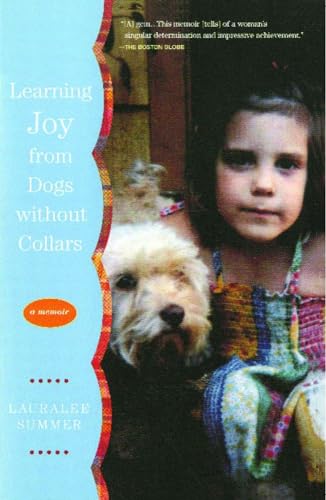
Learning Joy from Dogs without Collars is a memoir about growing up homeless. Lauralee Summer and her eccentric, idealistic mother move repeatedly in search of work and a better life, but most often find happiness and security only in their relationship with each other.
When she reaches junior high Lauralee and her mother set out for Boston in search of a better education. There Lauralee thrives under the care and guidance of Mr. Mac, becomes the only girl on the school wrestling team, and goes on to Harvard. Later, when she's nineteen, she finds her father and begins a relationship with him.
Learning Joy from Dogs without Collars is the story of a girl coming into her own, learning and understanding her place in the world. It is about the innocence and resiliency of childhood -- the space of joy that poverty is unable to demolish or diminish.
Die Inhaltsangabe kann sich auf eine andere Ausgabe dieses Titels beziehen.
Über die Autorin bzw. den Autor
Lauralee Summer received a B.A. in children's studies from Harvard University in 1998.
Auszug. © Genehmigter Nachdruck. Alle Rechte vorbehalten.
Chapter One: Mother
Keeping all this from them --
when they might have helped
-- Adrienne Rich
After fifteen months of being homeless my mother moved into a new apartment. I stood nervously -- hovering in the room's center, not wanting to get too close to the edges -- as if I was on a ship. The further to the edges I went, the whole place might shift under my feet, tipping me off the edge. If I went too far to the edge, I might be thrown to the walls or couch or the sink piled with dirty dishes. I might land in the midst of one of her quaint experiments. For Christmas, she placed the tree in a pot full of thousands of pennies, to keep it upright. The pennies are now soaking in water, being cleansed of the Christmas tree's sticky sap.
Broken bits of toys, confiscated from the church nursery, lie in a colorful plastic heap in another corner. As my mother stands in the doorway between the living room and kitchen, she says to me, "They were too small for safety -- one and five-eighths inches is the government standard for toys for children under three. One and three-quarters is safer yet." The late afternoon sunlight shines on her hair. She sometimes dyes it black or blond, but the gray always grows back in. My own hair is as straight as uncooked spaghetti, but hers spirals in loose flyaway curls around her face, or is tucked behind her ears with bobby pins. She looks girlish and innocent with her little space-rocket curls, salt and pepper colored.
I do not feel at home here though this might have been one of the homes of my childhood. All I see now is the poverty. The bleak walls are broken by yard-sale finds. My mother tries to fill the space with the contents of two bags she had while in the shelter. The refrigerator and cupboards are bare -- only a few items from the food bank: cans, stale taken-off-the-shelf pretzels, a new brand of cereal that didn't sell. All I feel is home's lack.
My mother can spend hours, days, even months on projects of her own devising, projects that utterly absorb her.
There are the three hundred small plants growing in styrofoam cups and egg cartons on her porch. She knows each type of plant and recites its name lovingly. To me they are just plants, although they look beautiful and green in the washed-out yellow sunlight.
In her refrigerator sit row upon row of sprouts: bean, alfalfa; and no food, only half a bottle of flat Pepsi, and some condiments. I worry -- this can't be healthy, Mother. She says she eats oatmeal every day, and uses powdered milk. There are Popsicles and vanilla ice cream in the freezer, which she blends together to make "orange crèmes." This was plain poverty, but it was also what she liked.
I was a snooty college student, a sophomore. I tried to analyze my mother -- distance and detach in an attempt to bring, gather her closer into my understanding. "Mother, do you feel generative or despairing?" I think of Erik Erikson's stages of ego development. The seventh stage, the one my mom should be going through: Generativity versus Stagnation. I sense these feelings pitching back and forth in my mother and I am inadequate to be at home with her. Yet what I have been taught to see as degeneracy (a disorganized house, leaving it only every few days...) may be my mom's way of generating new ideas.
Going to Harvard was in many ways a journey away from home for me. At Harvard, one of the favorite buzzwords of academics is discourse. A discourse is an ongoing conversation, a talking and listening back and forth. Each discourse is physically and culturally situated in a space. There is the discourse of cognitive psychologists, discourse on literature, sociological discourse on poverty and welfare reform. The word comes from the Latin discursus, "to run to and fro." The word current also comes from the same Latin root. So when I think of a discourse, I think of a flowing river of words, a current of communication.
With Harvard's discourses, I could categorize and analyze and discuss my mother's life and situation. I could analyze her according to Freudian or Eriksonian discourse; label her with a neurosis or a psychosocial stage of development. In the discourse of sociology, I could place my mother in a chart or a graph with other welfare mothers. I could understand her in a hundred different ways, a hundred different discourses. Yet none of these were satisfactory to me.
This journey -- from my mother's thought and speech to what I've learned at Harvard and afterwards -- this journey seemed to go in one direction and not the other. When I applied what I learned at Harvard to my mother, she grew farther and farther away from me. No longer a running to and fro, no longer a bridge, a pathway between two (cultural) locations, instead my education was a running away from. I moved away from my mother's thought and speech. I tried to travel back, but I could not find a bridge.
I was told I must not be too at home in the knowledge I created. I must objectively separate it from me as a mother gradually knows her child is separate. If discourses are a running to and fro, then I am left running between my mother's home and the world, out of place (homeless) in both spaces.
Good discourses make it easy to communicate. They increase understanding and clarity. They are like rivers with plenty of water in them, they are like a good steady run, like taking deep long breaths, they flow. There can be rocky parts in a discourse, places you must push through, but you do get from one place to another. As Jeanette Winterson wrote in Oranges Are Not the Only Fruit, "I don't know how to answer. I know what I think, but words in the head are like voices under water. They are distorted. Hearing the words as they hit the surface is sensitive work. You will have to be a bank robber and listen and listen to the little clicks before you can open the safe." A discourse may be an imperfect medium but it can help you get from the place inside your head to the place where you can begin to see inside someone else's.
In my mother's apartment, I try to reconcile my two homes, to build a strong bridge, one that will travel between the two (political, class) locations.
Once there was a time when I did not feel distant from my mother's voice. But then I was inside the slippery red warm walls of her womb. Yet it is hard to have been inside the womb of my mother and to know -- I can never take her inside of me. My eyes saw more of her wet dark caverns, spaces and limits, than she has ever seen. Although she felt me inside her, now she sees of me only the skin I present. This is difficult for us both.
You and I can judge her from outside, but in her womb, as she read and talked to me, I listened to her voice coming to me not through the wall of stomach muscles but through every inside vibration. I doubled, tripled, became an infinity of the self I was. I grew in nine months more than in the twenty-five years since.
When I was in grade school and high school, I played a violin. The violin's voice was like my mother's was when she read to the unborn me. The violin not only sounded on fingertips but also quivered and spoke within my body. Resounded in my bent elbows, my chin, between my ears, temples. The music spoke in the bones of my foot as it tapped the floor, keeping time. When I heard my mother's voice it was like this. Her voice did not come to me, it was part of me already. Its vibrations peeled me off the womb's walls. I didn't listen with ears because toes could hear as well.
I felt like I would never hear her voice and feel fully separate. I don't want to write only about my mother; I also want to write within.
One day last fall, I went to visit my mother, hoping to find some answers to questions I had about her life. My...
„Über diesen Titel“ kann sich auf eine andere Ausgabe dieses Titels beziehen.
Suchergebnisse für Learning Joy from Dogs without Collars: A Memoir

Beispielbild für diese ISBN
Learning Joy from Dogs without Collars: A Memoir
Anbieter: World of Books (was SecondSale), Montgomery, IL, USA
Verkäuferbewertung 5 von 5 Sternen

Paperback. Zustand: Good. Synopsis coming soon. Bestandsnummer des Verkäufers 00073271767
Gebraucht kaufen
EUR 4,47
Versand gratis
Versand innerhalb von USA
Versand innerhalb von USA
Anzahl: 1 verfügbar
Beispielbild für diese ISBN
Learning Joy from Dogs without Collars: A Memoir
Verlag:
Simon & Schuster (edition Reprint), 2004
ISBN 10: 0743257928
ISBN 13: 9780743257923
Gebraucht
Paperback
Anbieter: BooksRun, Philadelphia, PA, USA
Verkäuferbewertung 5 von 5 Sternen
Paperback. Zustand: Fair. Reprint. The item might be beaten up but readable. May contain markings or highlighting, as well as stains, bent corners, or any other major defect, but the text is not obscured in any way. Bestandsnummer des Verkäufers 0743257928-7-1
Gebraucht kaufen
EUR 4,47
Versand gratis
Versand innerhalb von USA
Versand innerhalb von USA
Anzahl: 1 verfügbar
Beispielbild für diese ISBN
Learning Joy from Dogs without Collars: A Memoir
Anbieter: More Than Words, Waltham, MA, USA
Verkäuferbewertung 5 von 5 Sternen
Zustand: Good. A sound copy with only light wear. Overall a solid copy at a great price! Bestandsnummer des Verkäufers BOS-M-13h-01679
Gebraucht kaufen
EUR 0,95
EUR 3,57 Versand
Versand innerhalb von USA
Versand innerhalb von USA
Anzahl: 1 verfügbar
Beispielbild für diese ISBN
Learning Joy from Dogs without Collars: A Memoir
Anbieter: World of Books Inc, Montgomery, IL, USA
Verkäuferbewertung 4 von 5 Sternen

Paperback. Zustand: Good. Synopsis coming soon. Bestandsnummer des Verkäufers CIN0743257928G
Gebraucht kaufen
EUR 6,31
Versand gratis
Versand innerhalb von USA
Versand innerhalb von USA
Anzahl: 1 verfügbar
Beispielbild für diese ISBN
Learning Joy from Dogs Without Collars
Anbieter: ThriftBooks-Atlanta, AUSTELL, GA, USA
Verkäuferbewertung 5 von 5 Sternen
Paperback. Zustand: Very Good. No Jacket. May have limited writing in cover pages. Pages are unmarked. ~ ThriftBooks: Read More, Spend Less. Bestandsnummer des Verkäufers G0743257928I4N00
Gebraucht kaufen
EUR 6,46
Versand gratis
Versand innerhalb von USA
Versand innerhalb von USA
Anzahl: 1 verfügbar
Beispielbild für diese ISBN
Learning Joy from Dogs Without Collars
Anbieter: ThriftBooks-Dallas, Dallas, TX, USA
Verkäuferbewertung 5 von 5 Sternen
Paperback. Zustand: Good. No Jacket. Pages can have notes/highlighting. Spine may show signs of wear. ~ ThriftBooks: Read More, Spend Less. Bestandsnummer des Verkäufers G0743257928I3N00
Gebraucht kaufen
EUR 6,46
Versand gratis
Versand innerhalb von USA
Versand innerhalb von USA
Anzahl: 1 verfügbar
Beispielbild für diese ISBN
Learning Joy from Dogs without Collars: A Memoir
Verlag:
Simon & Schuster June 2004, 2004
ISBN 10: 0743257928
ISBN 13: 9780743257923
Gebraucht
Soft cover
Anbieter: Dunaway Books, St. Louis, MO, USA
Verkäuferbewertung 4 von 5 Sternen
Soft cover. Zustand: Good. Bestandsnummer des Verkäufers 191656
Gebraucht kaufen
EUR 4,61
EUR 3,58 Versand
Versand innerhalb von USA
Versand innerhalb von USA
Anzahl: 1 verfügbar
Beispielbild für diese ISBN
Learning Joy from Dogs without Collars: A Memoir
Anbieter: Half Price Books Inc., Dallas, TX, USA
Verkäuferbewertung 5 von 5 Sternen
paperback. Zustand: Very Good. Connecting readers with great books since 1972! Used books may not include companion materials, and may have some shelf wear or limited writing. We ship orders daily and Customer Service is our top priority! Bestandsnummer des Verkäufers S_453129177
Gebraucht kaufen
EUR 5,29
EUR 3,36 Versand
Versand innerhalb von USA
Versand innerhalb von USA
Anzahl: 1 verfügbar
Beispielbild für diese ISBN
Learning Joy from Dogs Without Collars : A Memoir
Anbieter: Better World Books, Mishawaka, IN, USA
Verkäuferbewertung 5 von 5 Sternen
Zustand: Good. Reprint. Pages intact with minimal writing/highlighting. The binding may be loose and creased. Dust jackets/supplements are not included. Stock photo provided. Product includes identifying sticker. Better World Books: Buy Books. Do Good. Bestandsnummer des Verkäufers 4911931-6
Gebraucht kaufen
EUR 10,14
Versand gratis
Versand innerhalb von USA
Versand innerhalb von USA
Anzahl: 1 verfügbar
Beispielbild für diese ISBN
Learning Joy from Dogs Without Collars : A Memoir
Anbieter: Better World Books, Mishawaka, IN, USA
Verkäuferbewertung 5 von 5 Sternen
Zustand: Good. Reprint. Former library copy. Pages intact with minimal writing/highlighting. The binding may be loose and creased. Dust jackets/supplements are not included. Includes library markings. Stock photo provided. Product includes identifying sticker. Better World Books: Buy Books. Do Good. Bestandsnummer des Verkäufers 7484588-6
Gebraucht kaufen
EUR 10,14
Versand gratis
Versand innerhalb von USA
Versand innerhalb von USA
Anzahl: 1 verfügbar