
Verwandte Artikel zu The Essence of Style: How the French Invented High...
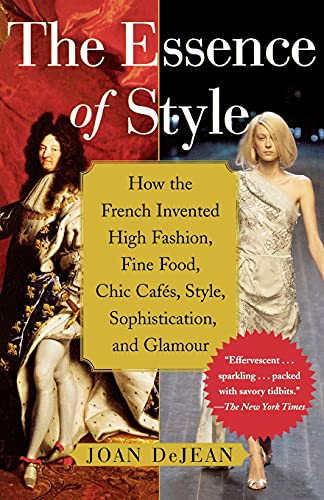
The Essence of Style: How the French Invented High Fashion, Fine Food, Chic Cafes, Style, Sophistication, and Glamour - Softcover
Inhaltsangabe
What makes fashionistas willing to pay a small fortune for a particular designer accessory? Why does a special occasion only become really special when a champagne cork pops? Why are diamonds the status symbol gemstone, instantly signifying wealth, power, and even emotional commitment?
Writing with great élan, one of the foremost authorities on seventeenth-century French culture provides the answer to these and other fascinating questions in her account of how, at one glittering moment in history, the French under Louis XIV set the standards of sophistication, style, and glamour that still rule our lives today. Joan DeJean takes us back to the birth of haute cuisine, the first appearance of celebrity hairdressers, chic cafés, nightlife, and fashion in elegant dress that extended well beyond the limited confines of court circles. And Paris was the magical center -- the destination of travelers all across Europe.
Full of wit, dash, and verve, The Essence of Style will delight fans of history and everybody who wonders about the elusive definition of good taste.
Die Inhaltsangabe kann sich auf eine andere Ausgabe dieses Titels beziehen.
Über die Autorin bzw. den Autor
Joan DeJean, author of seven previous books on French literature, history, and culture during the reign of Louis XIV, is Trustee Professor of French at the University of Pennsylvania, where she has taught for the past fifteen years. She has also held positions at both Princeton and Yale. Bicultural, she shuttles regularly between her homes in Philadelphia and Paris, with her finger on the pulse of both venues.
Von der hinteren Coverseite
Synopsis coming soon.......
Auszug. © Genehmigter Nachdruck. Alle Rechte vorbehalten.
Introduction: Living Luxe
Why is it that people all over the world share the conviction that a special occasion becomes really special only when a champagne cork pops? And why is that occasion so much more special when the sparkling wine being poured is French? Why are diamonds the status symbol gemstone, instantly signifying wealth, power, and even emotional commitment? What makes fashionistas so sure that a particular designer accessory -- a luxe handbag, for instance -- will be the ultimate proof of their fashion sense that they are willing to search high and low for it and, if necessary, wait for months for the privilege of paying a small fortune to acquire it? Why is having a haircut from the one-and-only stylist, and that stylist alone, so essential to the psychic well-being of so many that it seems they would do almost anything to make sure that less magic scissors never come near their hair?
All these dilemmas, and many other mysteries of the fashionable life as well, first became what we now call issues at the same period -- what may well be the most crucial period ever in the history of elegance, élan, and luxury goods. At that moment, Louis XIV, a handsome and charismatic young king with a great sense of style and an even greater sense of history, decided to make both himself and his country legendary. When his reign began, his nation in no way exercised dominion over the realm of fashion. By its end, his subjects had become accepted all over the Western world as the absolute arbiters in matters of style and taste, and his nation had found an economic mission: it ruled over the sectors of the luxury trade that have dominated that commerce ever since.
This book chronicles the origins of fashion and gastronomy and the process that brought luxury goods and luxurious experiences into the lives of people all over the Western world. It tells how the young King succeeded in giving his nation's culture a unique definition. It also describes how he accomplished something far more impressive: he set new standards for food, fashion, and interior decoration, standards that still provide the framework for our definitions of style.
Experiences that range from dining out in a fashionable spot to shopping in a chic boutique for a must-have fashion accessory or a diamond ring; luxury products such as champagne, as well as some of the dishes we most love to savor while we sip it (crème brûlée, for instance) -- all of them came into being at the same moment. The extraordinary wave of creativity that swept over France under Louis XIV's patronage unleashed desires that now seem fundamental. Without the Sun King's program for redefining France as the land of luxury and glamour, there would never have been a Stork Club, a Bergdorf Goodman, a Chez Panisse, or a Cristophe of Beverly Hills (and President Clinton would never have dreamed of holding Air Force One on the runway of LAX for an hour while Cristophe worked his styling magic on his hair).
The story of Louis XIV and of France at the defining moment of its history, the half century between 1660 and Louis XIV's death in 1715, is a saga that forces us to ask ourselves just how it is that countries and cities acquire a personality or a sense of definition. In most cases, no one person can be said to be responsible for these national images. The characteristics on which they are based -- Dutch cleanliness, German precision -- are the product of the shared sociopsychological makeup of a people.
But in the case of France, a national personality was the product of the type of elaborate and deliberate image making of which Hollywood or Madison Avenue would be proud. In the sixteenth century, the French were not thought of as the most elegant or the most sophisticated European nation. By the early eighteenth century, however, people all over Europe declared that "the French are stylish" or "the French know good food," just as they said, "the Dutch are clean." France had acquired a sort of monopoly on culture, style, and luxury living, a position that it has occupied ever since. At the same time, Paris had won out over all its obvious contemporary rivals -- Venice, London, Amsterdam -- and had become universally recognized as the place to find elegance, glamour, even romance. Beginning in the late seventeenth century, travelers were saying what novelists and filmmakers are still repeating: travel to Paris was guaranteed to add a touch of magic to every life.
Most remarkable of all is the fact that, from this moment on, that touch of magic became widely desired: elegance, luxury, and sophistication became factors to be reckoned with, to an extent never before conceivable. Within restricted, elite circles, sophisticated food and elegant dress had always been aspired to. Some of the trends described here had precedent, for example, in ancient Rome. At different moments, certain nations had been widely thought to be more knowledgeable about the luxurious life than others: during the Renaissance, for example, Italy set the standards for fine dining and dress.
All these earlier incarnations of the good life are, however, different in three essential ways from what was put into place in seventeenth-century France. First, their impact was always extremely limited: very few people outside of Italy ever dressed or ate in the Italian manner; even within Italy, the new luxury rarely touched the lives of those outside court circles. Second, even though we would surely agree that what was then considered a fabulous feast or a sumptuous outfit was indeed extraordinary, none of those fashions are still being copied. Finally, never before had a city ruled over the empire of style and sophistication for more than a brief period. In the 1660s, Paris began a reign over luxury living that still endures, three and a half centuries later. This happened because the French understood the importance of marketing: thus, when fashion became French, the fashion industry began, along with concepts such as the fashion season that continue to be essential to that industry's functioning.
The institutions, the values, and the commodities that came into existence under Louis XIV's patronage marked a radically new departure for the realm of luxury. For the first time, new standards for elegant living transcended all the barriers, both geographic and social, that had previously limited their influence. A French shopgirl would certainly not have been able to afford an entire outfit in the latest fashion. Even if she got only one new accessory, however, she wanted to get it just right -- the right cut, the right color, to be worn the right way -- and she wanted it to be beautiful. Indeed, one late-seventeenth-century commentator prepared foreigners planning a trip to Paris for a new experience: "Every ordinary woman there will be more magnificently dressed than the finest ladies in their home nations."
People in cities all over Europe became slaves to French food, fashion, and design, and to food, fashion, and design that imitated as closely as possible what was being created in Paris. As the German lawyer and philosopher Christian Thomasius announced in 1687: "Today we want everything to be French. French clothes, French dishes, French furniture." And even before the United States was a nation -- as soon as the new cities in North America had populations large enough to constitute a market -- we became a society of consumers: in matters of taste and style, many of the original American conspicuous consumers began to dream of dancing to the French drummer, too.
The refashioning of France did not take place because the French had somehow become inherently more elegant or had suddenly been genetically endowed with the most refined palates in the world. Today at least, the French do share characteristics that support their national image...
„Über diesen Titel“ kann sich auf eine andere Ausgabe dieses Titels beziehen.
Suchergebnisse für The Essence of Style: How the French Invented High...

Foto des Verkäufers
The Essence of Style: How the French Invented High Fashion, Fine Food, Chic Cafes, Style, Sophistication, and Glamour
Anbieter: Zoom Books East, Glendale Heights, IL, USA
Verkäuferbewertung 5 von 5 Sternen

Zustand: acceptable. Book is in acceptable condition and shows signs of wear. Book may also include underlining highlighting. The book can also include "From the library of" labels. May not contain miscellaneous items toys, dvds, etc. . We offer 100% money back guarantee and 24 7 customer service. Bestandsnummer des Verkäufers ZEV.0743264142.A
Gebraucht kaufen
EUR 4,09
Versand gratis
Versand innerhalb von USA
Versand innerhalb von USA
Anzahl: 1 verfügbar
Foto des Verkäufers
The Essence of Style: How the French Invented High Fashion, Fine Food, Chic Cafes, Style, Sophistication, and Glamour
Anbieter: Dream Books Co., Denver, CO, USA
Verkäuferbewertung 5 von 5 Sternen
Zustand: acceptable. This copy has clearly been enjoyedâ"expect noticeable shelf wear and some minor creases to the cover. Binding is strong, and all pages are legible. May contain previous library markings or stamps. Bestandsnummer des Verkäufers 4EKQOV000TU6_ns
Gebraucht kaufen
EUR 4,26
Versand gratis
Versand innerhalb von USA
Versand innerhalb von USA
Anzahl: 1 verfügbar
Beispielbild für diese ISBN
The Essence of Style: How the French Invented High Fashion, Fine Food, Chic Cafes, Style, Sophistication, and Glamour
Verlag:
Free Press (edition Reprint), 2006
ISBN 10: 0743264142
ISBN 13: 9780743264143
Gebraucht
Paperback
Anbieter: BooksRun, Philadelphia, PA, USA
Verkäuferbewertung 5 von 5 Sternen
Paperback. Zustand: Fair. Reprint. The item might be beaten up but readable. May contain markings or highlighting, as well as stains, bent corners, or any other major defect, but the text is not obscured in any way. Bestandsnummer des Verkäufers 0743264142-7-1
Gebraucht kaufen
EUR 4,67
Versand gratis
Versand innerhalb von USA
Versand innerhalb von USA
Anzahl: 1 verfügbar
Beispielbild für diese ISBN
The Essence of Style: How the French Invented High Fashion, Fine Food, Chic Cafes, Style, Sophistication, and Glamour
Anbieter: HPB-Diamond, Dallas, TX, USA
Verkäuferbewertung 5 von 5 Sternen
Paperback. Zustand: Very Good. Connecting readers with great books since 1972! Used books may not include companion materials, and may have some shelf wear or limited writing. We ship orders daily and Customer Service is our top priority! Bestandsnummer des Verkäufers S_462508362
Gebraucht kaufen
EUR 2,38
EUR 3,34 Versand
Versand innerhalb von USA
Versand innerhalb von USA
Anzahl: 1 verfügbar
Beispielbild für diese ISBN
The Essence of Style: How the French Invented High Fashion, Fine Food, Chic Cafes, Style, Sophistication, and Glamour
Anbieter: HPB-Ruby, Dallas, TX, USA
Verkäuferbewertung 5 von 5 Sternen
Paperback. Zustand: Very Good. Connecting readers with great books since 1972! Used books may not include companion materials, and may have some shelf wear or limited writing. We ship orders daily and Customer Service is our top priority! Bestandsnummer des Verkäufers S_398654150
Gebraucht kaufen
EUR 2,38
EUR 3,34 Versand
Versand innerhalb von USA
Versand innerhalb von USA
Anzahl: 1 verfügbar
Beispielbild für diese ISBN
The Essence of Style: How the French Invented High Fashion, Fine Food, Chic Cafes, Style, Sophistication, and Glamour
Anbieter: ThriftBooks-Atlanta, AUSTELL, GA, USA
Verkäuferbewertung 5 von 5 Sternen
Paperback. Zustand: Good. No Jacket. Former library book; Pages can have notes/highlighting. Spine may show signs of wear. ~ ThriftBooks: Read More, Spend Less. Bestandsnummer des Verkäufers G0743264142I3N10
Gebraucht kaufen
EUR 6,05
Versand gratis
Versand innerhalb von USA
Versand innerhalb von USA
Anzahl: 1 verfügbar
Beispielbild für diese ISBN
The Essence of Style: How the French Invented High Fashion, Fine Food, Chic Cafes, Style, Sophistication, and Glamour
Anbieter: ThriftBooks-Reno, Reno, NV, USA
Verkäuferbewertung 5 von 5 Sternen
Paperback. Zustand: Good. No Jacket. Pages can have notes/highlighting. Spine may show signs of wear. ~ ThriftBooks: Read More, Spend Less. Bestandsnummer des Verkäufers G0743264142I3N00
Gebraucht kaufen
EUR 6,05
Versand gratis
Versand innerhalb von USA
Versand innerhalb von USA
Anzahl: 1 verfügbar
Foto des Verkäufers
The Essence of Style: How the French Invented High Fashion, Fine Food, Chic Cafes, Style, Sophistication, and Glamour
Anbieter: Blue Vase Books, Interlochen, MI, USA
Verkäuferbewertung 5 von 5 Sternen
Zustand: good. The item shows wear from consistent use, but it remains in good condition and works perfectly. All pages and cover are intact including the dust cover, if applicable . Spine may show signs of wear. Pages may include limited notes and highlighting. May NOT include discs, access code or other supplemental materials. Bestandsnummer des Verkäufers 31UIGP0029RJ_ns
Gebraucht kaufen
EUR 6,05
Versand gratis
Versand innerhalb von USA
Versand innerhalb von USA
Anzahl: 1 verfügbar
Beispielbild für diese ISBN
The Essence of Style: How the French Invented High Fashion, Fine Food, Chic Cafes, Style, Sophistication, and Glamour
Anbieter: ThriftBooks-Phoenix, Phoenix, AZ, USA
Verkäuferbewertung 5 von 5 Sternen
Paperback. Zustand: Good. No Jacket. Pages can have notes/highlighting. Spine may show signs of wear. ~ ThriftBooks: Read More, Spend Less. Bestandsnummer des Verkäufers G0743264142I3N00
Gebraucht kaufen
EUR 6,05
Versand gratis
Versand innerhalb von USA
Versand innerhalb von USA
Anzahl: 1 verfügbar
Beispielbild für diese ISBN
The Essence of Style: How the French Invented High Fashion, Fine Food, Chic Cafes, Style, Sophistication, and Glamour
Anbieter: ThriftBooks-Atlanta, AUSTELL, GA, USA
Verkäuferbewertung 5 von 5 Sternen
Paperback. Zustand: Good. No Jacket. Pages can have notes/highlighting. Spine may show signs of wear. ~ ThriftBooks: Read More, Spend Less. Bestandsnummer des Verkäufers G0743264142I3N00
Gebraucht kaufen
EUR 6,05
Versand gratis
Versand innerhalb von USA
Versand innerhalb von USA
Anzahl: 2 verfügbar