
Verwandte Artikel zu No Excuses: Closing the Racial Gap in Learning
Inhaltsangabe
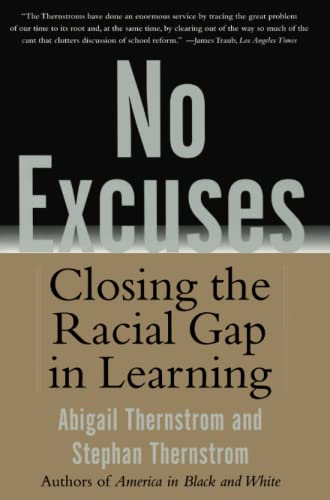
Black and Hispanic students are not learning enough in our public schools, and their typically poor performance is the most important source of ongoing racial inequality in America today—thus, say Abigail and Stephan Thernstrom, the racial gap in school achievement is the nation's most critical civil rights issue and an educational crisis; it's no wonder that "No Child Left Behind," the 2001 revision of the Elementary and Secondary Education Act, made closing the racial gap in education its central goal.
An employer hiring the typical Black high school graduate or the college that admits the average Black student is choosing a youngster who has only an eighth-grade education. In most subjects, the majority of twelfth-grade Black students do not have even a "partial mastery" of the skills and knowledge that the authoritative National Assessment of Educational Progress calls "fundamental for proficient work" at their grade.
No Excuses marshals facts to examine the depth of the problem, the inadequacy of conventional explanations, and the limited impact of Title I, Head Start, and other familiar reforms. Its message, however, is one of hope: Scattered across the country are excellent schools getting terrific results with high-needs kids. These rare schools share a distinctive vision of what great schooling looks like and are free of many of the constraints that compromise education in traditional public schools.
In a society that espouses equal opportunity we still have a racially identifiable group of educational have-nots—young African Americans and Latinos whose opportunities in life will almost inevitably be limited by their inadequate education. When students leave high school without high school skills, their futures—and that of the nation—are in jeopardy. With successful schools already showing the way, no decent society can continue to turn a blind eye to such racial and ethnic inequality.
Die Inhaltsangabe kann sich auf eine andere Ausgabe dieses Titels beziehen.
Über die Autorinnen und Autoren
Stephan Thernstrom, the Winthrop Professor of History at Harvard University, is the editor of The Harvard Encyclopedia of American Ethnic Groups and the author of several other books.
Abigail Thernstrom is a member of the Massachusetts State Board of Education, a commissioner on the U.S. Commission on Civil Rights, and a senior fellow at the Manhattan Institute in New York. She is the author of Whose Votes Count? Affirmative Action and Minority Voting Rights and, with her husband, Stephan, of America in Black and White: One Nation, Indivisible.
Auszug. © Genehmigter Nachdruck. Alle Rechte vorbehalten.
Introduction
There's nothing the school can do.Latisha Robinson, a black eighth-grader in Elk Grove, California
You've got to have to want to do better.
Kiarra Gibson, her classmate
The student body of Cedarbrook Middle School in a Philadelphia suburb is one-third black, two-thirds white. The town has a very low poverty rate, good schools, and a long-established black middle class. But an eighth-grade advanced algebra class that a reporter visited in June 2001 contained not a single black student. The class in which the teacher was explaining that the 2 in 21 stands for 20, however, was 100 percent black. A few black students were taking accelerated English, but no whites were sitting in the English class that was learning to identify verbs.
The Cedarbrook picture is by no means unique. It is all too familiar, and even worse in the big-city schools that most black and Hispanic youngsters attend. This is an American tragedy and a national emergency for which there are no good excuses.
The racial gap in academic achievement is an educational crisis, but it is also the main source of ongoing racial inequality. And racial inequality is America's great unfinished business, the wound that remains unhealed. Thus, this is a book about education, but it also addresses the central civil rights issue of our time: our failure to provide first-class education for black and Hispanic students, in both cities and suburbs.
The black high school graduation rate has more than doubled since 1960. And blacks attend college at a rate that is higher than it was for whites just two decades ago. But the good news ends there. The gap in academic achievement that we see today is actually worse than it was fifteen years ago. In the 1970s and through most of the 1980s, it was closing, but around 1988 it began to widen, with no turnaround in sight.
Today, at age 17 the typical black or Hispanic student is scoring less well on the nation's most reliable tests than at least 80 percent of his or her white classmates. In five of the seven subjects tested by the National Assessment of Educational Progress (NAEP), a majority of black students perform in the lowest category -- Below Basic. The result: By twelfth grade, African Americans are typically four years behind white and Asian students, while Hispanics are doing only a tad better than black students. These students are finishing high school with a junior high education.
Students who have equal skills and knowledge will have roughly equal earnings. That was not always true, but it is today. Schooling has become the key to racial equality. No wonder that Robert Moses, a luminous figure in the civil rights revolution of the 1960s, is convinced that "the absence of math literacy in urban and rural communities throughout this country is an issue as urgent as the lack of registered Black voters in Mississippi was in 1961." Algebra, he believes, is "the gatekeeper of citizenship."
Literacy, too, is a "gatekeeper," and the deadline for learning is alarmingly early. "For many students...the die is cast by eighth grade. Students without the appropriate math and reading skills by that grade are unlikely to acquire them by the end of high school...," a U.S. Department of Education study has concluded.
Race has famously been called the "American dilemma." But since the mid-1960s, racial equality has also been an American project. An astonish-ing, peaceful revolution in the status of blacks and the state of race relations has transformed the country. And yet too few Americans have recognized and acknowledged the stubborn inequalities that only better schools can address.
Even civil rights groups have long averted their gaze from the disquieting reality. "You can have a hunch that black students are not doing as well, but some of this was surprising," A. V. Fleming, president of the Urban League in Fort Wayne, Indiana, said, as the picture of low black achievement began to emerge in the late 1990s. In Elk Grove, California, an affluent suburb of Sacramento, black parents were shocked, angry, and in tears when they learned of the low test scores of their kids. "People know that this is an important issue, and they don't know how to talk about it," said Philip Moore, the principal of the local middle school, who is black himself.
For too long, the racial gap in academic performance was treated not only by civil rights leaders, but by the media, and even by scholars, as a dirty secret -- something to whisper about behind closed doors. As if it were racist to say we have a problem: Black and Hispanic kids, on average, are not doing well in school.
Suddenly, however, this shamefully ignored issue has moved to the front and center of the education stage. In part, the new attention is simply a response to an altered economic reality. A half century ago, an eighth-grade dropout could get a secure and quite well-paid job at the Ford Motor Company or U.S. Steel. Today, the Honda plant in Ohio does not hire people who cannot pass a test of basic mathematical skills.
Demographic change, too, has forced Americans to pay attention to an educational and racial catastrophe in their midst. Fifty years ago, Hispanic children were no more than 2 percent of the school population. Today, a third of all American students are black or Latino. In California, Louisiana, Mississippi, New Mexico, and Texas white schoolchildren have become a numerical minority. These numbers, in themselves, drive home the urgency of educating all children.
The unprecedented sense of urgency is unmistakable in No Child Left Behind (NCLB), the 2001 version of the nation's omnibus 1965 Elementary and Secondary Education Act. The central aim of the revised statute, as its preamble states boldly, is "to close the achievement gap...so that no child is left behind." Closing the gap is the core purpose of the legislation -- and the test of its eventual success.
Thus, the act requires all states to test children in grades 3-8 and report scores broken down by race, ethnicity, and other demographic characteristics associated with educational disadvantage. Each group must show significant annual progress. Affluent districts will no longer be able to coast along, hiding their lower-performing black and Hispanic students in overall averages that make their schools look good. A bucket of very cold water has been poured on educators -- and particularly those who have been quite complacent. NCLB has been an overdue attention-getter. At a well-attended...
„Über diesen Titel“ kann sich auf eine andere Ausgabe dieses Titels beziehen.
Suchergebnisse für No Excuses: Closing the Racial Gap in Learning

Beispielbild für diese ISBN
No Excuses: Closing the Racial Gap in Learning
Anbieter: World of Books (was SecondSale), Montgomery, IL, USA
Verkäuferbewertung 5 von 5 Sternen

Zustand: Good. Item in good condition and has highlighting/writing on text. Used texts may not contain supplemental items such as CDs, info-trac etc. Bestandsnummer des Verkäufers 00095419208
Gebraucht kaufen
EUR 3,59
Versand gratis
Versand innerhalb von USA
Versand innerhalb von USA
Anzahl: 1 verfügbar
Beispielbild für diese ISBN
No Excuses: Closing the Racial Gap in Learning
Anbieter: World of Books (was SecondSale), Montgomery, IL, USA
Verkäuferbewertung 5 von 5 Sternen
Zustand: Very Good. Item in very good condition! Textbooks may not include supplemental items i.e. CDs, access codes etc. Bestandsnummer des Verkäufers 00093150419
Gebraucht kaufen
EUR 4,57
Versand gratis
Versand innerhalb von USA
Versand innerhalb von USA
Anzahl: 2 verfügbar
Beispielbild für diese ISBN
No Excuses: Closing the Racial Gap in Learning
Anbieter: World of Books (was SecondSale), Montgomery, IL, USA
Verkäuferbewertung 5 von 5 Sternen
Zustand: Acceptable. Item in acceptable condition! Textbooks may not include supplemental items i.e. CDs, access codes etc. Bestandsnummer des Verkäufers 00096069174
Gebraucht kaufen
EUR 4,57
Versand gratis
Versand innerhalb von USA
Versand innerhalb von USA
Anzahl: 1 verfügbar
Foto des Verkäufers
No Excuses: Closing the Racial Gap in Learning
Anbieter: Greenworld Books, Arlington, TX, USA
Verkäuferbewertung 5 von 5 Sternen
Zustand: good. Fast Free Shipping â" Good condition. It may show normal signs of use, such as light writing, highlighting, or library markings, but all pages are intact and the book is fully readable. A solid, complete copy that's ready to enjoy. Bestandsnummer des Verkäufers GWV.074326522X.G
Gebraucht kaufen
EUR 4,58
Versand gratis
Versand innerhalb von USA
Versand innerhalb von USA
Anzahl: 2 verfügbar
Beispielbild für diese ISBN
No Excuses: Closing the Racial Gap in Learning
Anbieter: More Than Words, Waltham, MA, USA
Verkäuferbewertung 5 von 5 Sternen
Zustand: Good. . . All orders guaranteed and ship within 24 hours. Before placing your order for please contact us for confirmation on the book's binding. Check out our other listings to add to your order for discounted shipping. Bestandsnummer des Verkäufers WAL-A-3g-002153
Gebraucht kaufen
EUR 1,32
EUR 3,50 Versand
Versand innerhalb von USA
Versand innerhalb von USA
Anzahl: 1 verfügbar
Beispielbild für diese ISBN
No Excuses: Closing the Racial Gap in Learning
Anbieter: Once Upon A Time Books, Siloam Springs, AR, USA
Verkäuferbewertung 4 von 5 Sternen

paperback. Zustand: Good. This is a used book in good condition and may show some signs of use or wear . This is a used book in good condition and may show some signs of use or wear . Bestandsnummer des Verkäufers mon0003468531
Gebraucht kaufen
EUR 1,91
EUR 3,47 Versand
Versand innerhalb von USA
Versand innerhalb von USA
Anzahl: 1 verfügbar
Beispielbild für diese ISBN
No Excuses: Closing the Racial Gap in Learning
Anbieter: Bellwetherbooks, McKeesport, PA, USA
Verkäuferbewertung 4 von 5 Sternen
paperback. Zustand: Fine. LIKE NEW!!! Has a red or black remainder mark on bottom/exterior edge of pages. Bestandsnummer des Verkäufers 135035
Gebraucht kaufen
EUR 2,17
EUR 3,47 Versand
Versand innerhalb von USA
Versand innerhalb von USA
Anzahl: 17 verfügbar
Beispielbild für diese ISBN
No Excuses: Closing the Racial Gap in Learning
Anbieter: The Maryland Book Bank, Baltimore, MD, USA
Verkäuferbewertung 5 von 5 Sternen
paperback. Zustand: Good. Reprint. Corners are slightly bent. Used - Good. Bestandsnummer des Verkäufers 5-S-1-0274
Gebraucht kaufen
EUR 1,68
EUR 4,12 Versand
Versand innerhalb von USA
Versand innerhalb von USA
Anzahl: 1 verfügbar
Beispielbild für diese ISBN
No Excuses : Closing the Racial Gap in Learning
Anbieter: Better World Books, Mishawaka, IN, USA
Verkäuferbewertung 5 von 5 Sternen
Zustand: Good. Reprint. Former library copy. Pages intact with minimal writing/highlighting. The binding may be loose and creased. Dust jackets/supplements are not included. Includes library markings. Stock photo provided. Product includes identifying sticker. Better World Books: Buy Books. Do Good. Bestandsnummer des Verkäufers 2905786-20
Gebraucht kaufen
EUR 6,08
Versand gratis
Versand innerhalb von USA
Versand innerhalb von USA
Anzahl: 1 verfügbar
Beispielbild für diese ISBN
No Excuses : Closing the Racial Gap in Learning
Anbieter: Better World Books, Mishawaka, IN, USA
Verkäuferbewertung 5 von 5 Sternen
Zustand: Good. Reprint. Pages intact with minimal writing/highlighting. The binding may be loose and creased. Dust jackets/supplements are not included. Stock photo provided. Product includes identifying sticker. Better World Books: Buy Books. Do Good. Bestandsnummer des Verkäufers 2905785-75
Gebraucht kaufen
EUR 6,08
Versand gratis
Versand innerhalb von USA
Versand innerhalb von USA
Anzahl: 1 verfügbar