
Verwandte Artikel zu From Lucy to Language: Revised, Updated, and Expanded
Inhaltsangabe
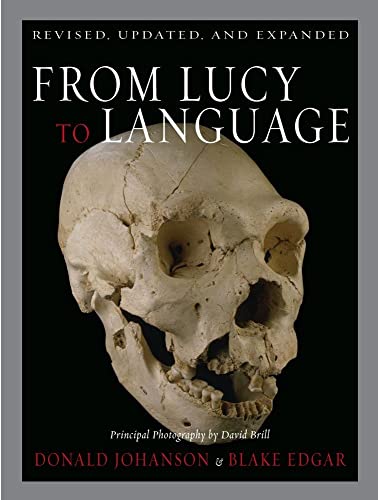
In 1974 in a remote region of Ethiopia, Donald Johanson, then one of America's most promising young paleoanthropologists, discovered "Lucy", the oldest, best preserved skeleton of any erect-walking human ever found. This discovery prompted a complete reevaluation of previous evidence for human origins.
In the years since this dramatic discovery Johanson has continued to scour East Africa's Great rift Valley for the earliest evidence of human origins. In 1975 this team unearthed the "First Family", an unparalleled fossil assemblage of 13 individuals dating back to 3.2 million years ago; and in 1986 at the Rift's most famous location, Olduvai Gorge, this same team discovered a 1.8 million-year-old partial adult skeleton that necessitated a reassessment of the earliest members of our own genus Homo.
Johanson's fieldwork continues unabated and recently more fossil members of Lucy's family have been found, including the 1992 discovery of the oldest, most complete skull of her species, with future research now planned for 1996 in the virtually unexplored regions of the most northern extension of the Rift Valley in Eritrea.
From Lucy to Language is a summing up of this remarkable career and a stunning documentary of human life through time on Earth. It is a combination of the vital experience of field work and the intellectual rigor of primary research. It is the fusion of two great writing talents: Johanson and Blake Edgar, an accomplished science writer, editor of the California Academy of Sciences' Pacific Discovery, and co-author of Johanson's last book, Ancestors.
From Lucy to Language is one of the greatest stories ever told, bracketing the timeline between bipedalism and human language. Part I addresses the central issues facing anyone seeking to decipher the mystery of human origins. In this section the authors provide answers to the basics -- "What are our closest living relatives?" -- tackle the controversial -- "What is race?" -- and contemplate the imponderables -- "Why did consciousness evolve?"
From Lucy to Language is an encounter with the evidence. Early human fossils are hunted, discovered, identified, excavated, collected, preserved, labeled, cleaned, reconstructed, drawn, fondled, photographed, cast, compared, measured, revered, pondered, published, and argued over endlessly. Fossils like Lucy have become a talisman of sorts, promising to reveal the deepest secrets of our existence. In Part II the authors profile over fifty of the most significant early human fossils ever found. Each specimen is displayed in color and at actual size, most of them in multiple views. With them the authors present the cultural accoutrements associated with the fossils: stone tools which evidence increasing sophistication over time, the earliest stone, clay, and ivory art objects, and the culminating achievement of the dawn of human consciousness -- the magnificent rock and cave paintings of Europe, Africa, Australia, and the Americas.
In the end From Lucy to Language is a reminder and a challenge. Like no species before us, we now seem poised to control vast parts of the planet and its life. We possess the power to influence, if not govern, evolution. For that reason, we must not forget our link to the natural world and our debt to natural selection. We need to "think deep", to add a dose of geologic time and evolutionary history to our perspective of who we are, where we came from, and where we are headed. This is the most poignant lesson this book has to offer.
Die Inhaltsangabe kann sich auf eine andere Ausgabe dieses Titels beziehen.
Über die Autorin bzw. den Autor
Donald Johanson has explored the Great Rift Valley of East Africa for more than two decades, seeking clues to our ultimate origins. One of the most lively and controversial scientists working today, he is the author of five previous books, the host of the three-part Nova series In Search of Human Origins, and continues to lecture regularly. Known worldwide for his discovery of the Lucy skeleton, he is founder and president of the Institute of Human Origins in Berkeley, California, where he resides.
Auszug. © Genehmigter Nachdruck. Alle Rechte vorbehalten.
Chapter 1
1. The Human Creature
A human is any member of the species Homo sapiens ("wise man"), the only living representative of the family Hominidae. The Hominidae, or hominids, are a group of upright-walking primates with relatively large brains (see page 33). So, all humans are hominids, although not all hominids could be called human. Next, all humans are primates. The mammalian order of Primates includes about 180 species of prosimians (such as lemurs, tarsiers, and lorises), monkeys, apes, and ourselves. Primates are unusual mammals, for they have evolved such distinctive traits as highly developed binocular vision (and a corresponding enclosed eye socket in the skull), mobile fingers and toes with flat nails instead of claws, and with sensitive pads at the tips, a shortened snout with a reduced sense of smell, and large brains relative to body size. If primates are unusual for mammals, humans are even more unusual for primates. We are essentially elaborated African apes. We share almost 99 percent of our genetic material -- the information that codes for our proteins, bones, brains, and bodies -- with chimpanzees. Yet, despite such similarities, there are significant genetic and pronounced physical differences between humans and apes. Clearly, that distinctive portion of our DNA must involve some regulatory genes that code for our unusual features. Humans also possess 46 chromosomes to an ape's 48, and our version of the extra ape genes has been lumped together on chromosome 2; perhaps in that process some crucial mutations arose, but we would have to sequence and study all human and ape DNA to solve this paradox. Our close genetic affinity to apes has prompted some authorities, notably Jared Diamond in his book The Third Chimpanzee, to argue that it is fallacious to separate humans and apes into two separate families (African apes constitute the family Pongidae). We walk upright on two limbs, and to accommodate such a strange posture we have developed a specialized pelvis, hip and leg muscles, and an S-shaped vertebral column. We have tiny canine teeth and flat faces with a protruding nose. Males have a pendulous penis, while in females the physical signs of ovulation are concealed, something that happens in no other primate. Humans are highly social animals, a trait we inherited from our primate past, but we have taken it to new extremes through the development of complex written and spoken language which enables us to communicate nuances of feeling as well as information, and a material culture that includes symbolic art. We are also called a moral animal. Besides that strange habit of walking upright, perhaps it is our inventiveness and our introspective nature that truly distinguish humans among the primates. Our species, Homo sapiens, was first described in 1758 by the Swedish botanist Carl von Linné, whom we know better as Carolus Linnaeus. Most early descriptions concentrated on a very few traits, the most obvious being brain size. If we were to create a richer, more complete biological characterization of our species, many other traits would need to be included. Humans have a relatively long life span that begins with immaturity at birth and a prolonged infancy. Physical maturation is delayed during childhood, then occurs quickly during the adolescent growth spurt. We are polytypic in morphology and skin and hair color but genetically very homogeneous. Our behavior is marked by habitual tool use, communication through spoken and written language, and the symbolic representation of objects. We are culturally adapted to survive in a broad range of physical environments, climates, and temperatures. We are omnivorous and share food extensively with others, another mark of our social being. Our body is relatively hairless except for the head and face, axilla (arm pits), and pubic region. Skeletal features include a hand with an opposable thumb that endows us with a power grip and precise, fine hand movements; relatively straight and slender limb bones; a pelvis, lower limbs, and associated muscles specifically modified for bipedal locomotion; an enlarged hallux, or big toe, in line with the rest of our toes rather than opposed to them; and a foot with a weight-bearing arch to absorb the stresses of two-legged locomotion. This list and the aforementioned traits provide a hint of who we are biologically. Many other features of anatomy, behavior, and diversity in Homo sapiens, as well as in other hominids, provide the basis of content for this book. As we query the remains of our extinct relatives for clues to who we are and how we got that way, we will discover that we are much nearer to them than we think, even if separated by millions of years.
2. The Quest for Origins
Since at least the Upper Paleolithic, some 40,000 years ago, every human society has devised a creation myth to explain how humans came to be. The need to explain our origins is one of the universals of being human. Creation myths are based on cultural beliefs that have, in one manner or another, been adopted as legitimate explanation by a particular society. To a large extent, creation myths glorify the specialness of humans. In the broadest view, such myths undertake to explain our differences from all other creatures-our humanness. In contrast to cultural myths about human origins, the science of paleoanthropology, which also tries to construct a narrative about how humans came to be, is rooted in the scientific method. This method, based on objective observation and evaluation, is governed by a set of rules that permit the testing of hypotheses, and the results of such tests may lead to the rejection or modification of the original construct. The success of paleoanthropology rests on integrating two different fields: Darwinian evolutionary theory and the study of Earth's geological history (see page 21). Much like a detective story, the quest for clues to our origins is exhilarating and filled with surprises. The goal, however, is not to figure out "who done it" but to understand why and how: why we differ from our closest relatives, the African apes, and how we became a bipedal, large-brained, culturally dependent animal. We are the last species in the zoological family Hominidae (hominids, in the vernacular), and to understand something of our place in nature (see page III) we need to explore the lessons held by the past. As we learn more about our origins, it becomes apparent that although an ape ancestor became bipedal several million years ago, there was nothing in that development that ensured the eventual evolution of Homo sapiens. Bipedalism, a basic feature of hominids, did not make modern humans inevitable. Paleoan-thropological discoveries make it clear that the human family tree is nota single lineage in which one species succeeded another, leading relentlessly to the appearance of modern humans. Instead, the hominid fossil record suggests that our ancestry is better thought of as a bush, with the branches representing a number of bipedal species that evolved along different evolutionary lines. All of those species were successful, sometimes for long periods, and ail went extinct. At the probable time of a common ancestor for humans and African apes, 6 to 8 million years ago, there was no guarantee that humans would evolve. Yet we did evolve, and because we turned out to be inquisitive creatures with the ability to reflect on our past, we have done so avidly. Paleoanthropology in part plays to that inquisitive, exploratory part of our makeup. Expeditions to remote terrains feature prominently in paleoanthropology, and whereas living for months in a tent, usually under desert conditions, is not to everyone's liking, the pursuit of our origins can be enjoyed in other ways. Each new find, it seems, receives front-page coverage in newspapers, and magazines featuring reconstructions...
„Über diesen Titel“ kann sich auf eine andere Ausgabe dieses Titels beziehen.
Suchergebnisse für From Lucy to Language: Revised, Updated, and Expanded

Foto des Verkäufers
From Lucy to Language: Revised, Updated, and Expanded
Anbieter: Dream Books Co., Denver, CO, USA
Verkäuferbewertung 5 von 5 Sternen

Zustand: good. Gently used with minimal wear on the corners and cover. A few pages may contain light highlighting or writing, but the text remains fully legible. Dust jacket may be missing, and supplemental materials like CDs or codes may not be included. May be ex-library with library markings. Ships promptly! Bestandsnummer des Verkäufers DBV.0743280644.G
Gebraucht kaufen
EUR 6,10
Versand gratis
Versand innerhalb von USA
Versand innerhalb von USA
Anzahl: 1 verfügbar
Beispielbild für diese ISBN
From Lucy to Language : Revised, Updated, and Expanded
Anbieter: Better World Books, Mishawaka, IN, USA
Verkäuferbewertung 5 von 5 Sternen
Zustand: Good. Pages intact with minimal writing/highlighting. The binding may be loose and creased. Dust jackets/supplements are not included. Stock photo provided. Product includes identifying sticker. Better World Books: Buy Books. Do Good. Bestandsnummer des Verkäufers 5326712-6
Gebraucht kaufen
EUR 7,45
Versand gratis
Versand innerhalb von USA
Versand innerhalb von USA
Anzahl: 1 verfügbar
Beispielbild für diese ISBN
From Lucy to Language : Revised, Updated, and Expanded
Anbieter: Better World Books, Mishawaka, IN, USA
Verkäuferbewertung 5 von 5 Sternen
Zustand: Good. Former library copy. Pages intact with minimal writing/highlighting. The binding may be loose and creased. Dust jackets/supplements are not included. Includes library markings. Stock photo provided. Product includes identifying sticker. Better World Books: Buy Books. Do Good. Bestandsnummer des Verkäufers 6107880-6
Gebraucht kaufen
EUR 7,45
Versand gratis
Versand innerhalb von USA
Versand innerhalb von USA
Anzahl: 4 verfügbar
Beispielbild für diese ISBN
From Lucy to Language: Revised, Updated, and Expanded
Anbieter: ThriftBooks-Atlanta, AUSTELL, GA, USA
Verkäuferbewertung 5 von 5 Sternen
Hardcover. Zustand: Fair. No Jacket. Readable copy. Pages may have considerable notes/highlighting. ~ ThriftBooks: Read More, Spend Less. Bestandsnummer des Verkäufers G0743280644I5N00
Gebraucht kaufen
EUR 8,13
Versand gratis
Versand innerhalb von USA
Versand innerhalb von USA
Anzahl: 1 verfügbar
Beispielbild für diese ISBN
From Lucy to Language: Revised, Updated, and Expanded
Anbieter: ThriftBooks-Atlanta, AUSTELL, GA, USA
Verkäuferbewertung 5 von 5 Sternen
Hardcover. Zustand: Good. No Jacket. Pages can have notes/highlighting. Spine may show signs of wear. ~ ThriftBooks: Read More, Spend Less. Bestandsnummer des Verkäufers G0743280644I3N00
Gebraucht kaufen
EUR 8,13
Versand gratis
Versand innerhalb von USA
Versand innerhalb von USA
Anzahl: 1 verfügbar
Beispielbild für diese ISBN
From Lucy to Language: Revised, Updated, and Expanded
Verlag:
Simon & Schuster (edition Revised, Updated), 2006
ISBN 10: 0743280644
ISBN 13: 9780743280648
Gebraucht
Hardcover
Anbieter: BooksRun, Philadelphia, PA, USA
Verkäuferbewertung 5 von 5 Sternen
Hardcover. Zustand: Fair. Revised, Updated. With dust jacket. The item might be beaten up but readable. May contain markings or highlighting, as well as stains, bent corners, or any other major defect, but the text is not obscured in any way. Bestandsnummer des Verkäufers 0743280644-7-1-29
Gebraucht kaufen
EUR 8,13
Versand gratis
Versand innerhalb von USA
Versand innerhalb von USA
Anzahl: 1 verfügbar
Beispielbild für diese ISBN
From Lucy to Language: Revised, Updated, and Expanded
Anbieter: ThriftBooks-Dallas, Dallas, TX, USA
Verkäuferbewertung 5 von 5 Sternen
Hardcover. Zustand: Good. No Jacket. Former library book; Pages can have notes/highlighting. Spine may show signs of wear. ~ ThriftBooks: Read More, Spend Less. Bestandsnummer des Verkäufers G0743280644I3N10
Gebraucht kaufen
EUR 8,14
Versand gratis
Versand innerhalb von USA
Versand innerhalb von USA
Anzahl: 1 verfügbar
Beispielbild für diese ISBN
From Lucy to Language: Revised, Updated, and Expanded
Anbieter: AwesomeBooks, Wallingford, Vereinigtes Königreich
Verkäuferbewertung 5 von 5 Sternen
Hardcover. Zustand: Very Good. From Lucy to Language: Revised, Updated, and Expanded This book is in very good condition and will be shipped within 24 hours of ordering. The cover may have some limited signs of wear but the pages are clean, intact and the spine remains undamaged. This book has clearly been well maintained and looked after thus far. Money back guarantee if you are not satisfied. See all our books here, order more than 1 book and get discounted shipping. . Bestandsnummer des Verkäufers 7719-9780743280648
Gebraucht kaufen
EUR 20,46
EUR 4,80 Versand
Versand von Vereinigtes Königreich nach USA
Versand von Vereinigtes Königreich nach USA
Anzahl: 1 verfügbar
Beispielbild für diese ISBN
From Lucy to Language
Anbieter: WorldofBooks, Goring-By-Sea, WS, Vereinigtes Königreich
Verkäuferbewertung 5 von 5 Sternen
Paperback. Zustand: Very Good. The book has been read, but is in excellent condition. Pages are intact and not marred by notes or highlighting. The spine remains undamaged. Bestandsnummer des Verkäufers GOR007907291
Gebraucht kaufen
EUR 18,92
EUR 6,53 Versand
Versand von Vereinigtes Königreich nach USA
Versand von Vereinigtes Königreich nach USA
Anzahl: 1 verfügbar
Beispielbild für diese ISBN
From Lucy to Language: Revised, Updated, and Expanded
Verlag:
Simon & Schuster 01/10/2006, 2006
ISBN 10: 0743280644
ISBN 13: 9780743280648
Gebraucht
Hardcover
Anbieter: Bahamut Media, Reading, Vereinigtes Königreich
Verkäuferbewertung 4 von 5 Sternen

Hardcover. Zustand: Very Good. Shipped within 24 hours from our UK warehouse. Clean, undamaged book with no damage to pages and minimal wear to the cover. Spine still tight, in very good condition. Remember if you are not happy, you are covered by our 100% money back guarantee. Bestandsnummer des Verkäufers 6545-9780743280648
Gebraucht kaufen
EUR 20,46
EUR 8,14 Versand
Versand von Vereinigtes Königreich nach USA
Versand von Vereinigtes Königreich nach USA
Anzahl: 1 verfügbar