
Verwandte Artikel zu View from the Summit: The Remarkable Memoir by the...
Inhaltsangabe
THE EXTRAORDINARY LIFE STORY OF
AN ORDINARY MAN WHO BECAME THE
CENTURY'S MOST IMPORTANT EXPLORER
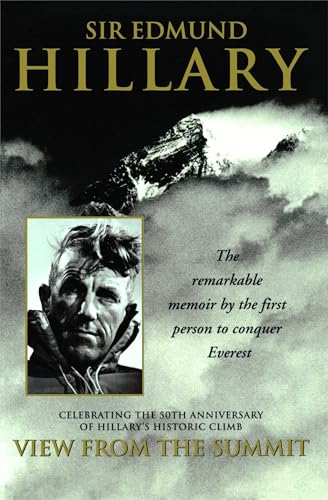
Adventurers the world over have been inspired by the achievements of Sir Edmund Hillary, the first man ever to set foot on the summit of Mount Everest. In this candid, wry, and vastly entertaining autobiography, Hillary looks back on that 1953 landmark expedition, as well as his remarkable explorations in other exotic locales, from the South Pole to the Ganges. View From The Summit is the compelling life story of a New Zealand country boy who daydreamed of wild adventures; the pioneering climber who was knighted by Queen Elizabeth after scaling the world's tallest peak; and the elder statesman and unlikely diplomat whose groundbreaking program of aid to Nepal continues to this day, paying his debt of worldwide fame to the Himalayan region.
More than four decades after Hillary looked down from Everest's 29,000 feet, his impact is still felt -- in our fascination with the perils and triumphs of mountain climbing, and in today's phenomenon of extreme sports. The call to adventure is alive and real on every page of this gripping memoir.
Die Inhaltsangabe kann sich auf eine andere Ausgabe dieses Titels beziehen.
Über die Autorin bzw. den Autor
Sir Edmund Hillary (1919 - 2008) was born in Auckland, New Zealand, and served in the New Zealand Air Force during World War II. Knighted for his ascent of Mount Everest in 1953, he achieved many more adventuring "firsts" before establishing the Himalayan Trust, an organization devoted to improving the lives of the Himalayan people.
Von der hinteren Coverseite
Adventurers the world over have been inspired by the achievements of Sir Edmund Hillary, the first man ever to set foot on the summit of Mount Everest. In this candid, wry, and vastly entertaining autobiography, Hillary looks back on that 1953 landmark expedition, as well as his remarkable explorations in other exotic locales, from the South Pole to the Ganges. VIEW FROM THE SUMMIT is the compelling life story of a New Zealand country boy who daydreamed of wild adventures; the pioneering climber who was knighted by Queen Elizabeth after scaling the world's tallest peak; and the elder statesman and unlikely diplomat whose groundbreaking program of aid to Nepal continues to this day, paying his debt of worldwide fame to the Himalayan region.
More than four decades after Hillary looked down from Everest's 29,000 feet, his impact is still felt -- in our fascination with the perils and triumphs of mountain climbing, and in today's phenomenon of extreme sports. The call to adventure is alive and real on every page of this gripping memoir.
Auszug. © Genehmigter Nachdruck. Alle Rechte vorbehalten.
Chapter 1: Roar of a Thousand Tigers
Tenzing called it the roar of a thousand tigers. hour after hour it came whining and screeching in an unrelenting stream from the west with such ferocity it set the canvas of our small Pyramid tent cracking like a rifle range. We were 25,800 feet up on the South Col, a desolate saddle between the upper slopes of Everest and Lhotse. Rather than easing off, the gale grew more violent the longer it went on. I began to fear that our heaving and thrashing shelter must surely be wrenched from its mooring, leaving us exposed and unprotected amongst the ice and boulders. I was braced between Tenzing Norgay and the tent wall with no room to stretch out to my full length. Jammed in tight, just turning over was difficult and resulted in a spasm of panting. The thudding canvas beat constantly against my ribs and whenever my head touched the fabric my brain felt like it had been placed under a pneumatic drill. As a weight-saving device, we had left behind our inner sleeping bags and this was proving to be a considerable mistake. Even wearing all my down clothing I found the icy breath from outside penetrating through to my bones. A terrible sense of fear and loneliness dominated my thoughts. What is the sense in it all? I asked myself. A man was a fool to put up with this! When it came, sleep was a half-world of noise and cold. Then my air mattress deflated, freezing my hip where it rested on the ice. It was the worst night I have ever spent on a mountain.
On the other side of Tenzing my old climbing friend and fellow New Zealander George Lowe and the English climber Alf Gregory were similarly hunched up in their sleeping bags, twisting about in futile search for some position less uncomfortable and for some escape from the bitter cold. We were using the oxygen sleeping sets at the rate of one liter per minute, which made it easier to doze. At this height you dribble a good bit in your sleep, and when your oxygen bottle gives out you wake with a terrible start and your rubber mask is all clammy and frigid. Throughout the endless night I kept looking at my watch, wondering if it had broken, for the hands hardly seemed to move. Finally, when the hour hand crawled around to 4 A.M., I struck a match and read the thermometer on the tent wall. It was -25°C and still pitch black. I gently nudged Tenzing and he was immediately awake and, in his universally helpful fashion, wriggled up and began lighting our primus stove. The tent started warming up a little and I retreated callously deeper into my bag and thought about the events of the previous day. What a momentous day it had been!
The 26th May 1953 had dawned cold, bright and clear. We were at Camp VII, 24,000 feet up in the middle of the Lhotse Face. Overhead a cloud of powder snow was being blown off Everest's upper ramparts, but it didn't look too bad. It boded well for the first assault pair of Charles Evans and Tom Bourdillon. They were at Camp VIII on the South Col and would be going all out for the South Summit this day. Their start would need to be better than ours. At Camp VII it took us ages to get moving. Even simple tasks at this height take an inordinate length of time, as oxygen-starved brains and bodies have little concentration and lack coordination. At 8:45 A.M., after breakfasting on biscuits and lukewarm tea, Tenzing and I, the second assault pair, led off on one rope. Our support team of George Lowe and Alf Gregory followed on a second rope. Behind them were our three high-altitude Sherpas who would help us establish Camp IX on the South-East Ridge. Bringing up the rear were five load-carrying Sherpas who were taking supplies only as far as the South Col. Charles Evans and Tom Bourdillon had been chosen for the first assault because they had developed a successful partnership and were better versed than any of us in using the more experimental closed-circuit oxygen equipment which, if it worked, would allow faster and more economical progress toward the South Summit and, maybe, beyond. If the weather made it a one-dash venture, they were equipped to take their chance. Meanwhile Tenzing and I had established our credentials by being acclimatized and strong, so we would be close behind, awaiting our turn, with the cumbersome but more familiar open-circuit systems.
We crossed a frighteningly unstable crevasse and made our way up the long steep slope of the Lhotse Face. We hadn't gone far before the ever-observant George shouted and pointed up to the distant South-East Ridge, where we could see two tiny figures making their way upward toward the South Summit. It could only be the first assault party of Evans and Bourdillon. Their main objective was to reach the South Summit itself but they could make the decision to carry on toward the top if they thought they could do it. Further down the South-East Ridge we could see another couple and judged this to be John Hunt and Da Namgyal carrying some assault supplies for us as high as they could on the ridge. It was an exciting scene -- we were really on the move!
Tenzing and I rushed on ahead and reached the top of the Geneva Spur. We caught glimpses of the first assault team making excellent time up the ridge until they disappeared into the cloud covering the upper part of the mountain. I noticed that Tenzing looked decidedly subdued. We dropped down the 200-foot descent to make our second visit to the South Col. The first had been when we had pioneered the major lift of supplies to the col which had made the attempts on the summit possible. The small group of tents in the camp, bucking in the wind, looked very lonely indeed and we crawled inside one for shelter.
I kept looking out the door and very soon picked up two figures moving down the Great Couloir, and traveling very slowly. I hurried across the South Col to meet them. It was John Hunt and Da Namgyal and they were completely exhausted. They had carried their loads until they could carry no longer and then dumped their supplies on the South-East Ridge. John had left his half bottle of oxygen there too and had come down without it, so was in a desperate condition. I supported him across the col as best I could but he collapsed time and time again. It was only when I obtained some oxygen from the camp and returned with it to John that his energy partly returned and he made it back to his tent and crawled thankfully inside.
By now George and his team had joined us, and he suddenly gave a yell. Through a break in the clouds his sharp eyes had caught a view of the tiny figures of Evans and Bourdillon, still above 27,000 feet, but descending into the Great Couloir. Clouds swept in again and then lifted barely ten minutes later. To our astonishment we realized that our two friends were now at the bottom of the couloir. Obviously they had slipped and fallen hundreds of feet. Only the soft snow at the bottom had saved them from plummeting into a crevasse or down the terrible Kangshung Face. They, too, were completely exhausted, only able to move a few steps before stopping and slumping over. George and I hurried across to join them. They were an astonishing sight -- covered in ice from head to foot. It demanded a great effort to get them over to a tent and push them inside with John Hunt.
With numb lips they told their story. Right from the start they had problems with their powerful but experimental closed-circuit oxygen equipment. When all went well they made excellent speed. High on the South-East Ridge Charles Evans' problems increased and they reached the South Summit with faulty gear and feeling very tired. The weather, too, had deteriorated with cloud and wind. The very stubborn Tom Bourdillon wanted to carry on, whatever the risks, but Charles Evans was sure that if they persisted they would never return. "If you do that, Tom," warned Charles Evans, "you will never see Jennifer again." So they came down.
That was a...
„Über diesen Titel“ kann sich auf eine andere Ausgabe dieses Titels beziehen.
Suchergebnisse für View from the Summit: The Remarkable Memoir by the...

Beispielbild für diese ISBN
View from the Summit
Anbieter: World of Books (was SecondSale), Montgomery, IL, USA
Verkäuferbewertung 5 von 5 Sternen

Paperback. Zustand: Good. THE EXTRAORDINARY LIFE STORY OF AN ORDINARY MAN WHO BECAME THE CENTURY'S MOST IMPORTANT EXPLORER Adventurers the world over have been inspired by the achievements of Sir Edmund Hillary, the first man ever to set foot on the summit of Mount Everest. In this candid, wry, and vastly entertaining autobiography, Hillary looks back on that 1953 landmark expedition, as well as his remarkable explorations in other exotic locales, from the South Pole to the Ganges. View From The Summit is the compelling life story of a New Zealand country boy who daydreamed of wild adventures; the pioneering climber who was knighted by Queen Elizabeth after scaling the world's tallest peak; and the elder statesman and unlikely diplomat whose groundbreaking program of aid to Nepal continues to this day, paying his debt of worldwide fame to the Himalayan region. More than four decades after Hillary looked down from Everest's 29,000 feet, his impact is still felt -- in our fascination with the perils and triumphs of mountain climbing, and in today's phenomenon of extreme sports. The call to adventure is alive and real on every page of this gripping memoir. Bestandsnummer des Verkäufers 00085200628
Gebraucht kaufen
EUR 4,05
Versand gratis
Versand innerhalb von USA
Versand innerhalb von USA
Anzahl: 10 verfügbar
Beispielbild für diese ISBN
View from the Summit: The Remarkable Memoir by the First Person to Conquer Everest
Anbieter: Orion Tech, Kingwood, TX, USA
Verkäuferbewertung 5 von 5 Sternen
paperback. Zustand: Very Good. Bestandsnummer des Verkäufers 0743400674-2-37427038
Gebraucht kaufen
EUR 4,06
Versand gratis
Versand innerhalb von USA
Versand innerhalb von USA
Anzahl: 1 verfügbar
Foto des Verkäufers
View from the Summit: The Remarkable Memoir by the First Person to Conquer Everest
Anbieter: Zoom Books East, Glendale Heights, IL, USA
Verkäuferbewertung 5 von 5 Sternen
Zustand: very_good. Book is in very good condition and may include minimal underlining highlighting. The book can also include "From the library of" labels. May not contain miscellaneous items toys, dvds, etc. . We offer 100% money back guarantee and 24 7 customer service. Bestandsnummer des Verkäufers ZEV.0743400674.VG
Gebraucht kaufen
EUR 4,08
Versand gratis
Versand innerhalb von USA
Versand innerhalb von USA
Anzahl: 2 verfügbar
Foto des Verkäufers
View from the Summit: The Remarkable Memoir by the First Person to Conquer Everest
Anbieter: Zoom Books East, Glendale Heights, IL, USA
Verkäuferbewertung 5 von 5 Sternen
Zustand: good. Book is in good condition and may include underlining highlighting and minimal wear. The book can also include "From the library of" labels. May not contain miscellaneous items toys, dvds, etc. . We offer 100% money back guarantee and 24 7 customer service. Bestandsnummer des Verkäufers ZEV.0743400674.G
Gebraucht kaufen
EUR 4,08
Versand gratis
Versand innerhalb von USA
Versand innerhalb von USA
Anzahl: 2 verfügbar
Foto des Verkäufers
View from the Summit: The Remarkable Memoir by the First Person to Conquer Everest
Anbieter: Reliant Bookstore, El Dorado, KS, USA
Verkäuferbewertung 5 von 5 Sternen
Zustand: good. This book is in good condition with very minimal damage. Pages may have minimal notes or highlighting. Cover image on the book may vary from photo. Ships out quickly in a secure plastic mailer. Bestandsnummer des Verkäufers RDV.0743400674.G
Gebraucht kaufen
EUR 4,53
Versand gratis
Versand innerhalb von USA
Versand innerhalb von USA
Anzahl: 1 verfügbar
Foto des Verkäufers
View from the Summit: The Remarkable Memoir by the First Person to Conquer Everest
Anbieter: Greenworld Books, Arlington, TX, USA
Verkäuferbewertung 5 von 5 Sternen
Zustand: very_good. Fast Free Shipping â" Very Good condition book with a firm cover and clean pages. Shows normal use and some light wear or limited notes markings. A solid, nice copy to enjoy. Bestandsnummer des Verkäufers GWV.0743400674.VG
Gebraucht kaufen
EUR 4,98
Versand gratis
Versand innerhalb von USA
Versand innerhalb von USA
Anzahl: 5 verfügbar
Foto des Verkäufers
View from the Summit: The Remarkable Memoir by the First Person to Conquer Everest
Anbieter: Greenworld Books, Arlington, TX, USA
Verkäuferbewertung 5 von 5 Sternen
Zustand: good. Fast Free Shipping â" Good condition. It may show normal signs of use, such as light writing, highlighting, or library markings, but all pages are intact and the book is fully readable. A solid, complete copy that's ready to enjoy. Bestandsnummer des Verkäufers GWV.0743400674.G
Gebraucht kaufen
EUR 4,98
Versand gratis
Versand innerhalb von USA
Versand innerhalb von USA
Anzahl: 3 verfügbar
Beispielbild für diese ISBN
View from the Summit: The Remarkable Memoir by the First Person to Conquer Everest
Anbieter: Once Upon A Time Books, Siloam Springs, AR, USA
Verkäuferbewertung 4 von 5 Sternen

paperback. Zustand: Good. This is a used book in good condition and may show some signs of use or wear . This is a used book in good condition and may show some signs of use or wear . Bestandsnummer des Verkäufers mon0003518664
Gebraucht kaufen
EUR 1,98
EUR 3,54 Versand
Versand innerhalb von USA
Versand innerhalb von USA
Anzahl: 1 verfügbar
Beispielbild für diese ISBN
View from the Summit: The Remarkable Memoir by the First Person to Conquer Everest
Anbieter: More Than Words, Waltham, MA, USA
Verkäuferbewertung 5 von 5 Sternen
Zustand: Good. A sound copy with only light wear. Overall a solid copy at a great price! Bestandsnummer des Verkäufers BOS-F-09e-02102
Gebraucht kaufen
EUR 1,99
EUR 3,58 Versand
Versand innerhalb von USA
Versand innerhalb von USA
Anzahl: 1 verfügbar
Beispielbild für diese ISBN
View from the Summit: The Remarkable Memoir by the First Person to Conquer Everest
Anbieter: Half Price Books Inc., Dallas, TX, USA
Verkäuferbewertung 5 von 5 Sternen
Paperback. Zustand: Very Good. Connecting readers with great books since 1972! Used books may not include companion materials, and may have some shelf wear or limited writing. We ship orders daily and Customer Service is our top priority! Bestandsnummer des Verkäufers S_431162009
Gebraucht kaufen
EUR 2,31
EUR 3,36 Versand
Versand innerhalb von USA
Versand innerhalb von USA
Anzahl: 1 verfügbar