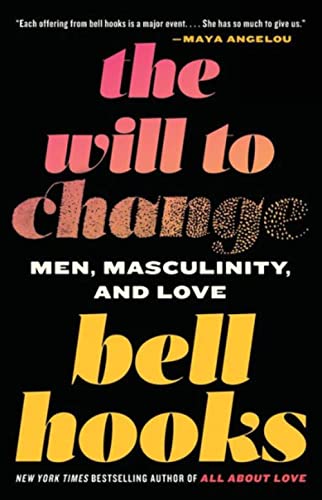
Everyone needs to love and be loved—even men. But to know love, men must be able to look at the ways that patriarchal culture keeps them from knowing themselves, from being in touch with their feelings, from loving.
In The Will to Change, bell hooks gets to the heart of the matter and shows men how to express the emotions that are a fundamental part of who they are—whatever their age, marital status, ethnicity, or sexual orientation. But toxic masculinity punishes those fundamental emotions, and it’s so deeply ingrained in our society that it’s hard for men to not comply—but hooks wants to help change that.
With trademark candor and fierce intelligence, hooks addresses the most common concerns of men, such as fear of intimacy and loss of their patriarchal place in society, in new and challenging ways. She believes men can find the way to spiritual unity by getting back in touch with the emotionally open part of themselves—and lay claim to the rich and rewarding inner lives that have historically been the exclusive province of women. A brave and astonishing work, The Will to Change is designed to help men reclaim the best part of themselves.
Die Inhaltsangabe kann sich auf eine andere Ausgabe dieses Titels beziehen.
bell hooks was a cultural critic, a feminist icon, and the renowned author of more than twenty books, including the enduring classic New York Times bestseller All About Love, Rock My Soul, The Will to Change, Sisters of the Yam, and When Angels Speak of Love. A charismatic speaker, she divided her time between teaching, writing, and lecturing around the world. She passed away in 2021.
From New York Times bestselling author, feminist pioneer, and cultural icon bell hooks, an evergreen treatise on how patriarchy and toxic masculinity hurts us all.
Feminist writing did not tell us about the deep inner misery of men.
Everyone needs to love and be loved―including men. But to know love, men must be able to look at the ways in which patriarchal culture keeps them from understanding themselves. In The Will to Change, bell hooks provides a compassionate guide for men of all ages and identities to understand how to be in touch with their feelings, and how to express versus repress the emotions that are a fundamental part of who we are.
With trademark candor and fierce intelligence, hooks addresses the most common concerns of men, such as fear of intimacy and loss of their patriarchal place in society, in new and challenging ways. The Will to Change “creates space for men to acknowledge their traumas and heal―not only for their sake, but for the sake of everyone in their lives” (BuzzFeed).
Excerpt
Chapter One: Wanted: Men Who Love
Every female wants to be loved by a male. Every woman wants to love and be loved by the males in her life. Whether gay or straight, bisexual or celibate, she wants to feel the love of father, grandfather, uncle, brother, or male friend. If she is heterosexual she wants the love of a male partner. We live in a culture where emotionally starved, deprived females are desperately seeking male love. Our collective hunger is so intense it rends us. And yet we dare not speak it for fear we will be mocked, pitied, shamed. To speak our hunger for male love would demand that we name the intensity of our lack and our loss. The male bashing that was so intense when contemporary feminism first surfaced more than thirty years ago was in part the rageful cover-up of the shame women felt not because men refused to share their power but because we could not seduce, cajole, or entice men to share their emotions - to love us.
By claiming that they wanted the power men had, man-hating feminists (who were by no means the majority) covertly proclaimed that they too wanted to be rewarded for being out of touch with their feelings, for being unable to love. Men in patriarchal culture responded to feminist demand for greater equity in the work world and in the sexual world by making room, by sharing the spheres of power. The place where most men refused to change - believed themselves unable to change - was in their emotional lives. Not even for the love and respect of liberated women were men willing to come to the table of love as equal partners ready to share the feast.
No one hungers for male love more than the little girl or boy who rightfully needs and seeks love from Dad. He may be absent, dead, present in body yet emotionally not there, but the girl or boy hungers to be acknowledged, recognized, respected, cared for. All around our nation a billboard carries this message: "Each night millions of kids go to sleep starving - for attention from their dads." Because patriarchal culture has already taught girls and boys that Dad's love is more valuable than mother love, it is unlikely that maternal affection will heal the lack of fatherly love. No wonder then that these girls and boys grow up angry with men, angry that they have been denied the love they need to feel whole, worthy, accepted. Heterosexual girls and homosexual boys can and do become the women and men who make romantic bonds the place where they quest to find and know male love. But that quest is rarely satisfied. Usually rage, grief, and unrelenting disappointment lead women and men to close off the part of themselves that was hoping to be touched and healed by male love. They learn then to settle for whatever positive attention men are able to give. They learn to overvalue it. They learn to pretend that it is love. They learn how not to speak the truth about men and love. They learn to live the lie.
As a child I hungered for the love of my dad. I wanted him to notice me, to give me his attention and his affections. When I could not get him to notice me by being good and dutiful, I was willing to risk punishment to be bad enough to catch his gaze, to hold it, and to bear the weight of his heavy hand. I longed for those hands to hold, shelter, and protect me, to touch me with tenderness and care, but I accepted that this would never be. I knew at age five that those hands would acknowledge me only when they were bringing me pain, that if I could accept that pain and hold it close, I could be Daddy's girl. I could make him proud. I am not alone. So many of us have felt that we could win male love by showing we were willing to bear the pain, that we were willing to live our lives affirming that the maleness deemed truly manly because it withholds, withdraws, refuses is the maleness we desire. We learn to love men more because they will not love us. If they dared to love us, in patriarchal culture they would cease to be real "men."
In her moving memoir In the Country of Men Jan Waldron describes a similar longing. She confesses that "the kind of father I ached for I have never seen except in glimpses I have embellished with wishful imaginings." Contrasting the loving fathers we long for with the fathers we have, she expresses the hunger:
Dad. It is a vow against all odds, in the face of countless examples to the contrary. Dad. It does not have the utilitarian effect of Mum or Ma. It's still spoken as a ballad refrain. It's a pledge that originates in the heart and fights for life amid the carnage of persistent, obvious history to the contrary and excruciatingly scant follow-through. Mother love is aplenty and apparent: we complain because we have too much of it. The love of a father is an uncommon gem, to be hunted, burnished, and hoarded. The value goes up because of its scarcity.
In our culture we say very little about the longing for father love.
Rather than bringing us great wisdom about the nature of men and love, reformist feminist focus on male power reinforced the notion that somehow males were powerful and had it all. Feminist writing did not tell us about the deep inner misery of men. It did not tell us the terrible terror that gnaws at the soul when one cannot love. Women who envied men their hardheartedness were not about to tell us the depth of male suffering. And so it has taken more than thirty years for the voices of visionary feminists to be heard telling the world the truth about men and love. Barbara Deming hinted at those truths:
I think the reason that men are so very violent is that they know, deep in themselves, that they're acting out a lie, and so they're furious at being caught up in the lie. But they don't know how to break it....They're in a rage because they are acting out a lie - which means that in some deep part of themselves they want to be delivered from it, are homesick for the truth.
The truth we do not tell is that men are longing for love. This is the longing feminist thinkers must dare to examine, explore, and talk about. Those rare visionary feminist seers, who are now no longer all female, are no longer afraid to openly address issues of men, masculinity, and love. Women have been joined by men with open minds and big hearts, men who love, men who know how hard it is for males to practice the art of loving in patriarchal culture.
In part, I began to write books about love because of the constant fighting between my ex-boyfriend Anthony and myself. We were (and at the time of this writing still are) each other's primary bond. We came together hoping to create love and found ourselves creating conflict. We decided to break up, but even that did not bring an end to the conflict. The issues we fought about most had to do with the practice of love. Like so many men who know that the women in their lives want to hear them declare love, Anthony made those declarations. When asked to link the "I love you" words with definition and practice, he found that he did not really have the words, that he was fundamentally uncomfortable being asked to talk about emotions.
Like many males, he had not been happy in most of the relationships he had chosen. The unhappiness of men in relationships, the grief men feel about the failure of love, often goes unnoticed in our society precisely because the patriarchal culture really does not care if men are unhappy. When females are in emotional pain, the sexist thinking that says that emotions should and can matter to women makes it possible for most of us to at least voice our heart, to speak it to someone, whether a close friend, a therapist, or the stranger sitting next to us on a plane or bus. Patriarchal mores teach a form of emotional stoicism to men that says they are more manly if they do not feel, but if by chance they should feel and the feelings hurt, the manly...
„Über diesen Titel“ kann sich auf eine andere Ausgabe dieses Titels beziehen.
Anbieter: Blue Vase Books, Interlochen, MI, USA
Zustand: good. The item shows wear from consistent use, but it remains in good condition and works perfectly. All pages and cover are intact including the dust cover, if applicable . Spine may show signs of wear. Pages may include limited notes and highlighting. May NOT include discs, access code or other supplemental materials. Bestandsnummer des Verkäufers BVV.0743456084.G
Anzahl: 1 verfügbar
Anbieter: Rarewaves USA, OSWEGO, IL, USA
Paperback. Zustand: New. From New York Times bestselling author, feminist pioneer, and cultural icon bell hooks, an evergreen treatise on how patriarchy and toxic masculinity hurts us all.Feminist writing did not tell us about the deep inner misery of men. Everyone needs to love and be loved-including men. But to know love, men must be able to look at the ways in which patriarchal culture keeps them from understanding themselves. In The Will to Change, bell hooks provides a compassionate guide for men of all ages and identities to understand how to be in touch with their feelings, and how to express versus repress the emotions that are a fundamental part of who we are. With trademark candor and fierce intelligence, hooks addresses the most common concerns of men, such as fear of intimacy and loss of their patriarchal place in society, in new and challenging ways. The Will to Change "creates space for men to acknowledge their traumas and heal-not only for their sake, but for the sake of everyone in their lives" (BuzzFeed). Bestandsnummer des Verkäufers LU-9780743456081
Anbieter: BooksRun, Philadelphia, PA, USA
Paperback. Zustand: Very Good. Reprint. It's a well-cared-for item that has seen limited use. The item may show minor signs of wear. All the text is legible, with all pages included. It may have slight markings and/or highlighting. Bestandsnummer des Verkäufers 0743456084-11-1
Anzahl: 1 verfügbar
Anbieter: GreatBookPrices, Columbia, MD, USA
Zustand: New. Bestandsnummer des Verkäufers 2505965-n
Anzahl: 2 verfügbar
Anbieter: Rarewaves.com USA, London, LONDO, Vereinigtes Königreich
Paperback. Zustand: New. From New York Times bestselling author, feminist pioneer, and cultural icon bell hooks, an evergreen treatise on how patriarchy and toxic masculinity hurts us all.Feminist writing did not tell us about the deep inner misery of men. Everyone needs to love and be loved-including men. But to know love, men must be able to look at the ways in which patriarchal culture keeps them from understanding themselves. In The Will to Change, bell hooks provides a compassionate guide for men of all ages and identities to understand how to be in touch with their feelings, and how to express versus repress the emotions that are a fundamental part of who we are. With trademark candor and fierce intelligence, hooks addresses the most common concerns of men, such as fear of intimacy and loss of their patriarchal place in society, in new and challenging ways. The Will to Change "creates space for men to acknowledge their traumas and heal-not only for their sake, but for the sake of everyone in their lives" (BuzzFeed). Bestandsnummer des Verkäufers LU-9780743456081
Anzahl: 1 verfügbar
Anbieter: World of Books (was SecondSale), Montgomery, IL, USA
Zustand: Good. Item in good condition. Textbooks may not include supplemental items i.e. CDs, access codes etc. Bestandsnummer des Verkäufers 00107797662
Anzahl: 2 verfügbar
Anbieter: World of Books (was SecondSale), Montgomery, IL, USA
Zustand: Very Good. Item in very good condition! Textbooks may not include supplemental items i.e. CDs, access codes etc. Bestandsnummer des Verkäufers 00106827909
Anzahl: 2 verfügbar
Anbieter: Eagle Eye Books, Decatur, GA, USA
Paper Back. Zustand: New. Bestandsnummer des Verkäufers 719971
Anzahl: 2 verfügbar
Anbieter: Grand Eagle Retail, Bensenville, IL, USA
Paperback. Zustand: new. Paperback. From New York Times bestselling author, feminist pioneer, and cultural icon bell hooks, an evergreen treatise on how patriarchy and toxic masculinity hurts us all.Feminist writing did not tell us about the deep inner misery of men. Everyone needs to love and be lovedincluding men. But to know love, men must be able to look at the ways in which patriarchal culture keeps them from understanding themselves. In The Will to Change, bell hooks provides a compassionate guide for men of all ages and identities to understand how to be in touch with their feelings, and how to express versus repress the emotions that are a fundamental part of who we are. With trademark candor and fierce intelligence, hooks addresses the most common concerns of men, such as fear of intimacy and loss of their patriarchal place in society, in new and challenging ways. The Will to Change creates space for men to acknowledge their traumas and healnot only for their sake, but for the sake of everyone in their lives (BuzzFeed). Synopsis coming soon. Shipping may be from multiple locations in the US or from the UK, depending on stock availability. Bestandsnummer des Verkäufers 9780743456081
Anbieter: New Story Community Books, Marshall, MI, USA
Paperback. Zustand: Like New. Bestandsnummer des Verkäufers 9780743456081
Anzahl: 1 verfügbar