
Verwandte Artikel zu Copy, Rip, Burn: The Politics of Copyleft and Open...
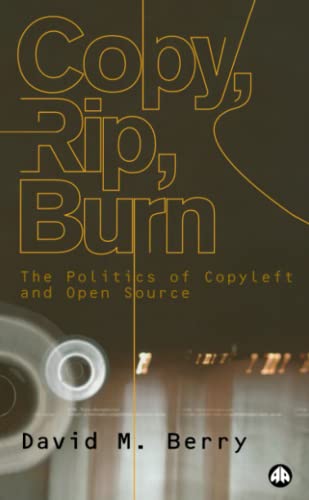
Copy, Rip, Burn: The Politics of Copyleft and Open Source: The Politics of Copyleft and Open Source: The Politics of Copyleft and Open Source - Softcover
Inhaltsangabe
From downloading music and movies to accessing free software, digital media is forcing us to rethink the very idea of intellectual property. While big companies complain about lost profits, the individual has never enjoyed such freedom and autonomy. Berry explores this debate in a concise way, offering an ideal introduction for anyone not versed in the legalistic terminology that -- up until now -- has dominated coverage of this issue. Looking at the historical development of the free software and the open source movement he examines its growth, politics and potential impact, showing how the ideas that inspired the movement have now begun to influence the wider cultural landscape. He explores whether free software offers us the potential to re-think our relationship with technology in the information society. This book will appeal to students of media and journalism, and anyone interested in new opportunities for creating a truly independent and democratic media.
Die Inhaltsangabe kann sich auf eine andere Ausgabe dieses Titels beziehen.
Über die Autorin bzw. den Autor
David M. Berry is a lecturer in the Media and Communication department at the University of Swansea. He researches the philosophy of technology, medium theory, digital media and the social and political implications of the information society. He is the author of Copy, Rip, Burn (Pluto, 2008).
Auszug. © Genehmigter Nachdruck. Alle Rechte vorbehalten.
Copy, Rip, Burn
The Politics of Copyleft and Open Source
By David M. BerryPluto Press
Copyright © 2008 David M. Berry
All rights reserved.
ISBN: 978-0-7453-2414-2All rights reserved.
Contents
Acknowledgements, ix,
Preface, x,
1. The Canary in the Mine, 1,
2. The Information Society, 41,
3. The Concept of the Commons, 79,
4. From Free Software to Open Source?, 98,
5. The Contestation of Code, 147,
6. The Poetics of Code, 188,
Notes, 202,
Bibliography, 234,
Index, 253,
CHAPTER 1
THE CANARY IN THE MINE
There's something I don't understand about the open-source movement. Oh, I understand open-source intellectually. I understand that it means that source code is open to be read and reviewed and perhaps revised by anyone who wants to ... What I don't understand is something more sociological. I don't understand who those folks are who want to do all that code reading and reviewing for no recompense. It goes against the grain of everything I know about the software field. (Glass 2000: 104)
Man produces himself through labour. (Marx and Engels 1999: 21)
In 1995, two scientists from the University of Mississippi were granted a patent on a method of increasing the effectiveness of treatments of wounds and cuts by the use of turmeric in a 'special preparation'. They calculated that the estimated market for this product could be worth billions of dollars a year. Turmeric as a treatment for minor skin cuts and wounds has been used in India as a traditional remedy for hundreds of years. However, intellectual property law in the US does not see anything that constitutes 'originality' or 'inventiveness' in traditional remedies and so is unwilling to grant any protection to traditional knowledges.
In America in 1998, a man who had his spleen removed by doctors as treatment for leukaemia discovered that the doctors had proceeded to patent some of the genetic material they removed from his body. After the patient sued the doctors, the court found that the man did not have any claim to his own bodily material as it was a 'naturally' occurring substance and he was classified as a 'source' who had 'abandoned' his genetic material. Yet it was argued that the doctors, due to their 'expertise' and 'ingenuity', had contributed to an 'original' and creative act by 'discovering' this cell-line and were awarded the property rights to this portion of the patient's genetic code. The products that are being developed using his genetic material are estimated to be worth over $2 billion annually (Boyle 1996: 22–4).
In 2002, a nursery in the US innocently painted pictures of Disney characters on the walls for the amusement of the children, aged between one and five years old, who played there. Somehow, the Disney corporation (estimated market capitalisation – $20 billion) found out and their lawyers sent a cease and desist letter to the nursery explaining that this represented an infringement of copyright. They warned that the nursery should remove the offending paintings and images from their walls. Failure to comply would mean an expensive and drawn-out court action that would most likely bankrupt the nursery. Even though the children from the nursery went on national television to plead for their beloved nursery walls, the Disney representative claimed that they viewed the nursery as a for-profit organisation and didn't feel a need to distinguish between it and other organisations. They stated that any infringement by anybody else would be dealt with in the same harsh way (Cox, quoted in Coombe 1998: 53).
In 2005 in the UK, the government discussed developing a new campaign to teach children and young people that copying music, pictures or text without permission is 'theft' and that intellectual property should be respected in the same way as physical property. The programme is largely funded by the content-industry (e.g. music, film and publishing multinationals) intent on educating children into a 'better' understanding of how intellectual property should be used. The aim is to teach children that whenever they produce any work they should mark it with a copyright symbol to prevent other people (presumably also children) 'stealing' from them. Nobody seems to have borne in mind that children learn by repetition and copying, and teaching 'property' rights in this corporate-approved way is likely to undermine learning and education. Combined with this 'education' programme, the Federation Against Copyright Theft (FACT) has been running a campaign attempting to draw a link between terrorism and copyright infringement (the poster images from which were hastily removed from the web following a critical outcry). Even language itself is being manipulated with our ongoing corporate reeducation about copyright infringement through compulsory property-theft DVD trailers, cinema adverts and assertive control of trademarks and corporate slogans.
Again in 2005, a reborn Napster (the company that was originally infamous for allowing the allegedly illegal copying of music until it was forced into bankruptcy by the music industry) introduced a service that for $15 a month allows customers to rent music online by downloading music to your portable music player from their catalogue. In contrast to the download purchase-type services (such as Apple's iTunes), this service is designed to be more like an online music library that you rent from month to month which effectively gives you a huge variety of music from which to choose. The service is aimed particularly at those between the ages of 15 and 25 whom the music industry has identified as most likely to pirate and download illegal music. However, in contrast to purchasing the music, should you fail to keep up payments then the technology will automatically cancel your rights to play on your computer and portable player and your Napster music collection will vanish (Rothman 2005).
Lastly, in 2007, volunteers continued to develop a computer operating system collaboratively over the Internet called GNU/ Linux (Stallman 1999). Started in 1991, GNU/Linux has challenged our understanding of the production of complex software projects and the best method of organising, controlling and managing them. In short, GNU/Linux eschews traditional methods of copyright protection and code secrecy in favour of a common-ownership model (known as copyleft). It is then freely distributed with the source code for little or no cost and encourages contributions, comments, criticisms and bug-fixes from its users and developers. This has led to an exponential rate of growth both in terms of its code quality (which directly relates to the workable nature of the software in a production environment) and also in terms of its feature-list and capabilities. It is now a viable challenger to Microsoft Windows and is taken seriously as an important infrastructural software product (most noticeably supported by IBM).
These cases and wider arguments over intellectual property rights (IPR) may seem disconnected and distant from our everyday lives and worries. After all, it seems unlikely that multinational corporations would be bothered to look into all our collections of music, film and images. The worlds of IPR, legal copyright cases and patent infringement do not usually impinge on the lives of individuals going about their daily activities. However, corporations are becoming increasingly assertive and aggressive in their claims to rights in intellectual property, as well as increasing their holdings and portfolios. It appears that across the...
„Über diesen Titel“ kann sich auf eine andere Ausgabe dieses Titels beziehen.
Suchergebnisse für Copy, Rip, Burn: The Politics of Copyleft and Open...

Beispielbild für diese ISBN
Copy, Rip, Burn: The Politics of Copyleft and Open Source
Anbieter: WorldofBooks, Goring-By-Sea, WS, Vereinigtes Königreich
Verkäuferbewertung 5 von 5 Sternen

Paperback. Zustand: Very Good. The book has been read, but is in excellent condition. Pages are intact and not marred by notes or highlighting. The spine remains undamaged. Bestandsnummer des Verkäufers GOR003507501
Gebraucht kaufen
EUR 3,37
EUR 6,56 Versand
Versand von Vereinigtes Königreich nach USA
Versand von Vereinigtes Königreich nach USA
Anzahl: 1 verfügbar
Beispielbild für diese ISBN
Copy, Rip, Burn: the Politics of Copyleft and Open Source
Anbieter: Better World Books, Mishawaka, IN, USA
Verkäuferbewertung 5 von 5 Sternen
Zustand: Good. Former library copy. Pages intact with minimal writing/highlighting. The binding may be loose and creased. Dust jackets/supplements are not included. Includes library markings. Stock photo provided. Product includes identifying sticker. Better World Books: Buy Books. Do Good. Bestandsnummer des Verkäufers 45761270-6
Gebraucht kaufen
EUR 10,22
Versand gratis
Versand innerhalb von USA
Versand innerhalb von USA
Anzahl: 1 verfügbar
Beispielbild für diese ISBN
Copy, Rip, Burn: the Politics of Copyleft and Open Source
Anbieter: Better World Books, Mishawaka, IN, USA
Verkäuferbewertung 5 von 5 Sternen
Zustand: Good. Pages intact with minimal writing/highlighting. The binding may be loose and creased. Dust jackets/supplements are not included. Stock photo provided. Product includes identifying sticker. Better World Books: Buy Books. Do Good. Bestandsnummer des Verkäufers 812376-6
Gebraucht kaufen
EUR 10,22
Versand gratis
Versand innerhalb von USA
Versand innerhalb von USA
Anzahl: 1 verfügbar
Beispielbild für diese ISBN
Copy, Rip, Burn: the Politics of Copyleft and Open Source
Anbieter: Better World Books Ltd, Dunfermline, Vereinigtes Königreich
Verkäuferbewertung 5 von 5 Sternen
Zustand: Good. Pages intact with minimal writing/highlighting. The binding may be loose and creased. Dust jackets/supplements are not included. Stock photo provided. Product includes identifying sticker. Better World Books: Buy Books. Do Good. Bestandsnummer des Verkäufers 812376-6
Gebraucht kaufen
EUR 6,06
EUR 5,86 Versand
Versand von Vereinigtes Königreich nach USA
Versand von Vereinigtes Königreich nach USA
Anzahl: 1 verfügbar
Beispielbild für diese ISBN
Copy, Rip, Burn: The Politics of Copyleft and Open Source
Anbieter: Powell's Bookstores Chicago, ABAA, Chicago, IL, USA
Verkäuferbewertung 5 von 5 Sternen
Paperback. Zustand: Used-Very Good. Pbk. Some shelf-wear. Else clean copy. Bestandsnummer des Verkäufers 1792774
Gebraucht kaufen
EUR 8,18
EUR 4,41 Versand
Versand innerhalb von USA
Versand innerhalb von USA
Anzahl: 1 verfügbar
Beispielbild für diese ISBN
Copy, Rip, Burn: The Politics of Copyleft and Open Source
Anbieter: Anybook.com, Lincoln, Vereinigtes Königreich
Verkäuferbewertung 5 von 5 Sternen
Zustand: Good. This is an ex-library book and may have the usual library/used-book markings inside.This book has soft covers. In good all round condition. Please note the Image in this listing is a stock photo and may not match the covers of the actual item,400grams, ISBN:9780745324142. Bestandsnummer des Verkäufers 2919724
Gebraucht kaufen
EUR 3,02
EUR 15,27 Versand
Versand von Vereinigtes Königreich nach USA
Versand von Vereinigtes Königreich nach USA
Anzahl: 1 verfügbar
Beispielbild für diese ISBN
Copy, Rip, Burn: The Politics of Copyleft and Open Source
Anbieter: Ammareal, Morangis, Frankreich
Verkäuferbewertung 5 von 5 Sternen
Softcover. Zustand: Bon. Ammareal reverse jusqu'à 15% du prix net de cet article à des organisations caritatives. ENGLISH DESCRIPTION Book Condition: Used, Good. Ammareal gives back up to 15% of this item's net price to charity organizations. Bestandsnummer des Verkäufers G-071-563
Gebraucht kaufen
EUR 6,49
EUR 16,50 Versand
Versand von Frankreich nach USA
Versand von Frankreich nach USA
Anzahl: 1 verfügbar
Beispielbild für diese ISBN
Copy, Rip, Burn - The Politics of Copyleft and Open Source
Anbieter: PBShop.store UK, Fairford, GLOS, Vereinigtes Königreich
Verkäuferbewertung 5 von 5 Sternen
PAP. Zustand: New. New Book. Shipped from UK. Established seller since 2000. Bestandsnummer des Verkäufers FW-9780745324142
Neu kaufen
EUR 30,39
EUR 4,87 Versand
Versand von Vereinigtes Königreich nach USA
Versand von Vereinigtes Königreich nach USA
Anzahl: 15 verfügbar
Beispielbild für diese ISBN
Copy, Rip, Burn - The Politics of Copyleft and Open Source (eng)
Anbieter: Brook Bookstore On Demand, Napoli, NA, Italien
Verkäuferbewertung 5 von 5 Sternen
Zustand: new. Bestandsnummer des Verkäufers 62a2f7176b888193ed80a705e9df199a
Neu kaufen
EUR 31,02
EUR 5,50 Versand
Versand von Italien nach USA
Versand von Italien nach USA
Anzahl: Mehr als 20 verfügbar
Beispielbild für diese ISBN
Copy, Rip, Burn: The Politics of Copyleft and Open Source: The Politics of Open Source
Anbieter: Pearlydewdrops, Streat, Vereinigtes Königreich
Verkäuferbewertung 5 von 5 Sternen
Paperback. Zustand: Fine. New & unread, however may have light shelf wear to cover face, edges or corners. Shipped from the UK within 2 business days of order being placed. Bestandsnummer des Verkäufers mon0000186834
Gebraucht kaufen
EUR 11,72
EUR 25,76 Versand
Versand von Vereinigtes Königreich nach USA
Versand von Vereinigtes Königreich nach USA
Anzahl: 13 verfügbar