
Verwandte Artikel zu Guardians of Power: The Myth of the Liberal Media
Inhaltsangabe
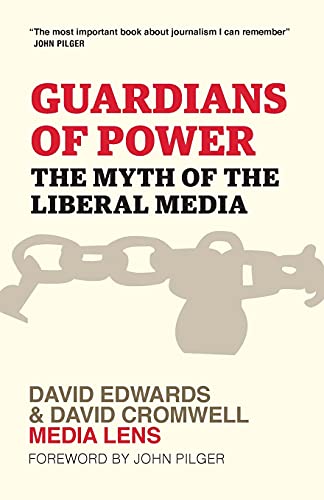
"Guardians of Power ought to be required reading in every media college. It is the most important book about journalism I can remember." John Pilger "Regular critical analysis of the media, filling crucial gaps and correcting the distortions of ideological prisms, has never been more important. Media Lens has performed a major public service by carrying out this task with energy, insight, and care." Noam Chomsky "Media Lens is doing an outstanding job of pressing the mainstream media to at least follow their own stated principles and meet their public service obligations. [This is] fun as well as enlightening." Edward S. Herman Can a corporate media system be expected to tell the truth about a world dominated by corporations? Can newspapers, including the 'liberal' Guardian and the Independent, tell the truth about catastrophic climate change -- about its roots in mass consumerism and corporate obstructionism -- when they are themselves profit-oriented businesses dependent on advertisers for 75% of their revenues? Can the BBC tell the truth about UK government crimes in Iraq when its senior managers are appointed by the government? Has anything fundamentally changed since BBC founder Lord Reith wrote of the establishment: "They know they can trust us not to be really impartial"? Why did the British and American mass media fail to challenge even the most obvious government lies on Iraqi weapons of mass destruction before the invasion in March 2003? Why did the media ignore the claims of UN weapons inspectors that Iraq had been 90-95% "fundamentally disarmed" as early as 1998? This book answers these questions, and more. Since July 2001, Media Lens has encouraged thousands of readers to email senior editors and journalists, challenging them to account for their distorted reporting on Iraq, Afghanistan, Kosovo, Haiti, East Timor, climate change, Western crimes in Central America, and much more. The responses
Die Inhaltsangabe kann sich auf eine andere Ausgabe dieses Titels beziehen.
Über die Autorin bzw. den Autor
David Edwards is is co-editor and co-founder of Media Lens. He is the author of Free To Be Human (1995), The Compassionate Revolution (1998), and co-author, with David Cromwell, of Guardians of Power (2006), Newspeak in the 21st Century (2009), and Propaganda Blitz: How and Why Corporate Media Distort Reality (Pluto, 2018).
Auszug. © Genehmigter Nachdruck. Alle Rechte vorbehalten.
Guardians of Power
The Myth of the Liberal Media
By David Edwards, David CromwellPluto Press
Copyright © 2006 David Edwards and David Cromwell
All rights reserved.
ISBN: 978-0-7453-2482-1All rights reserved.
Contents
Acknowledgments, viii,
Foreword by John Pilger, ix,
1 The Mass Media – Neutral, Honest, Psychopathic, 1,
2 Iraq – The Sanctions of Mass Destruction, 13,
3 Iraq Disarmed – Burying the 1991-98 Weapons Inspections, 32,
4 Iraq – Gunning for War and Burying the Dead, 47,
5 Afghanistan – Let Them Eat Grass, 76,
6 Kosovo – Real Bombs, Fictional Genocide, 94,
7 East Timor – The Practical Limits of Crusading Humanitarianism, 109,
8 Haiti – The Hidden Logic of Exploitation, 117,
9 Idolatry Ink – Reagan, the 'Cheerful Conservative' and 'Chubby Bubba' Clinton, 132,
10 Climate Change – The Ultimate Media Betrayal, 154,
11 Disciplined Media – Professional Conformity to Power, 172,
12 Towards a Compassionate Media, 188,
13 Full Human Dissent, 204,
Resources, 218,
About Media Lens, 229,
Index, 231,
CHAPTER 1
The Mass Media – Neutral, Honest, Psychopathic
Another helpful attitude is one of deep distrust. Since most of what we hear is either plainly untrue, or half true and half distorted, and since most of what we read in the newspapers is distorted interpretations served as facts, it is by far the best plan to start out with radical scepticism and the assumption that most of what one hears is likely to be a lie or a distortion. (Erich Fromm, The Art of Being, Continuum, 1992, p. 44)
PULLING THE OTHER ONE – THE CORPORATE 'FREE PRESS'
Even the word 'media' is problematic. It is the plural of the word medium, which can be defined as 'the intervening substance through which impressions are conveyed to the senses'. Air, for example, acts as a medium for the transmission of sound – it is a neutral, disinterested carrier of energetic vibrations.
News organisations would have us believe that they transmit information in a similarly neutral, natural way. They represent themselves as self-evidently dispassionate windows on the world. Thus, while there is plenty of discussion about what appears in these windows, there is next to no discussion about who built them, about what their goals and values might be. One might almost think that the mass media had always existed in their current form; that they were simply facts of life, even God-given.
And yet consider two salient facts: 1) much of the contemporary world is dominated by giant, multinational corporations; 2) the media system reporting on that world is itself made up of giant corporations. Indeed, media entities are often owned by the same giant corporations they are tasked with covering.
How young would a child have to be before it failed to recognise a problem here? And yet this is a realisation that escapes close to 100 per cent of professional journalists, at least if their public utterances are to be believed.
The complacent media silence surrounding the oxymoron that is 'the corporate free press' is not indicative of an honest, rational consensus in a free society; it is symptomatic of an all-pervasive media corruption, of a deep cultural malaise. The silence, quite simply, is a lie.
In this book, we will argue that the corporate mass media – not just the right-wing Tory press, but also the most highly respected 'liberal' media – broadcasters like the BBC, and newspapers like the Guardian, the Observer and the Independent – constitute a propaganda system for elite interests. We will show how even the most obvious facts concerning even the most vital subjects – US-UK government responsibility for genocide, vast corporate criminality, threats to the very existence of human life – are distorted, suppressed, marginalised and ignored. In what lies ahead, readers will encounter rational mainstream discussion and forensic analysis – and then sudden, inexplicable silence. We will encounter confident, reasoned debate – and then weird irrationality.
For readers subjected to the corporate media version of the world over several decades, the above claim may well seem remarkable, even outlandish. The natural response is to insist: 'Sorry, but we do see honest reporting and commentary in the media. We read Robert Fisk in the Independent, Seumas Milne in the Guardian and John Pilger (and Media Lens!) in the New Statesman. The government has been widely criticised and challenged on its conduct in the build up to the Iraq war. Corporations are subject to robust censure and investigation – look at the Enron scandal, for goodness sake!'
Alas, all is not as it seems. As ever, the devil lies in the detail. He is also highly visible one step back from our common-sense presumptions – when we are able to recognise, with psychologist Erich Fromm, 'the pathology of normalcy'. Then we will see that the media system is less a window on the world and more a painting of a window on the world.
Correcting for the distorted vision of the media begins with an understanding of just how and why that vision has been distorted. It begins, in fact, with an understanding of the fundamental structure of that curious abstract entity – the corporation.
OUTLAWING SOCIAL RESPONSIBILITY
In his book, The Corporation, Canadian law professor Joel Bakan notes that corporations are legally obliged to maximise returns for shareholders. Company executives are literally compelled to subordinate all considerations to profit:
The law forbids any motivation for their actions, whether to assist workers, improve the environment, or help consumers save money. They can do these things with their own money, as private citizens. As corporate officials, however, stewards of other people's money, they have no legal authority to pursue such goals as ends in themselves – only as means to serve the corporation's own interests, which generally means to maximise the wealth of its shareholders. Corporate social responsibility is thus illegal – at least when it is genuine. (Joel Bakan, The Corporation, Constable, 2004, p. 37)
This ban on social responsibility has been established in legal judgments over hundreds of years. In a key nineteenth-century court case, for example, Lord Bowen declared:
charity has no business to sit at boards of directors qua charity. There is, however, a kind of charitable dealing which is for the interest of those who practise it, and to that extent and in that garb (I admit not a very philanthropic garb) charity may sit at the board, but for no other purpose. (Quoted, ibid., pp. 38-9)
The inevitable consequence, Bakan writes, is what are known blandly as 'externalities': the routine and regular harms caused to others – workers, consumers, communities, the environment. This, Bakan notes, makes the corporation essentially a 'psychopathic creature', unable to recognise or act upon moral reasons to refrain from harming others (ibid., p. 60).
Robert Hinkley, who spent 23 years as a corporate securities attorney advising large corporations on securities offerings, mergers and acquisitions explains:
When toxic chemicals are spilled, forests destroyed, employees left in poverty, or communities devastated through plant shutdowns, corporations view these as...
„Über diesen Titel“ kann sich auf eine andere Ausgabe dieses Titels beziehen.
Suchergebnisse für Guardians of Power: The Myth of the Liberal Media

Beispielbild für diese ISBN
Guardians of Power: The Myth of the Liberal Media
Anbieter: World of Books (was SecondSale), Montgomery, IL, USA
Verkäuferbewertung 5 von 5 Sternen

Zustand: Good. Item in good condition. Textbooks may not include supplemental items i.e. CDs, access codes etc. Bestandsnummer des Verkäufers 00100132190
Gebraucht kaufen
EUR 4,91
Versand gratis
Versand innerhalb von USA
Versand innerhalb von USA
Anzahl: 1 verfügbar
Beispielbild für diese ISBN
Guardians of Power: The Myth of the Liberal Media
Anbieter: World of Books (was SecondSale), Montgomery, IL, USA
Verkäuferbewertung 5 von 5 Sternen
Zustand: Acceptable. Item in acceptable condition! Textbooks may not include supplemental items i.e. CDs, access codes etc. Bestandsnummer des Verkäufers 00096006207
Gebraucht kaufen
EUR 4,91
Versand gratis
Versand innerhalb von USA
Versand innerhalb von USA
Anzahl: 1 verfügbar
Beispielbild für diese ISBN
Guardians of Power: The Myth of the Liberal Media
Anbieter: BooksRun, Philadelphia, PA, USA
Verkäuferbewertung 5 von 5 Sternen
Paperback. Zustand: Very Good. It's a well-cared-for item that has seen limited use. The item may show minor signs of wear. All the text is legible, with all pages included. It may have slight markings and/or highlighting. Bestandsnummer des Verkäufers 0745324827-8-1
Gebraucht kaufen
EUR 4,92
Versand gratis
Versand innerhalb von USA
Versand innerhalb von USA
Anzahl: 1 verfügbar
Beispielbild für diese ISBN
Guardians of Power: The Myth of the Liberal Media
Anbieter: ThriftBooks-Dallas, Dallas, TX, USA
Verkäuferbewertung 5 von 5 Sternen
Paperback. Zustand: Very Good. No Jacket. Former library book; May have limited writing in cover pages. Pages are unmarked. ~ ThriftBooks: Read More, Spend Less. Bestandsnummer des Verkäufers G0745324827I4N10
Gebraucht kaufen
EUR 6,08
Versand gratis
Versand innerhalb von USA
Versand innerhalb von USA
Anzahl: 1 verfügbar
Beispielbild für diese ISBN
Guardians of Power: The Myth of the Liberal Media
Anbieter: ThriftBooks-Dallas, Dallas, TX, USA
Verkäuferbewertung 5 von 5 Sternen
Paperback. Zustand: Good. No Jacket. Pages can have notes/highlighting. Spine may show signs of wear. ~ ThriftBooks: Read More, Spend Less. Bestandsnummer des Verkäufers G0745324827I3N00
Gebraucht kaufen
EUR 6,08
Versand gratis
Versand innerhalb von USA
Versand innerhalb von USA
Anzahl: 1 verfügbar
Beispielbild für diese ISBN
Guardians of Power: The Myth of the Liberal Media
Anbieter: ThriftBooks-Atlanta, AUSTELL, GA, USA
Verkäuferbewertung 5 von 5 Sternen
Paperback. Zustand: Very Good. No Jacket. May have limited writing in cover pages. Pages are unmarked. ~ ThriftBooks: Read More, Spend Less. Bestandsnummer des Verkäufers G0745324827I4N00
Gebraucht kaufen
EUR 6,08
Versand gratis
Versand innerhalb von USA
Versand innerhalb von USA
Anzahl: 1 verfügbar
Beispielbild für diese ISBN
Guardians of Power : The Myth of the Liberal Media
Anbieter: Better World Books, Mishawaka, IN, USA
Verkäuferbewertung 5 von 5 Sternen
Zustand: Very Good. Former library copy. Pages intact with possible writing/highlighting. Binding strong with minor wear. Dust jackets/supplements may not be included. Includes library markings. Stock photo provided. Product includes identifying sticker. Better World Books: Buy Books. Do Good. Bestandsnummer des Verkäufers 8972751-6
Gebraucht kaufen
EUR 6,60
Versand gratis
Versand innerhalb von USA
Versand innerhalb von USA
Anzahl: 1 verfügbar
Beispielbild für diese ISBN
Guardians of Power : The Myth of the Liberal Media
Anbieter: Better World Books, Mishawaka, IN, USA
Verkäuferbewertung 5 von 5 Sternen
Zustand: Very Good. Pages intact with possible writing/highlighting. Binding strong with minor wear. Dust jackets/supplements may not be included. Stock photo provided. Product includes identifying sticker. Better World Books: Buy Books. Do Good. Bestandsnummer des Verkäufers 15239758-20
Gebraucht kaufen
EUR 6,60
Versand gratis
Versand innerhalb von USA
Versand innerhalb von USA
Anzahl: 1 verfügbar
Beispielbild für diese ISBN
Guardians of Power : The Myth of the Liberal Media
Anbieter: Better World Books: West, Reno, NV, USA
Verkäuferbewertung 5 von 5 Sternen
Zustand: Very Good. Pages intact with possible writing/highlighting. Binding strong with minor wear. Dust jackets/supplements may not be included. Stock photo provided. Product includes identifying sticker. Better World Books: Buy Books. Do Good. Bestandsnummer des Verkäufers 15239758-20
Gebraucht kaufen
EUR 6,60
Versand gratis
Versand innerhalb von USA
Versand innerhalb von USA
Anzahl: 1 verfügbar
Beispielbild für diese ISBN
Guardians of Power: The Myth of the Liberal Media
Anbieter: World of Books Inc, Montgomery, IL, USA
Verkäuferbewertung 4 von 5 Sternen

Paperback. Zustand: Good. 'The most important book about journalism I can remember.' John Pilger. Bestandsnummer des Verkäufers CIN0745324827G
Gebraucht kaufen
EUR 6,76
Versand gratis
Versand innerhalb von USA
Versand innerhalb von USA
Anzahl: 1 verfügbar