
Verwandte Artikel zu Revolutionary Learning: Marxism, Feminism and Knowledge
Inhaltsangabe
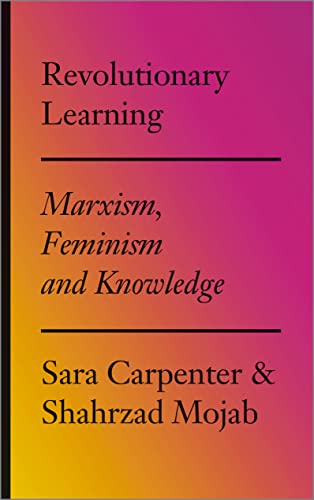
Revolutionary Learning explores the Marxist and feminist theorisation of dialectics, praxis and consciousness in education and learning. Moving beyond previous books on Marxism and education, this groundbreaking text explores the core philosophical concepts that build the Marxist analysis of learning, extending its critique with significant implications for critical education scholarship, research and practice by drawing upon work by feminist, anti-racist and anti-colonial scholars. The authors reconsider the contributions of Marx, Gramsci and Freire to educational theory from an explicitly feminist perspective, moving Marxist analysis of education into a more complex relation to patriarchal and imperialist capitalism. The authors’ distinctive approach moves beyond other Marxian analyses which focus on the reproductive nature of schooling and educational institutions, by expanding theorisation into domains of radical and revolutionary educational praxis. Revolutionary Learning's importance lies not only in its contribution to theory, but its extension into pedagogical practice with special attention to how a revolutionary critique of ideology is taken up by educators in their daily work.
Die Inhaltsangabe kann sich auf eine andere Ausgabe dieses Titels beziehen.
Über die Autorin bzw. den Autor
Sara Carpenter is assistant professor in educational policy studies at the University of Alberta and previously worked as an adult educator in both community organizations and higher education. She is co-editor of Educating from Marx: Race, Gender, and Learning. Shahrzad Mojab is a scholar, teacher, and activist. She is professor of adult education and women's studies at OISE/University of Toronto, the co-editor Educating from Marx: Race, Gender and Learning, and the editor of?Marxism and Feminism.
Auszug. © Genehmigter Nachdruck. Alle Rechte vorbehalten.
Revolutionary Learning
Marxism, Feminism and Knowledge
By Sara Carpenter, Shahrzad MojabPluto Press
Copyright © 2017 Sara Carpenter and Shahrzad Mojab
All rights reserved.
ISBN: 978-0-7453-3638-1All rights reserved.
Contents
Dedication, vi,
Acknowledgements, vii,
1 Introduction: Revolutionary Feminist Praxis, 1,
2 What is 'Critical' About Critical Educational Theory?, 27,
3 Learning and the 'Matter' of Consciousness in Marxist Feminism, 45,
4 Centring Marxist Feminist Theory in Adult Learning, 72,
5 Institutional Ethnography: A Marxist Feminist Analysis, 92,
6 Capitalist Imperialism as Social Relations: Implications for Praxis, Pedagogy and Resistance, 111,
7 Learning by Dispossession: Democracy Promotion and Civic Engagement in Iraq and the United States, 129,
Index, 150,
CHAPTER 1
Introduction: Revolutionary Feminist Praxis
It is now an intellectual and political habit for us to begin our writing with the assertion that the world is messy and chaotic. The more we open our essays with this statement, the messier the world gets. Millions of people are driven to the seas and through the deserts by wars, destruction, dispossession and displacement. Aspirations to live free of violence are difficult to realize in the context of the vast, persistent and growing inequities of Europe and North America, compounded by increasingly reactionary and racist violence on the part of the state and civil society against forcibly displaced people. The persistence of this material condition is utterly dependent on the ideologies of patriarchal, racist capitalist social relations. Under the global expression of racialized patriarchy, violence has increased exponentially, taking on a massified character and regularly reported around the world: the rape to death of women in public, including by military, paramilitary and extremist forces; their abduction and selling in the sex market; the enforcement of child marriage; sexual abuse and assault from refugee camps to university campuses; arrest and imprisonment of Palestinian girls and women for their resistance to occupation; the detainment of Kurdish women activists in Turkey; the missing and murdered indigenous women in Canada; the murder of women on the US-Mexico Border; girls kidnapped across Africa; and religious forms of terrorism against women's reproductive autonomy. These are breath-taking atrocities committed every day and night by patriarchal forces of capitalism, imperialism and fundamentalisms. As Bannerji argues, 'the very content of the word "human" is being emptied out and filled with screams of agony of those condemned to it. In this atmosphere of violence how can violence against women not intensify, almost as an excrescence of this ordered disorder?' (2016, p. 17).
In order to address not only these forms of violence and degradation, but also the continuing contradictions of patriarchal, racist capitalism, we argue that we need to revolutionize our thinking around learning and the critical education project. We consider this endeavour to be our contribution as revolutionary feminist scholars of education. By revolutionize, we do not simply mean change: we need to fully embrace the revolutionary potential of learning and pedagogical work and engage with our history of scholarship through the imperative of generating revolutionary feminist praxis. By praxis we mean, following Allman's dialectical articulation, 'a concept that grasps the internal relation between consciousness and sensuous human experience, a unity of opposites that reciprocally shape and determine one another' (2007, p. 79, emphasis in original). We explore this dialectical iteration of praxis through this text. It is our contention – and we would argue these claims can easily be seen in the last three decades of debate – that critical education is plagued by persistent theoretical and political inconsistencies. Following significant articulations of the relation between education and social reproduction, the field of critical education has been unable to contend with the growing complexity of both the material condition of the world and the ideological apparatus of bourgeois society in the academy. As argued by key Marxist scholars of education, including Paula Allman, Wayne Au, Noah De Lissovoy, Teresa Ebert, Sandy Grande, John Holst and Glenn Rikowski, critical education theory suffers from several important inconsistencies and reformist tendencies. The influence of a non-dialectical reading of Marx under conditions of patriarchy and racism continues to produce substantial errors in scholarship, including: the inability to understand class and labour power as relations and processes; a causal and deterministic articulation of consciousness and praxis as external relations; culturalist and identity-based approaches to 'difference' that cannot illuminate inter-constitutive social relations; confusion over the relationality between colonialism, fundamentalisms, imperialism and neoliberalism within capitalism; and the continued marginalization of feminist, anti-racist and anti-colonial scholarship within the academy. This position has left critical education theory stuck in economistic, reformist and culturalist cycles, unable to contend with the aggressive tendencies of both liberalism and the veiled bourgeois project of postand identity theories. Or, as Bannerji has argued in a discussion of her own feminist praxis, we see a clear need to overcome 'a binary and inverse relationship between "class" and "culture", or "discourse" and "social relations", structure and forms of consciousness, which seems to pervade our intellectual world' (2001, p. 9).
This book is both a collection of previous work and a reflection on our own struggle to understand 'revolutionary learning'. It includes pieces informed by multiple conversations with different scholars over the last ten years. This reading is deeply influenced by Paula Allman's theorization of consciousness and praxis (1999, 2001, 2007), the epistemological work of Dorothy E. Smith (1988, 1990, 1999, 2011), and Himani Bannerji's Marxist feminist theorization of race, gender and class (1995, 2000, 2001, 2011, 2015, 2016). The text represents an ongoing engagement with the deepening of our theoretical and empirical work around the question of consciousness and praxis in educational theory and is informed by our intellectual and political praxis in feminist, anti-colonial and anti-racist struggles. Over the years, this engagement has resulted in extensive writing, both published and unpublished, and this process has helped us deepen our grasp of the theoretical tools necessary to make sense of the relations of ruling. This includes consciousness and praxis, but also the concepts of learning, education, experience, community, reform, revolution, social relations, dialectics, racism, colonialism, materialism and patriarchy, among others. In each chapter, we endeavour to get closer to the key concepts we need to understand. As such, conceptually there is some overlap between the chapters, but they are a record and reflection of our own struggle to learn and to sharpen our understanding of both the theorization and the political implications of this body of work.
We see this book as both continuing and extending the argument offered by Paula Allman. As such, we use her work extensively, but also try to expand her analysis into domains of racialized, patriarchal capitalism. We also intend to follow her thesis that Marx's theory of consciousness and praxis is the most important theoretical core of...
„Über diesen Titel“ kann sich auf eine andere Ausgabe dieses Titels beziehen.
Suchergebnisse für Revolutionary Learning: Marxism, Feminism and Knowledge

Beispielbild für diese ISBN
Revolutionary Learning: Marxism, Feminism and Knowledge
Anbieter: World of Books (was SecondSale), Montgomery, IL, USA
Verkäuferbewertung 5 von 5 Sternen

Zustand: Very Good. Item in good condition. Textbooks may not include supplemental items i.e. CDs, access codes etc. Bestandsnummer des Verkäufers 00059277902
Gebraucht kaufen
EUR 10,94
Versand gratis
Versand innerhalb von USA
Versand innerhalb von USA
Anzahl: 1 verfügbar
Beispielbild für diese ISBN
Revolutionary Learning: Marxism, Feminism and Knowledge
Anbieter: Midtown Scholar Bookstore, Harrisburg, PA, USA
Verkäuferbewertung 5 von 5 Sternen
paperback. Zustand: Very Good. Very Good - Crisp, clean, unread book with some shelfwear/edgewear, may have a remainder mark - NICE PAPERBACK Standard-sized. Bestandsnummer des Verkäufers M0745336388Z2
Gebraucht kaufen
EUR 11,44
EUR 5,22 Versand
Versand innerhalb von USA
Versand innerhalb von USA
Anzahl: 1 verfügbar
Beispielbild für diese ISBN
Revolutionary Learning : Marxism, Feminism and Knowledge
Anbieter: GreatBookPrices, Columbia, MD, USA
Verkäuferbewertung 5 von 5 Sternen
Zustand: As New. Unread book in perfect condition. Bestandsnummer des Verkäufers 27953241
Gebraucht kaufen
EUR 25,51
EUR 2,30 Versand
Versand innerhalb von USA
Versand innerhalb von USA
Anzahl: 1 verfügbar
Foto des Verkäufers
Revolutionary Learning : Marxism, Feminism and Knowledge
Anbieter: GreatBookPrices, Columbia, MD, USA
Verkäuferbewertung 5 von 5 Sternen
Zustand: New. Bestandsnummer des Verkäufers 27953241-n
Neu kaufen
EUR 28,22
EUR 2,30 Versand
Versand innerhalb von USA
Versand innerhalb von USA
Anzahl: 1 verfügbar
Foto des Verkäufers
Revolutionary Learning
Anbieter: Rarewaves.com USA, London, LONDO, Vereinigtes Königreich
Verkäuferbewertung 5 von 5 Sternen
Paperback. Zustand: New. Revolutionary Learning explores the Marxist and feminist theorisation of dialectics, praxis and consciousness in education and learning. Moving beyond previous books on Marxism and education, which tend to focus on the reproductive nature of educational institutions, this groundbreaking text draws upon work by leading feminist, anti-racist and anti-colonial scholars in its exploration of the key philosophical concepts that build the Marxist analysis of learning.Alongside chapters dealing with adult education, institutional ethnography and the promotion of civic engagement, the authors also reassess the contributions of Marx, Gramsci and Freire to educational theory. Adopting an innovative and explicitly feminist perspective, they relocate these theorists' Marxist analyses of education into a more complex relation to patriarchal and imperialist capitalism. With significant implications for critical education scholarship, research and practice, Revolutionary Learning's importance lies not only in its contribution to theory, but its extension into pedagogical practice with special attention to how a revolutionary critique of ideology is taken up by educators in their daily work. Bestandsnummer des Verkäufers LU-9780745336381
Neu kaufen
EUR 30,58
Versand gratis
Versand von Vereinigtes Königreich nach USA
Versand von Vereinigtes Königreich nach USA
Anzahl: 3 verfügbar
Beispielbild für diese ISBN
Revolutionary Learning (Paperback)
Anbieter: Grand Eagle Retail, Bensenville, IL, USA
Verkäuferbewertung 5 von 5 Sternen
Paperback. Zustand: new. Paperback. Revolutionary Learning explores the Marxist and feminist theorisation of dialectics, praxis and consciousness in education and learning. Moving beyond previous books on Marxism and education, which tend to focus on the reproductive nature of educational institutions, this groundbreaking text draws upon work by leading feminist, anti-racist and anti-colonial scholars in its exploration of the key philosophical concepts that build the Marxist analysis of learning. Alongside chapters dealing with adult education, institutional ethnography and the promotion of civic engagement, the authors also reassess the contributions of Marx, Gramsci and Freire to educational theory. Adopting an innovative and explicitly feminist perspective, they relocate these theorists' Marxist analyses of education into a more complex relation to patriarchal and imperialist capitalism. With significant implications for critical education scholarship, research and practice, Revolutionary Learning's importance lies not only in its contribution to theory, but its extension into pedagogical practice with special attention to how a revolutionary critique of ideology is taken up by educators in their daily work. A collection of essays exploring the Marxist and feminist theorisation in education and learning. Shipping may be from multiple locations in the US or from the UK, depending on stock availability. Bestandsnummer des Verkäufers 9780745336381
Beispielbild für diese ISBN
Revolutionary Learning - Marxism, Feminism and Knowledge (eng)
Anbieter: Brook Bookstore On Demand, Napoli, NA, Italien
Verkäuferbewertung 5 von 5 Sternen
Zustand: new. Bestandsnummer des Verkäufers b583b034181fc1d98ff61b3a8e97f517
Neu kaufen
EUR 26,71
EUR 4,00 Versand
Versand von Italien nach USA
Versand von Italien nach USA
Anzahl: 6 verfügbar
Beispielbild für diese ISBN
Revolutionary Learning: Marxism, Feminism and Knowledge
Anbieter: WorldofBooks, Goring-By-Sea, WS, Vereinigtes Königreich
Verkäuferbewertung 5 von 5 Sternen
Paperback. Zustand: Very Good. The book has been read, but is in excellent condition. Pages are intact and not marred by notes or highlighting. The spine remains undamaged. Bestandsnummer des Verkäufers GOR009373940
Gebraucht kaufen
EUR 24,27
EUR 6,53 Versand
Versand von Vereinigtes Königreich nach USA
Versand von Vereinigtes Königreich nach USA
Anzahl: 1 verfügbar
Beispielbild für diese ISBN
Revolutionary Learning Format: Paperback
Anbieter: INDOO, Avenel, NJ, USA
Verkäuferbewertung 5 von 5 Sternen
Zustand: New. Brand New. Bestandsnummer des Verkäufers 9780745336381
Neu kaufen
EUR 33,51
Versand gratis
Versand innerhalb von USA
Versand innerhalb von USA
Anzahl: Mehr als 20 verfügbar
Beispielbild für diese ISBN
Revolutionary Learning
Anbieter: PBShop.store UK, Fairford, GLOS, Vereinigtes Königreich
Verkäuferbewertung 5 von 5 Sternen
PAP. Zustand: New. New Book. Shipped from UK. Established seller since 2000. Bestandsnummer des Verkäufers FW-9780745336381
Neu kaufen
EUR 29,89
EUR 3,84 Versand
Versand von Vereinigtes Königreich nach USA
Versand von Vereinigtes Königreich nach USA
Anzahl: 6 verfügbar