
Verwandte Artikel zu Highly Selective Separations in Biotechnology
Inhaltsangabe
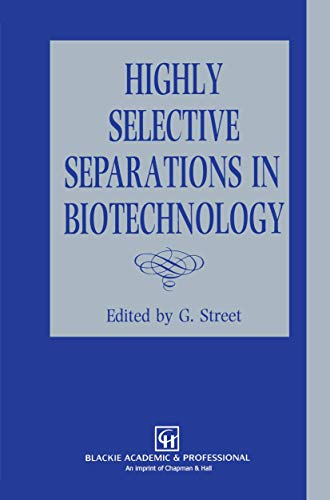
Success in meeting the challenge to produce the commercial products anticipated by the exploitation of biological processes depends upon provid ing effective separation protocols. Effectiveness can be measured in terms of selectivity, purity, resolution and validatory success. The major processing problems are associated with either the selective recovery of molecules which are present in low concentrations from complex mixtures or the selective removal of contaminants from the desired molecule. Central to the evolution of processes satisfying this demand are the regulatory requirements being imposed by governments on the purity of a product, especially in the health care market. Synthetic organic chemists are increasingly finding it advantageous to conduct one or more steps using either enzymic biotransformations where molecules with a single and consistent stereochemistry or chirality are required. The underlying princi ples behind the methods, techniques and processes currently being used and developed commercially rely upon the biospecific nature and properties of the desired molecule. When these factors are married to the more traditional techniques of precipitation, chromatography, liquid-liquid extraction and membrane processes, powerful tools emerge, allowing highly selective separations to be designed. The logical extension of these combinations is to apply genetic engineering techniques to influence the separations at a more fundamental and structural level by modifying the target protein at source, during its synthesis, to facilitate its separation in a given, selective manner, leading to the distinct possibility of producing 'designer' separation programmes.
Die Inhaltsangabe kann sich auf eine andere Ausgabe dieses Titels beziehen.
Von der hinteren Coverseite
This book primarily concentrates on the larger molecules of immediate therapeutic interest - usually protein in nature, since these are currently at the forefront of commercial development - but chapters on molecular imprinting and chiral separations explore the opportunities available for the highly selective separation of small molecules. This is a book for biotechnologists, chemical engineers and biochemists in the academic world and industry.
„Über diesen Titel“ kann sich auf eine andere Ausgabe dieses Titels beziehen.
Suchergebnisse für Highly Selective Separations in Biotechnology

Beispielbild für diese ISBN
Highly Selective Separations in Biotechnology
Anbieter: Phatpocket Limited, Waltham Abbey, HERTS, Vereinigtes Königreich
Verkäuferbewertung 5 von 5 Sternen

Zustand: Good. Your purchase helps support Sri Lankan Children's Charity 'The Rainbow Centre'. Ex-library, so some stamps and wear, but in good overall condition. Our donations to The Rainbow Centre have helped provide an education and a safe haven to hundreds of children who live in appalling conditions. Bestandsnummer des Verkäufers Z1-S-004-03634
Gebraucht kaufen
EUR 5,23
EUR 12,37 Versand
Versand von Vereinigtes Königreich nach USA
Versand von Vereinigtes Königreich nach USA
Anzahl: 1 verfügbar
Beispielbild für diese ISBN
Highly Selective Separations in Biotechnology
Anbieter: Ammareal, Morangis, Frankreich
Verkäuferbewertung 5 von 5 Sternen
Hardcover. Zustand: Très bon. Ancien livre de bibliothèque avec équipements. Edition 1994. Ammareal reverse jusqu'à 15% du prix net de cet article à des organisations caritatives. ENGLISH DESCRIPTION Book Condition: Used, Very good. Former library book. Edition 1994. Ammareal gives back up to 15% of this item's net price to charity organizations. Bestandsnummer des Verkäufers G-042-566
Gebraucht kaufen
EUR 4,86
EUR 16,50 Versand
Versand von Frankreich nach USA
Versand von Frankreich nach USA
Anzahl: 1 verfügbar
Beispielbild für diese ISBN
Highly Selective Separations in Biotechnology
Verlag:
Blackie Academic & Professional, Glasgow, United Kingdom, 1994
ISBN 10: 0751400513
ISBN 13: 9780751400519
Gebraucht
Hardcover
Erstausgabe
Anbieter: P.C. Schmidt, Bookseller, Kettering, OH, USA
Verkäuferbewertung 5 von 5 Sternen
Hard Cover. Zustand: Very Good. First Edition. a very good hardcover; an ex-library copy with usual markings; internally pages bright and clean; ---------- SATISFACTION GUARANTEED --------- FAST, COURTEOUS SERVICE ------ Size: 6 x 9". Ex-Library. Bestandsnummer des Verkäufers A51361
Gebraucht kaufen
EUR 18,10
EUR 4,39 Versand
Versand innerhalb von USA
Versand innerhalb von USA
Anzahl: 1 verfügbar
Beispielbild für diese ISBN
Highly Selective Separations in Biotechnology
Anbieter: Buchpark, Trebbin, Deutschland
Verkäuferbewertung 5 von 5 Sternen
Zustand: Gut. Zustand: Gut | Sprache: Englisch | Produktart: Bücher | Success in meeting the challenge to produce the commercial products anticipated by the exploitation of biological processes depends upon provid ing effective separation protocols. Effectiveness can be measured in terms of selectivity, purity, resolution and validatory success. The major processing problems are associated with either the selective recovery of molecules which are present in low concentrations from complex mixtures or the selective removal of contaminants from the desired molecule. Central to the evolution of processes satisfying this demand are the regulatory requirements being imposed by governments on the purity of a product, especially in the health care market. Synthetic organic chemists are increasingly finding it advantageous to conduct one or more steps using either enzymic biotransformations where molecules with a single and consistent stereochemistry or chirality are required. The underlying princi ples behind the methods, techniques and processes currently being used and developed commercially rely upon the biospecific nature and properties of the desired molecule. When these factors are married to the more traditional techniques of precipitation, chromatography, liquid-liquid extraction and membrane processes, powerful tools emerge, allowing highly selective separations to be designed. The logical extension of these combinations is to apply genetic engineering techniques to influence the separations at a more fundamental and structural level by modifying the target protein at source, during its synthesis, to facilitate its separation in a given, selective manner, leading to the distinct possibility of producing 'designer' separation programmes. Bestandsnummer des Verkäufers 1946021/3
Gebraucht kaufen
EUR 7,69
EUR 105,00 Versand
Versand von Deutschland nach USA
Versand von Deutschland nach USA
Anzahl: 2 verfügbar
Foto des Verkäufers
Highly Selective Separations in Biotechnology
Anbieter: moluna, Greven, Deutschland
Verkäuferbewertung 5 von 5 Sternen
Gebunden. Zustand: New. Bestandsnummer des Verkäufers 5959408
Neu kaufen
EUR 180,07
EUR 48,99 Versand
Versand von Deutschland nach USA
Versand von Deutschland nach USA
Anzahl: Mehr als 20 verfügbar
Foto des Verkäufers
Highly Selective Separations in Biotechnology
Print-on-DemandAnbieter: preigu, Osnabrück, Deutschland
Verkäuferbewertung 5 von 5 Sternen
Buch. Zustand: Neu. Highly Selective Separations in Biotechnology | G. Street | Buch | Einband - fest (Hardcover) | Englisch | 1994 | Springer Netherland | EAN 9780751400519 | Verantwortliche Person für die EU: Springer Netherlands, Haberstr. 7, 69126 Heidelberg, buchhandel-buch[at]springer[dot]com | Anbieter: preigu Print on Demand. Bestandsnummer des Verkäufers 107435686
Neu kaufen
EUR 186,70
EUR 70,00 Versand
Versand von Deutschland nach USA
Versand von Deutschland nach USA
Anzahl: 5 verfügbar
Beispielbild für diese ISBN
Highly Selective Separations in Biotechnology
Anbieter: Ria Christie Collections, Uxbridge, Vereinigtes Königreich
Verkäuferbewertung 5 von 5 Sternen
Zustand: New. In English. Bestandsnummer des Verkäufers ria9780751400519_new
Neu kaufen
EUR 249,36
EUR 13,13 Versand
Versand von Vereinigtes Königreich nach USA
Versand von Vereinigtes Königreich nach USA
Anzahl: Mehr als 20 verfügbar
Foto des Verkäufers
Highly Selective Separations in Biotechnology
Anbieter: AHA-BUCH GmbH, Einbeck, Deutschland
Verkäuferbewertung 5 von 5 Sternen
Buch. Zustand: Neu. Druck auf Anfrage Neuware - Printed after ordering - Success in meeting the challenge to produce the commercial products anticipated by the exploitation of biological processes depends upon provid ing effective separation protocols. Effectiveness can be measured in terms of selectivity, purity, resolution and validatory success. The major processing problems are associated with either the selective recovery of molecules which are present in low concentrations from complex mixtures or the selective removal of contaminants from the desired molecule. Central to the evolution of processes satisfying this demand are the regulatory requirements being imposed by governments on the purity of a product, especially in the health care market. Synthetic organic chemists are increasingly finding it advantageous to conduct one or more steps using either enzymic biotransformations where molecules with a single and consistent stereochemistry or chirality are required. The underlying princi ples behind the methods, techniques and processes currently being used and developed commercially rely upon the biospecific nature and properties of the desired molecule. When these factors are married to the more traditional techniques of precipitation, chromatography, liquid-liquid extraction and membrane processes, powerful tools emerge, allowing highly selective separations to be designed. The logical extension of these combinations is to apply genetic engineering techniques to influence the separations at a more fundamental and structural level by modifying the target protein at source, during its synthesis, to facilitate its separation in a given, selective manner, leading to the distinct possibility of producing 'designer' separation programmes. Bestandsnummer des Verkäufers 9780751400519
Neu kaufen
EUR 230,55
EUR 35,00 Versand
Versand von Deutschland nach USA
Versand von Deutschland nach USA
Anzahl: 1 verfügbar
Foto des Verkäufers
Highly Selective Separations in Biotechnology
Verlag:
Springer Netherlands, Springer Netherlands Aug 1994, 1994
ISBN 10: 0751400513
ISBN 13: 9780751400519
Neu
Hardcover
Anbieter: buchversandmimpf2000, Emtmannsberg, BAYE, Deutschland
Verkäuferbewertung 5 von 5 Sternen
Buch. Zustand: Neu. This item is printed on demand - Print on Demand Titel. Neuware -Success in meeting the challenge to produce the commercial products anticipated by the exploitation of biological processes depends upon provid ing effective separation protocols. Effectiveness can be measured in terms of selectivity, purity, resolution and validatory success. The major processing problems are associated with either the selective recovery of molecules which are present in low concentrations from complex mixtures or the selective removal of contaminants from the desired molecule. Central to the evolution of processes satisfying this demand are the regulatory requirements being imposed by governments on the purity of a product, especially in the health care market. Synthetic organic chemists are increasingly finding it advantageous to conduct one or more steps using either enzymic biotransformations where molecules with a single and consistent stereochemistry or chirality are required. The underlying princi ples behind the methods, techniques and processes currently being used and developed commercially rely upon the biospecific nature and properties of the desired molecule. When these factors are married to the more traditional techniques of precipitation, chromatography, liquid-liquid extraction and membrane processes, powerful tools emerge, allowing highly selective separations to be designed. The logical extension of these combinations is to apply genetic engineering techniques to influence the separations at a more fundamental and structural level by modifying the target protein at source, during its synthesis, to facilitate its separation in a given, selective manner, leading to the distinct possibility of producing 'designer' separation programmes.Springer Verlag GmbH, Tiergartenstr. 17, 69121 Heidelberg 248 pp. Englisch. Bestandsnummer des Verkäufers 9780751400519
Neu kaufen
EUR 213,99
EUR 60,00 Versand
Versand von Deutschland nach USA
Versand von Deutschland nach USA
Anzahl: 1 verfügbar
Foto des Verkäufers
Highly Selective Separations in Biotechnology
Verlag:
Springer Netherlands Aug 1994, 1994
ISBN 10: 0751400513
ISBN 13: 9780751400519
Neu
Hardcover
Anbieter: BuchWeltWeit Ludwig Meier e.K., Bergisch Gladbach, Deutschland
Verkäuferbewertung 5 von 5 Sternen
Buch. Zustand: Neu. This item is printed on demand - it takes 3-4 days longer - Neuware -Success in meeting the challenge to produce the commercial products anticipated by the exploitation of biological processes depends upon provid ing effective separation protocols. Effectiveness can be measured in terms of selectivity, purity, resolution and validatory success. The major processing problems are associated with either the selective recovery of molecules which are present in low concentrations from complex mixtures or the selective removal of contaminants from the desired molecule. Central to the evolution of processes satisfying this demand are the regulatory requirements being imposed by governments on the purity of a product, especially in the health care market. Synthetic organic chemists are increasingly finding it advantageous to conduct one or more steps using either enzymic biotransformations where molecules with a single and consistent stereochemistry or chirality are required. The underlying princi ples behind the methods, techniques and processes currently being used and developed commercially rely upon the biospecific nature and properties of the desired molecule. When these factors are married to the more traditional techniques of precipitation, chromatography, liquid-liquid extraction and membrane processes, powerful tools emerge, allowing highly selective separations to be designed. The logical extension of these combinations is to apply genetic engineering techniques to influence the separations at a more fundamental and structural level by modifying the target protein at source, during its synthesis, to facilitate its separation in a given, selective manner, leading to the distinct possibility of producing 'designer' separation programmes. 248 pp. Englisch. Bestandsnummer des Verkäufers 9780751400519
Neu kaufen
EUR 263,22
EUR 23,00 Versand
Versand von Deutschland nach USA
Versand von Deutschland nach USA
Anzahl: 2 verfügbar