
Verwandte Artikel zu Peace War
Inhaltsangabe
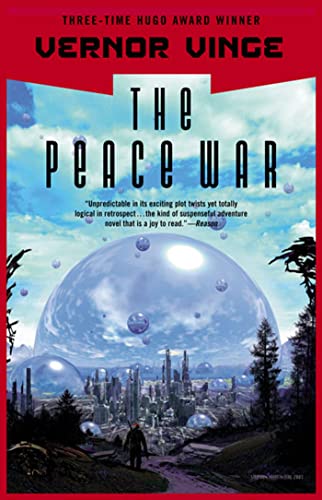
The Peace War is quintessential hard-science adventure. The Peace Authority conquered the world with a weapon that never should have been a weapon--the "bobble," a spherical force-field impenetrable by any force known to mankind. Encasing governmental installations and military bases in bobbles, the Authority becomes virtually omnipotent. But they've never caught Paul Hoehler, the maverick who invented the technology, and who has been working quietly for decades to develop a way to defeat the Authority. With the help of an underground network of determined, independent scientists and a teenager who may be the apprentice genius he's needed for so long, he will shake the world, in the fast-paced hard-science thriller that garnered Vinge the first of his four Hugo nominations for best novel.
Die Inhaltsangabe kann sich auf eine andere Ausgabe dieses Titels beziehen.
Über die Autorin bzw. den Autor
Vernor Vinge has won five Hugo Awards, two of them for novels in the Zones of Thought series, A Fire Upon the Deep and A Deepness in the Sky. Known for his rigorous hard-science approach to science fiction, he became an iconic figure among cybernetic scientists with the publication in 1981 of his novella "True Names," which is considered a seminal, visionary work of Internet fiction. His many novels also include Marooned in Realtime, Rainbows End and The Peace War.
Von der hinteren Coverseite
After the World Ends
Fifty years before, the "Peace Authority" took control of governments worldwide with a radically different weapon, the "bobbler," which encased its targets within an impenetrable force field, rendering resistance impotent. After the decimation caused by severe plagues, civilization fell into a semifeudal state, and all high technology was banned.
But Paul Naismith, inventor of the bobbler, has never given up hope, and having hidden from the usurpers for decades, he is finally ready to lead the tinker underground against the evil he helped to create. The odds against them seem impossibly long. Nothing has been able to defeat the Peace Authority's bobbler.
Until now . . .
"Combines the tautness of a political thriller with strong characterizations. A suspenseful story."
--Library Journal
"Conveys the excitement of a conceptual breakthrough as well as the gap between theory and actuality."
--Publishers Weekly
"A fascinating scientific concept worked into a colorful, carefully thought-out future."
--Locus
Aus dem Klappentext
After the World Ends
Fifty years before, the "Peace Authority" took control of governments worldwide with a radically different weapon, the "bobbler," which encased its targets within an impenetrable force field, rendering resistance impotent. After the decimation caused by severe plagues, civilization fell into a semifeudal state, and all high technology was banned.
But Paul Naismith, inventor of the bobbler, has never given up hope, and having hidden from the usurpers for decades, he is finally ready to lead the tinker underground against the evil he helped to create. The odds against them seem impossibly long. Nothing has been able to defeat the Peace Authority's bobbler.
Until now . . .
"Combines the tautness of a political thriller with strong characterizations. A suspenseful story."
--Library Journal
"Conveys the excitement of a conceptual breakthrough as well as the gap between theory and actuality."
--Publishers Weekly
"A fascinating scientific concept worked into a colorful, carefully thought-out future."
--Locus
After the World Ends
Fifty years before, the "Peace Authority" took control of governments worldwide with a radically different weapon, the "bobbler," which encased its targets within an impenetrable force field, rendering resistance impotent. After the decimation caused by severe plagues, civilization fell into a semifeudal state, and all high technology was banned.
But Paul Naismith, inventor of the bobbler, has never given up hope, and having hidden from the usurpers for decades, he is finally ready to lead the tinker underground against the evil he helped to create. The odds against them seem impossibly long. Nothing has been able to defeat the Peace Authority's bobbler.
Until now . . .
"Combines the tautness of a political thriller with strong characterizations. A suspenseful story."
--Library Journal
"Conveys the excitement of a conceptual breakthrough as well as the gap between theory and actuality."
--Publishers Weekly
"A fascinating scientific concept worked into a colorful, carefully thought-out future."
--Locus
Auszug. © Genehmigter Nachdruck. Alle Rechte vorbehalten.
The Peace War
By Vinge, VernorTor Books
Copyright © 2003 Vinge, VernorAll right reserved.
ISBN: 9780765308832
1
The Old California Shopping Center was the Santa Ynez Police Company’s biggest account—and one of Miguel Rosas’ most enjoyable beats. On this beautiful Sunday afternoon, the Center had hundreds of customers, people who had traveled many kilometers along Old 101 to be there. This Sunday was especially busy: All during the week, produce and quality reports had shown that the stores would have best buys. And it wouldn’t rain till late. Mike wandered up and down the malls, stopping every now and then to talk or go into a shop and have a closer look at the merchandise. Most people knew how effective the shoplift-detection gear was, and so far he hadn’t had any business whatsoever.
Which was okay with Mike. Rosas had been officially employed by the Santa Ynez Police Company for three years. And before that, all the way back to when he and his sisters had arrived in California, he had been associated with the company. Sheriff Wentz had more or less adopted him, and so he had grown up with police work, and was doing the job of a paid undersheriff by the time he was thirteen. Wentz had encouraged him to look at technical jobs, but somehow police work was always the most attractive. The SYP Company was a popular outfit that did business with most of the families around Vandenberg. The pay was good, the area was peaceful, and Mike had the feeling that he was really doing something to help people.
Mike left the shopping area and climbed the grassy hill that management kept nicely shorn and cleaned. From the top he could look across the Center to see all the shops and the brilliantly dyed fabrics that shaded the arcades.
He tweaked up his caller in case they wanted him to come down for some traffic control. Horses and wagons were not permitted beyond the outer parking area. Normally this was a convenience, but there were so many customers this afternoon that the owners might want to relax the rules.
Near the top of the hill, basking in the double sunlight, Paul Naismith sat in front of his chessboard. Every few months, Paul came down to the coast, sometimes to Santa Ynez, sometimes to towns further north. Naismith and Bill Morales would come in early enough to get a good parking spot, Paul would set up his chessboard, and Bill would go off to shop for him. Come evening, the Tinkers would trot out their specialties and he might do some trading. For now the old man slouched behind his chessboard and munched his lunch.
Mike approached the other diffidently. Naismith was not personally forbidding. He was easy to talk to, in fact. But Mike knew him better than most—and knew the old man’s cordiality was a mask for things as strange and deep as his public reputation implied.
“Game, Mike?” Naismith asked.
“Sorry, Mr. Naismith, I’m on duty.” Besides, I know you never lose except on purpose.
The older man waved impatiently. He glanced over Mike’s shoulder at something among the shops, then lurched to his feet. “Ah. I’m not going to snare anyone this afternoon. Might as well go down and window-shop.”
Mike recognized the idiom, though there were no “windows” in the shopping center, unless you counted the glass covers on the jewelry and electronics displays. Naismith’s generation was still a majority, so even the most archaic slang remained in use. Mike picked up some litter but couldn’t find the miscreants responsible. He stowed the trash and caught up with Naismith on the way down to the shops.
The food vendors were doing well, as predicted. Their tables were overflowing with bananas and cacao and other local produce, as well as things from farther away, such as apples. On the right, the game area was still the province of the kids. That would change when evening came. The curtains and canopies were bright and billowing in the light breeze, but it wasn’t till dark that the internal illumination of the displays would glow and dance their magic. For now, all was muted, many of the games powered down. Even chess and the other symbiotic games were doing a slow business. It was almost a matter of custom to wait till the evening for the buying and selling of such frivolous equipment.
The only crowd, five or six youngsters, stood around Gerry Tellman’s Celest game. What was going on here? A little black kid was playing—had been playing for fifteen minutes, Mike realized. Tellman had Celest running at a high level of realism, and he was not a generous man. Hmmm.
Ahead of him, Naismith creaked toward the game. Apparently his curiosity was pricked, too.
Inside the shop it was shady and cool. Tellman perched on a scuffed wood table and glared at his small customer. The boy looked to be ten or eleven and was clearly an outlander: His hair was bushy, his clothes filthy. His arms were so thin that he must be a victim of disease or poor diet. He was chewing on something that Mike suspected was tobacco—definitely not the sort of behavior you’d see in a local boy.
The kid clutched a wad of Bank of Santa Ynez gAu notes. From the look on Tellman’s face, Rosas could guess where they came from.
“Otra vez,” the boy said, returning Tellman’s glare. The proprietor hesitated, looked around the circle of faces, and noticed the adults.
“Aw right,” agreed Tellman, “but this’ll have to be the last time…Esta es el final, entiende?” he repeated in pidgin Spanish. “I, uh, I gotta go to lunch.” This remark was probably for the benefit of Naismith and Rosas.
The kid shrugged. “Okay.”
Tellman initialized the Celest board—to level nine, Rosas noticed. The kid studied the setup with a calculating look. Tellman’s display was a flat one, showing a hypothetical solar system as seen from above the plane of rotation. The three planets were small disks of light moving around the primary. Their size gave a clue to mass; the precise values appeared near the bottom of the display. Departure and arrival planets moved in visibly eccentric orbits, the departure planet at one rev every five seconds—fast enough so precession was clearly occurring. Between it and the destination planet moved a third world, also in an eccentric orbit. Rosas grimaced. No doubt the only reason Tellman left the problem coplanar was that he didn’t have a holo display for his Celest. Mike had never seen anyone without a symbiotic processor play the departure/destination version of Celest at level nine. The timer on the display showed that the player—the kid—had ten seconds to launch his rocket and try to make it to the destination. From the fuel display, Rosas was certain that there was not enough energy available to make the flight in a direct orbit. A cushion shot on top of everything else!
The kid laid all his bank notes on the table and squinted at the screen. Six seconds left. He grasped the control handles and twitched them. The tiny golden spark that represented his space-craft fell away from the green disk of the departure world, inward toward the yellow sun about which all revolved. He had used more than nine-tenths of his fuel and had boosted in the wrong direction. The children around him murmured their displeasure, and a smirk came over Tellman’s face. The smirk froze.
As the spacecraft came near the sun, the kid gave the controls another twitch, a boost which—together with the gravity...
The Old California Shopping Center was the Santa Ynez Police Company’s biggest account—and one of Miguel Rosas’ most enjoyable beats. On this beautiful Sunday afternoon, the Center had hundreds of customers, people who had traveled many kilometers along Old 101 to be there. This Sunday was especially busy: All during the week, produce and quality reports had shown that the stores would have best buys. And it wouldn’t rain till late. Mike wandered up and down the malls, stopping every now and then to talk or go into a shop and have a closer look at the merchandise. Most people knew how effective the shoplift-detection gear was, and so far he hadn’t had any business whatsoever.
Which was okay with Mike. Rosas had been officially employed by the Santa Ynez Police Company for three years. And before that, all the way back to when he and his sisters had arrived in California, he had been associated with the company. Sheriff Wentz had more or less adopted him, and so he had grown up with police work, and was doing the job of a paid undersheriff by the time he was thirteen. Wentz had encouraged him to look at technical jobs, but somehow police work was always the most attractive. The SYP Company was a popular outfit that did business with most of the families around Vandenberg. The pay was good, the area was peaceful, and Mike had the feeling that he was really doing something to help people.
Mike left the shopping area and climbed the grassy hill that management kept nicely shorn and cleaned. From the top he could look across the Center to see all the shops and the brilliantly dyed fabrics that shaded the arcades.
He tweaked up his caller in case they wanted him to come down for some traffic control. Horses and wagons were not permitted beyond the outer parking area. Normally this was a convenience, but there were so many customers this afternoon that the owners might want to relax the rules.
Near the top of the hill, basking in the double sunlight, Paul Naismith sat in front of his chessboard. Every few months, Paul came down to the coast, sometimes to Santa Ynez, sometimes to towns further north. Naismith and Bill Morales would come in early enough to get a good parking spot, Paul would set up his chessboard, and Bill would go off to shop for him. Come evening, the Tinkers would trot out their specialties and he might do some trading. For now the old man slouched behind his chessboard and munched his lunch.
Mike approached the other diffidently. Naismith was not personally forbidding. He was easy to talk to, in fact. But Mike knew him better than most—and knew the old man’s cordiality was a mask for things as strange and deep as his public reputation implied.
“Game, Mike?” Naismith asked.
“Sorry, Mr. Naismith, I’m on duty.” Besides, I know you never lose except on purpose.
The older man waved impatiently. He glanced over Mike’s shoulder at something among the shops, then lurched to his feet. “Ah. I’m not going to snare anyone this afternoon. Might as well go down and window-shop.”
Mike recognized the idiom, though there were no “windows” in the shopping center, unless you counted the glass covers on the jewelry and electronics displays. Naismith’s generation was still a majority, so even the most archaic slang remained in use. Mike picked up some litter but couldn’t find the miscreants responsible. He stowed the trash and caught up with Naismith on the way down to the shops.
The food vendors were doing well, as predicted. Their tables were overflowing with bananas and cacao and other local produce, as well as things from farther away, such as apples. On the right, the game area was still the province of the kids. That would change when evening came. The curtains and canopies were bright and billowing in the light breeze, but it wasn’t till dark that the internal illumination of the displays would glow and dance their magic. For now, all was muted, many of the games powered down. Even chess and the other symbiotic games were doing a slow business. It was almost a matter of custom to wait till the evening for the buying and selling of such frivolous equipment.
The only crowd, five or six youngsters, stood around Gerry Tellman’s Celest game. What was going on here? A little black kid was playing—had been playing for fifteen minutes, Mike realized. Tellman had Celest running at a high level of realism, and he was not a generous man. Hmmm.
Ahead of him, Naismith creaked toward the game. Apparently his curiosity was pricked, too.
Inside the shop it was shady and cool. Tellman perched on a scuffed wood table and glared at his small customer. The boy looked to be ten or eleven and was clearly an outlander: His hair was bushy, his clothes filthy. His arms were so thin that he must be a victim of disease or poor diet. He was chewing on something that Mike suspected was tobacco—definitely not the sort of behavior you’d see in a local boy.
The kid clutched a wad of Bank of Santa Ynez gAu notes. From the look on Tellman’s face, Rosas could guess where they came from.
“Otra vez,” the boy said, returning Tellman’s glare. The proprietor hesitated, looked around the circle of faces, and noticed the adults.
“Aw right,” agreed Tellman, “but this’ll have to be the last time…Esta es el final, entiende?” he repeated in pidgin Spanish. “I, uh, I gotta go to lunch.” This remark was probably for the benefit of Naismith and Rosas.
The kid shrugged. “Okay.”
Tellman initialized the Celest board—to level nine, Rosas noticed. The kid studied the setup with a calculating look. Tellman’s display was a flat one, showing a hypothetical solar system as seen from above the plane of rotation. The three planets were small disks of light moving around the primary. Their size gave a clue to mass; the precise values appeared near the bottom of the display. Departure and arrival planets moved in visibly eccentric orbits, the departure planet at one rev every five seconds—fast enough so precession was clearly occurring. Between it and the destination planet moved a third world, also in an eccentric orbit. Rosas grimaced. No doubt the only reason Tellman left the problem coplanar was that he didn’t have a holo display for his Celest. Mike had never seen anyone without a symbiotic processor play the departure/destination version of Celest at level nine. The timer on the display showed that the player—the kid—had ten seconds to launch his rocket and try to make it to the destination. From the fuel display, Rosas was certain that there was not enough energy available to make the flight in a direct orbit. A cushion shot on top of everything else!
The kid laid all his bank notes on the table and squinted at the screen. Six seconds left. He grasped the control handles and twitched them. The tiny golden spark that represented his space-craft fell away from the green disk of the departure world, inward toward the yellow sun about which all revolved. He had used more than nine-tenths of his fuel and had boosted in the wrong direction. The children around him murmured their displeasure, and a smirk came over Tellman’s face. The smirk froze.
As the spacecraft came near the sun, the kid gave the controls another twitch, a boost which—together with the gravity...
„Über diesen Titel“ kann sich auf eine andere Ausgabe dieses Titels beziehen.
Suchergebnisse für Peace War

Beispielbild für diese ISBN
The Peace War (Peace War, 1)
Anbieter: Wonder Book, Frederick, MD, USA
Verkäuferbewertung 5 von 5 Sternen

Zustand: Good. Good condition. A copy that has been read but remains intact. May contain markings such as bookplates, stamps, limited notes and highlighting, or a few light stains. Bestandsnummer des Verkäufers L12D-02484
Gebraucht kaufen
EUR 6,23
Versand gratis
Versand innerhalb von USA
Versand innerhalb von USA
Anzahl: 1 verfügbar
Beispielbild für diese ISBN
The Peace War
Anbieter: Evergreen Goodwill, Seattle, WA, USA
Verkäuferbewertung 5 von 5 Sternen
paperback. Zustand: Good. Bestandsnummer des Verkäufers mon0000729621
Gebraucht kaufen
EUR 3,46
EUR 3,46 Versand
Versand innerhalb von USA
Versand innerhalb von USA
Anzahl: 1 verfügbar
Beispielbild für diese ISBN
The Peace War
Anbieter: ThriftBooks-Phoenix, Phoenix, AZ, USA
Verkäuferbewertung 5 von 5 Sternen
Paperback. Zustand: Fair. No Jacket. Readable copy. Pages may have considerable notes/highlighting. ~ ThriftBooks: Read More, Spend Less. Bestandsnummer des Verkäufers G0765308835I5N00
Gebraucht kaufen
EUR 7,10
Versand gratis
Versand innerhalb von USA
Versand innerhalb von USA
Anzahl: 1 verfügbar
Beispielbild für diese ISBN
The Peace War
Anbieter: ThriftBooks-Reno, Reno, NV, USA
Verkäuferbewertung 5 von 5 Sternen
Paperback. Zustand: Good. No Jacket. Pages can have notes/highlighting. Spine may show signs of wear. ~ ThriftBooks: Read More, Spend Less. Bestandsnummer des Verkäufers G0765308835I3N00
Gebraucht kaufen
EUR 7,10
Versand gratis
Versand innerhalb von USA
Versand innerhalb von USA
Anzahl: 1 verfügbar
Beispielbild für diese ISBN
The Peace War
Anbieter: ThriftBooks-Atlanta, AUSTELL, GA, USA
Verkäuferbewertung 5 von 5 Sternen
Paperback. Zustand: Fair. No Jacket. Readable copy. Pages may have considerable notes/highlighting. ~ ThriftBooks: Read More, Spend Less. Bestandsnummer des Verkäufers G0765308835I5N00
Gebraucht kaufen
EUR 7,12
Versand gratis
Versand innerhalb von USA
Versand innerhalb von USA
Anzahl: 1 verfügbar
Beispielbild für diese ISBN
The Peace War
Anbieter: ThriftBooks-Atlanta, AUSTELL, GA, USA
Verkäuferbewertung 5 von 5 Sternen
Paperback. Zustand: Good. No Jacket. Pages can have notes/highlighting. Spine may show signs of wear. ~ ThriftBooks: Read More, Spend Less. Bestandsnummer des Verkäufers G0765308835I3N00
Gebraucht kaufen
EUR 7,12
Versand gratis
Versand innerhalb von USA
Versand innerhalb von USA
Anzahl: 1 verfügbar
Beispielbild für diese ISBN
The Peace War
Anbieter: ThriftBooks-Dallas, Dallas, TX, USA
Verkäuferbewertung 5 von 5 Sternen
Paperback. Zustand: Very Good. No Jacket. Former library book; May have limited writing in cover pages. Pages are unmarked. ~ ThriftBooks: Read More, Spend Less. Bestandsnummer des Verkäufers G0765308835I4N10
Gebraucht kaufen
EUR 7,12
Versand gratis
Versand innerhalb von USA
Versand innerhalb von USA
Anzahl: 1 verfügbar
Beispielbild für diese ISBN
The Peace War
Anbieter: ThriftBooks-Dallas, Dallas, TX, USA
Verkäuferbewertung 5 von 5 Sternen
Paperback. Zustand: Good. No Jacket. Pages can have notes/highlighting. Spine may show signs of wear. ~ ThriftBooks: Read More, Spend Less. Bestandsnummer des Verkäufers G0765308835I3N00
Gebraucht kaufen
EUR 7,12
Versand gratis
Versand innerhalb von USA
Versand innerhalb von USA
Anzahl: 1 verfügbar
Foto des Verkäufers
The Peace War
Anbieter: Blue Vase Books, Interlochen, MI, USA
Verkäuferbewertung 5 von 5 Sternen
Zustand: acceptable. The item is very worn but is perfectly usable. Signs of wear can include aesthetic issues such as scratches, dents, worn and creased covers, folded page corners and minor liquid stains. All pages and the cover are intact, but the dust cover may be missing. Pages may include moderate to heavy amount of notes and highlighting, but the text is not obscured or unreadable. Page edges may have foxing age related spots and browning . May NOT include discs, access code or other supplemental materials. Bestandsnummer des Verkäufers BVV.0765308835.A
Gebraucht kaufen
EUR 7,51
Versand gratis
Versand innerhalb von USA
Versand innerhalb von USA
Anzahl: 1 verfügbar
Beispielbild für diese ISBN
The Peace War
Anbieter: HPB-Ruby, Dallas, TX, USA
Verkäuferbewertung 5 von 5 Sternen
Paperback. Zustand: Very Good. Connecting readers with great books since 1972! Used books may not include companion materials, and may have some shelf wear or limited writing. We ship orders daily and Customer Service is our top priority! Bestandsnummer des Verkäufers S_482317100
Gebraucht kaufen
EUR 4,45
EUR 3,25 Versand
Versand innerhalb von USA
Versand innerhalb von USA
Anzahl: 1 verfügbar