
Verwandte Artikel zu Deadlands: Thunder Moon Rising
Inhaltsangabe
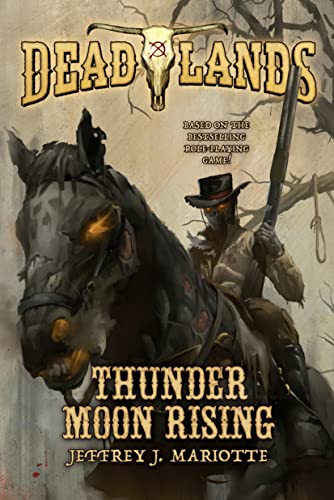
Fear is abroad in the Deadlands as a string of brutal killings and cattle mutilations trouble a frontier town in the Arizona Territory, nestled in the forbidding shadow of the rugged Thunder Mountains. A mule train is massacred, homes and ranches are attacked, and men and women are stalked and butchered by bestial killers who seem to be neither human nor animal. Meanwhile, a ruthless land baron tries to buy up all the surrounding territory and possibly bring about an apocalypse. Once an officer in the Union Army, Tucker Bringloe is now a worthless drunk begging for free drinks at the corner saloon. When he's roped into a posse searching for the nameless killers, Tuck must rediscover the man he once was if he's to halt the bloodshed and stop occult forces from unleashing Hell on Earth ...when the Thunder Moon rises.
Die Inhaltsangabe kann sich auf eine andere Ausgabe dieses Titels beziehen.
Über die Autorin bzw. den Autor
Jeffrey J. Mariotte was born in Park Forest, Illinois. He moved away from there at the age of six, when his father, a civilian working for the Department of Defense, was transferred to Paris, France. Since then he's lived in Arlington and Reston, Virginia, Worms and Schriesheim, Germany, San Jose, San Diego, and Arizona.
Auszug. © Genehmigter Nachdruck. Alle Rechte vorbehalten.
Deadlands
Thunder Moon Rising
By Jeffrey J. MariotteTom Doherty Associates
Copyright © 2016 Pinnacle Entertainment Group, LLC
All rights reserved.
ISBN: 978-0-7653-7528-5All rights reserved.
Contents
Title Page,
Copyright Notice,
Dedication,
Acknowledgments,
Epigraph,
Part One: Cutting Sign,
Part Two: Memento Mori,
Part Three: Thunder Moon,
Coda,
Novels in the Deadlands Series,
About the Author,
Copyright,
CHAPTER 1
Tucker Bringloe remembered his mother as a grim-faced woman with thin lips. Small black eyes floated on her graceless visage like bloated deer ticks that had landed there accidentally. She almost never smiled, in his memory, though there had been one occasion, when she'd been passing a kidney stone, that he had mistaken a spasm of pain for an expression of delight. His father said that when she was a young girl, she had shot her older brother to death with their father's rifle, in the false belief that he was a savage Indian. Tuck knew his father doubted her version of that story, since, as he'd said, "They lived in downtown Rensselaer, New York, at the time. Probably weren't no savages within twenty mile, and not any reason for one to bother her if they was."
A couple of years after that, Tuck's father had come home drunk from a barn dance, and had made suggestions to his wife that she had forcefully declined. When Tuck woke the next morning, she was sitting on their bed, using a needle and heavy black thread to try to stitch up a gaping hole in the man's throat. His body was limp and gray, and bed, father, and mother were all soaked in blood. One of his mother's carving knives was on the floor beside her feet.
"He was ornery," she explained. "Ill-mannered and grabby. But never you mind, he'll be fixed up directly." And so saying, she had met his gaze with those black buttons of hers, and her face had split into what he guessed had to be the first smile it had ever tried on.
It was ghastly, and he never forgot it.
But that wasn't what drove him to drink. Instead, it was a memory that mostly came back to him when he had been drinking and drove him to drink still more.
He had reached that stage. He slouched in front of the polished wooden bar in a saloon called Soto's, fingering his empty glass. Jack O'Beirne, the barkeep, glanced his way, and Tuck tapped the rim.
"Got to see some coin," Jack said.
Tuck swore and dug into the pockets of his tattered Union army coat. In the right one he found lint and some kind of sandy grit and an old piece of blue glass polished by weather that he had found once and thought pretty enough to keep. One day there would be a child, or a woman, someone he'd want to give something to.
He held out empty hands and caught a glimpse of himself in the mirror behind the bar: dark hair matted and askew, eyes so bloodshot he could see red from here. Pathetic. He looked away. "One for the road?"
Jack's thick black brush of a mustache twitched. "Got a dime?"
"No."
"Half-dime gets you a beer."
Tuck's hands clenched into fists. "I don't have it!"
"You're done, mister." The barkeep jerked his head toward the door.
His dismissive tone riled Tuck, but there was nothing to be done. Maybe he'd be able to scrounge up a coin or two somewhere. Sometimes one fell onto the floor around the poker tables, or he could snatch one from the piano player's cup when no one was looking.
Tuck swiveled away from the bar, stumbled, and caught his balance by grabbing the back of a chair. A cowhand was sitting there with a big redhead on his lap, and when Tuck's hand fell on the chair, the man shot him an angry scowl. The redhead was whispering something in his ear and grinding on him, though, and he didn't say anything.
For an instant, Tuck wondered if he should start something. The man was wearing a pistol. If he would draw it and plant a couple of slugs in Tuck, it would free him of his mother and the war and all the other things that haunted his every hour, asleep or not, except when drink stilled those ghosts for a few hours.
The man turned his attention back to the whore on his lap. Tuck wasn't even worth five seconds of his time. The worst part was, he couldn't argue with the cowboy's assessment. To shoot him would be to waste a bullet, because everything inside him that had ever been any good had died long ago. He would figure it out and fall down, one of these days, and that would be best for everyone.
He took a last look at the saloon. Above the piano was a bad painting of a nude woman who would have needed her backbone removed to pose the way she was. Senora Soto, who owned the place, sat at her usual spot in the corner, a drink in front of her and a revolver next to it, in case anybody tried anything funny with one of her girls. Two tables were crowded with poker players, and others with men there for the drink or the women or both. Some men sat alone or in quiet pairs, brooding and glum, but at most tables, people laughed and carried on as if they were having a good time. Maybe it was a good time lubricated by alcohol and maybe not, but everybody looked happier than he did.
Probably this wasn't the right place for him, after all.
Probably no place was right for him.
He breathed in the sweat and smoke and spilled beer and damp clothes, and walked outside into a downpour.
The drinks and now the rain conspired to remind him that his bladder needed emptying. He followed the boardwalk to the end of the block and stepped off into the muddy road. He had been in Carmichael for three weeks now, and Maiden Lane had been soup the entire time. He'd heard that the Arizona Territory was hot and dry, but was coming to think there must be two Arizonas. This one was hot, but the rains came almost every afternoon, drenching the town. By the time he had staggered back to the alley behind the saloon, he was soaked to the skin.
Between the clouds and the rain and the unpainted staircase to the floor above the saloon where Senora Soto's girls had their cribs, no moonlight leaked through. Tuck could have pissed in the street, and maybe found himself a warm, dry bed in one of the marshal's cells. But there were women in town. Kids, too, though not many. And as low as he had sunk (and that was very low indeed; Tucker Bringloe could have slid under a rattlesnake's belly without scraping), he hadn't lost every last ounce of the part of himself that had once been a Union officer. A warm bed was one thing, but was it worth the degradation of his last shreds of decency?
He put out one hand and gripped the back of a stair tread, to stay more or less upright while he relieved himself. When he was nearly done, a peal of thunder echoed off the walls and lightning lit the world with the sudden brightness of a thousand lanterns all uncovered at once, then closed again before the reality of it had set in. Tuck lost his grip on the stair, but caught it again before he fell into the mud that sucked at his boots.
As he put himself away and righted himself, he heard a footfall on the staircase above, and he realized that at the moment the thunder clapped and the lightning released its blinding glare, someone must have come out the door and started down. Tuck had faced Confederate soldiers with bayonets, had led his men into cannon fire, had taken a minié ball in his left arm and watched an untrained medic dig it out with a rusty blade. And he had seen much, much worse, sights he didn't like to admit were taken in by his eyes rather than constructs of the part of his...
„Über diesen Titel“ kann sich auf eine andere Ausgabe dieses Titels beziehen.
Suchergebnisse für Deadlands: Thunder Moon Rising

Beispielbild für diese ISBN
Deadlands: Thunder Moon Rising (Deadlands, 2)
Anbieter: World of Books (was SecondSale), Montgomery, IL, USA
Verkäuferbewertung 5 von 5 Sternen

Zustand: Good. Item in good condition. Textbooks may not include supplemental items i.e. CDs, access codes etc. Bestandsnummer des Verkäufers 00108259331
Gebraucht kaufen
EUR 5,50
Versand gratis
Versand innerhalb von USA
Versand innerhalb von USA
Anzahl: 1 verfügbar
Beispielbild für diese ISBN
Deadlands: Thunder Moon Rising
Anbieter: Better World Books: West, Reno, NV, USA
Verkäuferbewertung 5 von 5 Sternen
Zustand: Good. Former library copy. Pages intact with minimal writing/highlighting. The binding may be loose and creased. Dust jackets/supplements are not included. Includes library markings. Stock photo provided. Product includes identifying sticker. Better World Books: Buy Books. Do Good. Bestandsnummer des Verkäufers 15632960-6
Gebraucht kaufen
EUR 10,10
Versand gratis
Versand innerhalb von USA
Versand innerhalb von USA
Anzahl: 1 verfügbar
Beispielbild für diese ISBN
Deadlands: Thunder Moon Rising (Deadlands, 2)
Anbieter: HPB-Emerald, Dallas, TX, USA
Verkäuferbewertung 5 von 5 Sternen
paperback. Zustand: Very Good. Connecting readers with great books since 1972! Used books may not include companion materials, and may have some shelf wear or limited writing. We ship orders daily and Customer Service is our top priority! Bestandsnummer des Verkäufers S_482305910
Gebraucht kaufen
EUR 11,93
EUR 3,34 Versand
Versand innerhalb von USA
Versand innerhalb von USA
Anzahl: 1 verfügbar
Beispielbild für diese ISBN
Deadlands: Thunder Moon Rising
Anbieter: HPB-Ruby, Dallas, TX, USA
Verkäuferbewertung 5 von 5 Sternen
Paperback. Zustand: Very Good. Connecting readers with great books since 1972! Used books may not include companion materials, and may have some shelf wear or limited writing. We ship orders daily and Customer Service is our top priority! Bestandsnummer des Verkäufers S_484606088
Gebraucht kaufen
EUR 13,19
EUR 3,34 Versand
Versand innerhalb von USA
Versand innerhalb von USA
Anzahl: 1 verfügbar
Beispielbild für diese ISBN
Deadlands: Thunder Moon Rising
Anbieter: GoldBooks, Denver, CO, USA
Verkäuferbewertung 5 von 5 Sternen
Paperback. Zustand: new. New Copy. Customer Service Guaranteed. Bestandsnummer des Verkäufers 74S35_22_0765375281
Neu kaufen
EUR 90,17
EUR 4,90 Versand
Versand innerhalb von USA
Versand innerhalb von USA
Anzahl: 1 verfügbar